
Dark web monitoring is an active intelligence operation that searches unindexed criminal forums, marketplaces, infostealer logs and encrypted chat channels for your stolen credentials, private media or corporate data before it is used against you. Unlike credit monitoring, which reports fraud after the fact, it aims to find the exposure at its source and trigger verification, containment and removal.
Key facts
- Sources include infostealer logs, private forums, Telegram and Discord channels and ransomware leak sites.
- Credentials from infostealer logs are often sold within hours of a device infection.
- Response runs verification, then account securing, stakeholder notice, evidence preservation, removal and de-indexing.
- Data on a simple paste site can often be removed within hours, hostile jurisdictions take longer.
Where ContentRemoval.com comes in. ContentRemoval.com takes over once an exposure is found: getting leaked files, private images and personal data removed from forums, paste sites and file hosts, then de-indexing whatever public traces remain. Security teams, family office advisors and general counsel usually make the first call. A free 15-minute Exposure Scan maps what is circulating about you and what can be removed, and the report is yours to keep. Get a Free, Confidential Exposure Scan or read how our personal data removal work is done.
Dark web monitoring is an active intelligence operation designed to scout the internet’s unindexed, criminal territories for threats against you. It is the process of methodically searching clandestine forums, criminal marketplaces, and private communication channels to find your stolen information before it can be weaponized.
For high-net-worth individuals, executives, and their families, this discipline is not merely a component of cybersecurity; it is an essential element of personal and operational security. The objective is to discover if your login credentials, private media, or proprietary corporate data are for sale before they precipitate a financial breach, a public relations disaster, or a direct physical threat.

Going Beneath the Surface
The publicly accessible internet, or “surface web,” represents only a fraction of the digital world. The dark web is the massive, unindexed portion of the internet hidden beneath, accessible only with specialized browsers that grant users near-total anonymity. That anonymity has cultivated a thriving black market for illicit goods and services, particularly stolen data.
Herein lies the critical function of dark web monitoring. It is not a passive alarm system like a credit alert, which only notifies you after an adversary has already exploited your information. It is an active intelligence mission. We find the breach at its source, the moment your data appears for sale, providing a crucial window of opportunity to neutralize the threat.
The Scale of the Digital Underworld
The dark web hosts a massive and professionalized criminal industry. As of early 2026, over 37 active dark web marketplaces generate an estimated $3.2 billion in annual revenue. On these platforms, threat actors trade everything from corporate network access to complete personal identities, often for shockingly low prices. The discovery that a company’s entire executive email list is for sale for $50 is a real and daily occurrence.
Analysis of current dark web statistics confirms the scale and sophistication of this economy.
The guiding philosophy is simple: you cannot protect yourself from a threat you cannot see. Monitoring illuminates these hidden risks, transforming raw fear and uncertainty into a clear, actionable defense plan.
This is a world away from running automated keyword searches. True monitoring requires a sophisticated fusion of AI-powered tools and, crucially, human intelligence experts who can infiltrate private forums, interpret criminal jargon, and verify threats. The human element separates actionable intelligence from distracting noise.
To provide executives with a clear understanding of the stakes, this table outlines the most common threats we uncover and their direct consequences.
Threat Landscape Overview For Executives
| Threat Category | Description | Direct Impact on Executives & Brands |
|---|---|---|
| Compromised Credentials | Stolen usernames and passwords for corporate email, VPNs, financial portals, and personal accounts. | Enables direct network breaches, financial fraud, impersonation, and unauthorized access to sensitive company data. |
| Intellectual Property (IP) Leaks | Trade secrets, product designs, proprietary source code, and confidential business strategies offered for sale. | Leads to loss of competitive advantage, brand erosion, and direct financial losses from stolen innovation. |
| Personal & Financial Data | Social Security numbers, dates of birth, bank account details, credit card numbers, and private medical information. | Fuels identity theft, targeted phishing attacks, financial fraud, and potential extortion against the individual. |
| Reputational Threats | Leaked private photos, fabricated compromising material (deepfakes), or sensitive internal communications. | Can cause severe personal and professional reputational damage, public humiliation, and brand sabotage. |
Each of these threats represents a significant vulnerability. Identifying them early is the first and most critical step in a robust defense. Dark web monitoring is a foundational part of any modern security posture, and it is among the essential cybersecurity measures that allows you to get ahead of criminals, protect your assets, and secure your reputation.
How Professional Dark Web Surveillance Operates

Professional dark web surveillance is not a passive scan. It is an active, intelligence-gathering operation analogous to deploying a dedicated security detail into a hostile digital city. Its mission is singular and direct: find and neutralize threats aimed at you before they hit their mark.
This practice extends far beyond the automated tools marketed to the public. Those services are little more than digital tripwires, capable of catching data from old, well-known breaches but lacking the access and analytical horsepower to stop a determined, sophisticated threat actor. True professional surveillance is a different discipline entirely, combining powerful technology with human intelligence operatives who are already inside the criminal ecosystem.
A Dual-Pronged Approach: Machine and Human
Effective surveillance integrates technology and human expertise. Automated crawlers and AI tools are the workhorses, essential for covering vast amounts of ground at incredible speed. They tirelessly scour thousands of sources (marketplaces, paste sites, public forums) for specific identifiers like names, emails, or company domains, sifting through billions of records in seconds.
This is only half the operation. The most valuable intelligence and the most dangerous threats do not reside where software can easily find them.
The most immediate threats to an executive often emerge from private forums, encrypted chat channels, and stealer logs, sources that require human intelligence operatives to gain and maintain access. This is where raw data is transformed into vetted, actionable intelligence.
The human element is absolutely critical. Our analysts are not just observing; they are actively infiltrating private criminal communities. They build the necessary rapport, learn the culture, and navigate the complex social webs of the digital underworld. They understand the jargon, recognize credible threats, and can instantly differentiate between a genuine plot and the empty bluster of a low-level fraudster. It is this context that automated alerts simply cannot provide.
The Ecosystem of Monitored Sources
A serious surveillance program casts a wide but precise net. The effectiveness of any monitoring service is dictated by the breadth and depth of its sources, which are constantly in flux.
We focus our attention on several key environments, each with its own level of risk and urgency:
- Infostealer Logs: Data ripped from infected devices by malware, often including browser passwords and active login sessions. Because credentials from these logs are sold within hours of infection, they represent the most immediate and critical threats we track.
- Private Forums & Marketplaces: These are the gated communities of the cybercrime world, where access is often by invitation or vouching process only. This is the auction house where high-value assets, like an executive’s complete digital identity or a company’s intellectual property, are sold to the highest bidder.
- Encrypted Chat Channels: Platforms like Telegram and Discord host private channels where criminals plan attacks, trade data, and coordinate activities in real time. These channels are fleeting and hard to track, demanding constant, active human monitoring.
- Ransomware Leak Sites: When a company is hit with ransomware and refuses to pay, its data is often dumped on these public shaming sites. We monitor these sites closely, as they are a leading indicator of supply chain risk and secondary exposure from a breach at one of your partners or vendors.
By marrying broad technical collection with deep human infiltration, we deliver a clear, verified picture of your personal threat landscape. This comprehensive approach is foundational to any effective online reputation monitoring strategy, allowing us to cut through the noise and provide only the intelligence that requires your immediate attention.
Critical Signs That an Executive Is Being Targeted
A professional dark web monitoring service acts as an intelligence operative in the field. Its function is not to passively listen but to hunt for specific indicators that an executive or their company is in a threat actor’s crosshairs. This extends far beyond finding a stray password. We are looking for the exact pieces of information that, in the wrong hands, can destroy a reputation, cripple a business, or endanger a family.
Finding these digital breadcrumbs early is not just a technical win. It is the difference between managing a crisis and preventing one altogether. These indicators are often the first signals of a coming attack: be it corporate espionage, a ransomware deployment, or a meticulously planned public takedown. Spotting them is the only way to get ahead of the threat.
The Crown Jewels of Corporate Data
The most immediate danger stems from exposures that grant an attacker direct access or leverage. These are the assets criminals actively trade because they have a direct and often devastating impact. Our monitoring is laser-focused on finding them before they can be used.
Here is what we are looking for:
- Compromised Corporate Credentials: This is the primary target for an attacker. It includes everything from email and VPN logins to credentials for internal financial platforms. A single set of credentials can serve as the skeleton key to an entire digital kingdom.
- Exfiltrated Intellectual Property: We scan for any trace of a company’s proprietary data being sold or discussed. This includes source code, M&A playbooks, upcoming product designs, or sensitive client data. Its appearance on the dark web signals a serious breach.
- Leaked Board Communications: In the world of corporate espionage, nothing is more valuable than insider knowledge. Finding board minutes, private strategic plans, or confidential executive emails for sale online points to a catastrophic failure in operational security.
When we find assets like these on the dark web, it constitutes a critical emergency. It indicates an attack is not just possible; it is likely already in motion. This discovery opens a brief, critical window for you to act before an adversary can weaponize that information.
The Personal Is Now the Professional
For any high-profile leader, the line between their personal and professional life does not exist in the eyes of an attacker. A threat to one is a threat to both. Effective monitoring must therefore cover the personal data that can be twisted into professional blackmail, reputational ruin, or social engineering schemes.
This is why we also hunt for:
- Compromised Personal Email Accounts: An executive’s personal email is often a trove of sensitive data and, more importantly, the key to resetting passwords for dozens of other critical accounts.
- Leaked Private Media (NCII): The malicious release of private photos, videos, or intimate conversations, known as Non-Consensual Intimate Imagery (NCII), is a brutal tactic used for extortion and public shaming.
- Fabricated or Defamatory Content: This includes deepfakes, completely manufactured stories, or false rumors being workshopped in dark web forums before they are unleashed on the public. Catching these plots in the planning phase is crucial.
Understanding this full spectrum of risk, from corporate secrets to personal vulnerabilities, is the only way to build a truly resilient defense. As our guide on the topic explains, protecting your online identity provides a strategic framework for executives who face these complex, intertwined threats.
The table below breaks down the specific data points we track and the real dangers they represent if compromised.
Data Types Monitored and Their Associated Risks
| Data Type | Examples | Associated Risk/Threat Vector |
|---|---|---|
| Login Credentials | Corporate email & password, VPN access, personal account logins | Account takeover, network breach, financial fraud, impersonation |
| Intellectual Property | Source code, M&A documents, client lists, trade secrets | Corporate espionage, loss of competitive advantage, financial loss |
| Financial Data | Personal bank account numbers, corporate credit cards | Direct financial theft, identity fraud, targeted phishing attacks |
| Reputational Material | Private photos/videos, fabricated stories, defamatory content | Extortion, public humiliation, brand sabotage, personal endangerment |
Ultimately, dark web monitoring is a forward-looking intelligence operation. It is about finding the loaded gun before it is fired, giving you the time and insight needed to disarm the threat with precision and discretion.
From Threat Detection to Resolution: Our Response Protocol
Discovering your private information is on the dark web is a high-stakes, disorienting moment. A detected threat, however, is not yet a crisis. What separates a manageable incident from a full-blown disaster is the speed and precision of the response. Effective dark web monitoring is not just about finding the problem; it is about initiating a well-honed plan to verify, contain, and neutralize the threat before it can cause real-world damage.
This is a rapid-response framework that moves from the initial alert to a final, decisive resolution. It is not a theoretical exercise. It is a tested, deliberate process built for discretion and effectiveness, ensuring a digital vulnerability does not spiral into a material problem for your business or family.
Immediate Verification and Threat Triage
The moment an alert is generated, the first action is to verify. An alert is raw data; our first responsibility is to transform it into actionable intelligence. Is this a credible threat or noise? Is the data authentic? Is this a fresh leak from a new breach, or is it old, recycled data from a known incident? Our analysts answer these questions immediately.
A compromised password found in a new infostealer log on a private, high-tier criminal forum demands a different response than an old email address scraped from a public data dump. This triage process allows us to prioritize the response, focusing our efforts on the most urgent dangers first. We quickly assess the threat’s severity, its potential impact, and the fastest path to remediation.
This flowchart illustrates how we process different types of threats, from stolen credentials to attacks on your reputation.
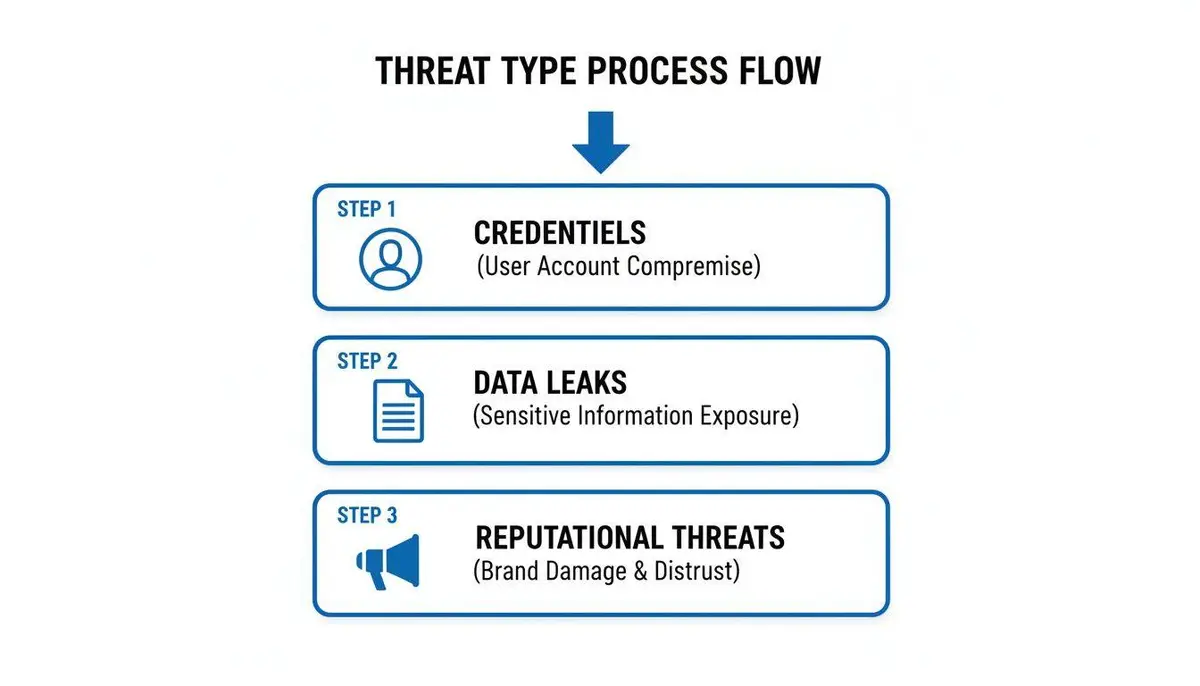
Each threat category triggers a specific response path, all beginning with the crucial verification step before escalation.
Containment, Removal, and Suppression
Once a threat is verified, the focus shifts to containment. The immediate goal is to cut off the attacker’s access and stop the exposure. This typically involves several key actions:
- Securing Compromised Accounts: We immediately initiate password resets, revoke access tokens, and enforce multi-factor authentication on every affected account, both personal and corporate.
- Notifying Key Stakeholders: We confidentially brief your internal security teams, legal counsel, or family office advisors on the exact nature of the exposure to ensure alignment.
- Preserving Evidence: We document everything, creating a clean chain of custody for the digital evidence in case it is needed for law enforcement or legal action.
Next comes the core of the protocol: removal. This is not a single action but a multi-pronged offensive, using our own technology, direct engagement with platform administrators, and, when required, formal legal takedown notices. Whether the threat is on a forum, a paste site, or a file-sharing service, our goal is to achieve removal at the source.
Remediation is not a polite request; it is a decisive action. It requires a deep understanding of platform policies, legal frameworks, and the operational quirks of the digital underworld to compel removal quickly and effectively.
Finally, for any threats with a public-facing element, such as defamatory content or leaked data that has begun to spread, we deploy suppression and de-indexing tactics. This step ensures that even if a trace of the harmful content persists on an obscure server, it becomes invisible on public search engines like Google. This is how we restore your digital narrative. This entire protocol is a critical part of a comprehensive information security risk management strategy, designed not just to find threats but to eliminate them permanently.
Measuring the ROI of Proactive Dark Web Monitoring
For an executive or a family office, every budget line is scrutinized. Security can be perceived as a cost center. Proactive dark web monitoring, however, is a strategic investment, and its return is measured by the disasters it averts.
The choice is between a fixed, predictable expense for continuous monitoring and the chaotic, spiraling costs of a public data breach or a targeted reputational attack.
Once sensitive data is exposed, the financial damage accelerates. The costs are not singular but multifaceted: direct losses from wire fraud, emergency retainers for forensic and legal teams, and potentially massive regulatory fines for data privacy violations that can reach millions of dollars.
The damage extends beyond direct financial outlay. A breach often erodes stock prices and shakes investor confidence. Once client trust is broken, rebuilding it is a slow, arduous process that can depress revenue for years.
Quantifying the Unseen Damage
The most severe consequences do not appear cleanly on a balance sheet. A reputational attack, built from leaked personal details or fabricated content, can inflict permanent harm on a professional legacy. The costs of emergency public relations, crisis consultants, and the long fight to reclaim one’s own narrative can be staggering.
Dark web monitoring is a form of active risk insurance. A conventional policy only pays out after an asset has been destroyed. Proactive monitoring functions like a smoke detector with an integrated sprinkler system. It works to prevent the fire from ever taking hold, preserving value that, once lost, may be irrecoverable.
This approach converts an unknown, potentially catastrophic liability into a predictable operational expense. The ROI is not a number on a spreadsheet; it is the continued stability of your business, the integrity of your reputation, and the security of your private life. The cost of a breach is not just an industry average like $4.88 million; it is the specific, personal cost it would inflict on you and your organization.
The Role of Service Level Agreements
Accountability is codified in a Service Level Agreement (SLA). This is not a vague promise but a binding document that defines the exact terms of service, ensuring transparency and measurable performance.
A robust SLA will clearly define success. Key metrics include:
- Reporting Frequency: Specifies the exact cadence of intelligence briefings, ensuring a consistent flow of information.
- Alert Timeliness: Guarantees a maximum time-to-alert from the moment a critical threat is discovered.
- Response Time: Defines the timeframe for initiating the remediation plan once a threat is verified.
This document makes the entire service accountable. It is a guarantee that the intelligence you receive is not only thorough but also delivered with sufficient speed to enable decisive action. A strong monitoring program is a critical component of any effective information security risk management strategy, guiding the entire process from detection to resolution. The true ROI is counted in the number of threats neutralized long before they become headlines.
Engaging a Specialist Firm for Your Protection
Standard cybersecurity tools and internal IT departments are essential for network protection, but they are not equipped for the dark web. It is a different domain, one that operates on human-driven deception and requires specialized tradecraft to navigate safely.
Attempting to operate in these hostile environments without the proper training and technology is not just ineffective. It is dangerous. It can alert threat actors to your interest, making you or your organization a direct target.
This is the role of a specialist firm. A burglar alarm protects an office, but for personal security, one retains an executive protection detail. A dedicated partner acts as your digital protection detail, blending proprietary technology with the on-the-ground expertise of intelligence analysts who understand how criminal communities think and operate.
From Assessment to Action
Engaging a professional firm is a discreet and direct process, beginning with a confidential risk assessment, not a sales pitch. We confer with you and your team to establish a clear picture of your unique threat profile: your public visibility, industry, and most pressing concerns. This initial discovery is vital; it allows us to construct a monitoring strategy that focuses on what is material to you.
Armed with that understanding, we deploy a combination of AI-powered monitoring and human intelligence operatives to surveil the specific dark web forums, marketplaces, and chat groups where threats against executives and high-profile individuals emerge.
The result is vetted, actionable intelligence. We filter the noise so you are not inundated with false alarms or raw data dumps that create more anxiety.
Engaging a specialist firm is not outsourcing a task; it is onboarding a dedicated team of security experts. It is an acknowledgment that in a world of escalating digital threats, an expert-led defense is the only reliable means to protect your assets, your reputation, and your peace of mind.
Our function is to manage the complexity on your behalf. We handle threat verification, damage containment, and removal initiation, all while keeping you informed with clear, concise reports. When a threat is neutralized, you will know precisely what happened and what actions were taken. You remain informed, but you are not burdened by the process.
For clients concerned with their wider digital footprint, we offer a comprehensive online privacy service that works in concert with our monitoring capabilities.
This partnership delivers certainty in an uncertain environment. It provides a team watching your back 24/7, ready to act with speed and discretion the moment a threat appears. This level of proactive defense is no longer a luxury for leaders. It is a fundamental necessity.
Your Questions About Dark Web Monitoring, Answered
In our conversations with executives, high-profile individuals, and their legal counsel, the same essential questions consistently arise. Here are direct answers to clarify what dark web monitoring entails and what it can accomplish.
Isn’t This Just a Fancy Version of Credit Monitoring?
No. The two services are fundamentally different in both philosophy and function. Credit monitoring is a reactive tool. It is a security camera that only reviews footage after a robbery has occurred, informing you that your financial data was used fraudulently when the damage is already done.
Dark web monitoring is proactive surveillance. We actively patrol the hidden corners of the internet (criminal forums, illegal marketplaces, and private chat rooms) looking for your stolen information. The objective is to find your credentials, private data, or intellectual property the moment they appear, long before they can be used against you. It is about preventing the fire, not reporting the smoke.
Is It Legal to Be Looking Around on the Dark Web?
Yes, when conducted correctly by professionals. A common misconception is that this work involves hacking or other illegal activities. That is not what we do.
Our work is digital intelligence gathering. We do not break into systems. We observe and document information that criminals are openly trading or selling within their own communities. This is analogous to a security professional legally monitoring a public area to identify threats before they escalate.
We operate strictly within legal and ethical boundaries, focusing on intelligence that is effectively public within those closed circles.
How Fast Can You Actually Get Rid of a Threat?
The speed of removal depends on the specific threat and its location. If your data appears on a simple paste site, a common dumping ground for hackers, we can often compel its removal within hours.
A coordinated smear campaign or sensitive files hosted on a server in a non-cooperative jurisdiction presents a more complex challenge. Such cases require a persistent legal and technical strategy. Our process is always built for speed, but we never allow urgency to compromise the thoroughness required to ensure the problem is resolved permanently.
When you face online threats, you require a partner who acts with precision and authority. ContentRemoval.com specializes in the monitoring and rapid response that protects your assets and reputation. To obtain a clear assessment of your risk profile, schedule a confidential assessment with our team.
Frequently asked questions
Is dark web monitoring legal?
Yes, when done properly by professionals. The article describes the work as observing and documenting information criminals are already trading in their own communities, not breaking into systems. Operating in those spaces without training can also alert threat actors to your interest, which is one reason to use a specialist.
What data about an executive shows up on the dark web?
Corporate email and VPN logins, personal email credentials, financial details, source code and M&A documents, board communications, private photos or intimate media and fabricated content being planned before release. The most urgent finds are fresh credentials that grant direct access.
What happens after my data is found on the dark web?
The alert is verified first to separate fresh leaks from recycled data. Then affected accounts are secured with resets and multi-factor authentication, counsel or security teams are briefed, evidence is preserved, and removal is pursued at the source with de-indexing for anything public-facing.