
Internet privacy, for executives and public figures, is control over what strangers, platforms, data brokers and adversaries can assemble, infer and publish about you. It is not about disappearing. Exposure builds from three layers, core identity data, behavioral trails and metadata, which combine into a working profile that enables doxxing, impersonation, extortion and physical safety threats.
Key facts
- Metadata alone can reveal location, relationships, daily routine and health-related behavior without message content.
- Most doxxing begins with compiling scattered public records, not with hacking or elite technical skill.
- Privacy law offers remedies after exposure begins and does not work as an emergency brake.
- Escalation triggers include active doxxing, impersonation at scale, leaked private material and live dark web credentials.
Where ContentRemoval.com comes in. ContentRemoval.com does the removal work when personal information has already escaped: home addresses on broker sites, doxxing posts, impersonation accounts, leaked documents and the search results that surface them. A chief of staff or head of family office security is usually the one who calls. A free 15-minute Exposure Scan maps what is exposed, where it is spreading and what can be removed, and the report is yours to keep. Get a Free, Confidential Exposure Scan or read how our personal data removal work is done.
You’re usually alerted to an internet privacy problem too late. A journalist calls about an old address tied to your family. A hostile account posts travel patterns that weren’t supposed to be public. A board member forwards a screenshot of a fake profile using your name and image. At that point, the issue isn’t philosophical. It’s operational.
For executives, founders, public figures, and family principals, internet privacy isn’t about disappearing. It’s about controlling what others can assemble, infer, weaponize, and publish about you. The central question isn’t whether you’ve done anything wrong. It’s whether strangers, platforms, brokers, vendors, and adversaries can build an accurate model of your life faster than you can contain it.
Redefining Privacy as a Strategic Asset
At 6:30 a.m., your chief of staff gets a message with your home address, your daughter’s school fundraiser, and the tail number tied to a recent flight. None of it came from a system breach. It was assembled from ordinary digital exhaust. That is what internet privacy means for people with visibility, assets, and decision-making authority.
For high-profile individuals, privacy is asset protection. It protects personal safety, negotiation advantage, family boundaries, reputation, and freedom of action. Consumer advice about cookies and app settings sits too low on the risk ladder. Your real exposure comes from the way scattered data points can be collected, matched, and turned into pressure.
Leadership exposure is different
Executives and public figures rarely face one clean privacy failure. They face accumulation. Vendor intake forms, event RSVPs, property filings, donation records, old biographies, staff-posted photos, and data broker entries gradually create a working profile of your life. An adversary does not need illegal access if public and commercial sources already reveal enough to identify routines, map relationships, and choose points of contact.
Treat privacy the way you treat tax planning or physical security. As a governance issue. The Building a Data Privacy Fortress Case Study is useful for this reason. It frames data privacy as an operational discipline tied to resilience, accountability, and business continuity.
Practical rule: If a data point helps someone identify you, reach you, map your routines, or apply pressure, it belongs under active control.
This is also where many otherwise capable leaders make a strategic mistake. They delegate privacy downward as an IT task or treat it as a legal compliance file. That misses the actual risk. Exposure involving family members, residences, travel, charitable activity, or executive authority can trigger extortion attempts, impersonation, harassment, targeted social engineering, and reputational attacks. A more appropriate model is governance with named owners, routine review, and escalation thresholds. This guide to online privacy governance for high-net-worth individuals outlines that standard in practical terms.
Privacy is not about secrecy. It is about control over what can be assembled about you, how fast it can spread, and how expensive it becomes to correct once exposed. For a high-value client, that control is a strategic asset.
The Anatomy of Your Digital Exposure
Your online footprint isn’t one file. It’s a layered dossier compiled from records that look harmless in isolation and dangerous in combination. Most executives underestimate the combination problem.
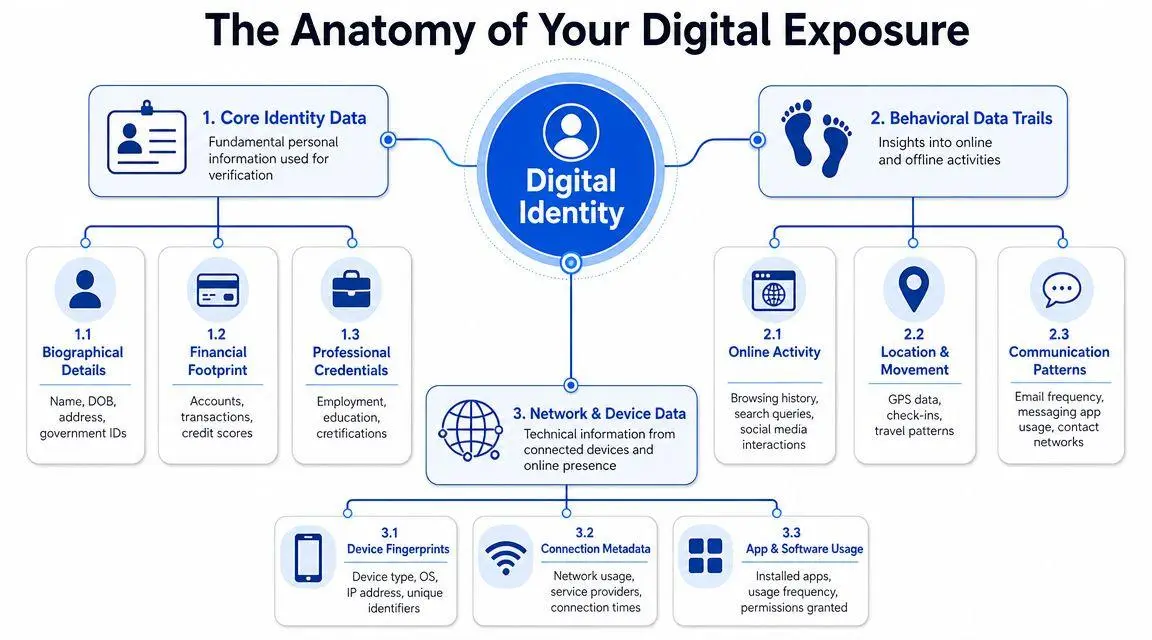
Core identity data
This is the obvious layer. Name variations, birth date, addresses, corporate affiliations, education history, relatives, phone numbers, emails, property links, legal filings, and professional licenses. This is the material people usually think of when they ask what internet privacy means.
It matters, but it’s only the opening layer. Core identity data lets someone confirm that you are who they think you are. It’s the skeleton of the dossier.
Behavioral trails
The second layer tells people how you live. Purchase habits, event attendance, browsing patterns, subscription activity, location history, travel timing, and platform engagement all create routine. Routine is what adversaries care about because routine is predictive.
A determined actor doesn’t need your private messages to understand your life. They need repetition. Repetition reveals where you go, when you’re reachable, what matters to you, and who sits inside your circle.
Metadata and network signals
Extensive data exposure carries significant risks. Internet privacy is not just about hiding message content; metadata and telemetry can be enough to infer highly sensitive attributes. A Tufts expert notes that non-content data can reveal a person’s location, identity, daily activities, likely relationships, social network structure, and even health-related behavior. The same analysis explains why privacy risk often comes from patterns of data rather than individual fields, which you can review in the Tufts discussion of digital privacy.
Metadata tells a stranger who matters to you, when you move, what you repeat, and which pressure points are likely to work.
A useful way to think about it is this:
| Layer | What it contains | Why it matters |
|---|---|---|
| Identity | Names, addresses, emails, employer links | Confirms who you are |
| Behavior | Searches, purchases, travel, engagement | Predicts what you do |
| Metadata | Timing, contacts, device and network patterns | Reveals how your life is structured |
Once aggregated, these layers stop looking like “personal data” and start functioning like an intelligence product. That’s why data broker ecosystems are so consequential. They don’t need one perfect source. They need many partial ones. If you want a direct look at that machinery, read this strategic guide on what data brokers are.
Primary Threats for High-Profile Individuals
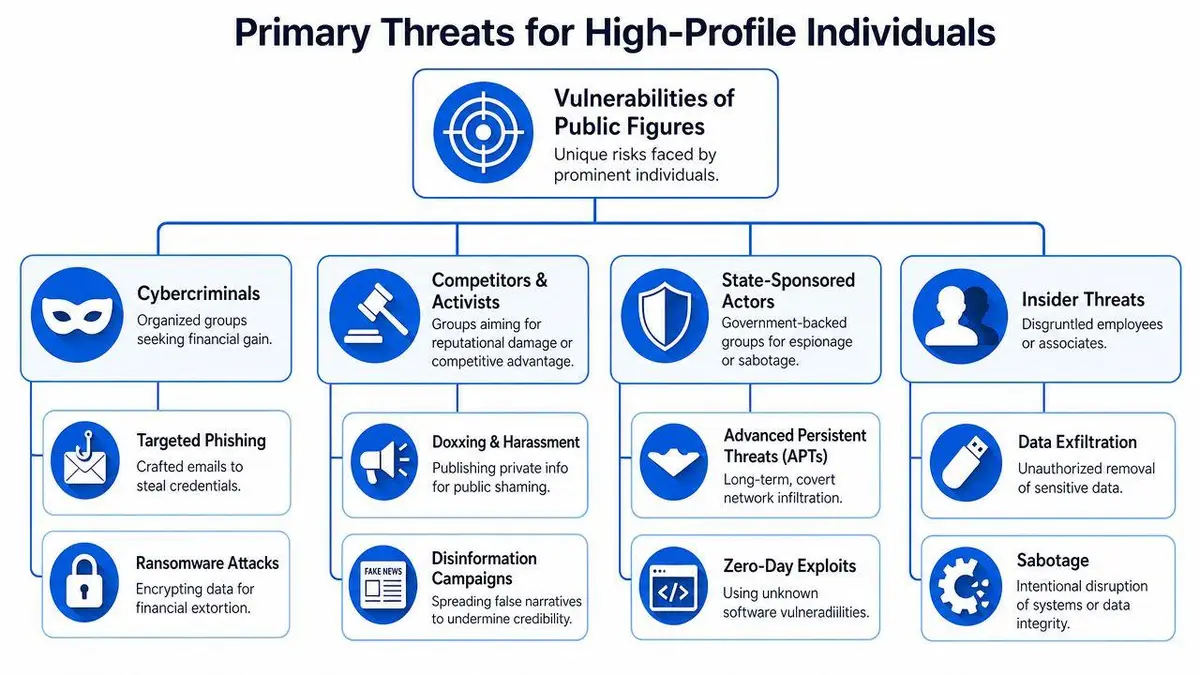
The threat isn’t “hackers” in the abstract. The threat is motivated actors using your data for a specific purpose. High-profile people attract different categories of adversary, and each one exploits exposure differently.
Doxxing starts with assembly, not intrusion
Most doxxing campaigns don’t begin with elite technical skill. They begin with compilation. Someone pulls home-associated records, family names, charitable affiliations, old usernames, map references, archived social posts, and contact details from scattered sources, then republishes them in a hostile format.
That repackaging is what creates danger. Information that was technically available but difficult to connect becomes instantly usable for harassment, stalking, swatting, extortion, or coordinated intimidation.
Insider leaks are often cleaner than external attacks
Executives tend to focus on outside attackers because those threats feel dramatic. Insider exposure is often more damaging. Current or former staff, contractors, agencies, household employees, and vendors don’t need to guess. They already know which details are real, current, and sensitive.
When an insider leaks travel plans, family routines, internal emails, or contact trees, they bypass the uncertainty that slows external actors. The damage also looks more credible because the material is usually precise.
The most dangerous leak is rarely the biggest file. It’s the accurate fragment released at the right time.
Adversaries use data to shape pressure
Competitors, activists, litigants, and opportunists don’t all want the same outcome. One group may want reputational damage. Another wants negotiating advantage. Another wants to force a response cycle that consumes your legal team, security lead, and communications staff.
Here’s how that usually maps in practice:
- Credential-driven attacks use exposed emails, habits, and known associates to craft persuasive phishing attempts.
- Reputational attacks combine partial truths, old records, and manipulated context to create a publishable narrative.
- Physical safety threats rely on addresses, movement patterns, family identifiers, and event attendance.
- Extortion scenarios often begin with the claim that private material, account access, or sensitive relationships can be exposed.
The dark web isn’t the only problem
Clients often fixate on dark web markets. That concern is justified, but it’s incomplete. A great deal of harmful exposure happens on the ordinary web, in search results, niche forums, social platforms, document repositories, cached pages, and broker databases.
The executive mistake is assuming that if data wasn’t “hacked,” it isn’t dangerous. Publicly accessible data can be just as operationally useful as stolen data when it’s indexed, correlated, and deployed by someone with intent.
The Inadequacy of Legal and Regulatory Frameworks
At 6:40 a.m., your chief of staff flags a post that includes your home address, a family name, and a false allegation packaged to look credible. By 8:00, screenshots are on multiple platforms. By noon, the original source is mirrored, indexed, and discussed by accounts you cannot identify. Privacy law does not stop that sequence. It gives you options after exposure has already begun.
Regulation matters, but executives routinely give it too much credit. Statutes create notice requirements, complaint channels, and grounds for enforcement. They rarely create fast, practical protection during a live incident. As noted earlier, many jurisdictions now have privacy laws on the books, yet breach losses remain high. The gap is obvious. Legal coverage exists. Operational containment still fails.
Laws help after damage starts
Speed decides outcomes. If your address is republished across broker pages and mirror sites, or an impersonation account starts pushing defamatory claims, your problem is not legal theory. Your problem is delay.
Jurisdiction questions, anonymous operators, offshore hosting, platform backlogs, evidentiary thresholds, and service requirements all slow removal. Search engines may continue to surface copies even after one source comes down. Data brokers can re-ingest the same information from a different feed. A court order may help, but it does not function like an emergency brake.
Treat legal remedies as part of the response stack, not the response itself.
Policy statements don’t equal operational control
A privacy policy tells you how one organization says it handles data. It does not stop other parties from collecting, correlating, reselling, or republishing that same data. If you want a clean example of internal governance language, review our privacy statement. It is useful for understanding collection and handling boundaries. It does nothing to stop hostile amplification once your information escapes into the wider web.
Consent has the same limitation. A signed disclosure or clicked banner may authorize collection. It does not give you meaningful control over every downstream transfer, vendor relationship, archive, cache, or derivative profile built from that data.
Compliance sets a minimum standard. It does not remove a doxxing post, shut down an impersonator, or stop a coordinated leak from spreading across platforms.
High-value clients need a harder standard. Build for time-to-response, not just legal defensibility. That means preserving evidence immediately, identifying the first source and its copies, pushing parallel takedown requests, pursuing de-indexing where available, monitoring for reposts, and preparing a communications position before the story hardens around someone else’s version of events.
Law still matters. Use it aggressively when the facts support it. But if your protection plan begins and ends with regulation, you are already behind.
A Strategic Framework for Personal Protection
The right question isn’t which privacy app to install. The right question is how to reduce what others can learn, store, correlate, and weaponize. That requires architecture.
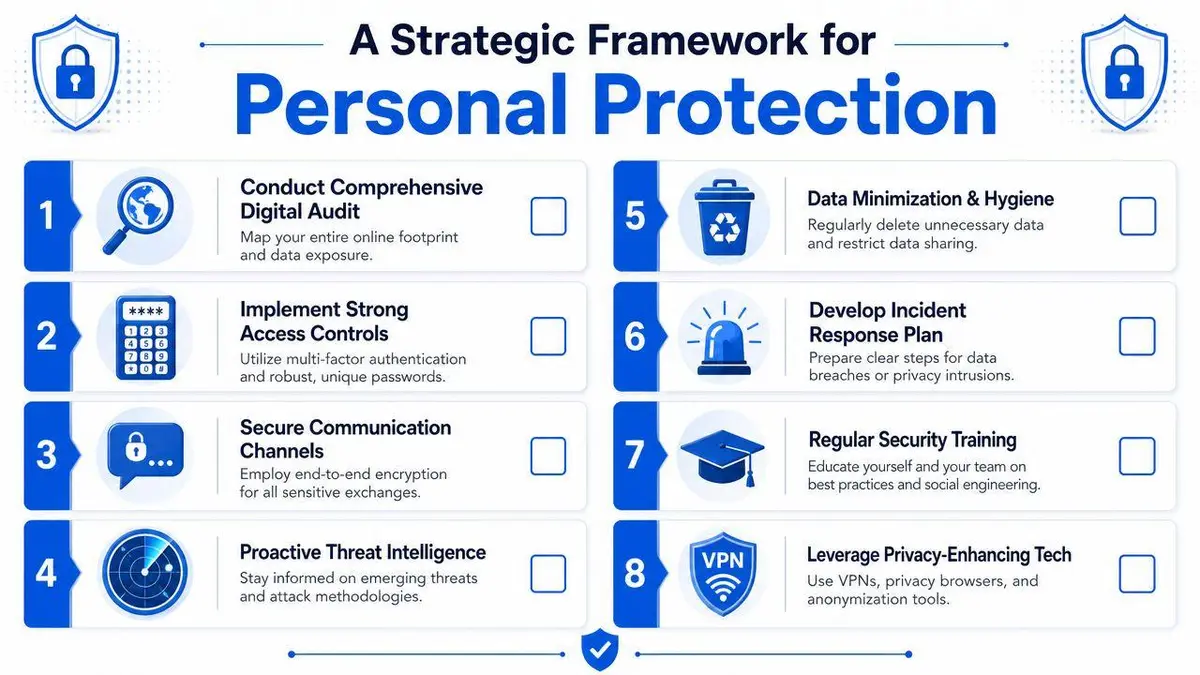
The U.S. NTIA’s view is useful here. Practical privacy protection requires layered controls. HTTPS helps encrypt data in transit, but privacy remains limited by identifiers such as IP addresses and cookies. Effective protection requires a combination of encrypted transport, tracking protection, and permission minimization, as discussed by the NTIA on technology and privacy policy.
Separate identities by function
Don’t run your life through one email domain, one device profile, one browser environment, or one phone number. Public-facing activity, internal business, personal relationships, and sensitive family matters should not share the same channels.
Compartmentalization does two things. It limits spillover from one compromised environment to another, and it reduces the accuracy of external profiling. If a platform, vendor, or broker can’t easily connect your contexts, it can’t assemble as coherent a picture.
Reduce permissions aggressively
Most executives grant data access by convenience, not necessity. Calendar permissions, contact sync, photo access, microphone access, location sharing, and app-to-app linkage create ambient leakage. Review those permissions like you’d review delegated authority in a finance department.
A practical operating model looks like this:
- Use dedicated devices for high-sensitivity communications and keep them out of low-trust app ecosystems.
- Limit app permissions to the minimum needed for the task. If location, contacts, or microphone access isn’t essential, deny it.
- Prefer encrypted communications for sensitive exchanges, but don’t mistake encryption for anonymity.
- Delete stale accounts because abandoned services often retain old identifiers, cards, contacts, and historical messages.
Treat privacy as a recurring process
One audit is not enough. New vendors, staff transitions, family travel, media exposure, real estate transactions, and litigation all change your attack surface. Build recurring reviews into your operating cadence.
A serious program usually includes credential review, broker removals, impersonation checks, search result assessments, public records analysis, and family exposure mapping. Services vary. Some families use internal security staff. Some retain specialist counsel. Some use firms such as ContentRemoval.com for content takedowns, de-indexing, dark web monitoring, and impersonation response when harmful material is already circulating.
Implementing Proactive Digital Monitoring
Reactive privacy is weak privacy. If you only move once a client, reporter, assistant, or spouse finds the problem, you’re already behind.

Monitoring isn’t one alert for your name. It’s a structured early-warning system that watches for changes in exposure across search, social, forums, broker databases, image duplication, credential leakage, and emerging impersonation. The purpose is simple. Detect small problems while they’re still containable.
What real monitoring includes
A credible monitoring program combines several streams rather than relying on a single dashboard.
- Search and web scanning tracks new pages, cached copies, profile pages, and harmful associations involving your name, companies, and known aliases.
- Dark web monitoring looks for exposed credentials, private contact data, and references to your accounts or domains in criminal marketplaces and forums.
- Social and platform surveillance identifies fake accounts, coordinated harassment, republished personal details, and early-stage narrative attacks.
For executives trying to justify budget and internal ownership, this framework on the cost of online monitoring services is a sensible reference because it treats monitoring as a risk-control function, not a vanity exercise.
The mechanics matter, but so does interpretation. A duplicate account may be benign or preparatory. A leaked credential may be old or active. A reposted address may be accidental or part of a pressure campaign. Monitoring without triage creates noise. Monitoring with triage creates options.
This short video gives a useful baseline for thinking about privacy exposure and response:
The point is lead time
Lead time is the asset you’re buying. If you can detect an impersonation account before journalists or customers see it, you have room to act discreetly. If you can identify exposed credentials before they’re reused, you can rotate access without drama. If you can spot a data broker relisting pattern, you can escalate before the record spreads.
That work is continuous. It doesn’t fit neatly into a spare hour on a Friday afternoon. For most high-profile people, that’s the clearest sign that privacy has become a specialist discipline.
When to Engage Professional Intervention
You should escalate the moment the issue exceeds your ability to contain it discreetly, quickly, and across platforms. That threshold arrives earlier than is commonly assumed.
A significant gap exists between awareness and control. Pew found that 67% of Americans say they understand very little or nothing about how companies use their personal data, and 77% say the same about government use, which is a useful reminder that self-management often breaks down under complexity, as shown in Pew’s data privacy findings.
Clear escalation triggers
If any of the following happens, stop treating it as a DIY problem:
- Active doxxing with addresses, family details, or movement patterns being posted or reshared.
- Impersonation at scale across social platforms, messaging apps, or search-visible profiles.
- Leaked images, videos, or private communications, especially when reposting has started.
- Coordinated defamation involving multiple accounts, mirrors, or search-indexed pages.
- Dark web exposure involving live credentials, internal documents, or verified personal records.
These situations fail fast because they combine speed, replication, and asymmetry. You’re trying to work through platform forms and legal process while an adversary can reupload in minutes and route traffic through accounts you can’t identify.
What specialists add
Professional intervention matters for three reasons. First, specialists know which remedy fits which surface. Source removal, de-indexing, preservation, escalation, and legal notice are not interchangeable. Second, they can act across systems at once instead of chasing one page at a time. Third, they work discreetly, which matters when escalation itself can attract more attention.
If harmful content is already spreading, your problem is no longer privacy alone. It’s distribution control.
The right external team should be able to coordinate platform takedowns, search suppression, evidence capture, repeat-upload monitoring, identity abuse response, and counsel alignment without turning the event into a public spectacle. Internal teams rarely have that combination of platform familiarity, procedural speed, and removal-specific experience.
The executive mistake is waiting until the issue becomes embarrassing enough to justify outside help. By then, the adversary has usually gained momentum. Engage earlier. Quiet intervention is cheaper, cleaner, and more effective than public cleanup.
If your personal information, leaked content, impersonation profiles, or harmful search results are already in circulation, ContentRemoval.com can assess the exposure confidentially and map the right response, including source removal, de-indexing, monitoring, and reupload containment. For executives and high-profile families, speed and discretion matter more than theory. The first step is a private assessment of what’s exposed, where it’s spreading, and which intervention will stop it.
Frequently asked questions
Is internet privacy just about cookies and app settings?
Not for anyone with visibility or assets. The article places consumer settings too low on the risk ladder and focuses instead on how vendor forms, property filings, donation records, staff photos and data broker entries combine into a usable profile of your life, routines and pressure points.
Can privacy laws stop someone posting my home address?
Rarely in time. Statutes create complaint channels and enforcement grounds, but jurisdiction, anonymous operators, offshore hosting and platform backlogs all slow removal, and search engines may keep surfacing copies. The article recommends treating legal remedies as one part of the response stack and building for time-to-response.
How do executives reduce their digital exposure day to day?
Separate identities by function so public, business, personal and family matters do not share one email, device or number. Cut app permissions to the minimum, use dedicated devices for sensitive communications, delete stale accounts, and run recurring reviews covering broker removals, impersonation checks and search results.