
Data breach monitoring is a risk discipline, not an IT alert feed. It watches dark web markets, paste sites, code repositories, exposed cloud storage and impersonation surfaces for your identities and data, triages findings by asset criticality, then launches technical containment and reputational containment together: resets and evidence preservation on one track, takedowns, de-indexing and recurrence monitoring on the other.
Key facts
- IBM’s 2025 report: average US breach cost USD 10.22 million; under 200 days to contain averaged USD 3.87 million.
- Four consequence layers for an executive breach: identity compromise, decision risk, reputation risk, personal safety risk.
- Triage asks whether the asset is active, privileged, reusable for fraud or impersonation, and whether it touches regulated data.
- Documented monitoring and documented response read as governance; unmanaged delay reads as indifference.
Where ContentRemoval.com comes in. ContentRemoval.com handles the track most breach programs leave unmanaged: removing leaked documents and images at source, de-indexing cached pages, taking down cloned profiles and watching for the long tail of reposts and broker republication after containment. Incident counsel, a CISO or a family office usually brings the firm in once the breach turns public-facing. A free 15-minute Exposure Scan maps what is still findable and removable, and the report is yours to keep. Get a Free, Confidential Exposure Scan or read how our personal data removal work is done.
You usually learn about a breach in the worst possible way. A board packet goes out, and someone notices an executive’s personal mobile number and home address are circulating online. Outside counsel asks whether the exposed credentials touched any privileged systems. A journalist calls before your internal team has finished basic triage. The immediate problem isn’t technical uncertainty alone. It’s that nobody can yet tell you what’s exposed, where it’s spreading, who’s exploiting it, or what must be removed before the issue becomes a reputational event.
That’s why data breach monitoring shouldn’t sit in a narrow IT lane. For executives, founders, family offices, and public figures, their risk is cumulative. A leaked password can become account takeover. A stolen mailbox can become impersonation. A copied document can become extortion, litigation pressure, or persistent search visibility. Traditional alerts may tell you something happened. They rarely tell you how to control the fallout.
Beyond IT Alerts Framing Data Breach Monitoring as Executive Risk
An executive rarely asks, “Was there a breach?” The difficult questions are harsher. Did the exposure touch regulated data, board communications, investor materials, travel records, or family information? Did a vendor create the opening? Is this a contained event, or the start of a longer reputational campaign?
That’s the right framing. Data breach monitoring is an executive risk discipline, not just a security dashboard. Recent sector analysis shows the risk picture is shifting. In healthcare, ransomware led the field, followed by third-party compromise and phishing, and 56% of breaches involved data stored on network servers according to the NIH-hosted research article. The board-level implication is straightforward. You don’t monitor everything with equal urgency. You monitor the systems, vendors, identities, and data stores that can produce material harm fastest.
What boards get wrong
Many organizations still treat monitoring as a notification service. They want a feed of exposed credentials, perhaps a monthly dark web scan, and a comfort statement from IT. That approach is too shallow for people with public visibility or concentrated legal exposure.
An executive breach has at least four layers of consequence:
- Identity compromise: Exposed credentials, tokens, and mailbox access create immediate operational risk.
- Decision risk: Leaked deal documents, legal drafts, and internal messages distort negotiations and invite opportunistic claims.
- Reputation risk: Images, private records, and impersonation accounts can outlast the initial incident.
- Personal safety risk: Home address, family data, travel patterns, and direct contact details change the threat profile quickly.
Board view: If your monitoring program can identify exposure but can’t route action across legal, communications, and removal workflows, it isn’t managing executive risk. It’s logging evidence.
A practical starting point is to review your external digital exposure in the same way you review your attack surface. Tools such as Manageengine Digital Risk Analyzer are useful for mapping visible risk signals around domains, brands, and public-facing assets. But executives also need to account for the parallel market in personal data. That usually means understanding how commercial profiling, people-search listings, and brokered records amplify breach harm. For that layer, our guide to what data brokers mean for executive privacy is often where the conversation becomes concrete.
The issue isn’t discovery alone
A breach alert without an outcome plan creates false reassurance. Boards need a monitoring model that answers three things immediately: what was exposed, who can weaponize it, and what can still be removed or suppressed. If your current vendor can’t answer all three, you don’t have mature data breach monitoring. You have detection without control.
The Anatomy of a Modern Monitoring Program
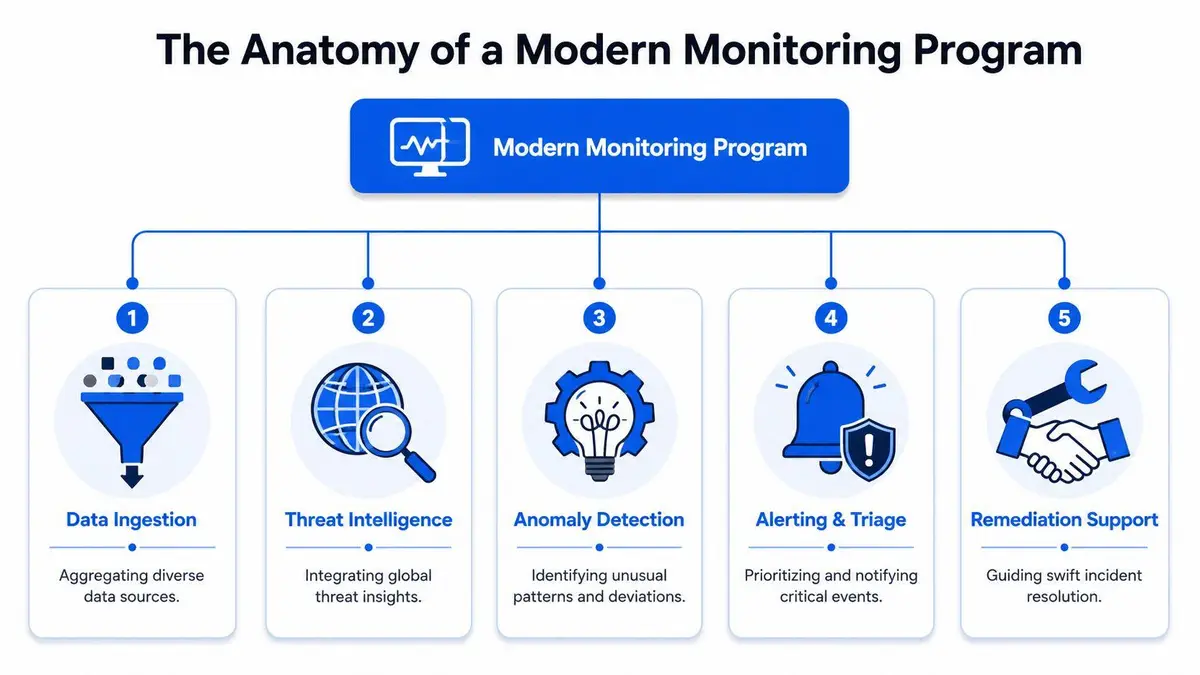
Most providers sell “dark web monitoring” as if one feed solves the problem. It doesn’t. A serious monitoring program behaves more like a distributed surveillance network. It ingests signals from multiple environments, verifies them against your actual assets and people, and then decides which findings demand immediate action.
Where professional monitoring actually looks
Start with the underground economy. Proofpoint notes that attackers acquire leaked credentials from prior breaches and dark web markets, then use them for credential stuffing and extortion. It also emphasizes that once a compromise is found, organizations need rapid action, including triage, forced password rotation, and MFA resets, as outlined in Proofpoint’s breach guidance.
That broad principle has distinct monitoring surfaces:
- Dark web marketplaces and forums: Stolen credentials, corporate access, session tokens, and identity records are offered, tested, and resold.
- Paste sites and transient dumps: These sources often expose data before it’s indexed elsewhere. They matter because they spread fast and are frequently copied.
- Code repositories and developer platforms: The threat here isn’t just source code. It’s hardcoded secrets, API keys, environment files, and accidental uploads.
- Open cloud storage and exposed databases: These incidents often reveal customer records, internal documents, and operational data at scale.
- Impersonation surfaces: Fraudulent domains, fake social accounts, cloned executive profiles, and fraudulent contact points turn an information leak into active deception.
What each alert should mean
A mature monitoring program doesn’t treat all findings equally. An exposed legacy password for a former employee is not the same as a live VPN credential tied to an executive assistant, or a mailbox token associated with finance approvals.
Use a triage model that asks:
- Is the asset still active?
- Does the identity have privileged or sensitive access?
- Can the exposed material be reused for fraud, impersonation, or public embarrassment?
- Does the finding touch legal hold, regulated data, or board communications?
A leaked credential matters because of what it unlocks. A leaked document matters because of where it will be republished.
Operational setup matters. If your team needs a practical example of how continuous site observation fits into a broader exposure program, Site Watch web monitoring setup is a useful reference point for thinking about persistent monitoring as a workflow rather than a one-off check.
Monitoring without context wastes time
You want correlation, not noise. IBM’s broader guidance on breach reduction emphasizes real-time insight into data usage, discovery and classification of sensitive data, encryption, formal response planning, and IAM controls such as password managers, MFA, SSO, role-based access control, and least privilege. In plain terms, alerts become valuable when they’re tied to identity context and asset criticality. A leaked executive mailbox, administrator token, or privileged remote account calls for immediate reset, session revocation, and re-enrollment into stronger controls. A generic alert with no access map is just another inbox problem.
The Business and Legal Imperative for Proactive Monitoring
Boards approve monitoring budgets too late because they still classify the function as technical overhead. That’s a category error. Proactive data breach monitoring is a cost-control mechanism, a liability-reduction mechanism, and a defensibility mechanism.
This is the financial backdrop.
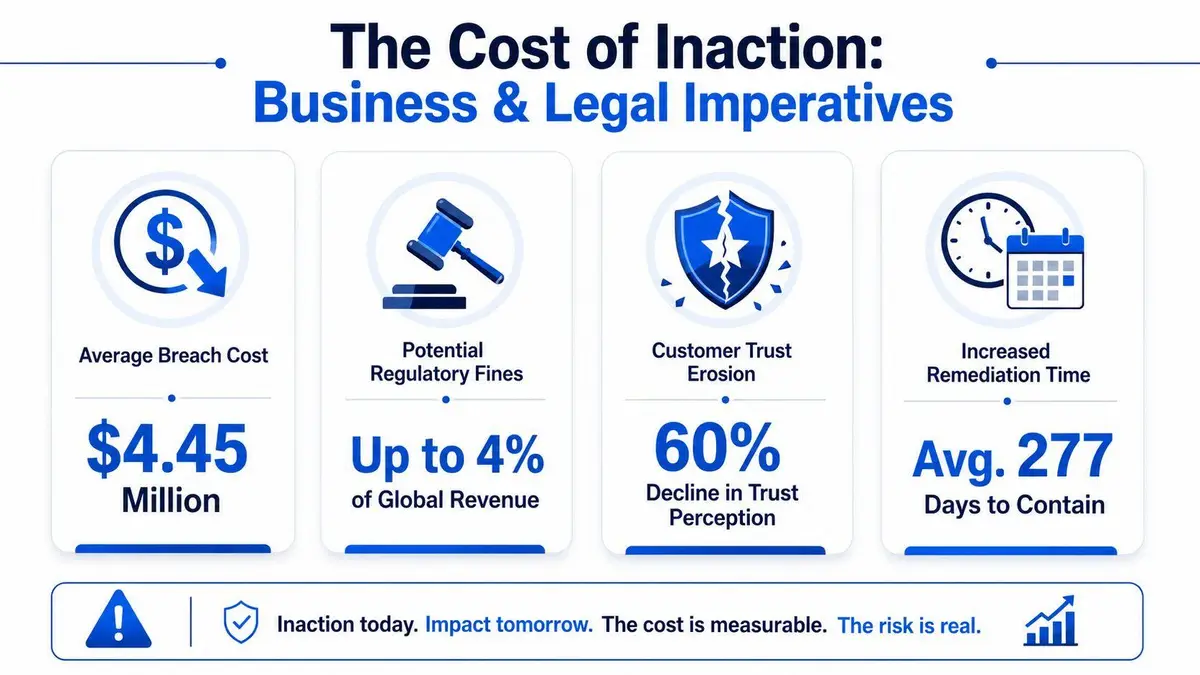
IBM’s 2025 Cost of a Data Breach Report found the average U.S. breach cost reached USD 10.22 million, while breaches contained in under 200 days averaged USD 3.87 million and those taking longer than 200 days averaged USD 5.01 million. Organizations using extensive security AI and automation averaged USD 3.62 million versus USD 5.52 million for those not using such tools, according to the IBM report summary hosted by Baker Donelson. Those figures don’t merely support monitoring. They support fast, continuous, intelligent monitoring tied to action.
Delay is a decision
When a company fails to detect exposed credentials, leaked records, or active impersonation early, the downstream costs multiply in familiar ways. Counsel spends longer reconstructing scope. Communications teams respond under pressure instead of from a position of control. Regulators and counterparties ask why the issue wasn’t discovered sooner. Plaintiffs’ lawyers focus on process gaps.
That’s why legal teams should treat monitoring evidence as part of diligence. If you can show that the organization continuously watched for exposed data, escalated findings, documented remediation steps, and notified affected parties promptly where required, you’re in a stronger position than a company that relied on periodic checks and informal escalation.
A short practical primer such as website security for SMBs can be helpful for smaller entities that need to understand baseline protective controls before they commission a more executive-focused monitoring and remediation framework.
Monitoring creates a record of reasonable conduct
The legal value of monitoring isn’t limited to prevention. It helps establish that leadership didn’t ignore obvious exposure pathways. That matters when the issue involves third-party processors, privileged communications, insider access, or known impersonation risks.
Later in the breach cycle, your organization may need to answer questions like these:
- When did you first know the data was circulating?
- What systems and identities did you examine first?
- Which affected individuals were notified, and on what basis?
- What steps did you take to prevent re-use or republication?
Material point: In breach matters, unmanaged delay looks like indifference. Documented monitoring and documented response look like governance.
For many boards, that’s the shift that matters. Monitoring isn’t just an alerting expense. It’s a way to reduce loss severity and demonstrate that the organization acted with discipline once risk became visible.
A short discussion on containment speed is useful here:
Integrating Monitoring with Incident Response and Remediation
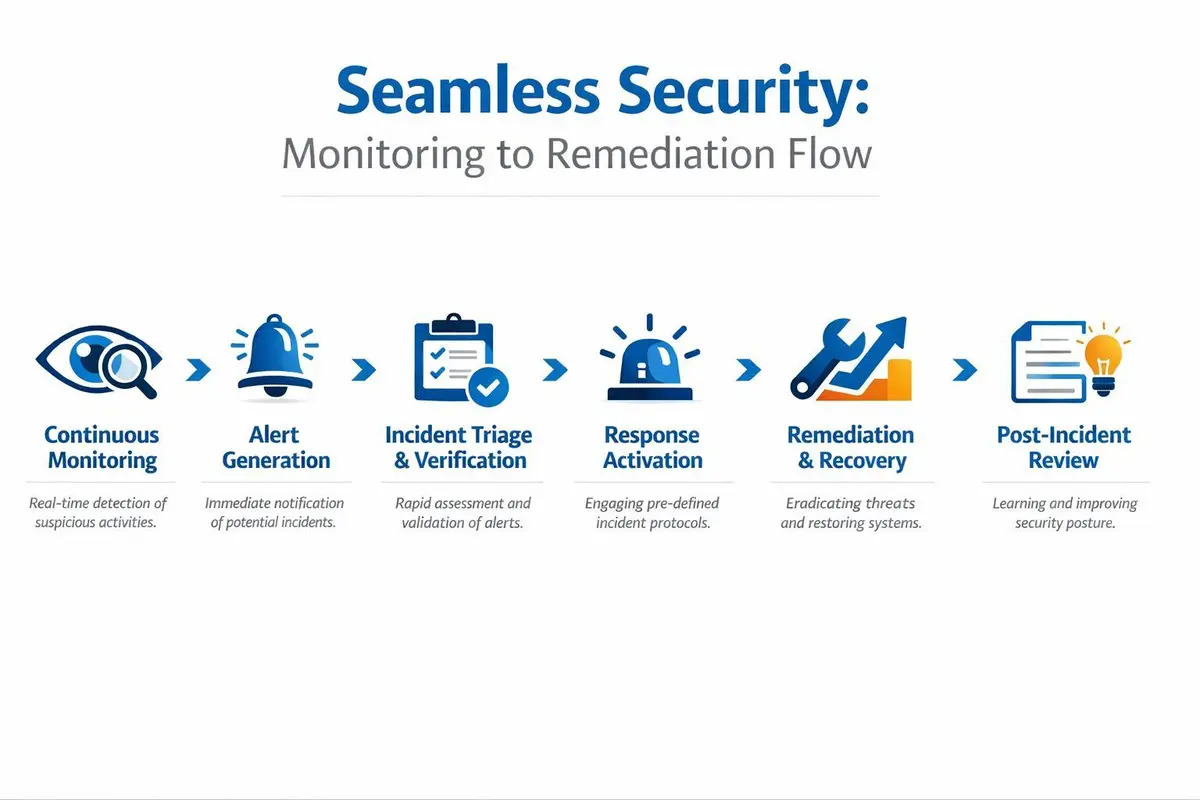
An alert is not a result. It’s the opening signal for two parallel tracks. One is technical containment. The other is reputational containment. Most breach programs handle the first unevenly and neglect the second almost entirely.
The market gap is obvious. Most guidance on data breach monitoring focuses on detection, MFA, and credit monitoring. It says far less about source takedowns, de-indexing, impersonation removal, or reupload prevention after a leak has been found. That omission matters because a 2024 industry report analyzed 734 breaches affecting 5,000+ people each, reinforcing that these incidents are frequent and operationally disruptive rather than isolated, as summarized by Breachsense’s discussion of post-detection gaps.
What must happen in the first hours
When monitoring identifies exposed credentials, session tokens, leaked documents, or published personal data, the organization should launch a coordinated response immediately. Not sequentially. Simultaneously.
The technical side is familiar:
- Reset and revoke: Force password changes, invalidate sessions, rotate keys, and reset MFA enrollment where warranted.
- Constrain access: Apply least-privilege corrections, isolate affected accounts, and review privileged pathways.
- Preserve evidence: Secure logs, document timestamps, and maintain chain-of-custody discipline for later legal use.
The reputational side is where many programs fail:
- Remove what can be removed: Target source pages, platform violations, search de-indexing, and fraudulent account takedowns.
- Suppress recurrence: Track mirrors, reposts, cloned profiles, and derivative content.
- Protect affected principals: Escalate personal safety issues when home addresses, family details, or travel data are exposed.
Why remediation must sit inside the monitoring workflow
Executives don’t care whether a harmful image, document, or fake profile was first detected by a dark web crawler, a brand monitor, or outside counsel. They care whether it disappears, stays down, and stops damaging negotiations, family privacy, or market confidence.
That’s why the response model should look like this:
| Alert Type | Immediate Containment | Reputation and Legal Action |
|---|---|---|
| Exposed executive credential | Reset password, revoke sessions, enforce stronger authentication | Assess impersonation attempts and fraudulent outreach |
| Leaked internal document | Restrict access pathways, investigate source, preserve evidence | Pursue source removal, de-indexing, and republication monitoring |
| Fake account or cloned profile | Secure legitimate account controls and linked email access | File platform takedowns, preserve screenshots, monitor reappearance |
| Exposed PII | Scope affected individuals and secure systems | Coordinate notifications, fraud monitoring, and people-search suppression |
Detection without takedown is incomplete response.
Specialist providers contrast sharply with commodity scanners. A scanner can tell you that a credential set is exposed. It won’t usually manage the removal of leaked material, the de-indexing of search results, or the suppression of recurring impersonation. If you need a practical framework for that overlap between cyber incident and public-facing harm, our guide on handling reputational damage from a data breach addresses the sequence directly.
The overlooked long tail
The hardest breach problems often begin after containment. An exposed image keeps resurfacing. A false social profile returns under a slight variation. A cached page remains searchable after the source is removed. A data broker ingests leaked details and republishes them elsewhere. That’s why one option some principals consider is ContentRemoval.com, which offers monitoring tied to takedown and recurrence tracking for leaked material and impersonation-related exposure. That isn’t a substitute for internal security response. It’s the adjacent function most organizations discover they need once the breach becomes public-facing.
Selecting a Data Breach Monitoring Partner
Most vendors in this category are selling a scanner. Executives usually need a response capability. That distinction decides whether your organization gets early warning with meaningful intervention, or more alerts to review under pressure.

The questions that separate serious providers from basic tools
Ask the provider what happens after an alert. If the answer is “we notify your team,” keep digging. A credible partner should explain how findings are verified, how criticality is assigned, how response is activated, and whether the service extends into takedown, de-indexing, impersonation handling, or coordination with counsel.
Ask where they monitor. “Dark web” is not a sufficient answer. You want specificity about marketplaces, forums, paste sites, code repositories, exposed cloud assets, executive impersonation surfaces, and recurrence tracking after removal.
Ask how they handle discretion. High-profile breaches often involve sensitive individuals, parallel legal issues, or active media risk. Loose ticketing systems and generic offshore workflows are the wrong fit for that environment.
Vendor Selection Criteria for Executive Monitoring
| Criterion | Why It Matters for Executives | Red Flags to Watch For |
|---|---|---|
| Scope of monitoring | Executives face exposure across personal, corporate, and reputational surfaces | Vendor only mentions credential dumps or “dark web scans” |
| Verification and triage | False positives waste time and real alerts need ranking by materiality | Every alert is treated the same |
| Remediation capability | High-stakes incidents require removal, de-indexing, and impersonation action | Vendor stops at notification |
| Legal and jurisdictional fluency | Takedowns and privacy disputes depend on platform rules and local law | No clear process for evidence preservation or counsel coordination |
| Confidential handling | Executive matters demand restricted visibility and controlled escalation | Shared inboxes, generic support queues, unclear data handling |
| Recurrence monitoring | Harm often reappears after the first removal effort | No post-removal watch or reupload prevention |
Choose the firm that can explain the chain from discovery to outcome, not the one with the most polished dashboard.
What sophisticated buyers usually want
They want one operating picture across executive identities, sensitive domains, leaked content, and impersonation. They want a partner that can brief legal, security, and communications without translation loss. They want evidence preserved correctly, notifications escalated selectively, and public-facing harm addressed before it compounds.
If the exposure involves personally identifiable information, do a parallel review of public-data exposure. The breach may have surfaced only part of the problem. Our guide to personal information removal for executives and founders addresses that adjacent layer.
Executive Checklist for Implementing Data Breach Monitoring
Treat this as a governance directive, not an IT task list. The executive role is to set scope, thresholds, and authority so the organization can act fast without procedural confusion.
Decisions to make now
- Authorize an exposure review for key principals: Include board members, executive assistants, finance approvers, legal leadership, and any public-facing family office personnel.
- Define material alert categories: Separate commodity findings from incidents involving privileged access, regulated data, live impersonation, leaked documents, or personal safety concerns.
- Prioritize vendors and data stores: Don’t spread effort evenly. Focus first on the third parties, repositories, and identities that would create the most legal and reputational damage if exposed.
- Assign one escalation owner: That person should have authority to convene security, legal, communications, and outside specialists immediately.
Controls that need executive sign-off
Some monitoring programs fail because leadership never sets the threshold for action. Solve that directly.
- Approve mandatory response triggers. If an executive mailbox, admin credential, or session token appears in monitoring, the response should be automatic.
- Require evidence preservation. Every serious alert should create a record suitable for legal review and later explanation.
- Integrate reputation defense. Takedown, de-indexing, and impersonation handling should be written into the breach workflow, not bolted on after media attention begins.
Operating rule: If a finding can affect negotiations, trust, regulatory posture, or personal safety, it belongs in the executive risk register.
What to ask your team this week
Use direct questions. Which exposed assets would hurt us most if weaponized tomorrow? Which third parties create the largest blind spots? Which public-facing individuals need enhanced monitoring now? What content, if leaked, could still be removed, and who owns that process?
Those questions expose whether you have a real program or a collection of tools. Boards don’t need more dashboards. They need faster decisions, clearer ownership, and fewer preventable surprises.
If your breach monitoring stops at alerts, you’re leaving the hardest part unmanaged. ContentRemoval.com works with executives, founders, family offices, and legal teams on the part most providers ignore: linking detection to discreet takedown action, de-indexing, impersonation removal, and recurrence monitoring. Start with a confidential assessment and get a clear action plan for what can be found, what can be removed, and how to keep it from coming back.
Frequently asked questions
What should happen in the first hours after a data breach alert?
Two tracks at once. Technical: reset passwords, revoke sessions, rotate keys, constrain access and preserve logs with chain of custody. Reputational: target source pages and platform violations, file fake account takedowns, request de-indexing and escalate personal safety issues where addresses or family data are exposed.
Why does breach monitoring matter legally?
It creates a record of reasonable conduct. Showing that the organization continuously watched for exposed data, escalated findings, documented remediation and notified affected parties promptly puts it in a stronger position with regulators, counterparties and plaintiffs than periodic checks and informal escalation.
How do I choose a data breach monitoring vendor for executives?
Ask what happens after an alert, exactly where they monitor, and how they handle discretion. Look for verification and triage by materiality, remediation capability, legal and jurisdictional fluency, confidential handling and post-removal recurrence monitoring.