
Dark web monitoring is worth it when it shortens the time between exposure and containment and sits inside a response plan with named owners. It scans hidden forums, marketplaces, paste sites and breach databases for executive emails, credentials and documents, but no provider sees private channels, and monitoring does not remove leaked data or prevent theft by itself.
Key facts
- Cited IBM data puts the average breach at $4.45 million, with faster responders saving $1.02 million.
- Commercial services watch public breach databases with over 8 billion entries; restricted forums stay blind spots.
- A useful alert says what surfaced, where, whether it looks current and what action is required.
- First-hour response: reset credentials, revoke sessions, verify MFA, then validate whether the alert is real.
Where ContentRemoval.com comes in. ContentRemoval.com provides dark web monitoring and remediation as part of a wider exposure-response model for executives, boards and family offices: verifying what surfaced, coordinating containment with counsel, and pursuing removal of leaked documents or credentials that appear on accessible sites. The chief of staff or general counsel usually makes the first call after a vendor alert nobody could interpret. A free 15-minute Exposure Scan maps what is exposed and removable, and the report is yours to keep. Get a Free, Confidential Exposure Scan or read how our personal data removal work is done.
Yes, dark web monitoring is worth it when it shortens the time between exposure and containment. The economic case is plain: the average global breach cost is $4.45 million, and organizations that respond within 200 days save $1.02 million on average compared with slower responders.
You are usually not asking this question in the abstract. You are asking because a board member’s credentials may have surfaced in a leak, a family office received a suspicious alert, or counsel wants to know whether another subscription reduces liability. That is the right frame. Dark web monitoring is not valuable because it “finds the dark web.” It is valuable because it gives decision-makers time to act before exposed credentials become fraud, extortion, account takeover, or a public relations crisis.
For high-stakes individuals and organizations, that distinction matters. A leaked password is a security issue for the IT team. A leaked executive mailbox, private document, or employee credential bundle is also a governance issue, a disclosure issue, and often a reputation issue. The board should evaluate monitoring as an intelligence capability tied to response readiness, not as a novelty feature in a cybersecurity dashboard.
The Moment of Exposure
At 6:40 a.m., an executive gets a message from a chief of staff. A monitoring vendor has flagged a credential tied to the executive’s personal email and a corporate account. The first reaction is predictable. Is this real? Who else has it? Has anyone logged in? Is there press risk? Are we already late?
That panic is understandable, but it’s not useful. The strategic question is different: what does this alert now enable us to do?
A credible dark web alert can trigger immediate decisions. Passwords can be reset. Sessions can be revoked. Multi-factor authentication can be rechecked. Counsel can assess notice obligations. Communications staff can prepare holding statements. A family office can review linked financial accounts and exposed personal services. Security can determine whether the leak is limited to stale credentials or whether it suggests deeper compromise.
Board-level rule: Treat a dark web alert as actionable intelligence, not as a curiosity report.
The value is not in discovering that criminals behave like criminals. The value is in compressing the time between signal and response. If exposed data includes credentials, internal access, employee accounts, or sensitive personal identifiers, every hour of delay gives an attacker more room to weaponize that data against the company, the executive, or both.
What the alert really means
A dark web alert rarely tells you everything. It often tells you enough.
That is how boards should think about it. A signal from an underground marketplace or breach repository doesn’t prove full compromise by itself. It does, however, justify immediate containment and disciplined verification. In crisis management, speed with judgment beats certainty delivered too late.
Why this is a board issue
When senior leaders are exposed, the incident rarely stays confined to technical remediation. It can spill into investor confidence, regulator scrutiny, client trust, executive safety, and media interest. If a board asks whether dark web monitoring is worth it, my answer is simple: it is worth it only if it sits inside a response system that can move immediately and discreetly.
What Dark Web Monitoring Actually Scans
Most buyers have been sold a fantasy. “Dark web monitoring” sounds like total visibility into a hidden internet. That is not what competent services provide.
They patrol known high-risk zones. Think of it as a security team running a disciplined route through the most dangerous blocks of a city, not as an omniscient force that sees into every locked room.
The sources that matter
Commercial monitoring generally focuses on identifiers that can be matched against illicit sources. Those identifiers may include executive email addresses, employee domains, usernames, passwords, customer records, phone numbers, or internal documents.
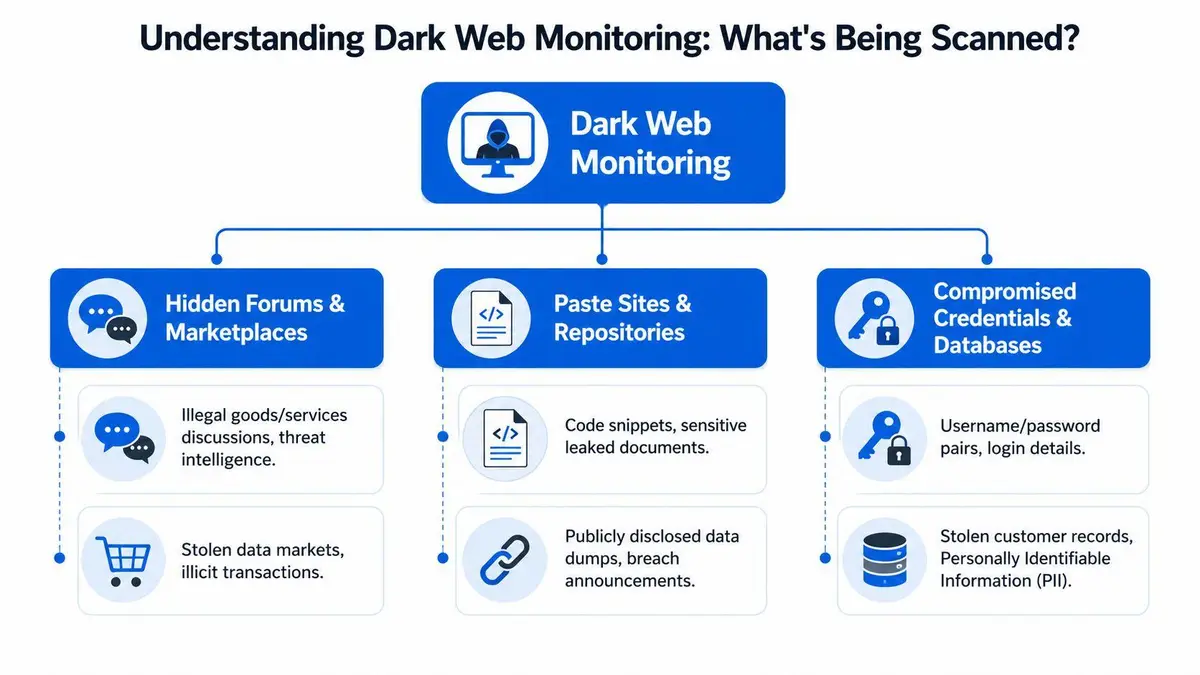
The main categories are straightforward:
- Hidden forums and marketplaces where criminals discuss access, sell stolen records, and advertise compromised accounts.
- Paste sites and repositories where leaked text, code, credentials, and internal documents may appear in public or semi-public form.
- Compromised credential and breach databases where large volumes of exposed usernames, passwords, and personal data are indexed and searched.
This scale is why the issue can’t be dismissed as niche. Panda Security reports that in 2025 dark web listings included more than 140 million stolen credit card records, about 93 million Facebook data logs, and 67 million Google data logs, while U.S. Social Security Numbers sold for as little as $1 to $6 and dark web sales were estimated at $2.6 billion in 2025, according to Panda Security’s dark web statistics overview.
What it does not scan
No provider sees everything. That is the first principle a board should insist on hearing.
VMware notes that no provider can scan the entirety of the dark web. Commercial services typically monitor large public breach databases with more than 8 billion entries and other publicly accessible sources, while restricted forums and peer-to-peer channels remain difficult to observe, as VMware explains in its analysis of whether dark web monitoring is worth it.
The right question is not “Do we have complete coverage?” You don’t. The right question is “Are we watching the sources most likely to expose actionable data about us?”
What a good alert should contain
An alert should do more than announce that “something was found.” It should identify what surfaced, where it appeared, whether the data looks current, and what action is required next. For executives and family offices, context matters as much as discovery. An unverified automated warning creates noise. A validated alert with source context creates options.
Calculating the ROI of Early Detection
The strongest case for dark web monitoring is not prevention. It is response-time economics.
If the board wants a clean answer to “is Dark Web Monitoring worth it,” use the same standard you would apply to any risk control. Does it reduce expected loss, shorten disruption, and improve the organization’s position during a crisis? If it does, it belongs in the program. If it only generates alerts no one acts on, it does not.
The numbers that matter
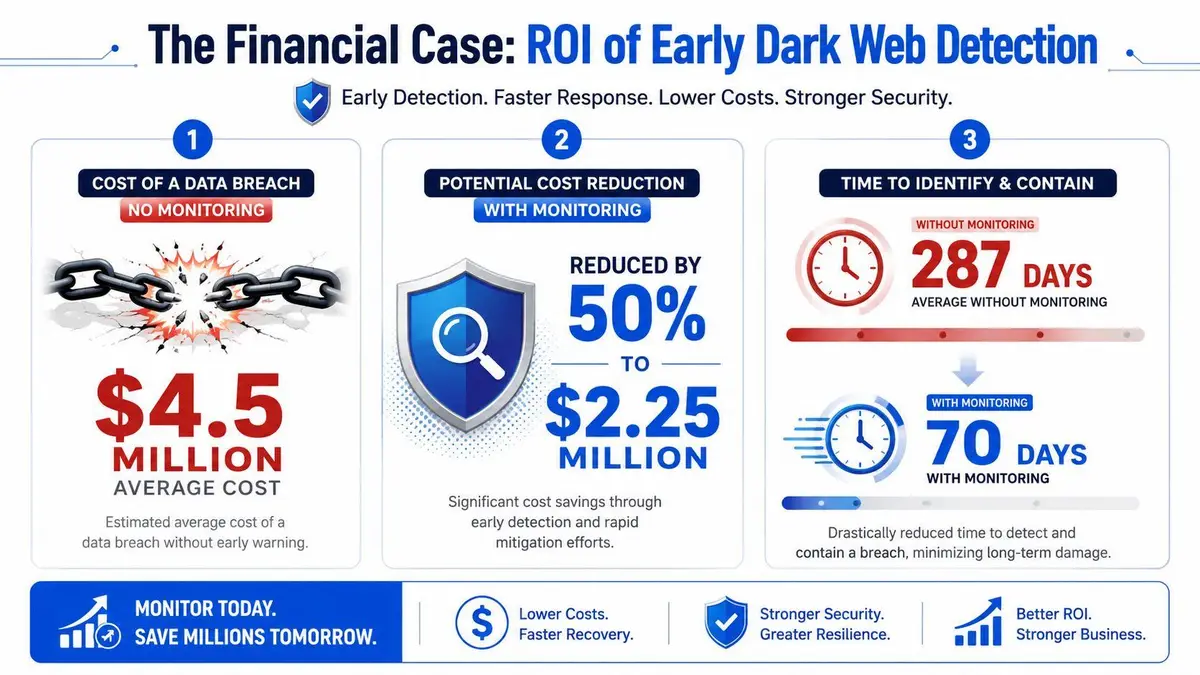
IBM’s 2023 Cost of a Data Breach data, as cited by Prey Project, puts the average global breach cost at $4.45 million. The same cited IBM data says organizations that respond within 200 days save $1.02 million on average compared with slower responders, and organizations using threat intelligence such as dark web monitoring save an average of $300,000 per incident versus those that do not, as summarized in Prey Project’s review of whether dark web monitoring is worth it in 2025.
That is the business case. Not “we found leaked data.” Not “we subscribed to another monitoring service.” The value comes from shrinking the interval between exposure and containment.
Where the savings actually come from
The savings are rarely a single line item. They come from avoided escalation.
| Exposure type | Early response can enable | Likely strategic benefit |
|---|---|---|
| Executive credentials | Reset access, revoke sessions, harden accounts | Lower risk of mailbox compromise and impersonation |
| Employee account leaks | Force resets, review privileges, isolate affected systems | Lower chance of lateral access and operational disruption |
| Customer or client data exposure | Assess scope, coordinate legal review, prepare notice strategy | Lower legal exposure and more defensible response |
| Internal document leaks | Verify authenticity, pursue removal, secure affected repositories | Lower reputational damage and tighter narrative control |
Boards often undervalue this because the return is defensive. That is a mistake. In a live incident, cost avoidance, defensibility, and preservation of trust are tangible outcomes. For a more detailed board framework on evaluating these decisions, see this analysis on justifying the cost of online monitoring services.
Practical rule: If a monitoring tool helps your team act before exposed credentials become unauthorized access, it has done its job.
My recommendation to directors
Approve dark web monitoring only when it is tied to a response playbook, named decision-makers, and clear escalation thresholds. If those conditions are absent, the board is not buying protection. It is buying delayed awareness.
The Critical Limitations of Monitoring Services
The sales pitch is usually stronger than the reality. That is why boards need a hard-edged view of what these services can’t do.
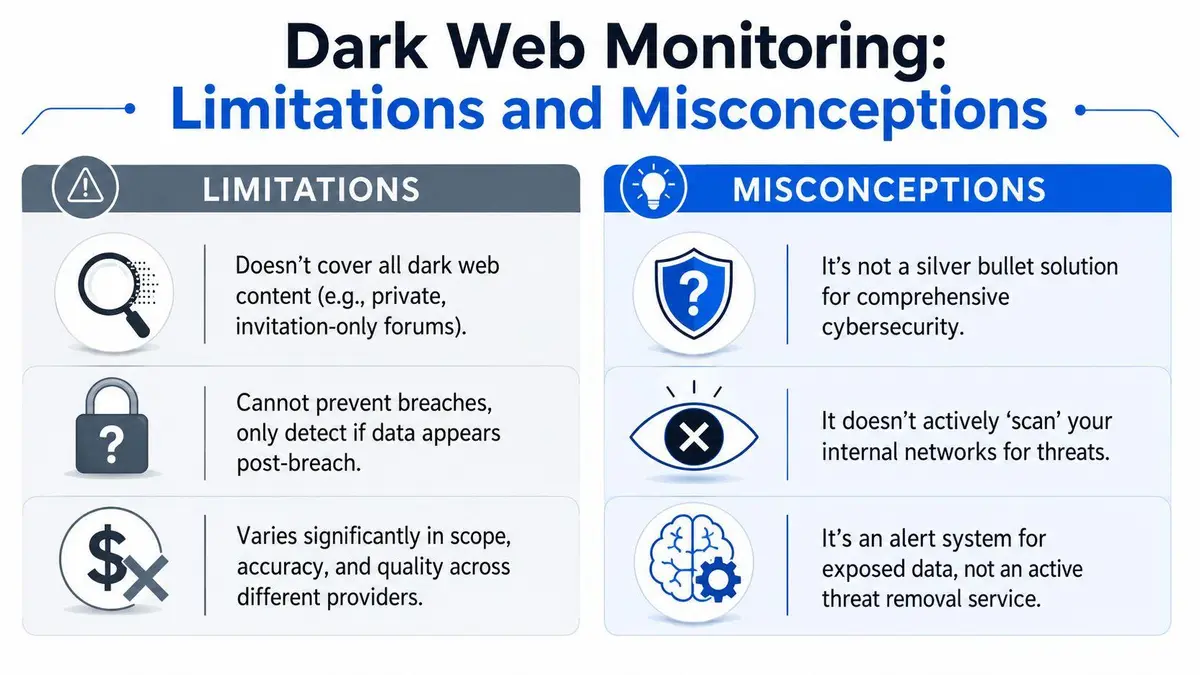
Dark web monitoring does not remove leaked data from criminal markets. It does not prevent theft by itself. It does not scan every private channel where criminals trade access, and it does not substitute for sound identity controls, legal strategy, or crisis communications.
The coverage problem
A service can only monitor what it can reach. Private forums, invitation-only communities, trusted criminal networks, and direct peer-to-peer exchanges remain blind spots. That does not make monitoring useless. It does mean the board should reject any claim of exhaustive visibility.
Here is the practical distinction:
- Useful coverage means the provider watches reachable, high-volume leakage sources where exposed credentials and records regularly surface.
- False confidence starts when a vendor implies that silence means safety.
- Strategic discipline means treating alerts as intelligence inputs and silence as non-confirmation, not reassurance.
The bigger limitation is internal
The most common failure is not technical. It is organizational.
Vendor-neutral guidance from Breachsense is blunt: the value of dark web monitoring depends on legitimate source coverage and a rapid response process. Without a team ready to act on alerts, the subscription fee is effectively wasted, as Breachsense explains in its guidance on whether dark web monitoring is worth it.
A board should sit with that for a moment. Many organizations buy monitoring before they decide who owns the response, who validates the alert, who speaks to counsel, who authorizes client notice, and who handles removal or containment. In those conditions, monitoring creates activity, not control.
An unread alert at midnight is not threat intelligence. It is an invoice.
What monitoring will never solve
SentinelOne’s vendor-neutral explanation gets this point right. Dark web monitoring is not a standalone solution. Its return depends on integration with a broader security program that includes strong passwords, multi-factor authentication, and a documented response plan, as outlined in SentinelOne’s overview of dark web monitoring and threat intelligence.
For individuals and smaller teams, that limitation is even sharper. If there is no one to verify alerts, lock down accounts, coordinate banks or platforms, and manage reputational fallout, the monitoring product will underperform no matter how polished its interface looks.
How to Select an Effective Monitoring Partner
Do not shop for a dashboard. Retain a partner that can operate under pressure.
That is the difference between commodity monitoring and a serious executive protection protocol. One sends automated notices. The other verifies findings, judges materiality, advises on containment, and coordinates discreet next steps.
What boards should evaluate
I advise directors to ask five questions, in this order.
First, how credible is the source coverage? Not in marketing language. In operational terms. Can the provider explain where it monitors, what it can validate, and where the blind spots are?
Second, who reviews the alerts? A purely automated feed may be acceptable for a low-risk consumer use case. It is not sufficient when exposed data could affect a public company officer, litigation strategy, or a family office principal.
Third, how fast is escalation? If the provider finds an executive credential bundle at an odd hour, what happens next? Does a person assess the alert? Who contacts the client? What evidence is preserved?
The partner must extend beyond detection
Detection without remediation leaves the hardest part untouched. High-stakes clients need continuity between monitoring, legal assessment, takedown strategy, impersonation response, leaked document handling, and reputation protection.
That is why the better procurement question is not “Which tool has more features?” It is “Which partner can reduce the consequences once exposure is discovered?” Boards reviewing broader protection models should compare monitoring in the context of online brand protection services, not as an isolated software line item.
A capable partner may include services such as source verification, takedown coordination, document leak assessment, and reputation management. For example, ContentRemoval.com offers dark web monitoring and remediation as part of a wider content removal and exposure-response model. That structure is more useful for executives than a stand-alone alert product because the incident rarely stays confined to one technical domain.
My selection standard
Retain the firm you would trust to wake your general counsel, brief your chief of staff, and advise your board chair with the same facts. If the provider cannot perform at that level, it is a software vendor, not a crisis partner.
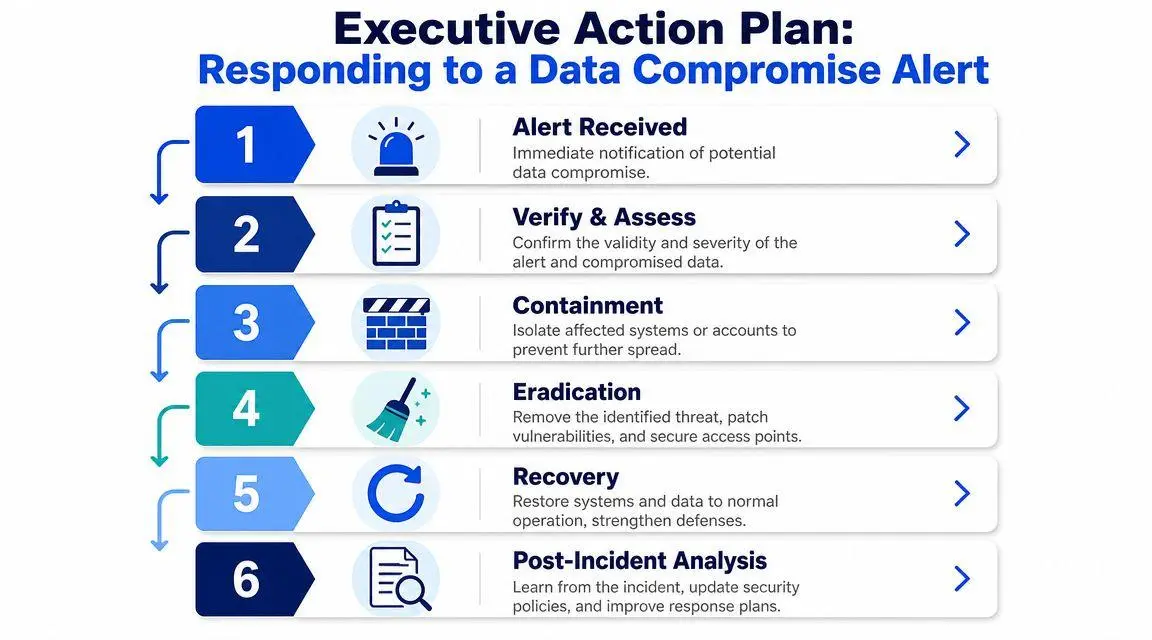
An Executive Action Plan for a Data Compromise Alert
When a credible alert lands, the first objective is control. The second is scope. The third is disciplined communication. Boards should insist that this sequence is documented before any monitoring service goes live.
First move in the first hour
Containment starts immediately. If the exposed data includes credentials, force password resets, revoke active sessions, review access tokens, and confirm multi-factor authentication is enabled and functioning on affected accounts. If the alert touches an executive, include personal accounts that may create a bridge into corporate systems or sensitive relationships.
Then verify the alert. Determine whether the data is current, whether it appears in a public dump or criminal marketplace, and whether it points to broader compromise. Weak providers often fall short here. They tell you something happened without helping you establish what happened.
The executive protocol
Use a structured sequence:
- Confirm authenticity. Validate that the data is real, relevant, and tied to current accounts or assets.
- Lock down access. Reset credentials, disable risky pathways, and isolate affected accounts or systems.
- Assess blast radius. Identify what else those credentials or records could expose, including financial, legal, operational, and personal exposure.
- Preserve evidence. Keep screenshots, timestamps, alert logs, and source details for legal review and incident handling.
- Decide on notifications. Bring in counsel early to determine whether employees, clients, institutions, platforms, or regulators must be informed.
- Pursue removal and suppression where possible. If leaked business documents or sensitive files have surfaced on accessible sites, begin a targeted removal process. This guide on how to remove leaked business documents from the internet is a useful reference point for that stage.
Move fast on containment. Move carefully on communication.
What the board should require in advance
SentinelOne’s guidance is right on the core issue: dark web monitoring primarily aids detection, not prevention, and its return depends on integration with strong passwords, MFA, and a documented response plan. That means the board should require named owners, preapproved escalation paths, external counsel access, and communications templates before the first alert ever arrives.
If those elements are absent, the organization is not prepared. It is merely notified.
When exposed credentials, leaked documents, or impersonation risks involve your executives, brand, or family office, speed and discretion matter more than another software subscription. ContentRemoval.com works with high-risk individuals and organizations to verify exposure, coordinate response, pursue removals, and contain reputational fallout through a confidential, results-focused action plan.
Frequently asked questions
Does dark web monitoring remove my leaked data?
No. Monitoring is a detection capability that patrols reachable criminal marketplaces, paste sites and breach databases. It does not delete records from those markets, prevent theft or cover private, invitation-only channels. Its value is the time it buys you to reset access and contain the exposure.
What should an executive do when a dark web alert flags their credentials?
Force password resets, revoke active sessions, review access tokens and confirm multi-factor authentication on affected accounts, including personal accounts that bridge into corporate systems. Then verify whether the data is current and real, assess what else it could expose, preserve the alert evidence, and bring in counsel on notification obligations.
How do I choose a dark web monitoring provider for a board or family office?
Ask how credible the source coverage is in operational terms, who reviews the alerts rather than relying on an automated feed, and how fast escalation happens at odd hours. The article’s standard is a partner that can also handle verification, takedown coordination and leaked document response, not a dashboard subscription.