
A data breach response plan for an executive has to cover four fronts at once: technical containment, legal duties, financial confidence and public exposure. Standard corporate plans treat a breach as an IT event and leave leaked files, fake profiles and search-indexed material to linger. The plan should end with public harm reversal, not just system recovery.
Key facts
- Executive breaches often begin with a compromised assistant mailbox, reused password or copied board archive.
- Outside breach counsel should engage the forensic team early to preserve privilege and control reporting.
- Containment runs in tiers: short-term isolation, stabilization and evidence preservation, then long-term hardening.
- Remediation has two tracks, technical recovery and forcing leaked content back down from public view.
Where ContentRemoval.com comes in. When a breach leaves leaked documents, impersonation accounts or copied screenshots circulating online, ContentRemoval.com works alongside counsel and security teams to remove them at source, de-index what remains and watch for reuploads. Outside counsel, a chief of staff or the crisis communications lead usually make the first call. A free 15-minute Exposure Scan maps what is removable, and the report is yours to keep. Get a Free, Confidential Exposure Scan or read how our personal data removal work is done.
At 6:40 a.m., your general counsel forwards a message marked urgent. A journalist has screenshots of internal emails. Your assistant can’t access a shared drive. Someone on the security team has already reset a group of accounts without preserving evidence. Meanwhile, a fake social profile starts posting fragments of what looks like confidential material.
That’s how this usually begins for executives. Not with a clean technical alert, but with confusion, leakage, and a fast-moving threat to reputation. A proper data breach response plan has to do more than protect servers. It has to protect decision-making, legal position, and public standing while facts are still incomplete.
Why a Standard Data Breach Plan Fails Executives
A standard corporate incident plan usually assumes the breach is an IT event that can be isolated, investigated, and disclosed in an orderly sequence. That assumption breaks down the moment the target is a known executive, founder, family office principal, or public figure. In those cases, attackers often aim at influence, embarrassment, commercial pressure, or media value as much as raw data extraction.

The weak point is rarely just the network. It may be a compromised assistant mailbox, a reused password in a personal account, an insider with access to travel records, or a copied archive of board materials. Once that material moves into search results, messaging apps, or social platforms, the crisis changes shape. You’re no longer dealing only with unauthorized access. You’re dealing with distribution.
The executive problem is different
For a high-profile client, a breach has four fronts at once.
| Front | What goes wrong |
|---|---|
| Technical | Systems, mailboxes, devices, or cloud platforms are exposed |
| Legal | Notification duties, preservation issues, and privilege questions begin immediately |
| Financial | Counterparties lose confidence, deals stall, and fraud risk rises |
| Public | Leaks, impersonation, and hostile commentary spread before the facts are stable |
That’s why generic plans fail. They assume the organization can afford to solve the technical issue first and the reputational issue later. Executives usually don’t have that luxury.
A breach involving an executive is often a credibility crisis before it becomes a completed forensic report.
The broader context is unforgiving. In the U.S., the average cost of a data breach reached $10.22 million in 2026, and Verizon reported 12,195 confirmed data breaches globally in 2024, according to Varonis’ summary of current breach statistics. Those figures matter because they confirm what clients already feel under pressure. These incidents are frequent, expensive, and no longer containable through a narrow IT workflow.
What a standard plan misses
Most internal plans don’t answer the questions executives ask in the first hour.
- Who controls the narrative: If leaked material appears online, who handles takedowns, media calls, and false amplification.
- What stays privileged: Which communications go through outside counsel, and which internal messages will become discoverable if mishandled.
- How personal exposure is separated from corporate exposure: Executives often have intertwined devices, assistants, travel data, and private communications.
- When public harm is contained: Not just when the attacker is removed, but when copied content stops spreading.
A useful data breach response plan for an executive must be custom-built. It has to assume hostile publication, impersonation, and reputational attack from the start. Anything less is paperwork.
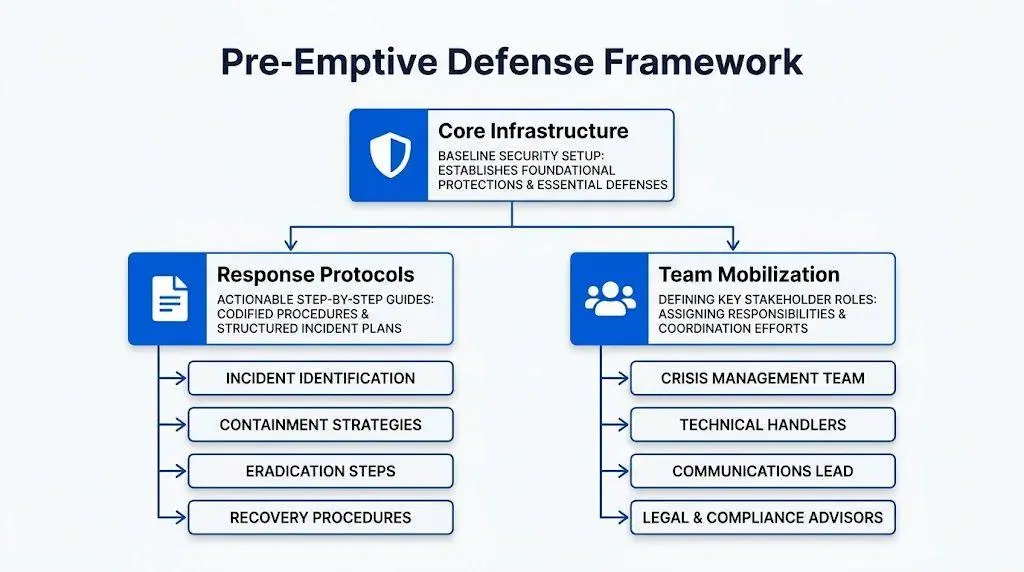
Assembling Your Pre-Emptive Defense Framework
Preparation determines whether you control the breach or the breach controls you. Most organizations can point to a document called a plan. Far fewer have a response capability that can be activated in minutes.
Research cited by Experian found that 86% of organizations had a data breach response plan, yet only 42% believed the plan was effective. The same research found 29% had never updated it after creation, and more than a quarter did not practice it at all, according to HIPAA Journal’s coverage of the survey. That gap is exactly where executive exposure lives.
Build the team before the incident
Your response structure should be named, not generic. Titles alone are useless at 2 a.m. You need named individuals, backups, direct numbers, and authority lines.
At minimum, your framework needs:
- An executive sponsor: Usually the CEO, president, or a delegated senior operator with authority to make immediate business-impact decisions.
- Outside breach counsel: Not your general corporate firm unless they handle cyber incidents routinely. They need to manage privilege, regulator strategy, and disclosure sequencing.
- A digital forensics lead: Pre-vetted and retained in advance. You don’t want to compare vendors while evidence is disappearing.
- A crisis communications lead: This person controls holding statements, employee messaging, media discipline, and board updates.
- A reputation and harm-containment lead: Someone responsible for search de-indexing requests, impersonation reports, copied content escalation, and monitoring.
- A documentation owner: One person maintains the decision log, timeline, approvals, and chain of events.
Pre-position the tools and documents
Most delays come from missing infrastructure, not lack of intent. The right data breach response plan includes the material you’ll need under pressure, already approved and accessible through a secure channel.
Use this baseline:
- A secure war room channel for leadership, legal, security, and communications. Don’t rely on the compromised environment.
- Prewritten notification templates for employees, counterparties, customers, and media holding statements.
- A contact matrix with after-hours numbers for internal leaders, outside counsel, forensic experts, insurers, and critical vendors.
- A public harm playbook covering leaked files, fake accounts, copied images, hostile reposts, and search engine indexing.
- An executive identity exposure inventory covering personal domains, aliases, family office assets, assistant-managed accounts, and known impersonation risks.
Practical rule: If your team has to decide who owns reputational containment during the breach, your plan is already late.
Rehearse the hard scenarios
Testing matters more than drafting. A breach plan that hasn’t been practiced is just a policy artifact. Your simulations should include technical compromise and public leakage in the same exercise. Most organizations test only the first part and then act surprised when the second part causes the lasting damage.
A good starting point is a broader executive privacy framework that ties identity protection to response readiness. This strategic framework for executives protecting their online identity is useful because it forces leadership to think beyond infrastructure and into visibility, exposure, and persistence.
The plan should feel operational, not aspirational. If the contact list is stale, the vendors are unvetted, and the templates don’t exist, you don’t have a defense framework. You have a binder.
Execution in the First Hour Containment and Confirmation
The first hour is about discipline. Not speed for its own sake. The worst mistakes happen when someone starts “fixing” the problem before the scope is understood and evidence is secured.

The objective is straightforward. Confirm whether you’re dealing with a real breach, contain active damage, preserve evidence, and keep critical operations running. That balance matters. BlackFog’s guidance on developing a breach response plan notes that effective containment requires balancing immediate isolation of compromised systems with maintaining critical operations, and that best practice involves tiered containment strategies and regular testing conducted at least annually.
Minute one to fifteen
Treat the first report as credible, but don’t broadcast it widely. Limit notification to the people who must act immediately. One senior decision-maker should authorize plan activation. One documentation lead should start a live timeline.
Your technical team should answer four questions before taking disruptive action:
- What triggered the alert
- Which systems or accounts appear affected
- Whether data exposure is plausible or already visible
- Whether the attacker may still be active
If the suspected breach involves executive mailboxes, file repositories, or cloud admin access, assume lateral implications until ruled out.
Minute fifteen to forty
This is the containment window. The right move is targeted isolation, not a blind shutdown. You may need to revoke specific credentials, segment affected systems, preserve relevant logs, and block active exfiltration routes while leaving unaffected operations intact.
Use a tiered approach.
| Containment tier | Purpose |
|---|---|
| Short-term | Stop active access, suspend risky credentials, isolate affected segments |
| Stabilization | Extend logging, secure backups, preserve evidence, verify scope |
| Long-term | Remove persistence, harden systems, rebuild or restore safely |
A practical external reference for regional teams is this guide for UK businesses on data breaches, which is useful for operational checklists and sequencing under pressure.
Don’t reboot, wipe, or broadly reset unless your forensic lead approves it. Panic destroys evidence faster than attackers do.
What leadership should demand in the first hour
The senior leader in charge shouldn’t be asking for technical jargon. They should ask for decision-grade facts.
- Status of the threat: Active, contained, or still uncertain.
- Business impact: Which critical functions are at risk right now.
- Data exposure risk: Unknown, suspected, or visibly confirmed.
- Public visibility: Any sign of leaks, journalist contact, impersonation, or copied files.
- Next decision point: What needs approval in the next thirty minutes.
A visual briefing often helps non-technical leaders keep pace without disrupting the response.
The first hour sets the tone for everything that follows. If you contain surgically, document carefully, and keep leadership focused on decisions rather than noise, you preserve options. If you improvise, you lose them.
Navigating Inviolate Legal and Regulatory Duties
After the incident is stabilized, legal exposure becomes immediate and concrete. Many executive teams make a costly mistake at this stage. They treat legal review as a late-stage signoff instead of the structure that should govern the investigation from the outset.
A formal forensic investigation isn’t optional. According to NIST standards, a response plan must include a forensic investigation phase in which certified experts analyze logs and attack pathways to build an official timeline and root cause analysis. Lindenwood University’s summary of that standard explains why that record is essential for legal and regulatory requirements.
Counsel first, then facts through counsel
Outside counsel should engage and direct the forensic team as early as possible. That helps preserve privilege, imposes discipline on internal communications, and creates a controlled reporting structure. Without that layer, executives often generate loose internal commentary that later becomes a litigation problem.
Your legal team needs to classify the incident fast, but carefully. The key questions are familiar:
| Legal variable | Why it matters |
|---|---|
| What data was involved | Personal, financial, health, confidential business, or privileged material trigger different obligations |
| Who is affected | Residency, employment status, customer status, and contractual position shape notice duties |
| Where the entity operates | Multiple jurisdictions may apply at once |
| What contracts require | Vendor agreements, cyber policies, financing covenants, and client terms can all create additional notice duties |
If a breach touches customer records, employee information, or third-party datasets, counsel should map regulatory and contractual obligations in parallel with the forensic review.
Documentation is part of compliance
Legal compliance depends on recordkeeping, not just judgment. Your incident log should capture who knew what, when they knew it, what actions were taken, and who approved each step. Regulators look for chronology, not just conclusions.
Precision matters more than volume. A short, accurate timeline is safer than a flood of speculative internal messages.
If your team handles external data-processing functions, even adjacent governance documents can matter. For example, operational teams sometimes need to confirm vendor-side privacy positions or processing terms quickly. In that context, email verification data privacy terms are the kind of reference counsel may review when mapping third-party data exposure and contractual handling standards.
Legal response also has a public-facing dimension. If leaked content, copied records, or defamatory commentary begin circulating, takedown and removal strategy should align with counsel’s broader legal posture. This strategic guide to navigating online content removal laws is useful because it frames removal work as part of risk control, not an afterthought.
Deal with authorities and counterparties carefully
Communications with regulators, law enforcement, insurers, lenders, and key clients should be factual, narrow, and consistent. Don’t speculate. Don’t overstate control. Don’t minimize what you don’t yet understand.
The legal function’s role is to keep the organization truthful without becoming reckless. That means sequencing disclosures correctly, preserving room for updated findings, and ensuring technical teams don’t undermine legal strategy by speaking too soon or too broadly.
Commanding the Narrative with Strategic Communications
Silence doesn’t buy safety in a breach. It creates a vacuum, and someone else will fill it. Usually a journalist, an aggrieved employee, a competitor, or the attacker.
The communications strategy has one job. Preserve trust while facts are developing. That requires controlled transparency. Not spin, not defensiveness, and certainly not improvisation.
Say less, but say it well
Your first external statement should be a holding statement, not a final account. Confirm that you’re investigating, that you’ve taken containment steps, and that further updates will follow through designated channels. Anything beyond verified facts invites contradiction later.
The internal message matters just as much. Employees who feel uninformed will talk anyway. Give them a short, approved script, instructions on where to direct inquiries, and a direct warning not to comment publicly or speculate externally.
A strong discipline model looks like this:
- One spokesperson: Everyone else refers inquiries.
- One message architecture: Board, staff, customers, and partners hear aligned facts specific to their concerns.
- One approval chain: Legal, executive lead, and communications lead clear outbound statements.
- One update rhythm: Scheduled updates reduce rumor and internal freelancing.
Tailor by audience
The board wants governance, exposure, and decision points. Customers want to know what happened, whether their data is affected, and what you’re doing next. Business partners want operational assurance. The media wants tension, accountability, and a quote. If you give every audience the same message, you will satisfy none of them.
Many plans collapse into generic language at this stage. Don’t say you “take privacy seriously.” Every failed organization says that. State the action already taken, the scope still under review, and the next update commitment.
People forgive incomplete facts sooner than they forgive evasive language.
For teams refining message discipline before a live event, Carlos Alba Media’s expert advice on building a crisis communications plan is a practical reference because it treats communications as a managed system rather than a press exercise.
The rule for difficult questions
When asked what you don’t know yet, answer directly. Say the issue is under active investigation, identify the part you can confirm, and state when the next update will come. Don’t speculate on motive, total scope, or final impact before the forensic record supports it.
The same rule applies to social channels. If impersonation, leaked screenshots, or manipulated extracts begin circulating, your public response must be calm and sparse. A sprawling thread usually worsens the story. A controlled statement, paired with immediate reporting and enforcement actions behind the scenes, is almost always the better move.
A communications plan isn’t separate from the data breach response plan. It is the visible face of it. If your words suggest confusion, markets, counterparties, and media will assume the facts are worse than they may be.
Achieving Full Remediation and Public Harm Reversal
A breach isn’t over when the attacker loses access. It’s over when the technical pathway is closed, the legal position is stabilized, and the public damage is being reversed in a measurable way.
That last part is where most data breach response plans are weak. They focus on network recovery and notification, then leave leaked documents, copied images, fake profiles, and search-indexed material to linger. That is a strategic error. Public remnants are what clients, journalists, counterparties, and future litigants continue to find.

Remediation has two tracks
The first track is technical. Remove persistence, rebuild compromised assets where necessary, rotate credentials, validate backups, harden access controls, and confirm the attack path is shut.
The second track is public harm containment. That means identifying what escaped into the public domain and forcing it back down.
- Leaked files: Issue takedown demands to hosting sites and submit de-indexing requests where appropriate.
- Impersonation accounts: Report and escalate with platform evidence packages, not generic complaints.
- Copied media or documents: Track reposts and mirror locations, then remove at source where possible.
- Search visibility: Monitor branded queries, executive names, and document titles for resurfacing.
- Ongoing surveillance: Use monitoring so reuploads and reposts are detected quickly.
This gap in mainstream planning is real. Fidelis Security’s discussion of breach response planning notes that most plans focus on IT security and legal notice but fail to address public-facing harm like leaked documents on search engines. The same source notes that organizations using AI and automation for security have reduced breach costs by an average of $2.22 million.
The right end-state
True recovery means a future investor, journalist, litigant, or adversary can’t easily reconstruct the worst moment of the incident from search results and recycled posts. That requires active suppression, removal, and monitoring. It doesn’t happen by waiting.
In this phase, one option is to use a specialist provider that handles de-indexing, impersonation reports, leaked content takedowns, and monitoring alongside counsel and internal teams. For executives dealing with personal exposure as well as corporate fallout, this guide to personal information removal for executives and founders is relevant because it connects cleanup to longer-term privacy control.
Your data breach response plan should end with remediation, not merely recovery. Recovery restores systems. Remediation restores position.
If your name, company, or private materials are already exposed, delay is expensive. ContentRemoval.com works with executives, legal teams, and high-profile clients to contain online fallout after a breach, including leaked content removal, de-indexing, impersonation takedowns, and ongoing monitoring. Start with a confidential assessment and build a response that addresses both the breach itself and the public damage it leaves behind.
Frequently asked questions
What are the first steps after discovering a data breach?
Treat the first report as credible but limit who knows. One senior leader authorizes plan activation and one person starts a live timeline. The technical team confirms what triggered the alert, which systems are affected, whether exposure is plausible and whether the attacker is still active, before any disruptive resets that could destroy evidence.
Who should be on an executive breach response team?
The article lists six named roles: an executive sponsor, outside breach counsel, a pre-vetted forensics lead, a crisis communications lead, a reputation and harm-containment lead, and a documentation owner. Titles alone are not enough. Each role needs a named person, a backup and direct contact numbers.
What should a company say publicly after a breach?
Start with a holding statement that confirms an investigation, notes containment steps taken and commits to updates through one channel. Use one spokesperson, one approval chain and a scheduled update rhythm. Avoid generic lines about taking privacy seriously and never speculate about motive or total scope before forensics support it.