
Privacy law is the body of statutes, regulations and international frameworks governing how personal data is collected, processed, stored, secured and disclosed. It creates obligations for organizations and enforceable rights for individuals, including erasure, objection, rectification and restriction. For executives and public figures those rights become practical tools for removing or delisting personal information, even when it is true.
Key facts
- The OECD principles set eight controls, from collection limitation and data quality to individual participation and accountability.
- GDPR penalties reach 20 million euros or 4% of worldwide turnover, and fines exceed 7.1 billion euros to date.
- UK organizations generally must answer a data subject request within one calendar month.
- Privacy-based search delisting can remove a URL from name searches while the source page stays online.
Where ContentRemoval.com comes in. ContentRemoval.com builds and sends privacy-based requests for exactly this situation, matching each URL to the strongest statutory or platform ground, coordinating source removal with search delisting, and tracking mirrors and reuploads afterward. Requests usually come from the individual’s counsel, chief of staff or family office. A free 15-minute Exposure Scan maps which personal data pages are removable and by which route, and the report is yours to keep. Get a Free, Confidential Exposure Scan or read how our personal data removal work is done.
You discover that a searchable database has published your home address, family details, and financial information. The page is attracting attention from journalists, clients, competitors, and strangers. You contact the operator and receive either silence or a generic refusal. At that moment, the question is no longer academic. You need to know what privacy law is, whether it applies to the data, and which legal right can force a controller, platform, or search engine to act.
Privacy law is the body of statutes, regulations, and international frameworks governing how personal data is collected, processed, stored, secured, and disclosed. It creates obligations for organizations and enforceable rights for individuals. For an executive or public figure, those rights can become practical tools for reducing exposure, challenging unlawful publication, and removing or delisting personal information.
The legal field covers far more than confidentiality. It includes consumer data rights, breach notifications, children’s data, biometric identifiers, AI and automated decision-making, profiling, and international transfers. Privacy practices also vary by jurisdiction and by the type of organization involved, so a company’s privacy practices in Dubai may provide useful context when assessing how a controller explains its collection and handling of personal information.
The Real-World Stakes of Privacy Law
The data broker’s page may contain information that was assembled from public records, commercial databases, marketing lists, scraped websites, or third-party disclosures. The fact that information is available somewhere else doesn’t automatically make every new use lawful. Privacy law examines the controller’s purpose, legal basis, transparency, accuracy, security, and relationship with the individual.
That distinction matters for reputation defense. A published address can create physical security concerns. Family details can expose relatives who never agreed to the disclosure. Financial information can distort public perception or create opportunities for fraud. A searchable profile can also make separate fragments of information far more damaging by placing them together in one indexed record.
Privacy law creates leverage, not just paperwork
A controller may be required to explain where data came from, why it’s being processed, who receives it, how long it will be retained, and how an individual can exercise statutory rights. If the controller can’t justify the processing, or if the data is inaccurate, excessive, outdated, or used for an incompatible purpose, the individual may have grounds to demand correction, restriction, erasure, or objection.
Practical rule: Treat every harmful data page as a legal and operational problem. Preserve the URL, screenshots, publication date, page source, search results, and communications before sending a removal demand.
Privacy law also reaches systems that never publish a conventional article. A facial-recognition database may process biometric identifiers. An AI tool may profile a person or support an automated decision. A marketing platform may combine location data with purchasing behavior. A breach may expose information that the organization never intended to make public. The applicable remedy depends on the data, the controller, the jurisdiction, and the processing activity.
Why public figures face amplified exposure
Executives, celebrities, family-office principals, and legal professionals often have several identities and data trails across jurisdictions. A single disclosure may involve a broker in one country, a hosting provider in another, a search engine serving users globally, and a platform that applies its own rules. The practical question is not whether the information is embarrassing. It’s whether the organization has a lawful basis to collect and continue using it, and whether the individual’s rights outweigh the controller’s stated purpose.
That is why privacy law belongs in reputation defense planning. It can provide a parallel route to traditional defamation claims, especially when the material is private or unlawfully processed rather than false. The strongest strategy usually begins with data mapping and evidence preservation, then selects the specific statutory right that creates the clearest obligation for the recipient.
The Eight Principles That Define Global Privacy Standards
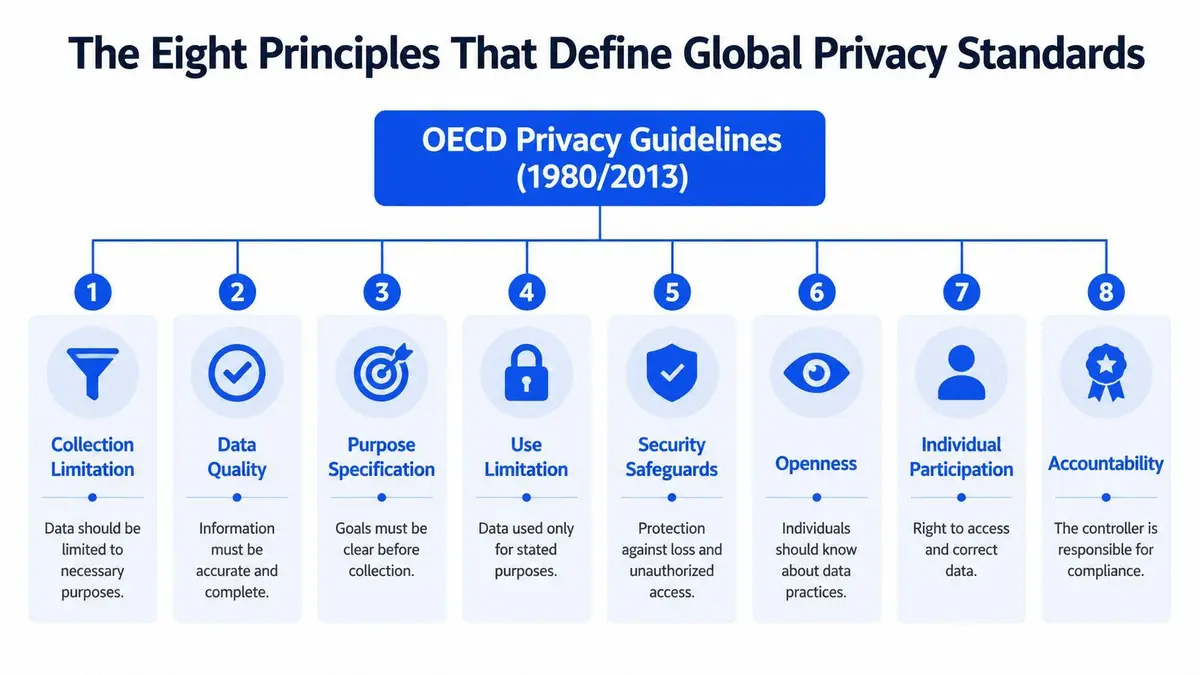
Privacy law has no single worldwide statute. Its common architecture comes from principles that have influenced national frameworks across borders. The OECD Privacy Guidelines were adopted on 23 September 1980, are widely described as the first internationally agreed privacy principles, and were revised in 2013 while retaining their role as a global baseline.
The framework identifies eight controls: collection limitation, data quality, purpose specification, use limitation, security safeguards, openness, individual participation, and accountability. These principles translate into constraints on data flows, not merely better wording in a privacy notice.
How the principles control data handling
Collection limitation requires organizations to limit collection to information that is necessary, lawful, and fair for the relevant purpose. A broker collecting extensive family information for an unclear commercial objective faces a more difficult justification than a service collecting a narrow set of account details.
Data quality requires personal information to remain accurate and complete enough for its purpose. Incorrect ownership records, outdated addresses, or misidentified individuals can support a rectification demand and may undermine the controller’s justification for continued publication.
Purpose specification requires the organization to identify why it collects information before or at collection. Use limitation then restricts later use to the stated purpose or another legally permitted basis. A controller that gathered data for one service may not automatically have permission to republish it in a searchable profile.
Security safeguards address protection against loss, unauthorized access, destruction, use, modification, or disclosure. These safeguards must reflect the sensitivity of the information and the risks created by the processing.
The principles that support a removal request
Openness gives individuals visibility into data practices, including collection sources, purposes, disclosures, retention, and available rights. A vague notice can make it harder for a controller to defend opaque processing.
Individual participation gives people a route to access personal data and seek correction or other remedies. This principle is directly relevant when you need to determine what a company holds before deciding whether to seek erasure.
Accountability places responsibility on the controller. The organization must be able to demonstrate that its processing complies with applicable requirements. It cannot point solely to an automated database or a third-party supplier and avoid responsibility for the resulting data use.
These principles became a global regulatory foundation rather than a purely European concept. A privacy program built around them examines retention, access controls, onward disclosure, processing logic, and governance. For an individual seeking removal, that creates several possible pressure points: excessive collection, inaccurate data, an undefined purpose, incompatible use, inadequate safeguards, poor transparency, or a controller’s failure to respond to participation rights.
Major Privacy Statutes and Their Enforcement Power
The most useful comparison for an internationally exposed executive is practical. GDPR rights are broad and governance-driven. California’s CCPA emphasizes consumer control over personal information. UK data protection law gives individuals a defined set of rights and a regulated process for exercising them. The right route depends on where the individual is located, where the controller operates, what data is involved, and how the organization uses it.
The GDPR entered into force on 25 May 2018 after approval by the European Parliament on 14 April 2016. Its penalties can reach €20 million or 4% of worldwide annual turnover, and regulators have issued more than €7.1 billion in GDPR fines since enforcement began, according to reported GDPR enforcement figures. Those consequences make a carefully supported request more serious than a routine customer-service complaint.
| Statute | Jurisdiction | Key Individual Rights | Maximum Penalties | Enforcement Authority |
|---|---|---|---|---|
| GDPR | European Union and qualifying cross-border processing | Access, rectification, erasure, restriction, objection, portability, and protections concerning certain automated decisions | Up to €20 million or 4% of worldwide annual turnover | National Data Protection Authorities and the European Data Protection Board coordination network |
| CCPA | California | Access, deletion in certain circumstances, and other controls over personal information | Penalties depend on the applicable statutory and regulatory framework | California Privacy Protection Agency and other authorized enforcement bodies |
| UK data protection framework | United Kingdom | Information, access, rectification, erasure, restriction, portability, objection, and protection against certain automated decision-making and profiling | The applicable UK statutory enforcement framework | Information Commissioner’s Office |
The official CCPA statute text shows how California’s model combines access and deletion rights with broader consumer controls. A controller’s website privacy terms can also reveal the language it uses for collection, sharing, retention, and rights requests, although a policy statement doesn’t replace the statute or guarantee lawful processing.
For EU-related exposure, the GDPR right to be forgotten can help frame an Article 17 erasure request. For UK data, the UK government’s explanation of data subject rights confirms that individuals can complain to the ICO and withdraw consent where consent is the legal basis.
The enforcement structure matters as much as the written right. The OECD describes the GDPR as operating through national Data Protection Authorities coordinated through the European Data Protection Board. A controller may therefore face scrutiny across jurisdictions for one processing activity, particularly where its records, rights workflow, or security controls are inconsistent.
Privacy Rights That Enable Content Removal
A content-removal request succeeds when it identifies the correct right, states the facts precisely, and gives the recipient enough information to locate the processing at issue. A vague demand to “delete everything about me” gives the controller room to reject or narrow the request. A targeted request identifies the URL, data category, processing purpose, legal basis, harm, and remedy sought.
Choose the right legal pressure point
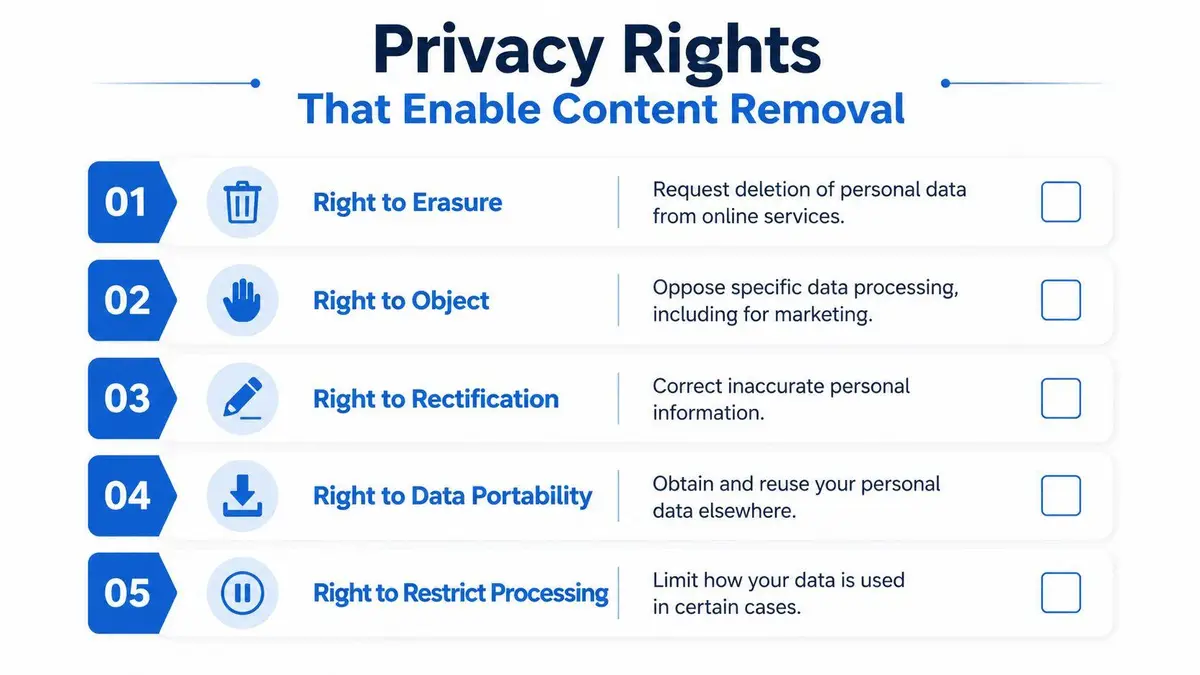
Erasure is the principal removal mechanism. It may apply where data is no longer necessary, consent has been withdrawn, or processing is unlawful. It isn’t an unconditional right, and the controller may weigh legal obligations, public interest, freedom of expression, or other recognized grounds. The request should therefore explain why the specific data no longer has a lawful basis for continued processing.
Objection challenges ongoing processing, especially where the controller relies on legitimate interests or uses data for direct marketing. State the processing you oppose and the reason the continued use creates a disproportionate impact. Marketing objections can be particularly direct because consent and objection rules often address continued promotional use separately from publication disputes.
Consent withdrawal works only where consent is the legal basis for processing. The UK privacy information guidance states that consent must be as easy to withdraw as it was to give. Withdrawal doesn’t automatically erase every record, but it removes the controller’s ability to rely on that consent going forward.
Restriction can freeze or limit processing while accuracy, lawfulness, or objection issues are resolved. It’s useful when immediate deletion is disputed but continued publication would worsen the harm.
Rectification addresses incorrect or incomplete data. It’s often the fastest route where the core problem is a false address, wrong identity, inaccurate financial detail, or misleading association. Portability is less likely to produce removal, but it can help an individual obtain data in a reusable form and understand what a controller maintains.
Build the request for auditability
Identify yourself only as far as necessary, specify the legal right, list each URL, attach evidence of inaccuracy or lack of necessity, and request written confirmation of the action taken. Keep the submission factual. Accusatory language can distract from the statutory test.
For practical guidance on submitting a targeted request, review personal data removal options. Also examine the relevant provider’s own disclosures, such as Solana Tracker data handling, when the disputed information appears in a specialized online service.
Under UK guidance, organizations generally must respond to data subject requests within one calendar month, with limited extensions for more complex requests. That deadline is useful leverage, but only if the request is clear enough to qualify as a valid rights exercise.
How Privacy Law Intersects with Online Reputation Management
Privacy law gives reputation defense a second track. Defamation law usually requires a claimant to address falsity, publication, identification, and harm. A privacy request asks a different question: whether the controller has a lawful, necessary, transparent, and proportionate basis to process or publish the person’s data.

That distinction matters when content is true but intrusive. A home address, family connection, location history, biometric identifier, or sensitive personal detail may create privacy concerns even if the publisher can defend its factual accuracy. Privacy rights don’t require an individual to prove that every damaging statement is false.
De-indexing can reduce exposure without source deletion
Search engines such as Google have procedures for privacy-based delisting requests in jurisdictions influenced by European data protection law. A successful request may remove a URL from searches for the individual’s name while leaving the source page online. That doesn’t erase the underlying material, but it can sharply reduce discoverability and limit the reputational damage caused by a prominent result.
The request should explain why the result is personal data, why continued indexing is unlawful or disproportionate, how current the information is, and why the public-interest balance favors delisting. Search engines assess the request rather than acting as automatic deletion services, so evidence and legal framing matter.
The objective is not always to erase the page. It’s to remove the page from the path people use to find you.
Platforms and hosting providers add another layer. Their policies may address doxxing, impersonation, non-consensual intimate imagery, account abuse, or sensitive personal information. A privacy claim can support those policy requests, while a platform violation may offer an independent removal route. Direct requests to the source, search engines, hosts, and relevant platforms should be coordinated rather than sent as disconnected complaints.
The OECD describes a distributed enforcement model in which national Data Protection Authorities monitor compliance, issue guidance, and coordinate cross-border enforcement through the European Data Protection Board. That structure creates complexity, but it also means a controller cannot assume that a cross-border activity is insulated from regulatory review.
For executives who need broader intervention, reputation management services can coordinate privacy requests, search delisting, platform reports, source negotiations, and monitoring. The legal theory remains central, but execution determines whether the harmful URL continues to rank, reappears under a new address, or spreads across derivative pages.
A short explanation of the enforcement and response process can be useful before a formal escalation.
The Gap Between Privacy Law and Breach Prevention
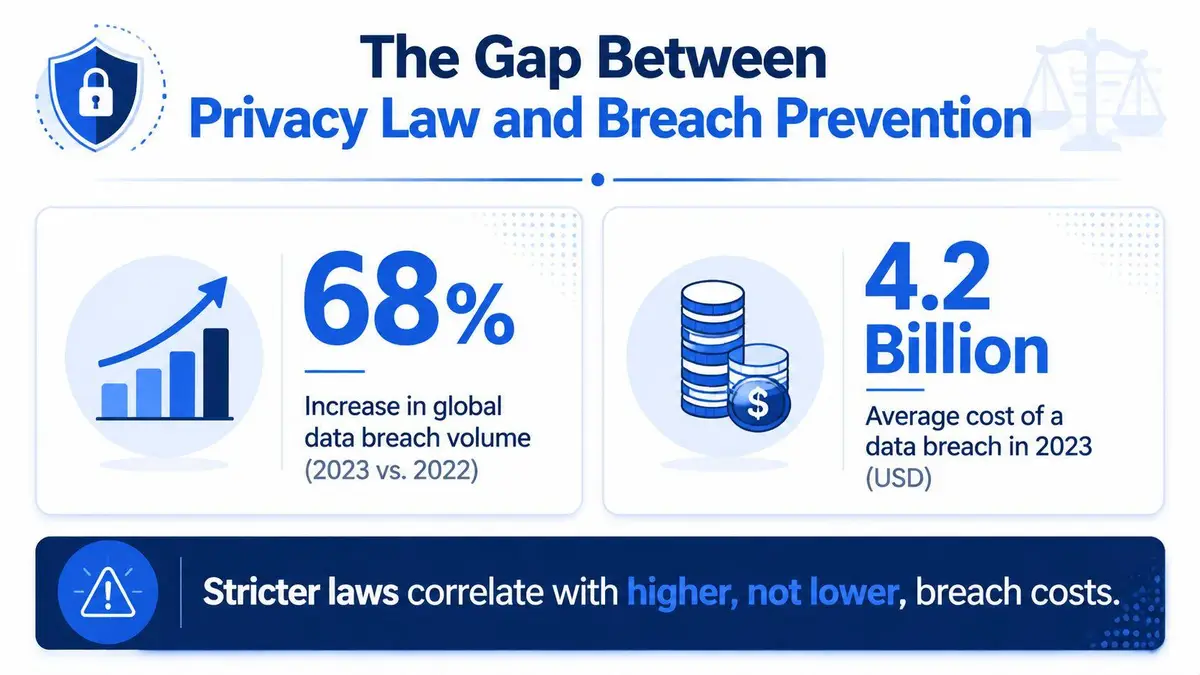
Privacy law creates accountability, but it doesn’t guarantee prevention. Organizations can face strict obligations and still suffer unauthorized access, compromised systems, accidental disclosure, or poor vendor control. The evidence points to an uncomfortable conclusion: privacy law often operates more effectively as a disclosure and remediation regime than as an absolute barrier against harm.
The Privacy Rights Clearinghouse logged 8,019 breach notification filings in 2025, as reported in its 2025 data breach report. DLA Piper also found that average breach notifications per day increased to 363 from 335 the prior year, according to the same reported breach context. Those figures show that legal pressure and breach volume can exist at the same time.
Notification creates visibility after the event
Under the GDPR, a controller must notify the competent supervisory authority without undue delay and, where feasible, within 72 hours of becoming aware of a personal data breach, unless the breach is unlikely to create a risk to individuals’ rights and freedoms. If notification occurs later, the controller must explain the delay, as stated in the official GDPR text.
That rule forces organizations to investigate, document, assess risk, and communicate. It doesn’t prevent the initial intrusion. The same is true of many privacy obligations. Access rights expose what a company holds. Erasure rights can reduce continued use. Security duties create consequences for weak controls. None can promise that a determined attacker or careless employee will never cause a disclosure.
For a high-profile individual, the value lies in damage control. A breach notification may identify the categories of exposed information, the controller involved, and the measures taken. That information supports follow-up requests, compensation analysis, security precautions, and removal demands directed at secondary recipients.
Privacy law is not a force field. It is a documented chain of responsibility that gives you leverage after an organization loses control of your data.
Executives should therefore separate prevention from response. Security architecture, access control, vendor management, and incident planning reduce risk. Privacy rights, notification duties, complaints, and enforcement create accountability when those measures fail. A serious reputation strategy requires both.
When to Engage Professional Takedown Services
A straightforward request to correct a minor error may be handled directly. Professional intervention becomes necessary when the exposure is broad, urgent, or contested. The threshold is lower when the affected person has a public profile, a family security concern, a pending transaction, or a board-level reputation risk.
Use a decision threshold, not instinct
Handle an initial request yourself only when the controller is identifiable, the data is narrow, the jurisdiction is clear, and the harm isn’t accelerating. Preserve evidence before contacting anyone, and avoid unnecessary admissions or explanations that could create a new record about the dispute.
Seek specialist assistance when:
- Multiple jurisdictions are involved: Different controllers, countries, and search engines may require coordinated legal theories and escalation paths.
- The harm is ongoing: Repeated publication, doxxing, impersonation, leaked material, or rapid redistribution requires immediate containment and monitoring.
- The data flow is unclear: Brokers, affiliates, analytics providers, hosting companies, and platforms may each control a different stage of processing.
- The first request was denied: A refusal may reflect a weak request, an incorrect recipient, an incomplete evidence record, or a genuine legal exception. It shouldn’t end the analysis.
- The material creates security or transaction risk: Home addresses, family information, financial details, and sensitive imagery require controlled communications and disciplined escalation.
A specialist engagement should begin with a confidential assessment, URL and data-source mapping, jurisdiction analysis, and a written action plan. The service should distinguish source removal from search delisting, identify the strongest statutory and policy grounds, prepare requests that preserve appeal rights, and monitor for reuploads or mirrored copies.
Privacy law gives you enforceable tools, but the tool only creates power when the facts, recipient, legal basis, and requested remedy align. Under reputational pressure, precision is cheaper than delay.
ContentRemoval.com assesses privacy-based removal and de-indexing opportunities for executives, public figures, family offices, and other high-risk individuals, then coordinates requests across search engines, websites, and social platforms. Visit ContentRemoval.com for a confidential assessment and a specific action plan addressing the URLs and personal data creating your current exposure.
Frequently asked questions
Can I use privacy law to remove information that is true?
Often, yes. Privacy rights ask whether the controller has a lawful, necessary and proportionate basis to process or publish your data, not whether the content is false. A home address, family connection or sensitive detail can support an erasure or objection request even where the publisher can defend its accuracy.
What should a data erasure request include?
Identify yourself only as far as necessary, name the specific legal right, list each URL, state the data category and why continued processing lacks a lawful basis, attach evidence of inaccuracy or lack of necessity, and ask for written confirmation of the action taken. Keep it factual and avoid accusatory language.
Does Google have to delist a page under privacy law?
Google assesses privacy delisting requests in jurisdictions influenced by European data protection law rather than deleting automatically. The request must explain why the result is personal data, why continued indexing is unlawful or disproportionate, how current the information is, and why the public interest balance favors delisting.