
Privacy protection, for executives and public figures, is the active control of who can identify you, locate you, profile you, contact you, impersonate you or publish harmful material about you. It is a risk management discipline combining legal tools, technical controls, search visibility management and incident response across four domains: personal data, online reputation, image and likeness, and search presence.
Key facts
- The four domains are data privacy, online reputation privacy, image and likeness privacy and search engine presence.
- Data broker removal is one of the first operational tasks for anyone with exposed addresses and family links.
- Privacy by Design calls for a proactive approach, end-to-end security and verify not store handling.
- The first 72 hours run from evidence capture and lockdown through triage to a documented action file.
Where ContentRemoval.com comes in. ContentRemoval.com covers the execution gap this post describes, between the law firm that knows your rights and the PR firm that shapes the message: source removal, de-indexing, reupload monitoring and coordination with counsel. Family offices, executive assistants and general counsel are usually the ones who call. A free 15-minute Exposure Scan maps what is discoverable about you and what can be removed, and the report is yours to keep. Get a Free, Confidential Exposure Scan or read how our personal data removal work is done.
At 6:15 a.m., before the market opens, your name is already attached to a problem you didn’t create. A leaked memo appears in search results. A stale court filing is resurfacing. A data broker has mapped your home address, relatives, and phone numbers into a profile anyone can buy. Then a journalist, activist, competitor, or opportunist connects the dots.
That’s the point at which people start asking what privacy protection is. They ask the question too late.
For executives, founders, investors, public figures, and family offices, privacy protection isn’t a browser setting or a password habit. It’s a risk management discipline. It protects deal flow, negotiating power, physical safety, family security, board confidence, and reputation under pressure. If your information can be found, copied, reframed, or weaponized, it can be used against you.
Privacy Protection Beyond the Basics
A CEO sees an article ranking on page one for their name. The headline alleges misconduct. The underlying facts are disputed, outdated, or incomplete, but none of that matters once counterparties, journalists, and employees start searching. At the same time, old addresses, relatives, and direct contact details remain exposed across people-search sites. The reputational issue and the privacy issue are the same problem. Too much access, too little control.

That’s the correct way to think about what is privacy protection in a high-stakes context. It’s the active control of who can identify you, locate you, profile you, contact you, impersonate you, or publish harmful material about you. It combines legal tools, technical controls, search visibility management, and disciplined incident response.
Privacy is control, not secrecy
Wealthy and visible people often make one basic mistake. They assume privacy means hiding. It doesn’t. It means controlling exposure with precision.
A board member doesn’t need total invisibility. They need boundaries around personal identifiers, family information, device exposure, image usage, and search results. A founder raising capital doesn’t need to disappear from the internet. They need accurate information to outrank distortions and harmful material removed where possible.
Practical rule: If a stranger can assemble your identity, movements, associates, and vulnerabilities in one afternoon, your privacy posture is weak.
Why leaders should treat privacy as a standing risk function
Consumer advice tends to focus on app permissions and stronger passwords. That’s not enough for anyone with public visibility or meaningful assets. Your risk isn’t just unauthorized access to a device. Your risk is that fragmented data from brokers, search engines, social platforms, court databases, and scraped archives can be combined into a narrative attack.
A serious privacy strategy does three things:
- Reduces discoverability by limiting how much sensitive information is publicly accessible.
- Improves removability by structuring evidence, ownership records, and legal rights before a crisis.
- Speeds containment when leaks, impersonation, doxxing, or defamatory material appear.
That’s why privacy belongs alongside legal, communications, and security planning. Treated casually, it becomes a cleanup exercise. Treated properly, it becomes part of asset protection.
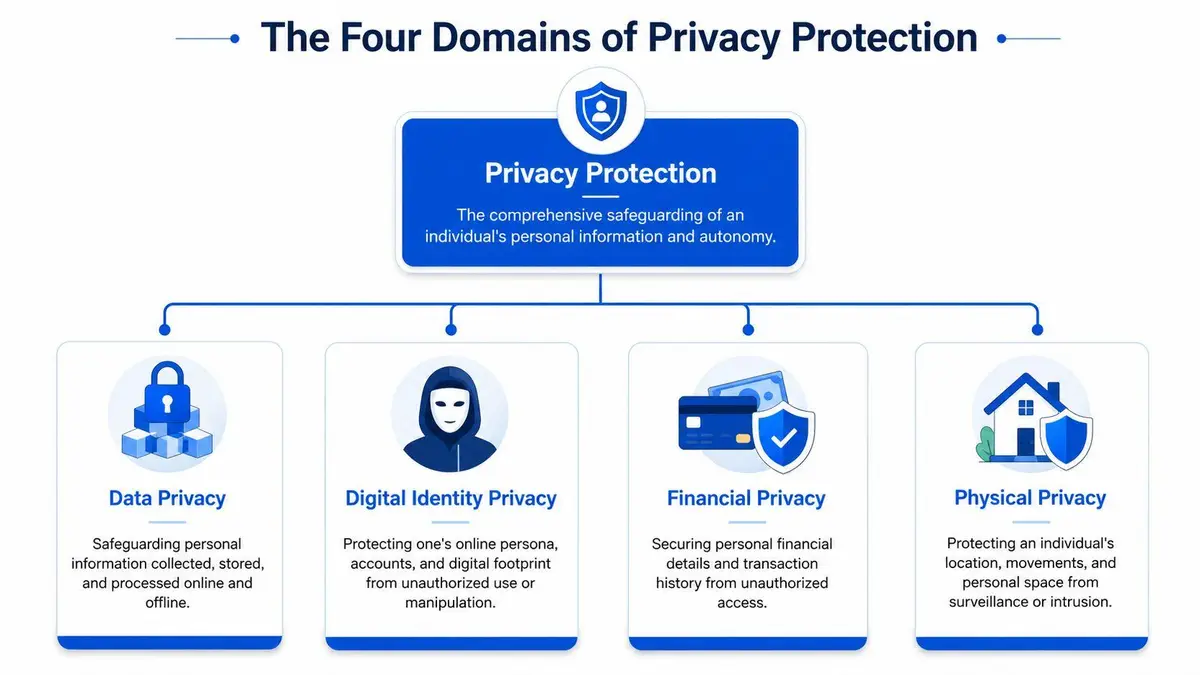
The Four Domains of Privacy Protection
Privacy problems become manageable once you separate them into domains. Most failures happen because people treat every threat as a single issue. It isn’t. A leaked address, a fake profile, a manipulated image, and a damaging search result require different remedies, different evidence, and different timelines.
The public already understands the stakes, even if most organizations still handle privacy poorly. 86% of the general population in the United States considers data privacy a significant concern, while 94% of customers refuse to do business with organizations that lack secure data handling methods, according to Countly’s data privacy statistics roundup.
Data privacy
This is the raw material layer. It covers personal identifiers, contact details, addresses, travel patterns, family links, health information, financial records, and internal documents. If this layer is exposed, everything above it becomes easier to attack.
A family office principal with multiple property records, leaked phone numbers, and staff contact details online doesn’t have an abstract privacy problem. They have an exposure map. That’s why data broker removal is one of the first operational tasks. If you need a practical removal workflow, this executive guide to removing yourself from data broker lists is a useful starting point.
Online reputation privacy
Privacy involves narrative control. False allegations, hostile blog posts, malicious reviews, forum threads, and outdated news can all reshape how counterparties assess risk around you. The issue isn’t only whether content is true or false. The issue is whether it is misleading, unnecessary, disproportionate, or harmful in context.
An executive under activist pressure may find old complaints, personal data, and selective reporting stitched together to damage credibility. The correct response isn’t generic PR. It’s a combined source-removal, de-indexing, and evidence strategy.
Image and likeness privacy
Photos and videos carry a different threat profile because they move faster than text and trigger stronger reactions. Here the risks include non-consensual image sharing, manipulated media, unauthorized commercial use, and deepfake abuse. For public figures, one altered clip can travel further than any legal rebuttal.
The response has to be immediate. You need chain-of-custody documentation, platform-specific reporting, and pressure on the original host, not just mirrors.
Search engine presence
Search is the gateway layer. Harmful material doesn’t need to dominate the web to dominate perception. It only needs to rank.
Search results are often the first diligence file anyone opens on you. If they’re unmanaged, you’re letting third parties define you at the exact moment trust matters.
Search engine presence includes indexation, autocomplete, cached copies, snippets, image results, and association queries. In these contexts, strategic de-indexing and suppression work matter most, because discoverability determines damage.
Navigating the Global Regulatory Maze
Regulation matters because it gives you an advantage. Most executives hear acronyms like GDPR or CCPA and think compliance burden. That’s the wrong lens if you’re trying to defend a person, a family, or a reputation. The better question is simple. Which laws create rights you can effectively use to force deletion, correction, restriction, or de-indexing?
The legal backdrop is no longer niche. A projection cited by Secureframe’s review of data privacy statistics states that by 2026, 179 out of 240 jurisdictions analyzed worldwide are expected to have enforceable data protection frameworks in place, covering approximately 80% of the world’s population. That matters because websites, brokers, and platforms increasingly operate, with privacy rights no longer being exceptional. They are becoming standard.
Rights create negotiation power
European privacy law remains influential because it treats personal data rights as enforceable claims rather than customer service requests. The right framework can support demands involving outdated material, excessive publication, irrelevant identifiers, and unnecessary retention.
California changed the conversation in the United States by giving residents more practical visibility into data collection and deletion rights. Other jurisdictions have expanded the patchwork. For a high-profile individual, that means location matters, hosting matters, and data flows matter. Jurisdiction shopping isn’t just something companies do. It affects personal defense strategy too.
A practical matter often overlooked is cross-border publication. A harmful post may be written in one country, hosted in another, indexed globally, and viewed by investors in a fourth. That’s why legal analysis has to be paired with technical execution.
Why international context matters
If your risk touches Asia, state regulation, platform control, and content governance can work differently from Western assumptions. For teams dealing with cross-border speech, platform enforcement, and takedown expectations, understanding China’s digital laws helps clarify how content control and internet regulation can shift your options.
Here’s the strategic point. Privacy law is not just about whether a company complied. It’s about whether you can build enough pressure to get action.
| Issue | Useful legal leverage |
|---|---|
| Outdated personal data | Erasure or deletion rights |
| Excessive identity exposure | Data minimization and necessity arguments |
| Search visibility of harmful content | De-indexing requests tied to privacy rights |
| Cross-border data handling | Jurisdiction-specific claims and platform escalation |
A legal right that isn’t translated into a documented takedown process is just theory.
The clients who get traction are the ones who document publication dates, cache copies, ownership, inaccuracies, and harm early. Regulation creates advantage. Preparation converts advantage into results.
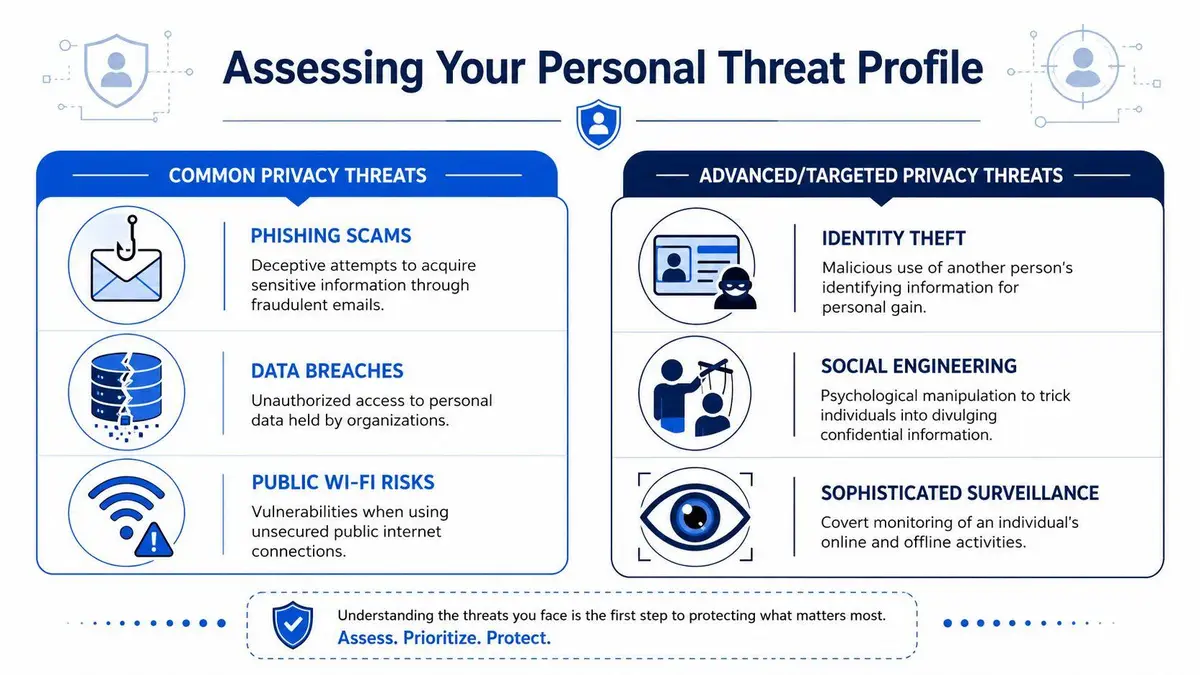
Assessing Your Personal Threat Profile
Not everyone needs the same privacy architecture. A private equity partner, a film actor, and a creator with a large online audience can all suffer severe privacy harm, but the attack patterns differ. If you misdiagnose your profile, you’ll spend money in the wrong place and still remain exposed.
The corporate executive
The executive’s threat profile usually starts with association risk. Your personal search results affect investor trust, media framing, recruiting, board confidence, and in some cases transaction timing. You’re also exposed to executive impersonation, staff-targeted phishing, leaked internal documents, and activist campaigns that blend public criticism with personal exposure.
One weak point is presence signaling. Small visibility cues can tell outsiders when you’re active, available, or engaged. Even simple platform settings can create unnecessary intelligence for adversaries. If your team uses LinkedIn heavily, this breakdown of Active Status on LinkedIn is a useful reminder that status indicators can reveal more than most executives realize.
The celebrity or public figure
The public figure faces a more chaotic environment. Risks often include doxxing, stalking, image leaks, paparazzi amplification, fake stories, manipulated clips, and fan-community harassment that spills into real life. The harm is rarely confined to one platform. Material spreads laterally across gossip sites, forums, social apps, search engines, and mirror pages.
The most dangerous misconception here is believing the issue is mainly reputational. It often becomes physical. Once home locations, routines, vehicle information, or family patterns become inferable, the threat shifts from embarrassment to safety.
A broader operating model for these cases appears in this high-net-worth digital privacy framework, especially where family exposure and staff protocols intersect.
Here’s a concise briefing on common attack paths and targeted ones:
The digital creator
Creators have a different weakness. Their income often depends on visibility, which means they can’t disappear. They face impersonation accounts, stolen content, account takeovers, subscription-content leaks, hostile subreddit or Discord campaigns, and platform moderation failures.
That tension matters. The creator has to stay discoverable while reducing exploitability. Their privacy posture must allow brand growth but prevent piracy, false attribution, and account hijacking.
The right standard isn’t “How private can I become?” It’s “How much exposure can I operate with safely?”
A simple comparison helps:
- Executives face diligence risk, impersonation, and business disruption.
- Public figures face surveillance, image abuse, and physical safety concerns.
- Creators face monetization theft, fake accounts, and high-volume harassment.
If you’re serious about what privacy protection means for you personally, start with role-based threat modeling. Generic advice won’t survive a targeted campaign.
Proactive Defense and Strategic Prevention
The strongest privacy programs are architectural. They don’t rely on everyone remembering to be careful. They reduce exposure by design.
That principle is embedded in Privacy by Design, which requires a “Proactive not Reactive” approach and emphasizes “End-to-end security” with lifecycle protection and granular access controls. It also points to a “Verify Not Store” model, where organizations authenticate users without retaining sensitive personal information, which can eliminate a major attack surface, as summarized by OneTrust’s explanation of the principles of Privacy by Design.
Build silos around sensitive information
Most high-profile people have too much data concentration. One assistant knows the home address, travel calendar, private numbers, family schedules, and document storage. One compromised inbox or one social-engineered staff member can expose everything.
Split functions. Let vendors and staff access only what they need to complete a task. Use separate contact channels for public-facing work, investor relations, household operations, and close family matters. The objective isn’t complexity for its own sake. It’s blast-radius reduction.
Replace retention with verification
If a concierge service, household manager, clinic, school, or vendor doesn’t need to retain a document, don’t let them keep it. Verification is often enough, making the “Verify Not Store” idea practical. The less sensitive information third parties hold, the fewer external repositories can leak or be subpoenaed, scraped, or stolen.
That same discipline should govern family offices and executive support teams. Retention creep is a hidden liability.
Consider this framework:
- Limit collection: Don’t hand over more data than a transaction requires.
- Control access: Assign permissions by role, not convenience.
- Separate identities: Use distinct emails, numbers, and accounts for distinct functions.
- Audit vendors: Ask what they store, who can access it, and how deletion works.
Use trustees and protocols, not improvisation
During sensitive periods such as litigation, transactions, public controversy, or security incidents, don’t let every participant gather fresh personal data just because they can. Use trusted intermediaries where possible. Keep communications disciplined, documented, and narrow.
This applies inside the home too. Spouses, children, household staff, and personal assistants are often the softest targets. Privacy protection fails when one person follows rigorous standards and everyone nearby lives casually online.
The goal is straightforward. Build a system that assumes pressure will come. If you only think about privacy after a leak, your operating model is already behind the threat.
A Framework for Incident Response
A privacy breach punishes hesitation. Once harmful material is indexed, copied, screenshotted, mirrored, and discussed, options narrow. The first three days matter because they determine whether you’re dealing with a contained incident or a long-tail reputational problem.
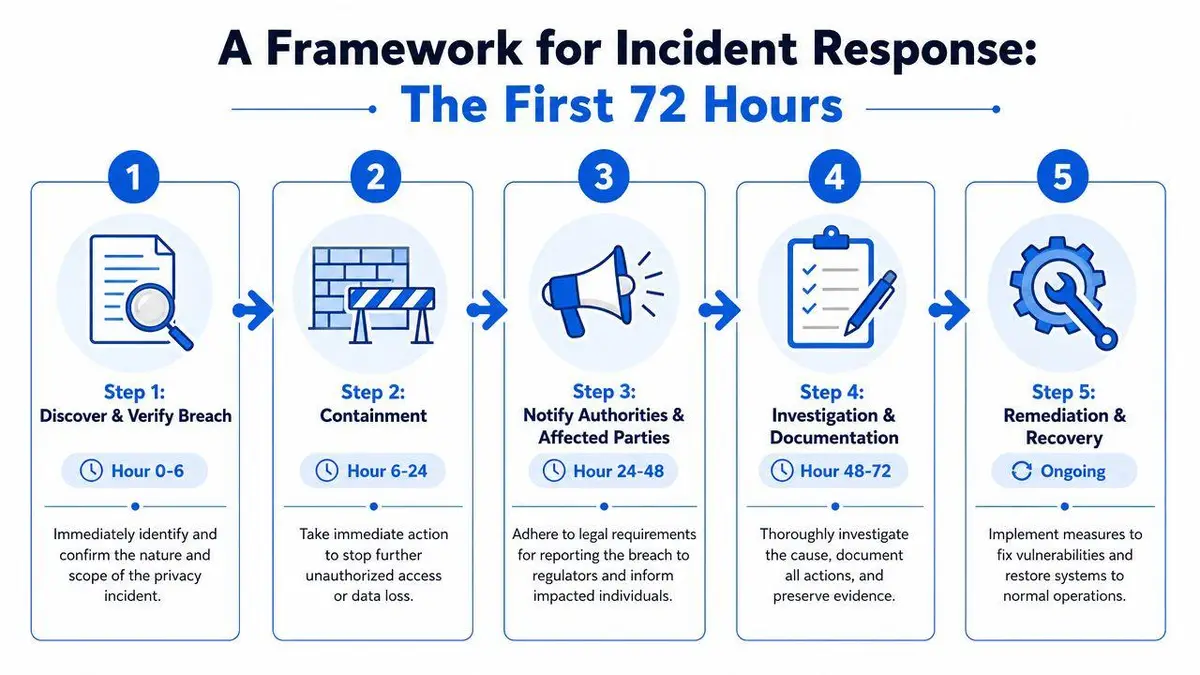
Hour 0 to 6
First, confirm that the incident is real. Don’t rely on forwarded screenshots alone. Capture URLs, account names, timestamps, search queries, cached appearances, and any evidence of impersonation or access. Preserve evidence before reporting anything publicly, because hostile content often changes once the poster realizes they’ve been noticed.
Then lock down access points. Password resets matter, but so do session revocations, admin access reviews, delegated mailbox checks, and platform recovery settings. If household staff or assistants have shared access, include them immediately.
Hour 6 to 24
Containment comes before public explanation. Remove unnecessary permissions. Pause vulnerable campaigns. Alert legal counsel and internal decision-makers who need to know. If physical safety is implicated, treat address exposure, travel leakage, and family visibility as urgent.
Use a triage model:
- Immediate harm includes exposed home data, intimate imagery, active impersonation, and credential compromise.
- Commercial harm includes investor-facing allegations, leaked business documents, and executive fraud attempts.
- Long-tail harm includes indexed archives, old forum posts, and scraped records that may persist unless addressed systematically.
Silence can be strategic. A premature public statement often confirms the issue, expands search interest, and hardens the story before you’ve contained it.
Hour 24 to 72
By this stage, you need a documented action file. List every publisher, platform, search engine surface, screenshot, and mirror. Identify what can be removed at the source, what requires de-indexing, what calls for legal notices, and what should be monitored rather than escalated immediately.
A concise response grid helps keep emotion out of it:
| Priority | Action |
|---|---|
| Safety-critical exposure | Immediate platform and host escalation |
| False or unlawful content | Evidence package plus legal review |
| Search amplification | De-indexing analysis and suppression planning |
| Media inquiry risk | Controlled communications decision |
Don’t confuse motion with control. Sending scattered emails to every platform contact you can find often weakens the record. Build chronology first. Then act in the right sequence.
Engaging Professional Reputation Defenders
Some privacy issues can be handled internally. Many can’t. Once a matter involves coordinated defamation, doxxing, leaked imagery, non-cooperative publishers, repeated reuploads, complex search indexation, or cross-border hosting, the economics change. Delay becomes expensive.
The scale of the ecosystem makes that obvious. Privacy and Security has been the third most common reason for Google content removal requests globally since 2020, with over 37,000 requests filed, contributing to a total of more than 330,000 removal attempts this decade, according to Surfshark’s analysis of Google content removal attempts. High volume means you’re operating in a crowded, procedural environment. Good intentions don’t get priority treatment.
When outside intervention is necessary
You should consider specialist help when the target is your name, your family, your company, or your liquidity event. The same applies if hostile content is spreading faster than your internal team can document it, or if the issue touches multiple systems at once, such as source publication, search visibility, impersonation, and media outreach.
Traditional PR firms often focus on message shaping. Law firms often focus on legal rights. The gap sits in execution across hosts, search engines, platforms, mirrors, and monitoring. That’s where specialist takedown operators become relevant.
For example, ContentRemoval.com’s executive privacy service framework reflects the practical model many high-risk clients need. Source removal where possible, de-indexing where necessary, monitoring to catch reuploads, and coordination with legal and communications teams when the matter is public.
Privacy response is also a communications problem
If an incident becomes visible enough to trigger inquiries, you need message discipline. That doesn’t mean issuing a statement every time. It means knowing when to disclose, when to deny oxygen, and how to avoid making a bad search cycle worse. For teams handling that side of the equation, this expert guide to cyber crisis PR is a practical reference.
A key value of professional intervention is speed, discretion, and process control. In a serious privacy event, those are not luxuries. They are the difference between a contained disruption and a durable reputational scar.
If your name, family, company, or assets are exposed online, treat it as a live risk issue, not an annoyance. ContentRemoval.com works with executives, public figures, family offices, and legal teams to assess exposure, remove harmful content where possible, reduce search visibility, and build a discreet response plan. Start with a confidential assessment and get a clear action path before the problem spreads.
Frequently asked questions
Does privacy protection mean disappearing from the internet?
No. The article frames privacy as control, not secrecy. A board member needs boundaries around identifiers, family information and search results rather than invisibility, and a founder raising capital needs accurate information to outrank distortions while harmful material is removed where possible.
What should I do in the first 24 hours after a privacy breach?
Confirm the incident with your own captures of URLs, accounts, timestamps and search results before saying anything publicly. Lock down access points including sessions, admin rights and shared staff access, then contain: remove unnecessary permissions, alert counsel and treat any address or family exposure as urgent.
How do executives, celebrities and creators differ in privacy risk?
Executives face diligence risk, impersonation and business disruption. Public figures face surveillance, image abuse and physical safety concerns. Creators face monetization theft, fake accounts and high-volume harassment while needing to stay visible. The article recommends role-based threat modeling before spending on protection.