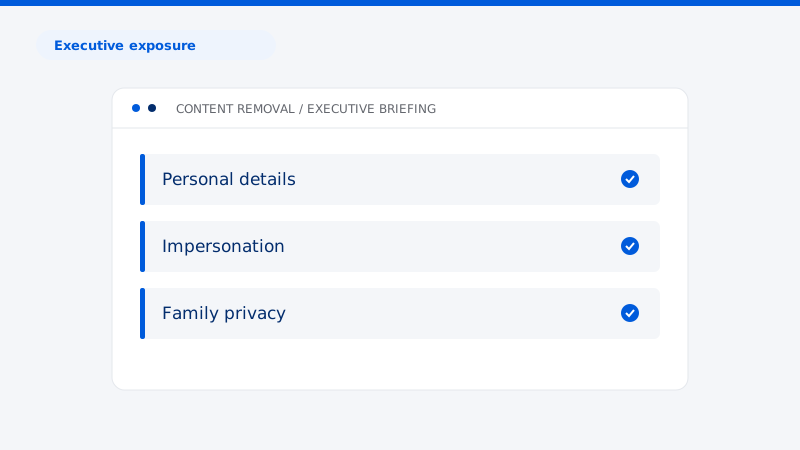
Executive exposure after a data breach requires a separate personal protection workstream when stolen company information reveals a leader’s private details or enables targeted abuse. Removing exposed content can reduce its availability and reach, but it does not secure compromised accounts, establish what attackers accessed, or replace the company’s incident response.
The distinction matters because a business can restore operations while its CEO’s private number, family correspondence, or signature remains publicly available. An executive can also become a target without having a compromised personal device. Records held by an employer, adviser, travel provider, or assistant may connect the corporate incident to the household.
If a breach has exposed a leader or their family, contact Content Removal for a confidential assessment. We assess the published content alongside your incident response firm, breach counsel, and insurer, with attention to the people affected as well as the company.
Why does a company breach become a personal targeting problem?
Leadership identities give stolen information context. A name in a contact list may be ordinary business data. The same name connected to a private phone number, home location, and assistant’s correspondence can make an approach to that person more convincing.
Attackers and opportunistic reposters do not need the complete stolen archive to cause harm. A small extract may expose a personal relationship, a recurring appointment, or the identity of someone trusted to act for the executive. Publicly available information can then supply additional context.
This creates two different questions. The incident response firm investigates the compromise and its scope. The personal exposure workstream asks what other people can currently see, what those details enable, and which published copies can be addressed.
Neither answer substitutes for the other. A forensic finding that the executive’s mailbox was unaffected does not resolve private information copied from another source. Equally, a removed page does not establish that the original theft was limited.
Which exposed details deserve the closest attention?
The priority is not simply whether an executive’s name appears. It is whether the surrounding information makes that person easier to locate, impersonate, pressure, or deceive.
Private contact details create direct access. Home and family information can connect a public controversy to people outside the business. Identity documents, financial records, and signatures can support misuse beyond embarrassment. Private correspondence can reveal relationships and expectations that make a fraudulent request sound familiar.
Context changes the assessment:
| Exposed material | Personal consequence to assess |
|---|---|
| Private number alongside a leadership role | Unwanted direct contact or convincing impersonation |
| Home details beside hostile commentary | Targeted harassment and potential physical safety concerns |
| Assistant correspondence and approval references | Requests that imitate a trusted working relationship |
| Family names within private records | Pressure directed at people outside the corporate response |
| Signatures or personal financial documents | Identity misuse and deceptive document presentation |
A chief of staff should receive a concise explanation of these consequences, not a broadly distributed copy of the sensitive material.
How is targeted exposure different from an ordinary breach mention?
A news article naming the CEO is not the same as a post publishing the CEO’s private contact details. A customer criticizing leadership is not the same as an account pretending to be that leader. Those distinctions determine both the nature of the harm and the scope of a content assessment.
The assessment should separate discussion of the incident from publication of stolen information and subsequent abuse. Otherwise, a personal protection engagement can drift into a general campaign against criticism, while genuinely dangerous details receive too little attention.
Intent may be unclear. A repost can expose a family address without an explicit threat. A file presented as business evidence can contain a personal identifier that has no relevance to the public discussion. The absence of threatening language does not make the exposure harmless.
For material that connects private information with targeting, our doxxing removal service addresses the published exposure. Credible threats or immediate danger belong with the appropriate safety professionals and emergency services.
Can small document fragments create a serious exposure?
Yes. An extract can reveal enough to create a problem even when the full company archive is not accessible. A cropped page, attachment preview, or copied email footer may contain a direct number, personal address, or signature.
Fragments also travel independently. Someone may repost an image without the surrounding document or attach a new caption that changes its apparent meaning. Removing the original file does not necessarily remove that image from a separate account or page.
Executives should therefore distinguish document-level exposure from person-level exposure. The company may be tracking the stolen board pack as one asset. The personal workstream may need to account for several individuals whose information appears in different extracts.
This is not a reason to circulate the entire archive for internal review. The responsible advisers can explain the affected information categories and the associated published locations without turning each leadership briefing into another distribution point for private records.
Why are assistants and family offices part of the exposure picture?
An executive’s working relationships can be more useful to an impersonator than a public biography. Assistants, household staff, advisers, and family office personnel know how legitimate requests normally sound and who usually makes them.
Leaked correspondence can make that familiarity easier to imitate. A fraudulent message may reference a real adviser or an existing business matter. The familiarity of those details is not evidence that the new message is authentic.
The relevant exposure picture includes people whose names or communications appear in the material, not everyone in the executive’s wider network. Collecting unnecessary household information creates a privacy problem of its own.
Briefings should also respect separate responsibilities. The corporate team needs enough context to understand the incident’s personal consequences. A family office may need more detail about a household exposure, but not unrelated customer records. The executive’s advisers should agree who receives which information rather than forwarding a single unrestricted incident pack.
What should happen if the exposure includes threats or extortion?
Immediate safety takes precedence over search visibility. Preserve evidence, involve counsel and your incident response provider, and contact emergency services if anyone faces imminent danger. Do not pay or contact attackers without counsel.
A removal provider should not become the executive’s substitute negotiator or personal security adviser. Its role is to assess and address published material within the agreed content scope. Threat assessment, physical protection, and decisions about engagement with attackers belong with the appropriate professionals.
Preservation and removal also need coordination. A threatening post may be important evidence even when leaving it publicly available creates further harm. Counsel and the relevant specialists can align those needs without asking the executive or their assistant to manage the conflict alone.
The company should avoid treating every mention as equally urgent. A newly published home location linked to hostile targeting deserves a different response from an old article that merely identifies the executive’s job title.
How should leadership impersonation be handled after a breach?
Impersonation is a separate exposure, even when it uses authentic stolen details. A fake profile, deceptive website, or fraudulent message may borrow the executive’s name and recognizable information to appear credible.
Removing a leaked document does not automatically remove those derivative assets. The content assessment should identify the impersonation separately, describe who it appears to represent, and distinguish it from an account that only discusses the executive.
The security team and relevant business functions address account compromise and suspicious transactions. Content Removal assesses the fake pages, profiles, and other published material. Our impersonation removal service covers that content workstream.
An executive should not have to publicly argue with a fake account to demonstrate that it is false. Any public clarification should be coordinated with counsel and communications advisers. It should help the affected audience recognize the issue without unnecessarily directing more people toward the leaked information used by the impersonator.
What can removal achieve, and what remains uncertain?
The useful objective is reduced exposure at identified locations, not a claim that the executive’s information has disappeared everywhere. Source removal addresses the published page or file. Search-result removal addresses discoverability through the relevant search engine. These are different outcomes.
Material may appear on websites, forums, paste sites, file hosts, social platforms, and messaging channels. Each location needs its own assessment. Dark-web sources are assessed case by case, with no assumption that every source is removable or beyond assessment.
Some uncertainty remains outside the visible footprint. A removed public copy does not establish that nobody downloaded it. A quiet search page does not demonstrate that private distribution stopped. A closed account does not confirm the status of a separately hosted file.
For executives, a useful report makes those boundaries explicit. It identifies the specific exposure addressed, what remains accessible, and what has not been verified, rather than declaring the person protected on the strength of a single successful removal.
How should corporate and personal responsibilities be separated?
A corporate breach can create personal needs that outlast an executive’s role. It can also expose family members who have no employment relationship with the company. Those differences should be reflected in the engagement scope and information handling.
Leadership should know which entity is commissioning the work, which people are included, and who can approve changes. Counsel and the insurer can advise on their respective requirements. Content removal should not be presented as automatically covered by an existing incident response engagement.
The personal report need not become a board document in full. A board may need to understand that a leadership safety issue remains active, while the individual’s private details stay restricted to those addressing it.
Continuity matters if the executive leaves the organization. Responsibility for remaining personal exposures, ongoing updates, and access to the relevant records should not depend on a company mailbox that may later close.
What should a useful executive exposure report show?
A useful report connects findings to people and decisions. A count of mentions alone can conceal the difference between many low-risk references and one highly sensitive publication.
For each material exposure, leadership needs to understand the affected person, the information category, the publication context, and the current visibility. The report should separate confirmed published information from an unverified claim that a larger archive contains more.
Progress should be equally specific. “Source no longer accessible when checked” is different from “not appearing in the reviewed search results.” “New copy identified” is different from “new compromise confirmed.” The removal team should not draw forensic conclusions from publication activity.
An executive summary can then focus on changes: newly exposed personal details, new impersonation, unresolved high-risk copies, and decisions requiring approval. Sensitive identifiers belong in controlled records, not in every summary sent to leadership.
How does Content Removal help with executive breach exposure?
Content Removal handles leaked content and subsequent published abuse. Our data breach removal service assesses the exposed footprint, while leaked documents removal addresses company files and extracts containing sensitive personal information.
Where hidden sources are involved, our dark web takedown service assesses those sources individually. We also address accessible copies and relevant search results. Ongoing monitoring can form part of a separately agreed scope.
We work alongside the incident response firm, breach counsel, and insurer. We do not provide incident response, forensics, malware removal, decryption, ransom negotiation, breach notification, or legal advice. The purpose of our involvement is narrower: reduce the availability and discoverability of identified harmful content, with clear reporting on what remains.
Frequently asked questions
Does personal targeting mean my own accounts were breached?
No. Private details may have come from company files, an assistant’s correspondence, or another organization’s records. Published material alone cannot establish the source or scope of a compromise. Your incident response provider investigates that question while the content workstream assesses what is available online.
Can removal protect family members named in company documents?
Their exposed information can be included in a content assessment, with appropriate authorization and careful handling. The scope should identify who is affected and where their details appear. Removal addresses published exposure, not every consequence of identity misuse or any physical safety concern.
Should my assistant contact the account posting my details?
Do not contact attackers without counsel. Preserve the relevant evidence and involve the appropriate advisers. An assistant can coordinate the executive’s internal point of contact without being expected to investigate hostile accounts, negotiate, or make promises about what the company will do.
Does removing a search result delete the exposed document?
No. Search-result removal reduces discoverability through that search engine, while source removal addresses the published document itself. A report should distinguish those outcomes and identify known copies separately. Neither outcome proves that privately held copies no longer exist.
When can the personal exposure workstream be closed?
Closure should reflect the agreed scope, the status of known exposures, and any remaining monitoring needs. It should not rely solely on the date the company’s systems were restored. Some personal targeting and impersonation can continue after the technical incident response has ended.
Need a confidential assessment of your exposure?
If a corporate breach has become a personal exposure problem, contact Content Removal. We can assess the published material and define a focused content scope that fits alongside the professionals already protecting your business and family.