
A family office digital privacy service treats discoverability as a controllable risk: it audits what an outsider can learn about principals, family members, staff and structures, removes exposed records at the source, de-indexes what cannot be deleted, and monitors for reappearance across search, social, people-search sites, paste sites and dark web channels. It is distinct from IT and PR.
Key facts
- Deloitte reports 43% of family offices faced a cyberattack within 24 months, rising to 62% above 1 billion dollars AUM.
- Ordinary data such as property records, donor lists and tagged photos becomes sensitive when combined into a map.
- Source removal comes first; de-indexing reduces visibility when the original page cannot be deleted.
- Vendor red flags include promised outcomes, no evidence workflow, vague confidentiality answers and no recurrence plan.
Where ContentRemoval.com comes in. ContentRemoval.com provides this privacy layer for family offices: the footprint audit, people-search and data broker removals, impersonation and leaked-content takedowns, de-indexing, dark web monitoring and written reporting on what was found, what was removed and what remains. The chief of staff, general counsel or COO usually makes contact, often before a financing event or family transition. A free 15-minute Exposure Scan maps what is removable and the report is yours to keep. Get a Free, Confidential Exposure Scan or read how our personal data removal work is done.
You don’t usually discover the problem in a board meeting. You discover it on a quiet evening, on a phone, with a search result that should not exist.
A family address appears on a people-search site. A child’s school is visible through a tagged social post. A private aircraft tail number is easy to trace. An old legal filing, a charitable gift, a real estate record, and a personal email address sit in different corners of the internet waiting to be connected by someone with bad intent.
That’s the core issue. A family office’s digital exposure isn’t a narrow IT problem. It’s a live operational risk that touches fraud, extortion, harassment, deal confidentiality, and physical safety. A principal who treats online exposure as an annoyance is already behind.
The Unseen Exposure of Modern Wealth
Most principals still think about privacy in fragments. Home security is one budget. Cybersecurity is another. Reputation management sits somewhere else. That separation no longer matches how attacks happen.
A hostile actor doesn’t care how you organize your advisors. They assemble whatever is publicly available, add breached data, then look for an advantage. That advantage may be a wire transfer fraud attempt, a pressure campaign against a family member, a reputational hit timed around a transaction, or direct targeting of residences and travel.
Exposure now behaves like an asset liability
Wealth creates metadata. Properties, trusts, philanthropy, operating companies, litigation, aircraft, yachts, staff movements, and social media all leave traces. Many are lawful, routine, and individually harmless.
Together, they form a map.
That map gets richer over time unless someone is actively reducing it. The family office digital privacy service exists for exactly this reason. It treats discoverability itself as a controllable risk surface.
The urgency isn’t theoretical. 43% of family offices globally have experienced at least one cyberattack in the last 12 to 24 months, with 25% facing three or more incidents. North American family offices report a 57% attack rate, and family offices managing over US$1 billion in AUM face a 62% incidence rate, according to Deloitte’s Family Office Cybersecurity Report.
Those figures should settle the debate. Family offices are being targeted repeatedly, and larger offices are exposed more often, not less.
Practical rule: If your family can be identified, located, mapped, or impersonated online, you already have a privacy problem even if no one has “hacked” you yet.
A serious response isn’t just better passwords and endpoint tools. Those matter, but they don’t remove exposed records, stop search visibility, suppress malicious pages, or monitor where family data is spreading across public channels and breach ecosystems.
That’s why principals increasingly need a dedicated privacy layer. Not PR. Not generic cyber consulting. A specialized service focused on discovering exposed information, removing what can be removed, de-indexing what should not surface, and monitoring the channels adversaries use. If you want a strategic framework for the household side of the problem, this online privacy protection guide for families is a useful reference point.
This is a control function, not a luxury
The family office protects capital, continuity, and discretion. Digital privacy belongs inside that mandate.
If your office still treats online exposure as a secondary issue delegated to junior staff or handled only after an incident, you’re relying on luck. That’s not a security strategy. It’s drift.
Defining the Threat Model for Family Offices
The threat isn’t just “cyber.” It’s layered, personal, and often embarrassingly simple.
A family office is attractive because it combines concentrated wealth, fragmented systems, trusted assistants, external advisors, and a large volume of information that can be exploited without breaching the core network. Attackers often don’t start with your firewall. They start with your footprint.

OSINT creep is the first stage
Open-source intelligence, or OSINT, sounds technical. In practice, it means collecting what’s already exposed. Property records. family foundations. Archived staff bios. Press releases. Club memberships. Metadata in uploaded files. Family photos with geolocation clues. Data broker profiles. Cached search results. Old donor lists. Litigation documents. Secondary market databases. Social posts from friends, not just family members.
None of this needs to be dramatic to be dangerous.
A patient adversary can build relationship maps, identify travel habits, infer bank and legal counterparties, and determine which family members or staff are easiest to approach. That’s why principals who focus only on “sensitive” data miss the problem. Ordinary data becomes sensitive when combined.
The wider environment has become far worse. The 2024 National Public Data breach exposed 2.7 billion records of personally identifiable information, including 292 million Social Security numbers, according to Global Guardian’s family office safety risks analysis. The same source notes that 78% of family office leaders rank cyber risks as their top concern, yet 60% have still endured at least one incident like a phishing attack or data breach.
Reputational attacks are often operational attacks
A false allegation, impersonation profile, leaked image, hostile forum post, or strategically timed article can do more than embarrass a family. It can interfere with financing, negotiations, governance, hiring, and succession planning.
The family office digital privacy service has to account for this. It’s not enough to “monitor mentions.” You need a system for triage and action.
That means asking questions like these:
- What’s visible in search: Not just defamatory material, but true information that is unnecessarily discoverable.
- What can be linked: Family identities, trusts, addresses, companies, and philanthropic vehicles.
- What creates impersonation risk: Executive bios, assistant names, travel details, and public signatures.
- What escalates offline: School names, routines, residences, security vendors, and vehicle details.
A short explainer helps clarify why this matters in practice.
The physical risk link is real
The line between online privacy and physical security is thin. Once a hostile actor can identify residences, schedules, children, staff, or travel patterns, online reconnaissance becomes operational planning.
That’s why I advise principals to stop separating digital privacy from protective intelligence. The same data that enables spear phishing can also support stalking, burglary planning, confrontation at events, or pressure tactics against domestic staff.
Public information rarely stays public-only. Someone always uses it for a private purpose.
A mature threat model for a family office includes four categories working together:
| Threat area | What it looks like | Why it matters |
|---|---|---|
| Exposure | Data broker listings, searchable addresses, public records aggregation | Makes the family easy to map |
| Manipulation | Impersonation, fake accounts, edited media, false narratives | Undermines trust and decision-making |
| Leakage | Breached credentials, scraped profiles, staff oversharing | Opens the door to fraud and surveillance |
| Escalation | Targeting of travel, homes, children, events, vendors | Converts online visibility into offline risk |
If your current advisors talk only about malware, they’re covering one slice of the problem. For family offices, the broader attack surface includes content, search visibility, and identity linkage. That is where privacy services earn their place.
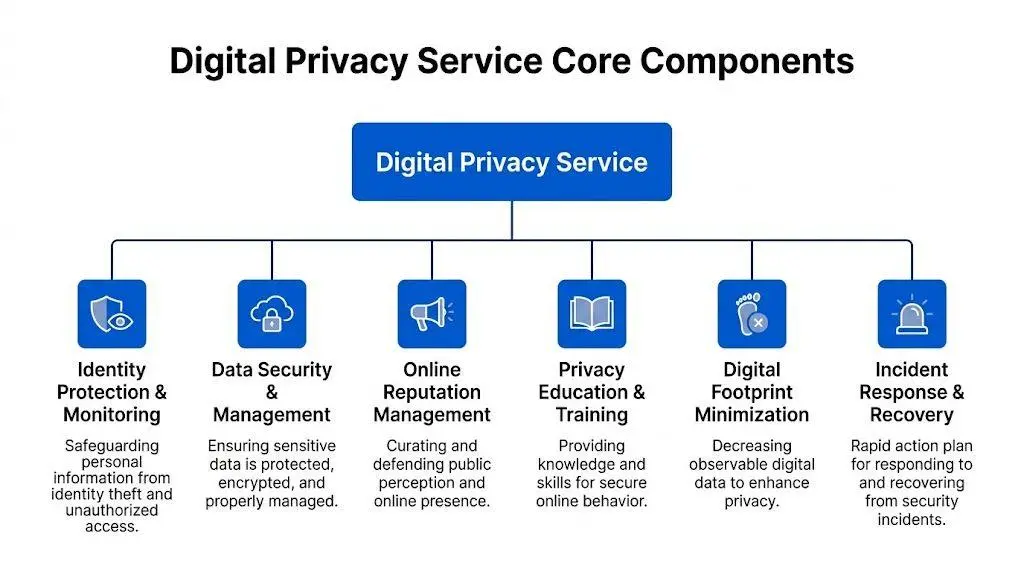
Core Components of a Digital Privacy Service
A proper family office digital privacy service should operate like a discreet campaign, not a software subscription. You are not buying a dashboard. You are buying reduction of discoverability, reduction of exposure, and a repeatable response when harmful content appears.
The work usually starts with an audit, but the audit is only useful if it leads to action.
Digital footprint audit
The first task is to establish what an outsider can learn quickly. That means searching for the family, principals, spouses, children where appropriate, household staff, senior office personnel, operating companies, trusts, foundations, aircraft, vessels, key properties, and common aliases.
The audit should examine clear-web search results, social platforms, people-search sites, public records portals, image search, cached results, and known breach indicators. It should also test whether your office’s own website, press materials, or philanthropic content are revealing too much.
A good audit doesn’t just produce a pile of screenshots. It ranks exposure by consequence.
For example:
- Immediate risk: Home address visibility, leaked phone numbers, impersonation accounts, exposed personal email addresses, images of minors, doxxing posts
- Strategic risk: Trust relationships, deal counterparties, staff names tied to authority, vendor naming, travel disclosures
- Reputational risk: Search-result associations, old allegations, legally stale but highly visible content, forum threads, gossip sites
Monitoring across public and hidden channels
Once the baseline is clear, monitoring begins. This has to extend beyond branded mention tracking.
A specialist service watches for new appearances of names, images, contact details, and identity markers across search engines, social platforms, forums, paste sites, selected dark web environments, and breach-related chatter. It also watches for reuploads after removals.
Many family offices underinvest. They commission a cleanup and assume the issue is finished. It rarely is.
Removal without monitoring is temporary housekeeping.
For ongoing watch, tools matter less than workflow. Alerts are useless unless someone validates them, assigns severity, and acts. That’s why many principals also need reputation monitoring tied to escalation rules, counsel coordination, and family office reporting.
Source removal first
If harmful material can be removed at the source, do that first. Source removal is usually cleaner than trying to bury content later.
The method depends on the content type. A people-search listing may require a formal opt-out route backed by identity-safe documentation. An impersonation account usually requires platform-specific reporting framed to the correct policy violation. A leak involving intimate images, stolen media, or copyright-protected material calls for a different route. Defamatory posts may require preservation of evidence before any removal request is sent.
The order matters. If you move too fast without preserving evidence, you can weaken legal options. If you move too slowly, the content can spread.
A capable provider should be comfortable with several tracks at once:
- Platform process: Terms-of-service, impersonation, privacy, harassment, or non-consensual content channels.
- Publisher negotiation: Direct outreach to site operators, admins, or hosts when platform forms are ineffective.
- Legal coordination: Counsel-led notices where privacy rights, defamation issues, intellectual property, or court-related remedies are relevant.
- Search intervention: De-indexing requests when source removal isn’t possible or will take time.
De-indexing is not the same as deletion
Principals often ask the wrong question. They ask whether content can be “deleted from the internet.” Sometimes yes. Often no.
The more useful question is whether the content can be made materially harder to find.
Search engine de-indexing removes visibility from common queries even if the original page still exists somewhere online. For many family offices, that’s the difference between an obscure page that almost no one sees and a high-visibility problem that shapes perception or invites targeting.
This distinction matters in real life. A record buried on an old site may not deserve a scorched-earth legal campaign. But if it ranks on the first page for a principal’s name, it demands action.
High-severity remediation
Some incidents need immediate specialist handling because they combine privacy, legal, and personal safety concerns.
These usually include:
- Leaked identity records: Breached credentials, Social Security exposure, account recovery data
- NCII and intimate leaks: Removal requires urgency, evidence control, and reupload prevention
- Impersonation with payment or instruction risk: Fake profiles, cloned email identities, spoofed authority
- Doxxing and threat-linked posts: Addresses, family member names, school references, movement patterns
- Dark web sale or circulation: Exposure may not be public, but the risk is still active
One provider in this market, ContentRemoval.com, works on source removal, de-indexing, impersonation takedowns, leaked image and video removal, and dark web monitoring for high-profile clients. That combination is relevant to family offices because these incidents rarely sit in just one category.
Family protocols matter as much as tools
The service won’t hold if the household and office keep producing fresh exposure. Every engagement should include practical rules for assistants, children’s visibility, travel posting, vendor naming, metadata handling, and what not to publish after events or philanthropy announcements.
The best privacy work looks boring from the outside. Less visible family data. Fewer searchable connections. Faster removal when something appears. Tighter reporting. No drama.
That’s exactly the point.
The Vendor Selection Checklist
Most privacy vendors market discretion. Very few are built for the standard a family office actually needs.
If you’re selecting a provider, don’t ask whether they “do removals.” Ask how they handle evidence, confidentiality, authority, and cross-border takedown mechanics under pressure. A weak vendor creates new exposure while trying to solve the old one.
Start with confidentiality that survives scrutiny
A standard NDA is not enough. You’re handing over identity documents, URLs, family relationships, litigation context, and sometimes material that would be catastrophic if mishandled.
You want contractual confidentiality, strict internal access controls, careful data minimization, and a workflow that can align with counsel when legal privilege considerations apply. If the vendor uses AI-driven tools, ask exactly where your data goes, whether it is retained, and whether it is used for model training or internal analytics.
In this area, many providers fail. They claim sophistication but can’t explain their own handling practices.
Ask directly:
- Who inside your firm can access our matter files
- How do you segregate high-sensitivity family data
- Can you work through outside counsel when privilege strategy matters
- What AI tools are used, if any, and what data enters them
- What data is deleted at matter close, and what is retained
A serious answer is specific. A weak answer sounds reassuring but vague.
Test their security posture, not just their marketing
If a vendor can’t protect its own environment, it shouldn’t touch your family’s data.
One standard worth understanding is zero-trust architecture. In plain terms, it means the vendor doesn’t assume access is safe just because someone is inside the network. Access is continuously verified and segmented by role and sensitivity. The source material in the brief also highlights the need for hardware-based identity such as passkeys and tokens, encrypted communications, DLP controls, vendor agreements, and regular AI-risk assessments. Those aren’t luxuries. They’re table stakes for firms handling family office matters.
The same brief also notes an underserved issue: many family offices lack robust vendor review around confidentiality clauses, privilege equivalence, and AI-related risk in service contracts. That gap matters because a privacy vendor becomes a trusted processor of your most sensitive information.
If a vendor can’t explain its own security controls in plain English, assume the controls are weaker than advertised.
Demand operational clarity
A good family office digital privacy service should tell you how it works without hiding behind proprietary mystique.
You need to know:
| Criterion | What to Ask | Red Flag |
|---|---|---|
| Confidential handling | How is client data stored, shared, and deleted | “We use secure systems” with no process detail |
| Counsel coordination | Can matters run through external counsel where needed | Resistance to working inside legal process |
| Takedown methodology | Do you prioritize source removal, de-indexing, or suppression, and why | One-size-fits-all answers |
| Jurisdictional reach | Which regions and platforms do you routinely handle | Claims of global coverage with no specifics |
| Evidence preservation | How do you preserve content before action | No documented preservation step |
| Reupload control | What happens after a successful removal | No monitoring or recurrence plan |
| Reporting | What will we receive, and how often | Only verbal updates or ad hoc summaries |
| Escalation | What constitutes urgent action, and who decides | No after-hours process |
Service levels should be written, not implied
For family offices, timing matters. A leaked address before an event, an impersonation account during a transaction, or a hostile post involving a child can’t wait for a weekly review.
I expect vendors to define intake channels, escalation thresholds, response windows, and decision authority. Not with vague promises, but in writing. You should know what qualifies as emergency action, who gets notified, what evidence is collected first, and when counsel or protective security teams are pulled in.
Reporting should help you govern the risk
Many vendors send activity logs. That isn’t enough.
You need reporting that answers four questions: what was found, what was removed, what remains, and what changed in your exposure profile. The report should distinguish solved issues from persistent ones and identify where internal household behavior is recreating the problem.
The right vendor doesn’t just perform tasks. They help the principal and chief of staff govern the issue with discipline.
Onboarding Process and Typical Timelines
The first call is usually triggered by urgency. A search result surfaces. A family member is being impersonated. Personal data is spreading. A journalist makes contact. Someone on the team realizes too much is public and wants it fixed before the next event, financing round, or travel window.
A well-run onboarding process should feel controlled from the first hour.
Phase one is confidential intake and scoping
The provider should identify what is exposed, what is actively harmful, and what can wait. This stage is also where authority lines are established. Who can approve action. Which family members are in scope. Which matters require counsel review. Which incidents involve minors or physical security.
This stage is fast because confusion wastes precious time.

A practical intake usually covers:
- Emergency items: Doxxing, impersonation, leaks, exposed contact details, sensitive search results
- Protected identities: Principals, spouses, children, assistants, household staff, office leadership
- Constraints: Litigation holds, regulatory concerns, press sensitivity, jurisdictional issues
Phase two is the initial takedown campaign
This is the most visible part of the work. The vendor moves against the highest-risk items first, preserves evidence where needed, and opens parallel tracks for source removal and search de-indexing.
Some actions begin immediately. Others require documentation, platform review, or legal coordination. The principal should expect motion quickly, not instant perfection.
The first wins should reduce immediate risk. They won’t erase a lifetime of digital residue in a weekend.
Phase three is footprint reduction
Once the urgent fires are controlled, the work becomes methodical. Data broker removals, public profile minimization, outdated page cleanup, search result management, and structural exposure reduction become the priority.
Many clients often grasp the full scope of their digital sprawl. This awareness also facilitates durable improvement. A useful companion resource is this executive guide to removing yourself from data broker lists.
Phase four is ongoing monitoring
The mature state is not “finished.” It is monitored.
New leaks appear. Old pages resurface. Search results shift. Family members post. Third parties tag, mention, archive, and republish. A retainer model often makes sense once the acute cleanup is done because recurrence is normal, especially for visible families.
The right onboarding process leaves the office with order. Clear contacts. Clear priorities. Clear reporting. No mystery.
Pricing Models and Calculating Return on Investment
Family offices usually encounter two pricing structures. The first is project-based, used for a defined incident or cleanup campaign. The second is a retainer, used when the office wants continuous monitoring, recurring removals, and standing response capacity.
Which model fits depends on the problem. A single impersonation incident can often be handled as a project. A principal family with multiple residences, active philanthropy, press visibility, public company connections, and adult children on social platforms usually needs a retained privacy function.
ROI is mostly about avoided escalation
Don’t judge a family office digital privacy service the way you’d judge a commodity vendor. The relevant question isn’t whether the invoice is lower than an ad budget. The question is whether it reduces the chance that a manageable digital issue becomes a high-cost legal, reputational, or physical security event.
The cost of inaction usually shows up sideways.
A leaked phone number becomes persuasive social engineering against an assistant. A visible home address turns a nuisance into stalking. A searchable allegation affects lender diligence. A fake account reaches vendors before anyone notices. A child’s routine becomes inferable because no one thought tagged photos mattered.
Two common patterns
The first pattern is the “contained incident.” A family office notices a cluster of exposed records and one or two damaging search results tied to a principal. The work starts as a cleanup mandate. During review, the provider finds broader identity linkage across people-search sites, archived social content, and staff bios. The visible issue gets resolved, but the larger value comes from reducing the family’s discoverability before the next problem appears.
The second pattern is the “quiet retainer.” Nothing dramatic has happened yet. The office has matured enough to realize that privacy should be maintained like any other control function. Monitoring, removals, and escalation are put in place early. The return isn’t flashy. It shows up as fewer surprises, fewer urgent calls to counsel, and fewer situations where family data is easy to weaponize.
A practical way to think about value
Use three lenses.
- Risk reduction: Is the family materially harder to map, contact, impersonate, or target?
- Speed: When something appears, is there a standing process to act without confusion?
- Governance: Does the principal receive clear reporting and know who is accountable?
If the answer to those is yes, the service is doing its job. For high-profile families, privacy work rarely feels dramatic when it is done well. It feels uneventful. That is a strong return.
Frequently Asked Questions for Family Principals
How is this different from what our internal IT team does
Your IT team protects systems, devices, accounts, and infrastructure. That’s essential, but it doesn’t usually cover the public internet as an exposure environment.
A family office digital privacy service focuses on what can be found, linked, copied, indexed, impersonated, leaked, or republished online. It removes content, reduces visibility, and monitors recurrence. IT secures the house. Privacy services reduce what strangers can learn by standing outside it.
How is this different from a PR firm
PR firms shape narrative. They don’t usually remove harmful source content, de-index search results, work through privacy-based takedown processes, or handle intimate leaks, doxxing, and breach-related identity exposure.
When a matter has messaging implications, PR may be useful. But if your name, address, child, or private material is online, you need operational removal work first.
Can true information be removed
Sometimes yes. Sometimes no. The key issue is legal basis, platform policy, jurisdiction, and context.
True information can still be removable or suppressible if it violates privacy rules, platform terms, image rights, impersonation rules, harassment policies, or search-engine standards. Even where source deletion is not possible, de-indexing can materially reduce visibility.
Is content ever really gone
Not always. That’s why monitoring matters.
A successful removal can still be followed by reposts, archives, mirrors, screenshots, or secondary commentary. Principals should expect privacy to be managed continuously, not solved once.
The right goal is not internet purity. It is controlled visibility and fast intervention.
What are the main red flags in a provider
Look for behavior that signals sloppiness or overpromising.
- Guaranteed outcomes: No serious operator guarantees every removal.
- No evidence workflow: If they don’t preserve first, they can damage your options.
- Vague confidentiality answers: High-trust work requires precise process.
- No counsel coordination: Family office matters often intersect with legal strategy.
- No recurrence plan: Successful removals attract reposts and workarounds.
- Overreliance on suppression: If they skip source removal analysis, they may be avoiding hard work.
- Loose intake practices: Sending sensitive material through casual channels is unacceptable.
Should we wait until there is a visible incident
No. That is the expensive way to learn.
The best time to start is before a financing event, before a family dispute becomes public, before a child becomes more visible online, before a staff transition, and before a journalist or hostile actor begins assembling a dossier. Once data is circulating, your options narrow.
Who inside the family office should own this
One senior decision-maker should own it operationally. Usually that is the chief of staff, general counsel, COO, or a principal with delegated authority.
Diffuse ownership creates delay. Delay creates spread. Spread creates an advantage for the other side.
If your family office needs a discreet assessment of exposed records, harmful search results, impersonation, leaked content, or recurring privacy threats, ContentRemoval.com provides confidential online content removal, de-indexing, and monitoring support for high-profile clients who need action rather than general advice.