
A GDPR data removal request invokes the right to erasure under Article 17 and works best as a compliance instruction: name the correct controller, lead with one strong ground such as withdrawn consent or data no longer necessary, define the exact data and URLs, give minimal identity proof, and demand written confirmation of deletion across all systems and recipients.
Key facts
- Article 17 grounds include withdrawn consent, unlawful processing, data no longer necessary, objection and legal obligation.
- Controllers must respond within about one month, and the clock only helps if you can prove when it started.
- Exceptions cover freedom of expression, legal obligations, public interest and defense of legal claims, and are often overstated.
- Controllers who made data public must take reasonable steps to tell other recipients to erase copies.
Where ContentRemoval.com comes in. ContentRemoval.com takes over when a GDPR request has stalled, been partially honored or produced a tactical refusal: identifying every controller and recipient holding the data, pressing exceptions to their proper scope, running search de-indexing in parallel with source erasure, and building the file for regulator complaints where needed. Counsel, a chief of staff or the executive usually makes contact. A free 15-minute Exposure Scan maps what is removable and the report is yours to keep. Get a Free, Confidential Exposure Scan or read how our content removal work is done.
A private dossier appears in search results. A stale executive bio still carries a home address. A vendor dashboard exposes personal identifiers long after the relationship ended. A gossip site republishes fragments of lawful but damaging information and wraps it in commentary designed to rank. If you’re dealing with that kind of exposure, a standard GDPR data removal request isn’t just paperwork. It’s the first move in a pressure campaign.
The same advice is commonly given. Find a template, send an email, wait. That advice is fine for low-stakes consumer disputes. It is weak advice for founders, public figures, family offices, and senior executives whose names are constantly scraped, syndicated, cached, and copied across systems they don’t control.
The right to erasure under GDPR is real. It is also narrower, slower, and more operationally messy than most guides admit. Controllers can ask for identity verification. They can invoke exceptions. They can remove one record while leaving duplicates in analytics environments, test systems, vendor platforms, or public-facing pages that continue to rank. They can also comply on paper while the practical damage remains.
That is why the question isn’t only how to send a GDPR data removal request. The core question is what you do when the straightforward request fails, stalls, or delivers partial removal that leaves the reputational risk intact.
Introduction The Limits of a Standard Request
A typical high-stakes scenario looks like this. An executive learns that a data broker, niche publisher, former service provider, or search-visible profile page still displays personal information that should have been deleted long ago. Counsel sends a polite request. The recipient replies with a generic privacy inbox acknowledgment, asks for broad identity documents, then goes silent. Weeks later, one page disappears, but the data survives elsewhere.
That pattern isn’t an anomaly. It’s how weak requests get managed.
The GDPR gives individuals a legal route to erasure under Article 17, including where consent is withdrawn, processing is unlawful, the data is no longer necessary, the individual objects to processing, erasure is required by law, or the data was collected for information society services directed at a child. The UK ICO explains the right and the timing clearly in its guidance on the right to erasure under UK GDPR. That legal foundation matters. But it doesn’t solve execution.
Where ordinary requests break down
Most failures come from one of three weaknesses:
- Wrong target: The request goes to a support inbox, not the actual controller or the legal entity making decisions.
- Weak legal framing: The sender asks for deletion as a favor instead of demanding it under a specific Article 17 ground.
- No downstream strategy: The sender treats removal as a single database event even when the data has already spread.
If the exposed material sits on a WordPress-based site, practical implementation issues often matter as much as legal theory. Theme plugins, forms, comment systems, and marketing tools can keep personal data circulating long after a page is edited. That is why technical context matters, and this overview of WordPress and GDPR is useful if the offending publication or business site runs on that stack.
A GDPR request is strongest when it reads like a compliance instruction, not a complaint.
The strategic view
You should assume the controller will test your precision. They may ask whether the data is personal data, whether an exception applies, whether they are the correct recipient, or whether they need more ID. A casual request invites delay. A disciplined one narrows the room for maneuver.
The rest of the process is about control. Control over the legal basis, the identity verification scope, the systems searched, the recipients notified, and the evidence preserved for escalation.
Framing a Legally Irrefutable Removal Request
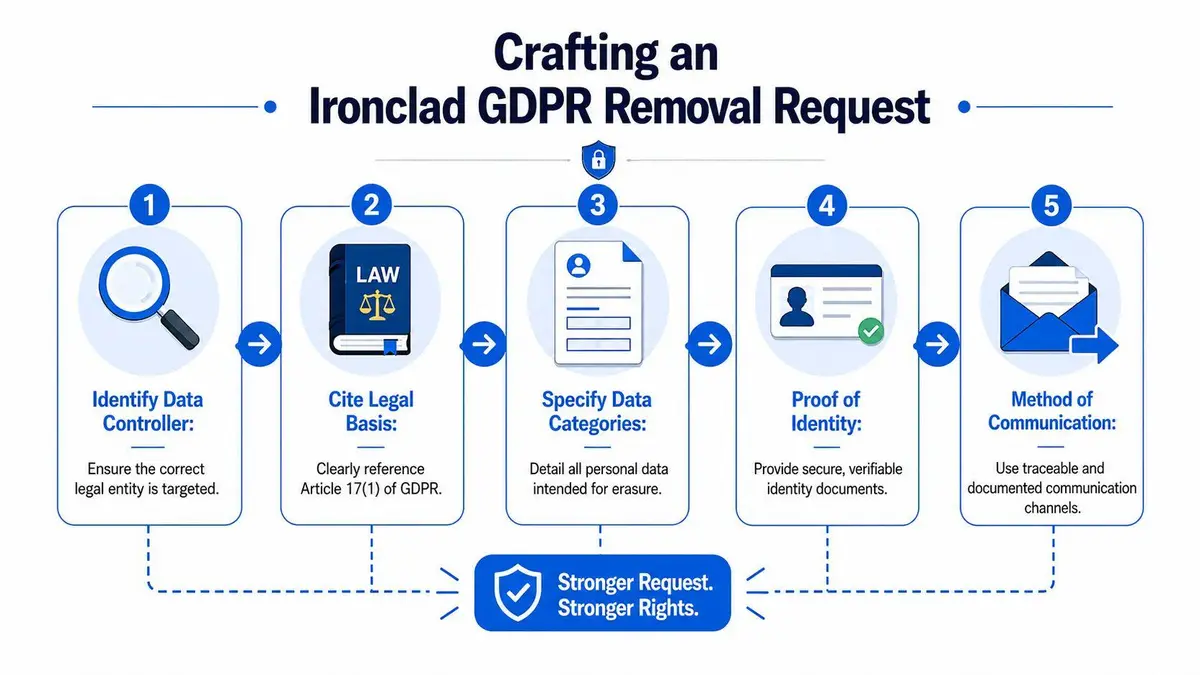
A strong GDPR data removal request doesn’t sound emotional. It sounds exact. You are identifying the controller, invoking Article 17(1), defining the data to be erased, limiting identity verification to what is necessary, and forcing the controller to answer a properly framed legal demand.
Choose the strongest Article 17 ground
Don’t throw every argument into the request. Lead with the ground that is hardest to evade.
A useful way to think about it is this:
| Situation | Stronger framing |
|---|---|
| You originally agreed to processing, but no longer do | Withdrawal of consent |
| The company no longer needs the data for the purpose it collected it for | Data no longer necessary |
| The processing should never have happened in the first place | Unlawful processing |
| You previously objected and the controller lacks overriding grounds | Objection to processing |
| A law or regulatory rule requires deletion | Legal obligation to erase |
Use one primary ground. Add a secondary ground only if it strengthens the record.
If the issue involves search visibility or broader online indexing rather than a private internal database, the legal and practical distinction matters. The removal path may overlap with a wider right to be forgotten strategy, especially where search results amplify older or unnecessary personal data. This guide on the right to be forgotten is a useful companion when the reputational problem extends beyond the original host.
Give enough identity proof, not more
Controllers are entitled to verify identity where necessary. That does not mean you should surrender a full file of personal documents on first contact.
Use the minimum material needed to let them match you to the record. If the account relationship already exists, reference the account email, customer number, transaction identifier, URLs, screenshots, and dates. If formal ID is unavoidable, redact irrelevant fields where possible and state that the document is provided solely for verification of the erasure request.
Practical rule: Never help a controller expand its file on you while you’re asking it to reduce that file.
Define the exact data and locations
Vague requests fail because they let the recipient delete one narrow field and claim completion. Specify the categories of personal data at issue. Name the page URLs, account IDs, screenshots, archived copies you know about, and any known processors or platforms involved.
The operational model should be controlled and complete. A GDPR data removal request should follow a workflow that includes intake, identity verification using only necessary data, mapping where the personal data exists, checking whether an Article 17 exception applies, and then deleting or anonymizing records across all systems before documented closure, as outlined in this practical guide to a GDPR data deletion request template.
To see the process visually, review this walkthrough.
Draft like someone prepared to escalate
Your request should include:
- The correct controller name and any trading names.
- A direct Article 17 reference and the specific basis you rely on.
- A defined list of personal data to erase or anonymize.
- A demand for confirmation of action taken across relevant systems and recipients.
- A reservation of rights if the request is delayed, refused, or only partially implemented.
Avoid rhetoric. Avoid threats you won’t carry through. Controllers are used to angry emails. They pay attention to requests that show procedural command.
Managing the Process From Submission to Verification
You send a clean Article 17 request. The controller replies with a polite acknowledgment, asks for more ID than it needs, then goes quiet. Three weeks later, the page is still live, the search result still shows your name, and you have no usable record of what they did. That is the standard failure pattern.
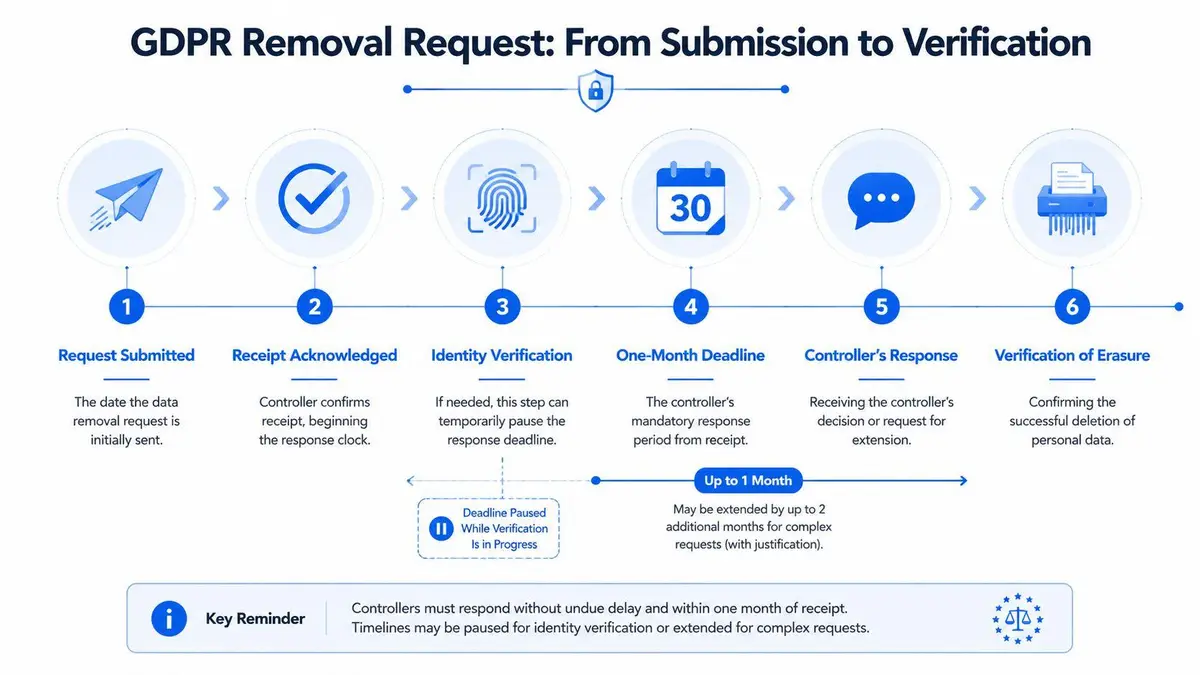
A serious request needs active management after submission. Treat the period between filing and verification as an evidence phase. You are building a record for compliance, challenge, and escalation if the controller stalls, narrows the scope without saying so, or claims completion without proving it.
Control the timeline from day one
The legal deadline matters only if you can prove when it started and whether the controller had a valid basis to pause for identity checks. Record the submission time, delivery confirmation, the exact wording used, and every reply. If they ask for ID, answer fast, but do not hand over more personal data than is needed to confirm identity for the records at issue.
A vague verification demand is often a delay tactic. Force precision. Ask what specific information is required, why it is required, and which part of the request cannot be processed without it. Put that in writing.
Keep the follow-up sequence tight:
- Submission file: Save the request, attachments, screenshots, and proof of delivery.
- Verification response: Provide only the minimum identification data and restate the original submission date.
- Mid-cycle chase: Ask whether the request is validated, whether any exception is being considered, and whether processors or recipients have been contacted.
- Deadline letter: Require a final decision, the scope of deletion or anonymization, and confirmation of onward notifications.
If the material is indexed in search, source removal on its own will not contain the reputational harm. Run the search-facing process in parallel where needed. Use this guide on how to submit a Google legal request when the search result has become a separate problem.
“Your request has been processed” is not a useful outcome. It is a placeholder until the controller proves what changed.
Verification needs specifics, not assurances
Controllers like abstract language because abstract language hides partial compliance. Do not accept statements such as “the data has been removed from our systems” unless they identify which systems, which identifiers, and what happened to copied or downstream records.
Ask for written confirmation on the points below:
| Verification point | What you want confirmed |
|---|---|
| Production systems | The data was deleted or anonymized in active records |
| Development and test environments | Copies used for testing were handled consistently |
| Analytics platforms | Event logs, profiles, or tags tied to your identifiers were addressed |
| Third-party processors | Vendors and recipients were notified where required |
| Backups and retained media | The handling method for retained copies was documented |
That level of detail is not excessive. It is the only way to tell the difference between a real erasure exercise and a front-end fix.
Downstream disclosure is where simple requests break down
The first controller is often only one node in the chain. If the data was syndicated, scraped, mirrored, pushed into vendor tools, or copied into affiliate pages, your problem has already spread beyond the original source. A standard GDPR data removal request often fails here because the controller confirms action on its own platform and says nothing useful about everyone else who received the data.
Press for recipient handling. Ask whether the controller disclosed the data to processors, partners, publishers, ad platforms, analytics vendors, or search-related services. Ask what notification was sent, when it was sent, and whether any recipient challenged or ignored it.
This is also the point where professional intervention becomes necessary in many high-risk matters. Once there are multiple controllers, evasive verification demands, conflicting legal positions, or visible reputational harm continuing after nominal deletion, you are no longer dealing with a simple rights request. You are managing a cross-platform enforcement problem.
Overcoming Common Refusals and Exceptions
Most refusals rely on a lawful-sounding phrase used far too broadly. The right to erasure is not absolute. That is true. It is also the favorite shield for controllers who prefer retention by default.
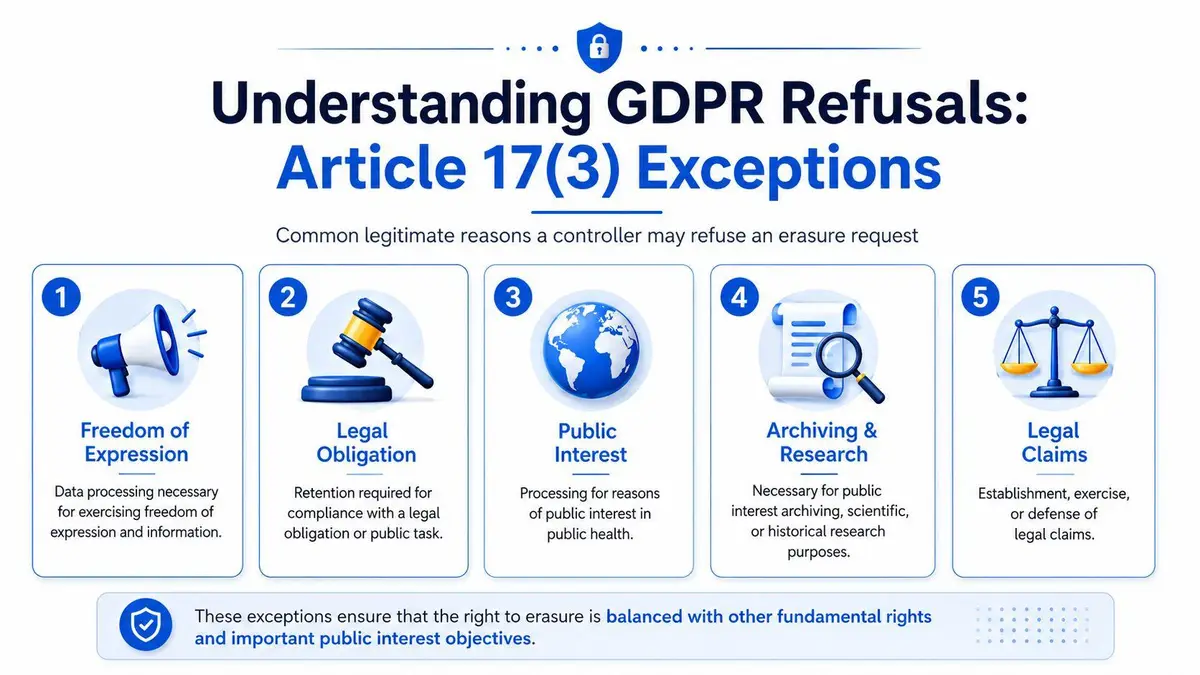
The Irish DPA and UK ICO identify major exceptions for freedom of expression, legal obligations, public interest, and the defense of legal claims, and they also note that controllers must take reasonable steps to inform other websites about an online erasure request, as set out in the Irish DPA’s guidance on the right to erasure under Articles 17 and 19 GDPR.
Freedom of expression isn’t a blanket immunity
Publishers, forums, and commentary sites often invoke freedom of expression as if it ends the discussion. It doesn’t.
Ask a narrower question. Is the specific personal data necessary for expression or information, or is it merely decorative, excessive, outdated, or gratuitously identifying? A report may remain publishable while direct identifiers, contact details, family references, or irrelevant personal history do not.
A targeted challenge works better than an absolutist one. Don’t demand that an entire article vanish if your strongest argument is that particular data fields should be erased.
Legal obligation means actual obligation
Controllers also claim they “must retain” data without identifying the obligation. Press them.
Request the precise legal basis, the category of data covered by that obligation, and whether restricted retention rather than broad operational access would satisfy it. Many organizations retain more data than any rule requires because deletion is operationally inconvenient.
Public interest and legal claims are often overstated
These exceptions can be legitimate. They are also frequently stretched beyond their proper limits.
Use this approach:
- For public interest claims: Ask why your specific data is necessary to that purpose, rather than merely useful.
- For legal claims: Ask whether there is a live, concrete dispute or only a hypothetical desire to keep everything forever.
- For archiving or research claims: Test whether anonymization would preserve the asserted purpose without continuing to process your personal data.
If a controller can meet its purpose with anonymized data, continued identifiable retention becomes much harder to defend.
Push for narrower outcomes when full erasure is contested
Clients often make the mistake of treating this as all or nothing. That helps the controller. If one exception may justify limited retention, force the issue onto scope.
Ask whether the controller will:
- Remove public-facing availability.
- Restrict internal access.
- Delete nonessential duplicate copies.
- Anonymize data that does not need to remain identifiable.
- Notify downstream recipients where online dissemination is involved.
That kind of counterproposal does two things. It protects the record for a regulator or court, and it exposes whether the refusal is principled or lazy.
Strategic Escalation When Controllers Do Not Comply
When a controller ignores a valid request, dribbles out partial answers, or hides behind a generic refusal, escalation stops being optional. It becomes the mechanism that gives the first request teeth.
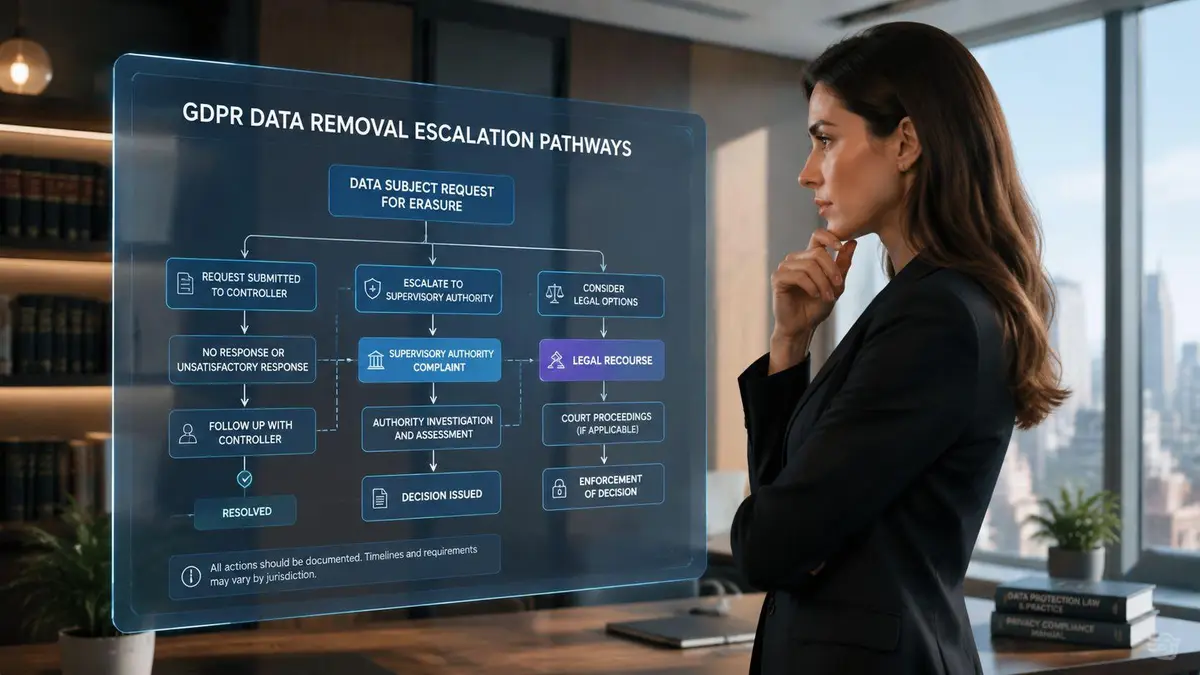
The legal footing is established. GDPR became enforceable on 25 May 2018, creating a formal right to erasure with a one-month response framework and a basis for escalation to data protection authorities and, where necessary, the courts, as summarized by the European Commission’s guidance on when personal data must be deleted on request.
Build the file before you file the complaint
Do not escalate with a vague narrative. Build a record.
Your file should include the original request, identity verification exchanges, proof of delivery, screenshots of the data before and after, any refusal language, and a chronology that shows delay or non-compliance. Regulators respond better to disciplined evidence than outrage.
A simple evidence grid helps:
| Evidence item | Why it matters |
|---|---|
| Original request text | Shows the legal basis and scope you demanded |
| Proof of receipt | Fixes the start of the timeline |
| Verification exchange | Shows whether the controller used ID issues to stall |
| Refusal or partial compliance | Defines the dispute |
| Current screenshots and search captures | Proves ongoing exposure |
Regulatory pressure works best when it is precise
A complaint to the relevant authority should identify the controller, the request history, the Article 17 basis asserted, the exception claimed if any, and the practical harm caused by partial or absent deletion. Keep the tone cold. Regulators see enough emotion. What helps is a file that demonstrates the controller had a clean opportunity to comply and chose not to.
If the matter also warrants a formal warning letter from counsel, drafting discipline matters there as well. Lawyers who want a concise model for escalation language may find TheLawGPT’s guide for lawyers useful as a structural reference for pre-litigation correspondence.
For situations where the website itself refuses to cooperate, this broader strategic guide on what to do when a website won’t remove your information is relevant because the remedy path often extends beyond a pure privacy request.
Escalation should increase pressure and reduce ambiguity at the same time.
When litigation stops being theoretical
Litigation becomes realistic when three factors align. The data remains visible or actively processed. The controller has had a fair chance to comply. The reputational or commercial risk is serious enough that delay is more expensive than action.
At that point, the objective isn’t symbolic vindication. It’s compulsion, speed, and containment. The strongest cases are not the loudest. They are the ones with a clean paper trail showing a valid request, a weak refusal, and ongoing exposure that the controller could have addressed.
Deciding When to Engage a Specialist Firm
There is a point at which a self-managed GDPR data removal request stops being a legal exercise and becomes a coordination problem across law, systems, vendors, indexing, and reputational risk. That point arrives sooner than generally anticipated.
If the issue involves a single cooperative controller, a narrow internal dataset, and no public visibility, you may not need outside help. If the matter involves multiple recipients, search visibility, mirrored publication, backups, hostile commentary sites, or a controller that understands just enough GDPR to obstruct the process, a DIY approach becomes expensive in the wrong way. It burns time while the data remains live.
Signs the matter has outgrown a simple request
Use this test.
- The controller replies selectively: They answer one point and ignore the rest.
- The data exists in more than one place: A source page, a search result, a broker copy, a cached version, and a vendor database are not one problem. They are several linked problems.
- Identity verification is becoming a trap: The controller keeps expanding what it wants from you without validating the request.
- Exceptions are being used defensively: You receive broad references to legal claims, public interest, or expression with no disciplined explanation.
- Reputational timing matters: Waiting through procedural drift creates its own damage.
Compliant technical execution requires more than a simple delete command. It involves secure sanitization standards such as NIST SP 800-88 Rev. 2, propagation across production, development, and backup systems, and triage against legal holds, as described in Optimizely’s operational guidance on requesting or deleting data under GDPR or CCPA. That complexity is where many self-directed matters fail.
The real value of specialist intervention
At the high-value end of these disputes, you are paying for compression. Less delay, fewer procedural mistakes, tighter evidence, better targeting, and coordinated action across the source, the recipients, and the visibility layer.
You are also paying for discretion. High-profile removal matters shouldn’t become bigger stories because they were handled clumsily.
If your request has stalled, been partially honored, or produced a refusal that feels more tactical than lawful, treat that as a signal. Not of defeat. Of threshold. The threshold where informal effort should give way to a managed removal strategy.
If you’re facing a high-stakes privacy or reputation issue, ContentRemoval.com can assess the exposure, identify the fastest lawful removal path, and coordinate source removal, de-indexing, and escalation with discretion. For executives, public figures, family offices, and counsel managing urgent matters, the value is simple: a confidential plan built for outcomes rather than delay.
Frequently asked questions
How much identity proof do I have to give with a GDPR erasure request?
Only what is necessary to match you to the records at issue. Reference the account email, customer number, URLs and dates where possible; if formal ID is unavoidable, redact irrelevant fields and state it is provided solely for verification. Vague or expanding ID demands are often a delay tactic, so ask exactly what is required and why, in writing.
What can I do if a company refuses my GDPR deletion request citing freedom of expression?
Narrow the question. Ask whether the specific personal data is necessary for the expression or merely decorative, outdated or gratuitously identifying. A report may remain publishable while direct identifiers, contact details or family references are erased. Propose partial outcomes such as removing public availability or anonymizing fields, which exposes whether the refusal is principled.
Does a GDPR request remove my data from Google search results?
Not on its own. Source erasure at the controller is one track; search visibility is a separate one that may require a Google legal or de-indexing request run in parallel. Copies on scrapers, brokers, mirrors and vendor systems each need their own handling, which is where single requests usually break down.