

A digital footprint works through two mechanisms: an active footprint you create through posts, reviews, comments and form submissions, and a passive footprint collected in the background through cookies, tracking pixels, device fingerprinting, IP logging and location data. Search engine crawlers, web archives and data brokers then copy and store those traces, which is why the record persists after deletion.
Key facts
- Third-party cookies placed by ad networks follow you across sites to build a cross-site profile.
- Device fingerprinting combines OS, browser, screen and fonts to identify you even after clearing cookies.
- Search engine caches, the Wayback Machine and data brokers keep copies that outlive the original page.
- Reported figures put the average person at roughly 1,800 online traces a month.
Where ContentRemoval.com comes in. ContentRemoval.com works the removal and fortification stages for executives and public figures whose footprint has become a liability: source removal of harmful pages, de-indexing where the host will not act, data broker opt-outs at scale, suppression of content that cannot be removed, and monitoring across the open and dark web. The executive, their chief of staff or their counsel usually makes contact. A free 15-minute Exposure Scan maps what is removable and the report is yours to keep. Get a Free, Confidential Exposure Scan or read how our content removal work is done.
Your digital footprint is not a technical abstraction; it is your permanent public record. It is the sum of every online action you take and every piece of data recorded about you, and it defines your public and private self whether you consent to it or not.
This record is constructed through two distinct mechanisms. The first is your active footprint, which you create through deliberate online engagement. The second is your passive footprint, which is compiled in the background, often without your knowledge or explicit consent. Every click, search, and post adds another entry to this dossier, shaping a profile that can either be a managed asset or a critical liability.
Your Digital Footprint Is Your Permanent Public Record
For executives, public figures, and any individual with a significant reputation to protect, understanding how this system operates is a matter of professional survival. Your online presence is a dynamic file, perpetually updated and analyzed by search engines, data brokers, and potential adversaries.
The Footprint You Create: Active Data
Your active digital footprint comprises the data you consciously share. This is the most visible component of your online identity, encompassing every direct action you take.
Consider the following examples:
- Posts, comments, and endorsements on professional networks like LinkedIn or public forums like X (formerly Twitter).
- Online reviews submitted for services or products.
- Comments left on news articles or industry blogs.
- Personal information entered into online forms, including your name, email address, and telephone number.
Each of these actions is a deliberate contribution to your public persona. However, while you control the initial input, you do not control its subsequent context or longevity. A comment made years ago can be decontextualized and weaponized, creating significant professional damage. It is for this reason that protecting your online identity becomes a strategic framework for executives.
The Footprint You Don’t See: Passive Data
The more insidious component is your passive digital footprint. This is the data collected about you without your direct action or awareness. It is the hidden architecture tracking your behavior across the web. This data collection is not accidental; it is a structural component of the modern internet, designed to log your movements, preferences, and connections. The websites you visit, the articles you read, how long you linger on a page. It is all recorded.
As of October 2025, there are over 6.04 billion internet users, and every one of them is contributing to this massive web of data. The average person leaves behind roughly 1,800 online traces every single month. This accumulates into an annual digital footprint of around 2 gigabytes per person, a figure that is continuously expanding.
The following table delineates the critical differences between these two data collection methodologies.
Active Vs. Passive Digital Footprints
| Footprint Type | Definition | Examples |
|---|---|---|
| Active | Data you knowingly and intentionally share or create online. | • Social media posts • Blog comments • Online reviews • Filling out contact forms • Public forum discussions |
| Passive | Data collected about you in the background, often without your direct awareness. | • IP address tracking • Browsing history logs • Cookies tracking site visits • Location data from apps • Ad trackers |
While your active footprint feels within your control, it is the passive footprint that often tells a more detailed, and more private, story. Understanding both is the first step toward managing this public record.
How Your Data Is Tracked And Collected
To gain control over your digital footprint, you must understand the technology that enables its creation. This is not a passive system but a massive, commercially-driven machine designed to build a detailed file on you. It works silently in the background, converting your every online action into a valuable data point for advertisers, data brokers, and any other party willing to pay for access. Each time you visit a website, you are not merely a visitor; you are a party to a data transaction. Several key technologies facilitate this process, recording and interpreting your every move.
The Role of Browser Cookies
The process begins with browser cookies, small text files that websites place on your device. While some are benign, others serve a more invasive function. Distinguishing between them is critical.
- Session Cookies are ephemeral. They exist only for the duration of your current visit to handle basic functions, like retaining items in an online shopping cart. Upon closing the browser, they are deleted.
- Persistent Cookies remain on your device. They are designed to remember your preferences or login credentials for future visits, offering convenience at the cost of persistent tracking.
- Third-Party Cookies are the primary mechanism for cross-site surveillance. These are placed not by the website you are visiting but by advertising networks and analytics companies. They follow you from site to site, building a rich, detailed profile of your interests, habits, and demographics for hyper-targeted advertising and data aggregation.
These cookies work in concert to piece together a surprisingly complete picture of your online life, transforming a series of discrete clicks into a predictable pattern of behavior. As you navigate the web, it is imperative to adopt secure data privacy practices, as even the simplest online tools can become points of data collection.
This diagram illustrates the two primary methods by which your footprint is created, intentional actions (active) and background data collection (passive).
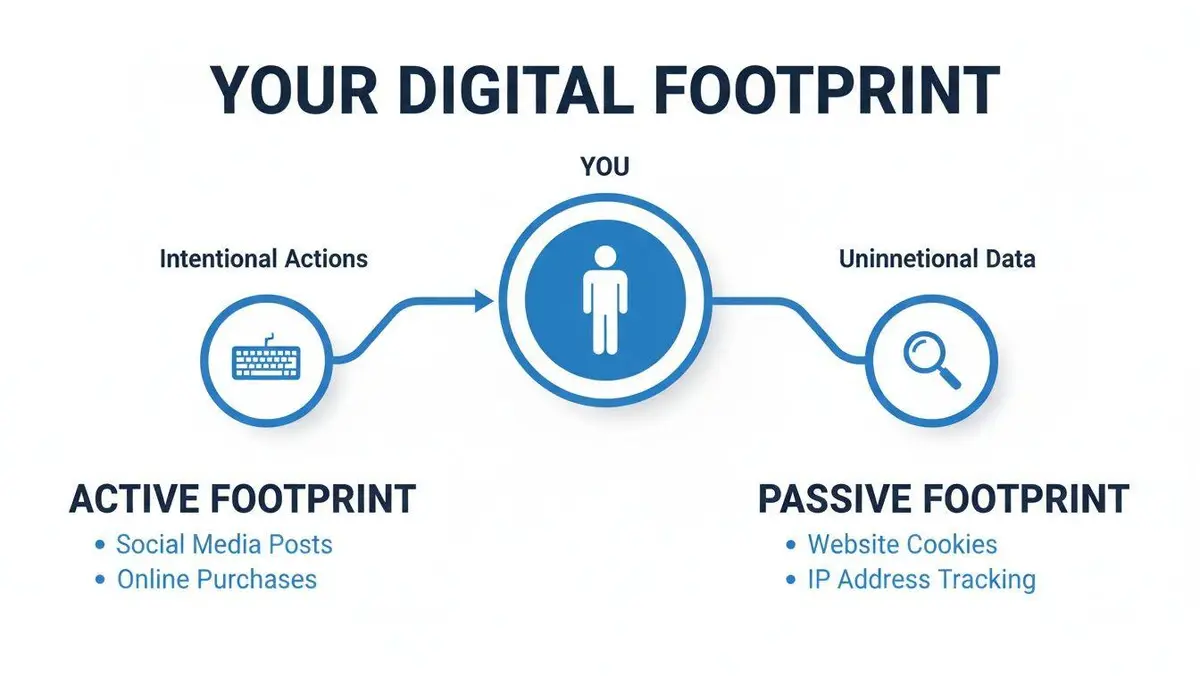
The distinction is clear: data you share intentionally versus information gathered behind the scenes. It is this invisible, passive data collection that often poses the greatest threat to your privacy and security.
Advanced Tracking Beyond Cookies
Tracking does not stop with cookies. Some of the most persistent tracking methods are technologies you will likely never see.
Tracking pixels, also known as web beacons, are a primary example. These are tiny, transparent 1×1 pixel graphics embedded in websites and marketing emails. When your browser or email client loads this pixel, it sends a signal back to a server. This simple action confirms you have visited a page or opened an email, logging your IP address, device type, and the precise time of the event.
Device fingerprinting is an even more aggressive technique. It gathers a host of technical details about your device: your operating system, browser version, screen resolution, installed fonts, and plugins. This information is combined to create a “fingerprint” so distinct it can identify you even if you clear your cookies or use a private browsing mode.
Why Your Digital Footprint Is Permanent
A common misconception is that online actions are ephemeral. A deleted comment, a removed photo, or a closed account is believed to be gone forever. This is incorrect. A single online action is not temporary; it is discovered, copied, and stored by a vast, automated system that never forgets.
Think of it less like writing in sand and more like carving in stone. These individual traces are collected and woven together, creating a permanent record. Understanding how these fleeting moments become a lasting liability is the first step toward managing your online exposure.

Search Engines: The Global Archivists
The primary reason your digital footprint endures is because of search engines. Their automated programs, known as crawlers or “spiders,” are constantly mapping the public internet. Their objective is to build a comprehensive index so that information can be retrieved instantly.
When a crawler discovers a new social media profile, blog post, or news article bearing your name, it does not merely note its location. It captures a copy. This saved version, a cached page, is stored in the search engine’s enormous database. Consequently, even if the original content is deleted, a copy often persists in the cache, discoverable by anyone who knows where to look.
The scale of this operation is staggering. In 2023, a reported 73,214 data breaches exposed over 3.2 billion personal records, and 85% of that information is directly tied to our digital footprints. With search engines indexing trillions of pages and 94% of data residing on cloud servers, the risk of damaging information spreading has never been higher.
Algorithmic Amplification: Creating Permanent Narratives
The issue is not just storage; it is amplification. Social media platforms, in particular, employ powerful algorithms to determine what content users see. An out-of-context photograph or a poorly worded comment can be algorithmically promoted, escalating from a minor misstep to a viral incident in hours.
Every time that content is shared, a new copy is created on a different server, tied to a new profile. This replication makes complete cleanup exceptionally difficult. What began as a single piece of data is now scattered across the web, with each copy becoming a new breadcrumb for search engine crawlers to find and re-index. A single negative news article does not exist in isolation. It is syndicated across partner sites, discussed on forums, and shared on social media, creating a web of interconnected links that solidifies its permanence and search engine ranking.
The Role of Digital Archives and Data Brokers
Two other key actors ensure your online history is permanent: public archives and commercial data brokers.
- Web Archives: Services like the Wayback Machine exist to create a historical library of the internet. They take periodic “snapshots” of websites, preserving them exactly as they appeared on a specific date. This means a public profile or an article about you can be found and viewed years after it was removed from the live internet.
- Data Brokers: These companies operate by collecting, packaging, and selling your personal information. They scrape data from public records, social media, marketing lists, and any other available source, compiling it into detailed profiles sold for background checks, marketing intelligence, and other purposes.
Both archives and data brokers create redundant, often outdated, copies of your information that exist completely outside of the original source. This is why simply deleting a post is an insufficient strategy. Your online history is not something you can ever truly erase. It can only be actively and continuously managed.
The Real-World Risks Of An Unmanaged Footprint
Here, the digital footprint transitions from a technical concept to a tangible, real-world liability. When left unchecked, your online trail does not remain dormant; it becomes an active vulnerability, providing adversaries with a detailed roadmap for exploitation. For executives and public figures, the consequences can be immediate and severe. Every piece of your past, from an old forum post to an out-of-context photo, is discoverable. During high-stakes negotiations or a public relations crisis, competitors and critics will conduct deep-dive research for leverage. A clumsy comment made a decade ago can be reframed to question your character today, derailing opportunities and eroding your authority.
Reputational Damage and Professional Fallout
The most immediate threat is a direct assault on your reputation. Information does not need to be false to be destructive; it merely needs to be presented without context. A leaked email, a misinterpreted social media “like,” or details of a past legal dispute can be amplified by algorithms until they dominate your public narrative.
This risk translates directly into professional consequences. While a surprising 90% of Americans are aware they have a digital footprint, most do not fully grasp its influence. Employers, however, act on this information decisively. A staggering 75% have rejected candidates based on online findings, citing everything from old photos to controversial posts. This reality is a critical factor for leadership roles in the US, Europe, and Asia, where a clean digital record is effectively a prerequisite. As you can learn in this detailed report on digital footprint trends, even younger generations are now aware of this, with over 40% attempting to erase parts of their online history.
From Digital Data To Physical Threats
The risks are not confined to the digital or corporate realm. For criminals, an unmanaged footprint is a goldmine for targeting you and your family. The same data that allows companies to build marketing profiles can be weaponized for far more sinister purposes. Your digital footprint provides the raw material for highly personalized attacks. It lowers the barrier for criminals to identify your routines, assets, and vulnerabilities, turning online data into real-world danger.
A prime example is the heightened risk of social engineering, where attackers exploit human trust. By gathering details about your career, interests, and professional network from public profiles, a criminal can craft a convincing spear-phishing email that appears to originate from a trusted colleague or institution.
The danger escalates from there:
- Doxxing: Malicious actors can gather and publish your private information (such as your home address, phone number, and family members’ names) exposing you to real-world harassment and threats.
- Impersonation: An attacker can create fraudulent social media profiles or email accounts in your name to defraud your contacts or destroy your reputation.
- Physical Security: Location data from geotagged photos or social media check-ins can reveal your daily and weekly patterns, creating opportunities for stalking or a well-timed burglary.
For high-net-worth individuals, this data trail can be used to plan kidnapping or extortion attempts. Every stray data point, a geotagged vacation photo or a public post about your child’s school, becomes another piece of a puzzle. This is precisely why managing your footprint is not an option; it is a core component of modern security.
An Action Plan for Controlling Your Digital Narrative
Reclaiming control of your online narrative is not a passive endeavor. It demands a clear, strategic plan. If left unmanaged, your digital footprint will become a significant liability. With a methodical approach, however, you can transform it into a carefully curated asset that serves your objectives.
This process moves from immediate damage control to the construction of long-term defenses, shifting the dynamic from reactive crisis management to proactive control. It is a proven methodology for containing damage, removing harmful information, and fortifying your reputation for the long term.

Containment: Stop the Bleeding
The first priority is to stop further data leakage. This is digital triage. The objective is to immediately reduce the information you are broadcasting and prevent new compromising content from appearing online. This requires a systematic lockdown of your digital life.
This phase begins with a comprehensive audit of every social media profile, legacy forum account, and platform you have ever used. From there, you must:
- Reconfigure all privacy settings to their most restrictive levels.
- Limit who can view your posts and personal information.
- Disable location tracking and ad personalization features across all platforms and devices.
This also requires a shift in daily habits. A crucial step is migrating to privacy-focused browsers and search engines that do not log your activity.
Removal: Erase the Damage
Once the leaks are contained, the focus shifts to cleaning up the existing exposure. This is the active process of removing harmful content that is already public, including negative search results, false articles, leaked data, and outdated personal details.
This problem is attacked on two fronts:
- Source Removal: This is the gold standard of content removal. It involves securing the permanent deletion of content from the website where it was first published. This often requires direct negotiation with site owners or the application of legal instruments like copyright claims or court orders to compel removal.
- De-indexing: When source removal is not immediately feasible, de-indexing provides an exceptionally powerful alternative. This involves submitting formal requests to search engines like Google to remove specific URLs from their search results. While the page still exists, it becomes invisible to the public for all practical purposes.
An effective strategy almost always employs both tactics simultaneously. For instance, while pursuing the takedown of a defamatory article, we will concurrently file for its de-indexing. This provides immediate relief while the more complex source removal process unfolds. Executing an effective digital footprint cleanup requires a deep understanding of platform policies and available legal avenues.
Fortification: Build a Digital Defense
The final stage is centered on building a strong, positive online presence while implementing systems to detect and neutralize future threats. This is not a one-time fix but an ongoing, proactive strategy to defend the narrative you have established. Fortification is a continuous process of monitoring and reinforcement that keeps your digital presence aligned with your goals and protects you from future attacks.
This stage involves advanced techniques. We employ proactive reputation management, often called “reverse SEO”, to create and promote positive, authoritative content about you. This new content is engineered to outrank and suppress any lingering negative information, thereby building a “digital firewall” that controls the first-impression narrative.
Concurrently, we deploy AI-powered monitoring tools that continuously scan the open, deep, and dark web for any new mentions of your name. This functions as an early-warning system, flagging new threats such as impersonator accounts, data leaks, or negative articles before they can gain traction and inflict damage.
Digital Footprint Mitigation Framework
The table below outlines this strategic framework, breaking down the essential actions needed to manage your online presence into immediate, intermediate, and long-term objectives.
| Strategy Tier | Objective | Key Actions |
|---|---|---|
| Containment | Immediately stop further data leakage. | • Audit and lock down all account privacy settings. • Disable location services and ad tracking. • Use privacy-first tools. |
| Removal | Eliminate existing harmful content. | • Pursue source removal via legal and technical means. • Execute de-indexing requests with search engines. |
| Fortification | Build a resilient, positive digital presence. | • Implement proactive reputation management. • Deploy continuous AI-driven monitoring. • Create and promote positive content. |
By methodically progressing through containment, removal, and fortification, you can successfully transform your digital footprint from an unpredictable risk into a powerful and controlled asset.
Expert Answers to Your Digital Footprint Questions
When your reputation is on the line, generic advice is insufficient. You require clear, direct answers from specialists who manage these challenges daily. This section addresses the most urgent questions we receive from our clients (executives, public figures, and high-net-worth individuals) who are confronting the real-world consequences of an unmanaged digital footprint. The information provided here is tactical, direct, and grounded in extensive experience controlling complex online narratives.
Can My Digital Footprint Ever Be Completely Erased?
The direct answer is no. Complete erasure is a myth. The internet was designed for redundancy; data is copied, cached, and archived across thousands of servers worldwide, most of which are beyond any single entity’s control.
The objective, therefore, is not total deletion but total control. We work to render harmful information effectively invisible to the public.
This is achieved through a systematic process:
- Source Removal: We target the content at its origin, securing its deletion from the publishing website. This is the most permanent solution.
- De-Indexing: We instruct search engines to remove the link from their results. If the public cannot find it via search, it functionally ceases to exist.
- Suppression: For content that cannot be removed, we bury it. This is accomplished by creating and promoting positive, authoritative content that outranks the negative material, pushing it off the first pages of search results.
Through this methodical approach, we transform a discoverable footprint from a liability into a curated asset and continuously monitor for re-emerging threats to ensure that what has been suppressed remains so.
How Long Does It Take to Remove Negative Online Content?
The timeline for removal is contingent on the specific circumstances. Factors such as the content type, the hosting platform, and the relevant legal jurisdiction are all determinative. However, we initiate action with urgency.
Our team typically commences work within 24 to 48 hours. For straightforward procedures, such as de-indexing requests with Google, results can often be achieved within days or weeks.
More complex situations, such as removing a defamatory article from a hostile news outlet or scrubbing data from international databases, demand a persistent legal and technical campaign. These cases can require several weeks or months to resolve. We always provide a confidential assessment upfront, detailing a clear action plan and realistic timelines for your specific case.
Is It Legal for Data Brokers to Sell My Information?
In many jurisdictions, including the United States, it is legal for data brokers to collect and sell information considered publicly available. This industry operates in a legal gray area, although regulations like the GDPR in Europe and the CCPA/CPRA in California are granting individuals greater power. These laws provide the right to access what data has been collected and to demand its deletion.
The challenge lies in exercising these rights. There are hundreds of data brokers, and they intentionally design their opt-out processes to be confusing and difficult to navigate. A specialized firm can execute these removal requests at scale, leveraging legal expertise to compel compliance and remove your information from their systems. This action drastically reduces your exposure to doxxing, identity theft, and invasive marketing.
What Is the Difference Between De-Indexing and Source Removal?
Understanding this distinction is fundamental to online information control. Consider an analogy: a book in a library has the physical book itself (the source) and a card in the catalog that directs you to it (the index).
- Source Removal is akin to taking the book off the shelf and destroying it. The information is permanently gone from the website where it was published. This is our primary objective as it is the only truly permanent solution.
- De-Indexing is like removing the card from the catalog. The book technically still exists on a shelf, but no one can find it by searching. The content remains live on the original website but is rendered invisible to search engines like Google.
De-indexing is an incredibly effective and rapid method for damage control, particularly when a website owner is uncooperative. In almost every engagement, we pursue both strategies concurrently: we de-index the content for an immediate fix while working relentlessly on source removal to resolve the problem permanently.
When your reputation, privacy, and security are at stake, professional intervention is necessary. ContentRemoval.com specializes in discreetly and decisively controlling your digital narrative. If you are contending with negative content, data exposure, or attacks on your reputation, schedule a confidential consultation to explore your options. Take control of your online presence today.
Frequently asked questions
Can a digital footprint be completely erased?
No. Data is copied, cached and archived across thousands of servers outside any single party’s control. The realistic objective is control: remove content at the source where possible, de-index what remains from search, suppress what cannot be removed with authoritative content, and monitor for re-emergence.
Is it legal for data brokers to sell my information?
In many jurisdictions, including the United States, collecting and selling publicly available information is legal. GDPR in Europe and CCPA and CPRA in California give individuals rights to access and demand deletion, but there are hundreds of brokers with deliberately awkward opt-out processes, which is why removal is usually run at scale.
How do executives reduce their passive digital footprint?
Audit every active and legacy account, set privacy controls to their most restrictive levels, disable location tracking and ad personalization across devices, and move to privacy-focused browsers and search engines. Then address the existing record through source removal and de-indexing, and keep monitoring so new exposure is caught early.