Anti-counterfeit solutions that make faking you unprofitable
Counterfeiters aren't just stealing sales: they're shipping your reputation in a worse box. Our anti-counterfeit solutions find fakes across marketplaces, social ads and standalone stores, and take down the sellers and the payment rails behind them. Book a free Exposure Scan to see who's selling 'you' right now.
What we remove
- Marketplace counterfeit listing takedowns
- Fake product ads on social platforms
- Standalone counterfeit store shutdowns
- Seller network mapping and repeat-offender tracking
- Payment-processor lockouts on counterfeit stores
- Ongoing program with monthly results reporting
How it works
What clients say

Alan Graves
DoNotAge.org · Brand Protection
"We were dealing with fake websites, ads & social media pages that copied our brand and were duping customers, costing us revenue. It was damaging our reputation."

Amy Hembrow
Saski Collection · Brand Protection
"Content Removal's team worked quickly & efficiently... the monetary value that we received as a result of stopping fraudulent companies profiting from selling fakes of our products was invaluable!"

Kayla Itsines
Founder, Sweat.com · Brand Protection
"Frankie & his team at Content Removal relentlessly protected our brand in the 7 years leading up to our first exit."
Every fake sold is two losses and a lie
A counterfeit sale costs you twice. The sale you lost is the visible loss. The invisible one is worse: a customer who believes they bought from you receives a product that fails, disappoints or harms, and their anger lands on your brand, your reviews, your support inbox. Counterfeiters spend nothing on quality, safety or service, then let you absorb the fallout, and modern counterfeiting is distributed by design: listings across marketplaces under throwaway seller accounts, polished ads on social feeds, and standalone stores dressed in your product photography with pricing tuned to look like a plausible sale.
Whack-a-mole reporting on individual listings barely registers against this. The sellers behind counterfeit operations expect to lose listings; account churn is priced into their model. What they don't price in is a counterparty that maps their network, files faster than they can relist, and goes after the money.
Find every fake, then take the whole cluster down
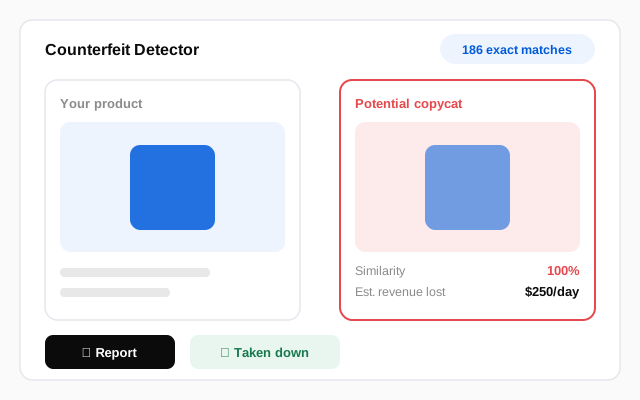
Our detection systems scan the surfaces where counterfeits sell: major marketplaces, social ad libraries, and the open web where standalone fake stores live. Image matching flags listings using your product photography or close imitations of it, and keyword sweeps catch the misspellings and 'replica' phrasings counterfeiters use to dodge naive searches. Human analysts then verify each hit, separating counterfeits from authorised resellers, parallel imports and used goods, distinctions that matter enormously to marketplaces and that automated reporting gets wrong constantly.
Enforcement runs on the strongest available ground for each surface: intellectual property complaints through marketplace brand-protection programs, counterfeit-policy filings against social ads, and infrastructure escalation against standalone stores, hosts, registrars and domain-level action. Because our analysts map connections between seller accounts, one verified counterfeit often unlocks takedowns across a seller's whole catalogue and its sibling storefronts, instead of trimming one listing off an operation that keeps nine.
Evidence discipline separates takedowns that stick from reports that bounce. For contested cases we document the tells that mark a fake (pricing far below any authorised channel, packaging and label errors, shipping origins that don't match your supply chain, seller account history) and where a claim needs physical proof, test purchases put an actual counterfeit on the table. Platforms act quickly when the case arrives already made; they stall when asked to build it themselves, and counterfeiters count on that stall.
The lockout that actually ends it: their payment rails
A counterfeit store without a checkout is a brochure. The single most decisive move against standalone counterfeit sites is cutting their ability to take payment, so we document the counterfeit sales evidence to the standard payment processors require and file for merchant-account termination. Processors take counterfeit complaints seriously because the liability flows to them, and a store that loses its processor doesn't relist under a new username; it has to rebuild its business. Sellers who feel that pain move on to easier brands.
Counterfeiting is seasonal, adaptive and persistent, so lasting protection runs as a program: continuous scanning, verified takedowns, network tracking and processor filings, reported monthly under a Protection Plan. It starts with the free Exposure Scan. We'll sweep the marketplaces, ad libraries and open web for fakes of your products and walk you through the findings on a call, with an honest scope of what a cleanup and an ongoing program would each involve.
Frequently asked questions
We only found a few fake listings (is a program overkill? +
Do marketplaces actually respond to counterfeit complaints? +
The counterfeiters are overseas. Can anything really be done? +
Start with a free, confidential Exposure Scan
We'll scan your digital footprint, show you exactly what's exposed, and recommend the fastest path to remove it, or tell you honestly if you don't need us.
Book Your Assessment