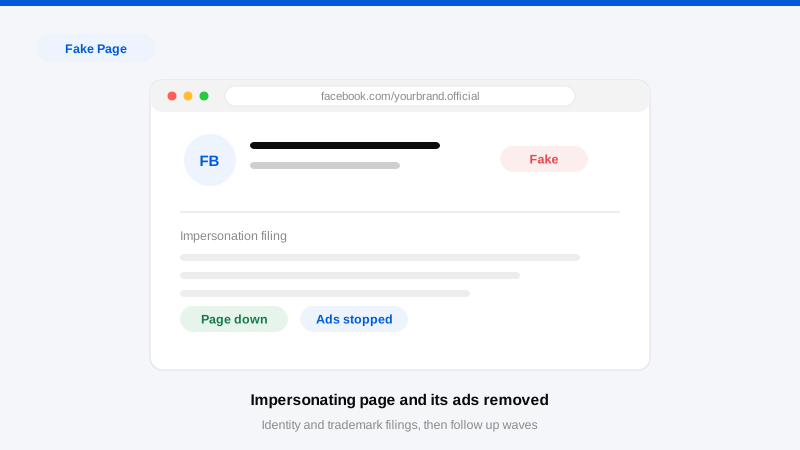
Removing a fake Facebook page impersonating you means proving to Meta, in a way it can act on, that you are the real person or brand and the page is not. Meta does remove these. Properly evidenced complaints succeed on pages that have already survived dozens of ordinary user reports.
Key facts
- Meta’s impersonation policy covers accounts and pages that pretend to be a real person, a brand or an organisation, but not clearly labelled parody or commentary.
- An individual being impersonated does not need to own a trademark to have Meta act, which surprises most people who have been told otherwise.
- Meta operates a dedicated channel for rights holders that covers Facebook and Instagram together, which matters because impersonators almost always run both.
- Your logo and your photographs are protectable regardless of what name the fake page uses, so an altered spelling is not the shield operators think it is.
- Advertising is held to a stricter standard than ordinary posts, so a page buying reach in your name is often more exposed, not less.
- Under the EU Digital Services Act, platforms must explain their decisions, so a wrongly declined complaint is no longer the end of the road.
- Impersonators rebuild within days, so the page you were sent is rarely the whole problem and almost never the whole network.
What counts as impersonation on Facebook?
Meta’s impersonation policy covers accounts and pages that pretend to be a real person, a brand, or an organisation. That includes a page using your name and your photographs, a page using your business name and logo, and a page that presents itself as your official support, careers or customer service channel.
It does not cover fan pages, parody clearly labelled as parody, or commentary pages that use your name to talk about you rather than as you. The line Meta enforces is whether a reasonable person would think the page is you or is authorised by you. Getting your filing on the correct side of that line is most of the work.
Why fake pages are built
Almost never to make a joke. The pages we are asked to remove exist to sell something to an audience that already trusts you.
The common patterns are a fake giveaway or competition harvesting personal details, a fake investment or coaching offer taking payment in your name, a cloned brand store selling counterfeits or nothing at all, and a customer service impostor intercepting complaints and asking for account or card details. Talent and creators also see impersonation pages built to open a private conversation with a follower and move them to another platform.
Two things make these urgent. The audience harmed is yours, so the complaints and the chargebacks arrive at your door, and impersonation pages frequently run paid ads, which means they reach people far faster than an organic page ever would, and they buy their way in front of the exact demographic that follows you.
Which route removes it fastest?
It depends on who you are. An individual being impersonated has a different and often faster path than a company, and a company that owns a registered mark has options an unregistered brand does not. Where more than one applies, using them together is normal rather than excessive.
What decides the speed is almost never the ground. It is whether the platform can tell, without having to investigate, that you are the real party and the page is not. That is why two complaints about identical pages can produce completely different outcomes in the same week.
Timelines depend on the route and the platform, and are set out in writing after the free Exposure Scan.
Get a Free, Confidential Exposure Scan
How we get a fake page removed
We start with the network rather than the page you were sent, because impersonators run several accounts and removing one out of six only teaches the operator which pattern to avoid. Then we establish, in a form the platform cannot argue with, that you are the real party and that people are being harmed, and we act on every ground that applies at once.
We also plan for the rebuild, because there almost always is one. The second and third removals are much faster than the first, and the pattern itself becomes useful. The outcome is pages gone, ads stopped, your name clean in Facebook search and in Google, and monitoring in place across Facebook and Instagram, where the same operator nearly always has a matching account. The work is verified, evidenced to you, and monitored afterwards.
Why most reports fail
A report filed from the in-app menu by someone the platform cannot verify is a single anonymous flag among enormous volumes of them. Nothing about it tells a reviewer who is real, and reviewers are not investigators.
The complaints that succeed are a different object entirely. They come from a party the platform can identify, they are backed by evidence rather than assertion, and they present the whole picture at once instead of one page at a time. That is why a properly built filing frequently succeeds within a day on a page that has survived dozens of user reports.
Related pages: Facebook content removal, brand protection, what we do for talent managers, and reputation management for Instagram influencers.
What Meta’s rules and the law say
Meta’s standards separate three things that clients tend to describe in the same sentence. Impersonation is pretending to be a person or an entity. Intellectual property infringement is using material that belongs to someone else. Fraud and deception is using an account to obtain money or data dishonestly. A single fake page usually breaches all three, which is the good news: there is more than one way to reach it.
Trademark law sits behind the rights position. Use of your registered mark to identify a page as your business, to sell to your customers, or to collect their details is the classic case, and it does not require you to prove that anyone was actually deceived. Brands that have never registered a mark are not without options either, because the logo, the product photography and the headshots on those pages are usually yours.
Where money has moved, other regimes matter. In the United Kingdom the Online Safety Act 2023 places duties on platforms around fraudulent advertising and illegal content, and in the European Union the Digital Services Act requires a notice and action process and a statement of reasons for decisions. In Australia the eSafety Commissioner and the ACCC both have relevant powers. Those regimes rarely remove a page quickly on their own, but they matter a great deal when a network keeps rebuilding.
One thing no framework does is decide who is real for you. That is the load bearing part of every one of these matters, and it is where most self filed complaints fall down.
What we need from you to start
- Every URL you have: the fake page, any duplicate pages, the cloned Instagram account, and any ads you have seen.
- Your own official page and account URLs, so the reviewer can compare.
- For an individual claim, a government photo identification document, which we submit through the platform’s own channel rather than passing around by email.
- For a brand claim, trademark registration numbers and jurisdictions if you have them, plus dated proof of your logo and imagery.
- Evidence of harm: messages the page has sent your followers, payment or crypto requests, screenshots of the giveaway or investment pitch, and any complaints your team has already received.
- Any customer who has lost money and is willing to describe what happened, which strengthens a fraud filing considerably.
- Written authorisation for us to file, signed by the individual or by an officer of the rights holding company.
Timelines and what usually happens first
The first day is inventory, not filing. Removing one page out of six costs you the element of surprise and teaches the operator which pattern to avoid, so it is worth knowing the full picture before anything moves.
A clear individual case often resolves within a day or two. A network that keeps rebuilding is ongoing work rather than a single event. Those are ranges, not commitments, and you get the realistic one for your matter in writing after the scan.
Common mistakes that make it harder
- Telling your audience to mass report the page. Coordinated reporting is detectable, gets discounted, and can be treated as abuse of the reporting tools.
- Reporting from a personal account with no evidence attached. It becomes one anonymous flag among many and tells the reviewer nothing about who is genuine.
- Messaging the impersonator. It confirms the account is working, and it often results in your own account being mass reported in return.
- Paying to make it stop. There is no version of this where paying ends it.
- Announcing the takedown publicly. It tells the operator exactly what worked and what to try next.
- Dealing with one page at a time. The network rebuilds faster than a one by one approach can work through it.
- Deleting the scam messages your followers forwarded you. Those are the consumer harm evidence that makes reviewers act decisively.
How this works alongside your lawyer, PR team or security team
Your counsel owns anything that requires a rights declaration under penalty, any pre action correspondence, and any application for disclosure where a network is being pursued properly. We prepare the rights pack, the harm evidence and the network map so the legal work starts from something complete.
Your PR and community team owns the warning to your audience, which is usually the most valuable thing anyone does in the first hour. A short, calm notice on your verified channels, saying what your real accounts are and that you never ask for payment by direct message, prevents more loss than any takedown. We help time it so it does not simply advertise the fake page.
Your security team owns account hardening on your side. Impersonation matters frequently sit next to credential stuffing attempts, so two factor authentication on every business account, a review of page roles, and removal of stale admins belong in the same piece of work.
Who usually makes first contact and what the 15 minute call covers
Talent managers, agencies, brand and legal teams, and founders directly. Very often the first person to notice is a follower who was scammed, and the message reaches a community manager before it reaches anyone senior.
Before the call we look for every version of the page we can find, check the ad library, and check whether Instagram carries a matching account. On the fifteen minute call we tell you what comes down, on which ground, in what order, and what your team should post to your audience today. Everything runs under NDA, and the written assessment is yours to keep whether you engage us or not.
Frequently asked questions
Do I have to send Meta my passport?
Some form of government photo identification is normally required, because Meta has to establish that you are the person being impersonated. When we act for you we handle that submission directly through the platform’s own channel rather than passing documents around, and identity material is not stored with the rest of the case file.
The page has my logo but a different name. Is that still removable?
Yes. Your logo, your product photography and your marketing imagery are yours regardless of what the page calls itself, so an altered name does not put it out of reach. Pages that are clearly trading on your identity are usually vulnerable on more than one front at once.
It is running ads pretending to be my company. Can that be stopped faster?
Often yes. Advertising is held to a stricter standard than ordinary posts, and stopping the spend is what limits the damage while the rest of the matter is dealt with. It is one of the first things we look at.
They keep making new pages. Is this ever finished?
The first removal is the slow one. After that each rebuild is handled far more quickly, and persistent networks eventually attract broader action from the platform. Ongoing monitoring across Facebook and Instagram is how our clients stop finding out about these from a follower’s message.
My clients have already lost money to it. What should we do first?
Preserve everything, tell your audience through a channel you control, and let us file. Depending on the amounts and the country there may be a law enforcement or payment provider route as well, and we work alongside your counsel on that rather than replacing them.
Who normally handles this with you?
Talent managers, agencies, brand and legal teams, and founders directly. Everything is under NDA as standard, and the assessment report is yours to keep whether or not you engage us. Pricing is quoted in writing after the free scan.
How long does it take to remove a fake page?
A clear individual case is often resolved within a day or two. A network that keeps rebuilding is ongoing work rather than a single event. We give you a realistic range after the scan and tell you which parts are likely to be quick.
Can you clear the matching Instagram account at the same time?
Yes, and it should be handled at the same time. The same operator almost always runs both, and clearing Facebook alone leaves a live account to rebuild from. See Instagram removals.
If there is a page pretending to be you right now, send us every version you can find. Start with a free, confidential Exposure Scan or read how we work first. We will tell you on the 15 minute call what comes down, what does not, and in what order.