
Social media for customer service is a public risk surface, not just a support channel. A defensible operation runs one unified queue for posts, comments and messages, answers routine questions publicly, moves anything involving personal data, disputes or accusations to private channels at once, and escalates by defined triggers when a complaint turns into an allegation or a coordinated attack.
Key facts
- 70% of customers have used social media for customer service at least once, per Nextiva.
- More than 75% of social users expect a brand reply within 24 hours, per Shopify.
- High performing teams target sub-hour replies to DMs and under four hours for public posts.
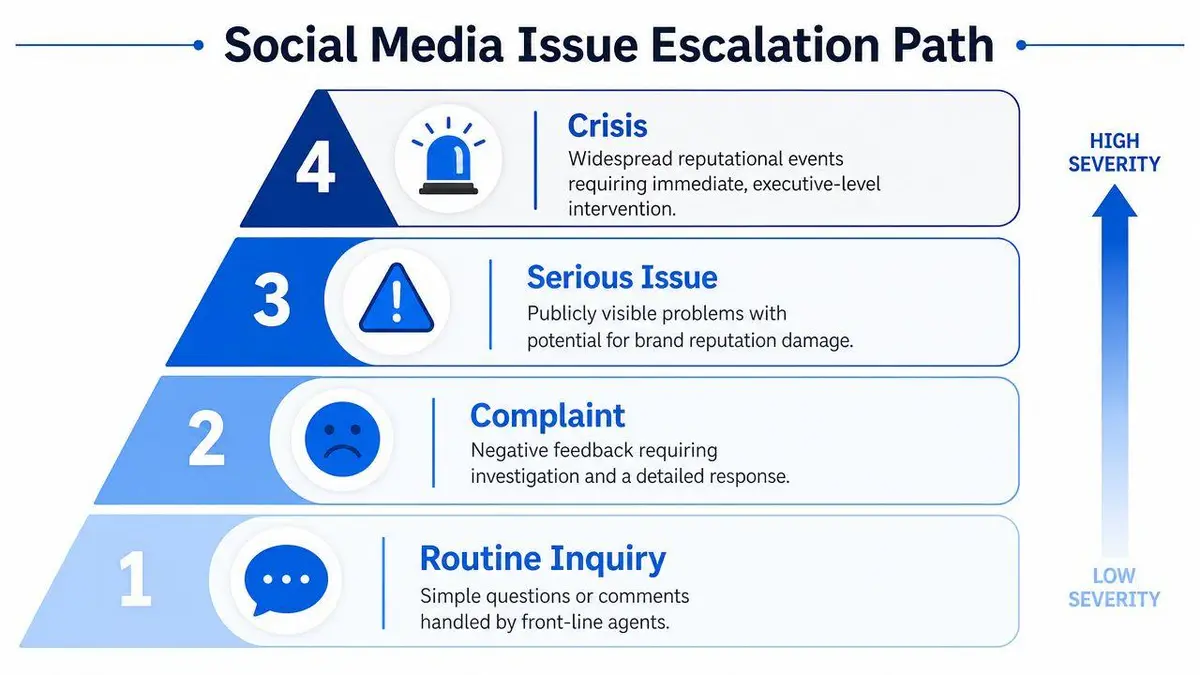
- Four escalation tiers run from frontline agents to executives, legal counsel and specialist advisers.
Where ContentRemoval.com comes in. When a customer thread crosses into defamation, impersonation, a fake review campaign or leaked content, ContentRemoval.com takes over where support playbooks end, removing the harmful material and containing the spread. Heads of communications, customer care directors and in-house counsel usually reach out at the Level 4 stage. A free 15-minute Exposure Scan maps what is removable, and the report is theirs to keep. Get a Free, Confidential Exposure Scan or read how our content removal work is done.
A customer posts a routine complaint on Friday afternoon. By evening, screenshots are circulating in group chats. By night, a journalist has noticed the thread. By Saturday morning, the issue is no longer a customer-service problem. It is a reputation event with legal implications, internal accountability questions, and a permanent search footprint.
That is the critical context for social media for customer service. Most companies still treat it as a support convenience. That is a mistake. Public platforms collapse the distance between an unresolved complaint, a hostile narrative, and executive exposure. If your team answers slowly, improvises in public, or asks for sensitive details in the open, you are not merely delivering poor service. You are creating discoverable evidence of weak controls.
The scale of the problem is no longer debatable. A 2026 customer-service statistics roundup reported that 70% of customers have used social media for customer service at least once, and 32% of people shared their biggest complaint on social media in 2023, more than double the 2020 level, according to Nextiva’s customer-service statistics roundup. That means complaints now move through a public channel that customers already see as normal, visible, and effective.
Executives and public figures have an additional problem. A complaint aimed at the business rarely stays confined to the business. It spills into leadership credibility, personal profiles, and search results. If you are already under scrutiny, you need a broader discipline than customer support. You need a reputation-control system that covers monitoring, evidence preservation, escalation, and takedown readiness. If you need a practical primer on how to secure your online presence, start there. Then assume the operational burden is larger than most marketing teams admit.
The New Frontline for Reputation Crises
Public complaints now define the first narrative
A customer who once would have sent an email now posts publicly because public pressure works. The post is short, emotional, and easy to share. Your response, or lack of one, becomes part of the story. Every minute of hesitation gives outside observers room to fill the gap with their own theory of what happened.
That is why social media for customer service belongs under risk management, not just under brand or community. The public feed is a live evidentiary record. It captures timestamps, tone, staff judgment, and whether the organization appears evasive, careless, or competent.
Public complaint handling is no longer a courtesy layer on top of service. It is the opening phase of crisis containment.
High-profile organizations lose control faster
For a visible brand, a complaint rarely stays isolated. Competitors can amplify it. Activists can frame it. Impersonators can join the thread. Former customers can add unrelated grievances and create the illusion of a pattern. Once that happens, the original issue matters less than the apparent volume and emotional force around it.
The danger is not just virality. It is misclassification. Teams often treat a reputationally loaded complaint as a basic support ticket because the underlying issue appears minor. That is how companies end up litigating product issues, privacy questions, or alleged misconduct in a comments thread.
Leaders should impose a simple rule. If a public complaint could damage trust beyond the individual customer, it is not a standard service interaction. It is a controlled-response matter.
A Risk Assessment of Key Social Platforms

Different platforms create different kinds of exposure. Treating them as interchangeable is lazy management. A board-level risk review should rank each platform by speed of spread, search persistence, impersonation risk, and likelihood that a routine complaint becomes a reputational allegation.
X and Instagram reward speed, but punish hesitation
On X, the threat is acceleration. The platform favors short, sharp allegations and public pile-ons. If your team misses the first wave, the second wave may come from people who have no relationship with your company at all. In this situation, response latency hurts most. X is a triage channel, not a place for extended argument.
Instagram creates a different problem. Complaints often attach themselves to promotional content, executive visibility, or creator partnerships. The comments section can turn a marketing asset into a reputation liability within minutes. DMs may be private, but the reputational trigger is usually public and visual.
LinkedIn and Facebook carry different legal and business risks
LinkedIn is slower but more dangerous for regulated businesses, executive brands, and B2B firms. Allegations there often sound more credible because the audience includes peers, clients, journalists, and recruiters. A complaint on LinkedIn can damage commercial trust, trigger board concern, and invite direct questions about leadership standards.
Facebook remains operationally messy. Complaints can appear across posts, comments, Messenger, local groups, and unofficial community pages. False narratives often persist there because they are repeated in fragmented spaces that internal teams fail to monitor consistently.
A serious operation needs centralized visibility across all of this. Native inboxes are not enough. If you are evaluating reputation monitoring systems, the key requirement is not convenience. It is a unified record of mentions, comments, and direct outreach that allows fast escalation before the issue fragments across channels.
Platform decisions should follow threat profile
A practical platform matrix looks like this:
| Platform | Primary risk | Typical failure |
|---|---|---|
| X | Rapid escalation and screenshot spread | Team argues publicly or responds too late |
| Complaint hijacks brand content | Marketing team moderates without escalation | |
| Executive and corporate credibility damage | Legal or leadership sees it too late | |
| Fragmented complaint visibility | Team misses groups, comments, and secondary threads |
Most companies overstaff the channels that feel familiar and understaff the ones that create the highest downside. Reverse that.
Establishing a Defensible Response Operation
A defensible operation starts with control of the workflow. If your staff toggles between native platform dashboards, personal logins, shared passwords, and ad hoc Slack threads, you do not have a system. You have a liability trail.
The correct structure is a single operational queue that pulls in posts, comments, mentions, and direct messages. NICE describes the technical standard clearly in its guide to social media customer service platforms. The queue should support routing rules, shared customer context, and analytics that track first-response time, resolution time, volume, sentiment, and agent performance across channels.
Build one command center, not four separate inboxes
The point of a unified stack is not efficiency alone. It is judgment. The agent answering an Instagram comment should see whether the same individual has already sent a Facebook message, opened an email ticket, or posted on X. Without that context, your team duplicates work, contradicts itself, and creates contradictory records.
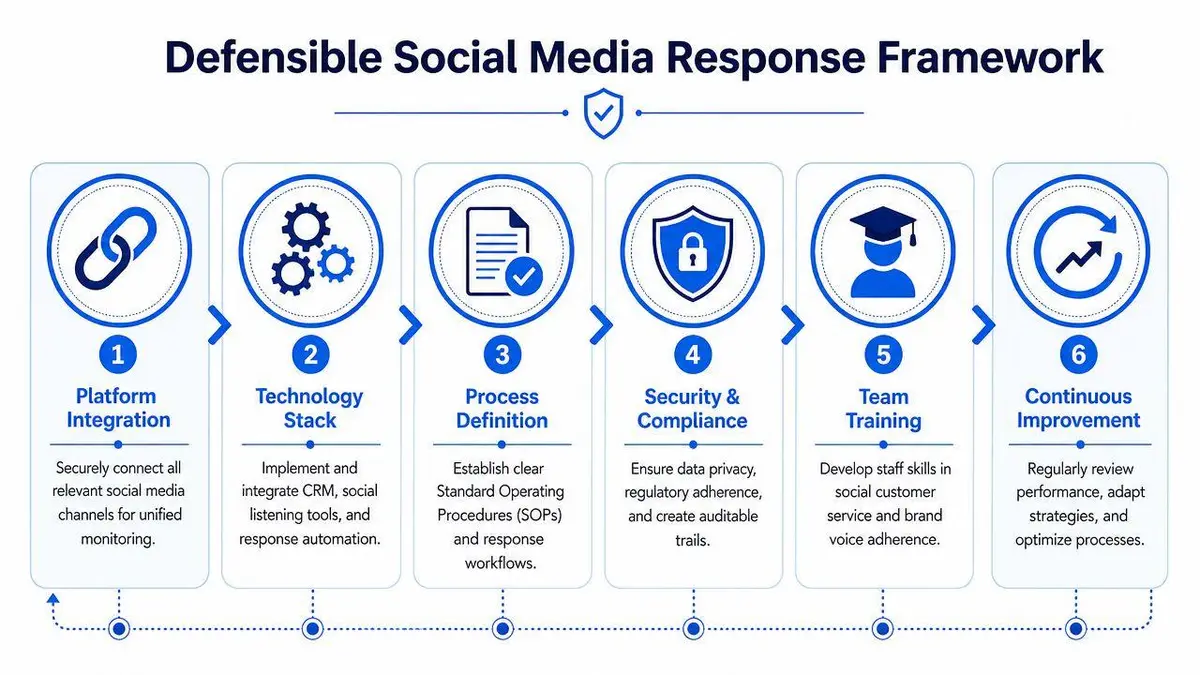
A disciplined stack should include:
- Unified intake so every social interaction lands in one queue.
- Routing logic that separates routine service from reputation-sensitive matters.
- Case history so staff can see prior complaints and prior promises.
- Audit trails that show who answered, when, and on what basis.
- Automation controls that acknowledge receipt without improvising legal or factual answers.
If you are exploring automating customer support with AI, use it for acknowledgement, categorization, and routing. Do not let automation freelance on allegations, privacy disputes, billing disputes, or any post that could be screenshot as an admission.
Set hard response standards and enforce them
The timing standard must be met because customer expectations are already fixed. A 2026 Shopify summary reported that 73% of social media users say they would buy from a competitor if a brand does not respond on social media, and more than 75% expect a reply within 24 hours, according to Shopify’s customer-service statistics summary.
That baseline is still too slow for high-risk organizations. For visible brands, the public issue is rarely the final issue. It is the trigger. The first reply should acknowledge, contain, and direct. It should not attempt a full defense before facts are known.
> **Practical rule:** If a response cannot be safely written in under two minutes using verified facts, move the issue to a controlled review path before anyone posts.Protocols for Public Versus Private Engagement
The biggest mistake in social media for customer service is not slow response. It is answering the wrong issue in the wrong place. Public visibility can build trust, but it can also invite disclosure, create admissions, and extend the life of a dispute.
The right default is simple. Public channels are for acknowledgement, brief clarification, and visible willingness to help. Private channels are for identity, account details, disputed facts, compensation discussions, legal threats, harassment claims, and anything involving personal data.
What belongs in public
A public reply works when the issue is simple and the answer is safe. Delivery timing. Store hours. A link to a status update. A brief apology for a service interruption that is already known. Public handling shows responsiveness without exposing the company or the customer.
That is the narrow lane. Stay in it.
Keep the public reply short, calm, and procedural. The goal is to reassure observers, not to win an argument in front of them.
What must move immediately to private
Second To None makes the core point directly in its guidance on social media customer service strategy. Complex or sensitive issues should be moved to private channels because social is best for quick fixes, while private channels are better for personal data and complicated cases. That is not a stylistic preference. It is the threshold between manageable service and avoidable exposure.
Use a strict triage protocol:
| Issue Type | Recommended Channel | Rationale |
|---|---|---|
| Simple question about policy or availability | Public reply | Safe to answer openly and useful to others |
| Minor complaint with no personal data | Public acknowledgement, then private if needed | Shows responsiveness without prolonged public exchange |
| Billing dispute or account-specific complaint | Private channel | Requires verification and detailed review |
| Complaint involving health, identity, family, or payment details | Private channel immediately | Protects personal data and limits legal exposure |
| Defamation, accusation of misconduct, or threat of legal action | Private channel plus internal escalation | Requires controlled language and evidence preservation |
| Harassment, impersonation, or false allegations spreading on-platform | Private channel plus specialized response | Standard support processes are not enough |
If the post crosses from complaint into accusation, your social team should stop improvising. Use a documented escalation path and, where necessary, a formal strategy for responding to slander on social media. Customer service staff should never be left to make quasi-legal decisions in a live thread.
The Escalation Path from Complaint to Crisis
Most damage happens because escalation starts too late. Junior staff try to solve a reputational problem as if it were a support issue. They offer goodwill where legal review is needed, or they go silent where executive coordination is required.
A proper escalation path starts with speed. Listen360’s guidance on social media customer service response timing notes that high-performing operations often target sub-hour response for DMs and roughly same-day to under-four-hour handling for public comments and posts. That speed matters because triage happens before the issue hardens into a public narrative.
Define triggers before the incident arrives
Escalation should not depend on personality or intuition. It should depend on triggers that any trained staff member can recognize. In practice, the most useful triggers are qualitative:
- Audience trigger when a verified journalist, major customer, regulator, or influential account engages.
- Allegation trigger when the post shifts from dissatisfaction to misconduct, fraud, discrimination, or safety.
- Spread trigger when the complaint begins appearing across multiple platforms or unrelated comment threads.
- Risk trigger when staff would need personal data, legal interpretation, or executive authority to answer properly.
Match each tier to a decision-maker
Level 1 belongs with frontline social agents. They can acknowledge, route, and answer routine issues.
Level 2 belongs with a team lead or customer-care manager. They can review facts, coordinate with operations, and approve a private resolution path.
Level 3 belongs with communications leadership and legal review. Posts at this level have visible reputational consequences, involve allegations, or require carefully controlled wording.
Level 4 belongs with senior executives, legal counsel, and specialist advisers. At this point, the matter is no longer customer service. It is crisis management, evidence preservation, public narrative control, and potentially takedown action.
The chain of command should be boring, documented, and fast. If staff are debating ownership while screenshots spread, the system has already failed.
Measuring ROI Through Risk Reduction
Most ROI discussions around social media for customer service are unserious. They focus on response rate, likes, sentiment snapshots, or whether the brand seems friendly. Those metrics may be useful at the team level, but they do not justify investment to a board, a family office, or a chief executive under pressure.
The proper question is whether social support reduces operational friction and reputational exposure. Zendesk frames the strategic issue well in its discussion of customer service through social media. The challenge is no longer only where to reply. It is whether integrated monitoring of mentions, DMs, and comments produces better decisions across the business, and what share of issues should be resolved publicly versus routed elsewhere.
Stop measuring vanity. Start measuring containment
That means your scorecard should focus on outcomes that matter to leadership:
- Containment quality by reviewing whether potentially harmful public threads were shortened, redirected, or resolved without prolonged exposure.
- Escalation accuracy by checking whether staff identified legal, privacy, or executive-risk issues early enough.
- Cross-channel coherence by testing whether the same customer received a consistent answer across social, email, and phone.
- Insight transfer by proving that complaint patterns informed legal, operations, compliance, or leadership decisions.
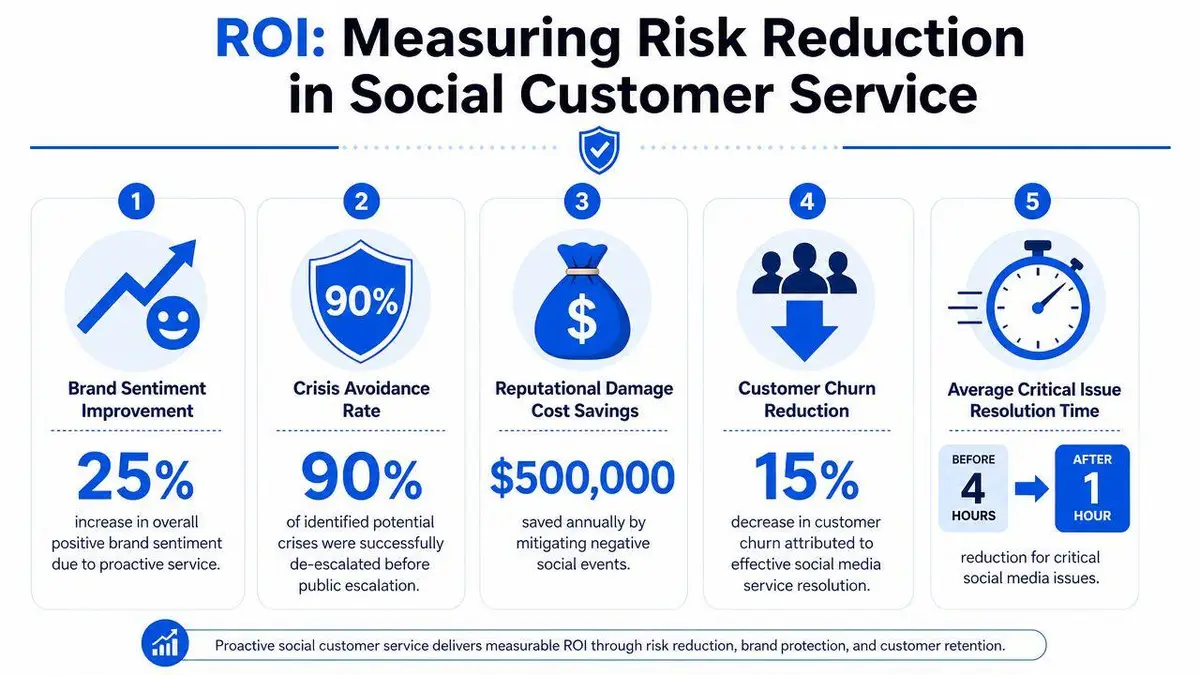
The assigned visual above contains example figures, but executives should treat those numbers as illustrative design elements, not decision-grade benchmarks. Your actual ROI model should rely on your own incident logs, legal reviews, support records, and post-incident analysis.
The boardroom case is resilience, not charm
A mature social customer-service function does three things well. It identifies issues before they metastasize. It routes sensitive matters away from public view. It turns complaint data into a warning system for larger reputational threats.
That is why the most credible ROI argument is risk reduction. If your operation can show fewer exposed disputes, faster routing of sensitive matters, and better recovery after visible criticism, it is creating enterprise value. If you are dealing with the aftermath of visible criticism, a structured plan for rebuilding trust after bad reviews becomes part of the same measurement logic. The point is not to look active. The point is to reduce harm.
Conclusion From Reactive Service to Proactive Defense
Social media for customer service is no longer a peripheral support channel. It is a public risk surface that sits at the intersection of brand, legal exposure, executive reputation, and operational control.
The organizations that handle it well do not rely on charm, speed alone, or clever community managers. They map platform-specific threats. They run a unified response operation. They enforce a strict line between public acknowledgement and private resolution. They escalate early when a complaint starts to look like an allegation, a coordinated attack, or a searchable reputational event.
That is the shift. Social customer service is not merely about answering people where they are. It is about controlling what becomes visible, discoverable, and repeatable. For high-profile brands and individuals, that distinction matters more than any traditional service metric.
Internal teams can manage routine issues. They should. But some matters exceed the limits of standard customer-care playbooks. Coordinated defamation, impersonation, false review campaigns, leaked content, hostile reposting, and platform-level abuse require specialist intervention. Those are not customer-service problems dressed up as social chatter. They are reputation threats that call for takedown processes, evidence strategy, and legal precision.
When a public complaint turns into defamation, impersonation, leaked content, or a sustained attack on your brand or name, standard social response protocols won’t solve it. ContentRemoval.com works with executives, public figures, family offices, and legal teams to remove harmful material, contain reputational damage, and build a discreet action plan quickly.
Frequently asked questions
Which customer complaints should never be handled in public on social media?
Anything involving identity, account details, billing disputes, health, family, payment data, legal threats or harassment claims. Accusations of misconduct and spreading false allegations need a private channel plus internal escalation, since customer service staff should not make quasi-legal decisions in a live thread.
When should a social media complaint be escalated beyond the support team?
Use fixed triggers rather than intuition. Escalate when a journalist, regulator, major customer or influential account engages, when the post shifts from dissatisfaction to fraud, discrimination or safety allegations, when the complaint spreads across multiple platforms, or when the reply would need personal data, legal interpretation or executive authority.
Can AI automation be used for social media customer service safely?
Yes, for acknowledgement, categorization and routing. It should never improvise on allegations, privacy disputes, billing disputes or any post that could be screenshotted as an admission. Those matters go to a controlled review path before anyone posts.