
HR reputation management in executive hiring is a four-phase defense: pre-offer digital due diligence that resolves identity variants and searches well beyond page one, a three-tier assessment of anything found with remediation through source removal, de-indexing or suppression, contract and onboarding controls covering online conduct and disclosure, and post-hire monitoring with named crisis owners.
Key facts
- Vetting starts with a naming map of legal variants, reused usernames and dormant corporate affiliations.
- Findings are classified as minor, moderate or severe, with severe issues pausing the search unless resolved.
- Source removal is strongest for unlawful or policy-breaching content; suppression suits lower-tier issues only.
- Executive contracts should cover online conduct, disclosure of threats, device discipline and crisis cooperation.
Where ContentRemoval.com comes in. ContentRemoval.com works with boards, general counsel and executive search firms when a finalist’s search results carry an old allegation, a hostile thread or a leaked record that could surface on announcement day. We assess what is authentic and discoverable, then remove or de-index what can be removed before the hire goes public. A free 15-minute Exposure Scan maps the candidate’s removable liabilities, and the report is theirs to keep. Get a Free, Confidential Exposure Scan or read how our reputation management work is done.
You’re probably staring at a finalist who looks perfect on paper. The references are clean. The résumé is polished. The board likes the story. Legal has reviewed the standard file. HR thinks the process is moving well.
Then someone sends a late-night email with a screenshot.
It’s an old post, a hostile thread, a buried lawsuit mention, a fringe podcast appearance, a failed business tied to angry commentary, or a pattern of online behavior that never showed up in the interview loop. Suddenly the issue isn’t talent. It’s exposure. The hire may still be capable, but capability stops mattering when the market, the press, your staff, or your customers decide the company exercised poor judgment.
That is the issue in HR reputation management executive hiring. You are not selecting a résumé. You are accepting, rejecting, or remediating a public risk profile attached to a future face of the company.
The Inevitable Cost of Unseen Digital Liabilities
A board approves a senior hire. The announcement goes live. Within hours, employees circulate archived posts and screenshots from years earlier. Reporters start asking questions the company can’t answer because nobody looked thoroughly enough. The executive says the material is misleading or out of context. Maybe that’s true. It no longer matters as much as it should.
This is the part too many companies still get wrong. They treat reputational vetting like an expanded background check. It isn’t. It’s a corporate defense function.
Around 85% of HR managers in the U.S. look online to check the reputations of job candidates, and that figure approaches 100% for senior roles where personal and professional reputations can directly affect trust and valuation, according to reputation management statistics on executive vetting. If your own hiring process remains limited to a quick search and a vendor report, you are operating below the market standard for high-stakes leadership selection.
The candidate isn’t the only party being judged
Executive vetting is now reciprocal. Candidates assess your discretion, your standards, and your judgment. Staff do too. If a serious issue surfaces after appointment, the damage lands on the company first because the company chose the person.
Practical rule: The ideal executive doesn’t exist. The executive with a known, manageable, and documented risk profile does.
That distinction matters because the internet doesn’t forget evenly. Search results can distort. Old allegations can outrank corrections. Satirical content can appear factual. Anonymous complaints can spread faster than formal findings. You are hiring into that environment whether you like it or not.
What companies miss when they move too fast
Most failed reputation reviews aren’t caused by secrecy alone. They’re caused by false confidence. Someone searched the candidate’s name, saw nothing alarming on page one, and assumed there was nothing to find.
That assumption costs people jobs and companies an advantage. If a candidate has already suffered reputational drag from search exposure, the recovery path is strategic, not cosmetic, as this guide on losing a job opportunity due to Google search results makes clear. The same logic applies when you’re the employer considering an executive hire. Surface calm is not proof of safety.
HR reputation management executive hiring starts with one sober premise. What you don’t know about a candidate’s digital liabilities can become your problem immediately after the offer, or worse, immediately after the announcement.
Phase One Digital Due Diligence Before the Offer
The standard “Google them and move on” approach is amateur hour. For a true executive search, digital due diligence has to function like litigation prep. You’re not browsing. You’re building a risk file.
An estimated 68% of executive searches fail within 18 months, partly due to undisclosed online scandals or personal digital risks that weren’t vetted during hiring, according to this analysis of executive search failure and digital exposure. That failure rate is more than a talent problem. It is a process problem.

Start with identity resolution
Before you assess risk, confirm you’re looking at the right person. Common names, old usernames, shell entities, prior married names, alternate spellings, and country-specific records create false negatives and false positives.
Build a naming map that includes:
- Legal and professional variants tied to public filings, speaking engagements, author bios, and old press mentions.
- Usernames and handles reused across platforms, forums, newsletters, comment sections, and cached pages.
- Corporate affiliations including dormant entities, acquired ventures, advisory roles, nonprofit boards, and side projects.
This sounds basic. It isn’t. Most sloppy vetting starts by missing the candidate’s real digital perimeter.
Search beyond page one
Search engines suppress, personalize, and reorder. That means a clean first page often proves nothing. You need a broader sweep across mainstream search, news search, image search, video platforms, archived pages, major social platforms, forum trails, and niche publications.
Use a structured query approach. Search the candidate’s name with former employers, city names, litigation-related keywords, public speaking topics, old products, known associates, and usernames. Review what appears in autocomplete, related searches, and cached snippets. Then compare that with what appears when logged out, in clean browser sessions, and across multiple devices.
For executives who’ve never audited their own presence, this overview of why searching and Googling your own name matters mirrors the discipline companies should expect before making a leadership offer.
Separate noise from pattern
One crude joke from fifteen years ago is different from a repeated pattern of hostility, deception, harassment, reckless disclosure, or poor judgment. Your task is not to punish every blemish. Your task is to identify what the blemish means when pressure hits.
A strong review file asks four questions:
-
Is the content authentic
Verify the asset before reacting. Screenshots can be manipulated. Cropped threads can omit context. Fake accounts can mimic real ones.
-
Is the content discoverable
A harmful item hidden in a forum archive is different from a result indexed prominently under the candidate’s name.
-
Is the content narratively dangerous
A manageable issue becomes dangerous when it confirms an existing criticism about your company, leadership, culture, or governance.
-
Is the issue active or dormant
Some matters are historical. Others are one search trend away from revival.
The serious mistake isn’t finding bad information. It’s failing to determine whether the information can be authenticated, amplified, or weaponized.
Review the hidden zones most recruiters ignore
Traditional recruiters focus on chronology, compensation, and references. Defensive digital vetting goes where embarrassment, undue influence, and credibility problems tend to hide.
Use this checklist as a baseline:
- Archived social activity from X, Facebook, Instagram, Reddit, YouTube comments, Medium, Substack, podcasts, and conference clips.
- Forum participation tied to pseudonyms that can still be traced through reused usernames, bios, or linked accounts.
- Corporate records showing lawsuits, dissolved entities, disputed partnerships, or affiliations the candidate omitted.
- Press sentiment across local outlets, trade publications, blogs, and syndicated content.
- Credential exposure such as old leaks, hacked-account traces, impersonation risks, or compromised contact points.
- Associational risk involving repeated ties to individuals or entities already under scrutiny.
Keep legal boundaries tight
Do not let digital due diligence turn into reckless collection of protected-category information. If your search process casually gathers religion, disability, family status, ethnicity, or other protected characteristics and then contaminates decision-making, you have created a second problem while trying to solve the first.
The answer isn’t to avoid vetting. The answer is to separate collection from decision authority. Have a controlled process, document business relevance, and filter out material your hiring team should not use.
Produce a written risk memorandum
If the candidate is serious, write the file as if a board committee may need it later. That memo should distinguish verified fact from allegation, note discoverability, describe likely stakeholder reaction, and recommend one of three positions: proceed, proceed with remediation, or stop.
That discipline changes everything. It forces the company to make a conscious decision instead of drifting into one.
Phase Two Assessing and Remediating Discovered Risks
Discovery is the easy part. Judgment is harder. A company usually gets into trouble after a digital issue is found, not because the issue was unknowable, but because nobody agreed on what it meant or who had authority to act.
As three-quarters of candidates, or 75%, thoroughly investigate a company’s online reputation before applying, how you handle sensitive findings during vetting becomes a reflection of your culture and integrity, according to research on candidate scrutiny of employer reputation. Candidates notice whether your process is disciplined, discreet, and fair.
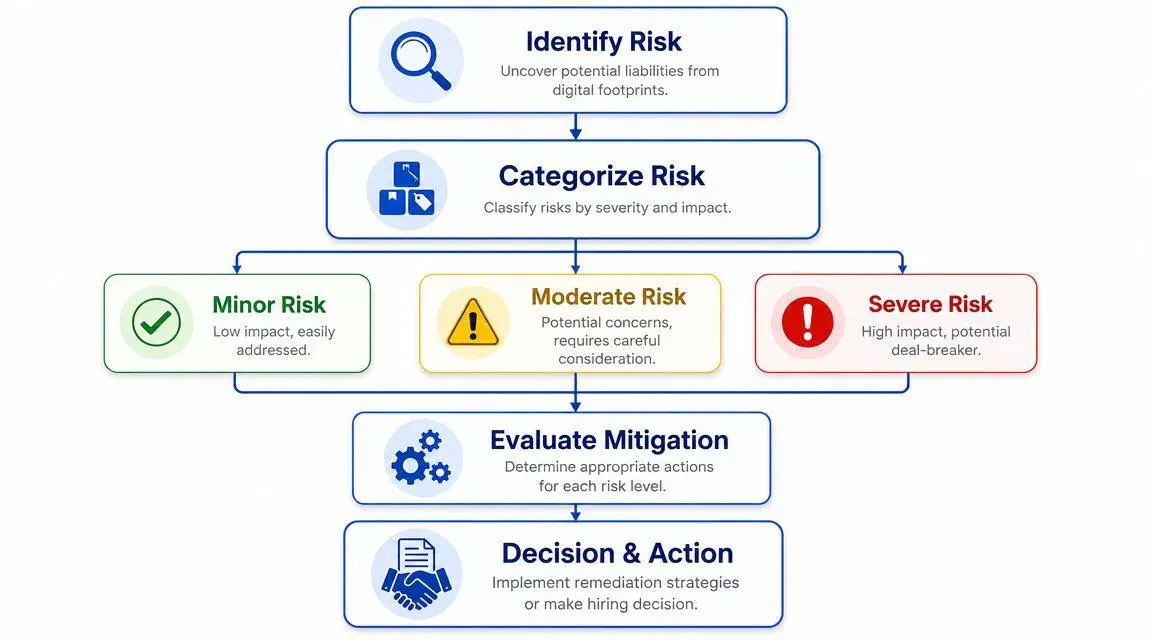
Use a three-tier risk framework
Not every ugly search result deserves the same response. Treating all digital liabilities as deal-breakers makes your process irrational. Treating them all as manageable is worse.
| Risk tier | Typical example | Appropriate response |
|---|---|---|
| Minor | Old low-visibility content, weak judgment, stale commentary with limited discoverability | Clarify with candidate, document context, monitor |
| Moderate | Indexed accusations, inflammatory content, recurring online hostility, misleading claims, visible association issues | Escalate to legal and HR leadership, require explanation, consider remediation before offer |
| Severe | Credible deception, serious undisclosed misconduct indicators, active scandal, extortion exposure, highly discoverable reputational threat tied to leadership role | Pause or terminate process unless independently resolved |
The point is consistency. If you don’t classify risks formally, personalities take over. One board member says it’s nothing. Another says kill the search. The company lurches instead of deciding.
Ask whether the issue is remediable
A discovered liability is not binary. Some issues can be reduced, contextualized, de-indexed, removed at the source, or contractually managed. Others can’t.
Use this decision test:
- Can the candidate explain it cleanly and credibly
- Can the issue be verified as false, outdated, misleading, or unlawfully published
- Can visibility be reduced before the hire is public
- Will remediation itself create a record or conflict you’d rather avoid
- Would the board still support the hire if the issue were reported tomorrow
If the answer to the final question is no, stop pretending the issue is manageable.
Choose the right remediation channel
Companies often blur three very different remedies.
Source removal is the strongest option when the content is unlawful, defamatory, nonconsensual, impersonated, or published in violation of platform rules. If it disappears at the source, downstream search impact usually weakens.
De-indexing is narrower. It may reduce discoverability in search even if the original page remains online. That can be useful when the publisher won’t cooperate but search visibility is the immediate risk.
Suppression means improving the prominence of neutral or positive assets so harmful material becomes harder to find. This is not a substitute for removal when the content is severe, but it can be useful for lower-tier issues.
For executives facing broader cleanup, this guide to a professional digital footprint cleanup service for executives captures the difference between cosmetic reputation work and actual risk reduction.
Decision standard: If the issue could alter board approval, customer trust, or employee confidence after announcement, don’t rely on suppression alone.
Bring in specialized judgment when facts are messy
Some findings sit in the gray zone between reputational risk and legal exposure. Old allegations, medical-adjacent disclosures, competency disputes, and online commentary around past incidents can raise questions that HR should not evaluate casually. In those situations, outside assessment grounded in evidence matters more than internal intuition. That’s where guidance from medico legal experts can help frame causation, documentation, and evidentiary standards without turning the hiring process into rumor management.
Speak to the candidate directly, but only after your file is complete
Don’t confront a finalist with fragments. Verify first. Then ask precise questions. Watch for the quality of the answer, not just the denial.
A capable candidate facing an old but manageable issue usually gives a coherent timeline, identifies what is false or outdated, and understands why the company is asking. A dangerous candidate attacks the process, changes the facts, or tries to rush the decision before you finish your review.
Know when to walk away
There is no prize for saving a bad hire through optimism. If the issue shows a pattern of dishonesty, coercive behavior, chronic recklessness, or a high probability of public escalation, move on. The sunk cost of a long search is still cheaper than appointing a reputational liability to a visible leadership role.
HR reputation management executive hiring requires a mature principle. You are not screening for perfection. You are screening for risks the institution can understand, explain, and survive.
Phase Three Contractual Safeguards and Onboarding Controls
A clean pre-hire review doesn’t eliminate risk. It only tells you what was knowable before signature. Once the executive joins, the company needs legal means, behavioral standards, and internal controls that treat reputation as part of the job.
Many corporate reputation strategies remain siloed from HR, yet firms that integrate reputation management into HR executive job descriptions and KPIs see 22% higher executive performance during brand crises, according to research on integrated reputation responsibilities in executive roles. If reputation isn’t written into the role, people treat it as optional until the first incident.

Write the conduct standard into the contract
Most executive agreements are too generic. They address compensation, severance, confidentiality, and duties, but they avoid the fundamental issue. Public leadership now includes online conduct, digital stewardship, and response obligations when reputation threats arise.
The contract should address:
- Online conduct expectations covering public posts, interviews, podcasts, newsletters, and commentary reasonably tied to the company.
- Disclosure obligations requiring prompt notice of threats, extortion attempts, account compromise, impersonation, or resurfacing historical content.
- Confidentiality and device discipline focused on leaks, insecure sharing, private group chats, and mishandling of sensitive information.
- Cooperation duties that require the executive to assist in internal review or external response when a digital issue emerges.
This is not overreaching. It is basic governance for visible leadership.
Use morality language carefully, but use it
Many companies avoid morality clauses because they sound old-fashioned or heavy-handed. That’s a mistake. The problem isn’t the existence of the clause. The problem is bad drafting.
A useful clause doesn’t rely on vague moral outrage. It ties conduct to measurable harm: reputational injury, breach of trust, conflict with company values, interference with duties, or conduct that predictably triggers public controversy materially affecting the business. Precision matters. So does jurisdiction.
If your counsel is revisiting restrictive covenants at the same time, this discussion of enforceability of non-compete agreements is a useful reminder that post-hire restraints and conduct controls only work when they’re drafted for actual enforceability, not theater.
Contract language should give the company options before a crisis, not arguments after one.
Build onboarding like a risk-control process
Most executive onboarding focuses on strategy, stakeholders, and culture. Add a formal reputation module. Make the standards explicit and documented.
A practical onboarding sequence looks like this:
-
Private briefing with legal and HR
Review the executive’s heightened visibility, expected communication discipline, escalation path for threats, and obligations around disclosure.
-
Account and platform review
Confirm which personal and professional channels exist, who controls access, which legacy accounts are inactive, and where impersonation risk is highest.
-
Public communications protocol
Define approval lines for high-risk statements, media engagement, social posting related to sensitive matters, and issue escalation.
-
Risk acknowledgment
Have the executive sign a policy acknowledgment specific to online conduct, confidentiality, and crisis cooperation.
Tie reputation to performance management
If you want behavior to change, make it measurable. Don’t bury reputation language in a handbook and hope for good instincts.
Use a simple operating model:
| Area | Example expectation |
|---|---|
| External communication | No unsanctioned commentary on sensitive legal, financial, or personnel matters |
| Digital hygiene | Prompt reporting of impersonation, credential compromise, or suspicious outreach |
| Brand stewardship | Participation in agreed media, search, and profile maintenance practices |
| Crisis cooperation | Immediate compliance with internal review and response directives |
This approach works because it turns abstract reputation talk into executive duty. Once it becomes part of the role, your company is no longer improvising.
Phase Four Post-Hire Monitoring and Crisis Response
A strong hire can still become a reputational target. Competitors dig. Former associates reappear. Fake accounts emerge. Stolen credentials surface. Anonymous posters test narratives before reporters do. If you wait for a crisis to build your response system, you have already lost time you won’t get back.
Given that 40-50% of executive hires fail within 18 months for reasons including cultural fit and performance, this executive hiring analysis notes that post-hire monitoring can provide early warnings of reputational friction that may contribute to that failure. Monitoring is not paranoia. It is early detection.

Monitor for attacks, not for gossip
This process should protect the executive and the company. It should not become internal voyeurism.
Focus monitoring on clear risk categories:
- Search changes involving the executive’s name, title, company affiliation, and recurring narrative keywords.
- Impersonation signals across social platforms, executive directories, and contact channels.
- Defamatory or false content on blogs, forums, review sites, complaint boards, and low-credibility news domains.
- Credential exposure involving suspicious account activity, leaked contact details, or compromised professional assets.
- Narrative acceleration when fringe allegations start moving into mainstream discovery paths.
Keep the monitoring rule simple. Track content that could affect public trust, investor confidence, employee confidence, or legal posture.
Assign owners before the incident
Most companies fail in the first hours because everyone assumes someone else is handling it. The executive contacts communications. Communications waits for legal. Legal asks HR for facts. HR assumes IT is checking account access. Meanwhile the content spreads.
Assign a standing response group with named roles:
| Function | Primary responsibility |
|---|---|
| Legal | Assess defamation, privacy, platform violation, evidence preservation, and takedown options |
| HR | Manage internal reporting, employee communication issues, and executive conduct review |
| Communications | Control messaging, holding statements, and media response |
| IT or security | Review compromise, impersonation, account integrity, and credential risk |
| Executive sponsor | Make final calls on escalation, outside advisers, and board notification |
That roster should exist before the first incident. Names, mobile numbers, backups, and authority thresholds should all be documented.
A crisis plan without named decision-makers is not a plan. It’s a memo.
Pre-approve the first moves
A useful crisis protocol doesn’t try to predict every scenario. It pre-approves the first sequence of actions so the company doesn’t debate basics under pressure.
Your response package should include:
- Evidence capture rules for screenshots, URLs, timestamps, account handles, and page source preservation.
- Internal escalation triggers defining when HR, legal, the CEO, or the board must be informed.
- Platform response routes for impersonation, privacy violations, defamatory content, and hacked-account scenarios.
- External messaging templates for employee inquiries, media outreach, and stakeholder reassurance.
- Outside vendor contacts for urgent takedowns, search de-indexing, and digital forensics.
Review the executive’s exposure periodically
Post-hire monitoring only works if someone reviews the findings and acts. Set a cadence. Reassess discoverability, recurring themes, stale vulnerabilities, and dormant accounts that should be secured or removed.
The purpose isn’t to create a dossier on your own leaders. The purpose is to stop preventable digital friction from becoming a governance event.
HR reputation management executive hiring doesn’t end with acceptance of the offer. It ends when the company can identify a threat early, decide fast, and neutralize the issue before others define it for you.
Conclusion Building a Reputationally Resilient Executive Team
The core mistake in executive hiring is treating reputation as a soft variable. It isn’t soft. It affects trust, authority, employee confidence, media posture, and board exposure. The market may forgive an imperfect résumé. It is far less forgiving when a company appears careless about who it appoints.
That is why HR reputation management executive hiring has to be run as a four-part defense system.
First, pre-offer digital diligence establishes what the candidate brings with them online. Not the polished narrative. The true record. You need a verified map of names, accounts, affiliations, visible content, hidden exposure, and narrative risk.
Second, discovered issues have to be assessed with discipline. Some problems are old and manageable. Some are misleading and remediable. Some are disqualifying. Serious companies don’t confuse these categories, and they don’t let optimism substitute for judgment.
Third, the hire must be fortified by contract and onboarding. If the executive will represent the company in public, digital conduct, disclosure obligations, and crisis cooperation belong inside the legal and operational framework of the role. Otherwise you are relying on custom, memory, and personality. That is not governance.
Fourth, post-hire monitoring and response controls turn a static review into an active shield. The threat environment changes. Search results shift. Bad actors test narratives. Former relationships sour. Impersonators exploit visibility. A company that monitors intelligently can act while the issue is containable. A company that reacts late usually pays more, explains more, and controls less.
What the strongest hiring teams understand
They don’t look for flawless people. They look for leaders whose reputational risk can be understood, documented, and managed.
That is a far better standard than false purity. Every serious executive has history. The question is whether that history creates surprise, vulnerability, contradiction, or public distrust once attached to your brand.
The board-level view
If this process still feels excessive, ask a harder question. Could you defend the hire after a public issue surfaced and explain, with credibility, what diligence the company performed and why it concluded the risk was acceptable?
If the answer is uncertain, the process is not yet strong enough.
Hire for capability, yes. But appoint only after you understand the candidate’s digital liabilities, your remediation options, and your legal leverage if things go wrong.
This is the new baseline for prudent leadership selection. The old model of résumé, references, and intuition is too thin for visible executive roles. Companies that adopt a defensive playbook won’t eliminate risk. They will do something more realistic and more valuable. They will reduce avoidable surprise.
When an executive hire carries hidden digital exposure, speed and discretion matter more than generic PR advice. ContentRemoval.com helps companies, executives, and counsel assess online liabilities, remove harmful content, reduce search visibility, and build rapid-response protection before a leadership issue becomes a public one. Start with a confidential assessment and get a clear action plan.
Frequently asked questions
How do you check an executive candidate’s online reputation properly?
Confirm identity first with a map of name variants, usernames and affiliations, then sweep mainstream, news, image and video search, archives, social platforms, forums and niche publications in logged-out sessions. Search the name alongside former employers, cities, litigation keywords and known associates, and review autocomplete and related searches rather than stopping at a clean first page.
Can a bad search result about a new executive be fixed before the announcement?
Sometimes. Content that is unlawful, defamatory, non-consensual, impersonated or in breach of platform rules can be removed at the source. Where the publisher will not cooperate, de-indexing can cut search visibility, and suppression can raise neutral assets for lower-tier issues. The article’s decision standard is that anything that could alter board or customer trust should not rely on suppression alone.
Is it legal to research a candidate’s social media for a senior hire?
Yes, but the process must not casually collect protected-category information such as religion, disability, family status or ethnicity and let it contaminate the decision. Separate collection from decision authority, document business relevance, and filter out material the hiring team should not use.