
Reputation management for private schools is the practice of protecting what prospective parents find when they research a school online, and removing the defamatory reviews, harassment campaigns, outdated incident coverage, and unlawful content that can quietly reshape an admissions season. For an independent school, the stakes concentrate in a way few other institutions experience: a small number of enrollment decisions, each worth years of tuition, each made by parents who research obsessively and say nothing about what they found.
Private schools live and die on trust. Parents are not buying a product; they are choosing custodians for their children, and they approach that decision with the diligence it deserves. That diligence now happens almost entirely online, before the first campus tour, and it is shaped by whatever ranks: review platforms, local parent forums, alumni communities, and news archives. When any of that content is false, malicious, or years out of date, the school loses families it never met.
This guide defines the online threat landscape independent schools face, what is genuinely at stake, and what professional, removal-first protection looks like, including why heads of school increasingly treat this as a specialist function rather than something the admissions or advancement office absorbs on the side.
What reputation management for private schools involves
Reputation management for private schools is the systematic identification and removal of harmful online content about the school, its leadership, and its faculty, paired with monitoring that catches new threats early. It is distinct from marketing, and it is distinct from crisis communications, though it protects the ground both of those functions stand on.
The caseload in the independent-school sector clusters into four categories:
- Defamatory reviews and posts: false statements of fact presented as parent or student experience: invented safety incidents, fabricated accusations against named teachers, false claims about accreditation or finances. Removing defamation requires documenting falsity and building the case each platform’s process demands.
- Harassment and targeted campaigns: coordinated review-bombing after a disputed expulsion or staff termination, doxxing of administrators, sock-puppet accounts run by a single aggrieved individual posing as many families. This is cyber abuse work, and attribution patterns matter to the case.
- Outdated incident coverage: news reporting on a years-old incident (an allegation later disproven, an employee long gone, a matter fully resolved) still ranking on page one as though current. The lever here is often search result removal and delisting rather than takedown at the source.
- Unlawful content: fake social accounts impersonating the school or its head, leaked student information, and misuse of photographs of minors, categories where platform policy and law both provide firm removal grounds.
What this work is not: suppressing honest criticism or accurate reporting. A school with a genuine problem needs to fix the problem. Professional reputation management addresses the content that is false, abusive, obsolete, or illegal, the content that misleads parents rather than informs them.
Why private schools are targeted
Independent schools carry a distinctive set of structural exposures.
Every relationship is high-emotion, and some end badly. Expulsions, denied admissions, staff terminations, disputed tuition matters, athletic-team decisions, independent schools make deeply personal decisions about families and employees, in a way most businesses never do. A small fraction of those decisions produce an aggrieved party with a laptop, and one motivated individual can generate a dozen reviews, a blog, and a forum thread that outrank the school’s own website. Small schools feel this acutely: with a modest online footprint, even a handful of hostile posts can dominate branded search.
Parent diligence is thorough and silent. Families comparing schools read every review, every forum thread, every news result, and never tell the school what they found. There is no complaint to respond to, no objection to overcome. The damage manifests only as inquiries that don’t convert and applications that don’t arrive, which makes it nearly invisible to the school until enrollment numbers move.
Community platforms amplify without verifying. Local parent Facebook groups, neighborhood forums, and regional “school talk” boards are where reputations are actually made in this sector. A single unverified claim posted in a parents’ group reaches precisely the school’s target market, carries peer credibility no advertisement can match, and gets screenshotted into permanence.
Alumni-forum narratives run on their own clock. Boarding and legacy day schools carry decades of alumni with active online communities. Old grievances, contested tellings of historical events, and claims about long-departed staff resurface in these spaces and get indexed, attaching to the school’s present-day name regardless of present-day reality.
Incident coverage is disproportionate and permanent. When something goes wrong at a private school, it is local news at minimum, and coverage involving children carries unusual emotional weight. The story remains in search results long after the school has investigated, remediated, and moved on. For a school with a small news footprint, one archived story can define page one for a decade.
Key takeaway: A private school’s search results can be reshaped by a single motivated individual or a single archived article, because the school’s overall online footprint is small and its audience, prospective parents, reads everything and says nothing.
See what's out there before it becomes the story.Free confidential Exposure Scan: live results on a 15-minute call, yours to keep either way.
Book Your Free ScanWhat’s at stake
The economics of independent-school enrollment make online harm unusually expensive per item of content.
Enrollment, compounded over years. Each enrolled student typically represents a multi-year relationship, tuition across many grade levels, often followed by siblings. A false review that deflects even a few families in a single admissions season therefore costs the school across a decade, and because word-of-mouth drives independent-school admissions, families deterred online never generate the referrals they otherwise would have.
Retention as well as recruitment. Current parents search too. A harassment campaign or a viral false claim reaches the existing community within days, forcing the head of school to manage internal reassurance and external damage simultaneously. Re-enrollment season is a referendum on trust, and hostile search results cast a vote in every household.
Advancement and endowment. Annual funds, capital campaigns, and planned giving all rest on institutional pride. Donors, especially alumni weighing major gifts, check what the school’s name returns before attaching their own name to it. Trustees know this, and boards increasingly ask heads of school directly what is being done about online exposure.
Faculty recruitment in a thin market. Independent schools compete for a limited pool of teachers and administrators, who research prospective employers like anyone else. A school whose search results feature an unresolved controversy or a defamed head of school recruits at a disadvantage it cannot see.
The head of school’s personal name. In the independent-school world, the head is the institution. Attacks on a head’s personal name (defamatory posts, fake profiles, doxxing) hit the school directly, and follow the individual into every future search by boards, search consultants, and communities. Protecting the school without protecting its leader is half a program; the same principle drives our executive protection work in other sectors.
AI-mediated diligence. Parents increasingly ask AI assistants directly: “Is [school] safe?” “What happened at [school]?” These systems synthesize whatever the open web contains, including false reviews and stale coverage, and deliver it as a confident answer. AI reputation auditing is fast becoming part of the standard protection scope for schools.
What professional reputation management for private schools looks like
Professional, removal-first protection for a private school follows a defined arc.
Audit first. A complete exposure map: branded search results for the school and its leadership, every relevant review platform, local and alumni forums, social platforms, news archives, and AI-generated answers about the school. Heads of school are routinely surprised by what a systematic audit surfaces, including content the school never knew existed because no parent ever mentioned it.
Classify with discipline. Each item is assessed against removal standards: false statements of fact, platform policy violations, harassment patterns, outdated or unlawful content. This is where specialist judgment earns its keep, distinguishing a defamatory fabrication (removable, with the right case) from a harsh but genuine parent opinion (not removable, and not something an ethical firm pursues). We are candid about that line, and we decline work aimed at suppressing truthful reporting of serious wrongdoing; that standard is why platforms and search engines take our filings seriously when we do file.
Execute through the correct channels. Review platforms, forum operators, social networks, hosting providers, and search engines each maintain distinct removal processes with distinct evidentiary expectations. Professional execution means building the strongest available case for each item and filing it in the form each venue actually adjudicates, then following through, escalating, and re-filing as facts develop, until resolution.
Delist what can’t be taken down. For outdated news coverage and content on non-cooperative sites, search engine delisting policies and related mechanisms can remove items from the results parents actually see, even when the source page survives. For schools carrying an old story that no longer reflects reality, this is often the highest-value work in the engagement.
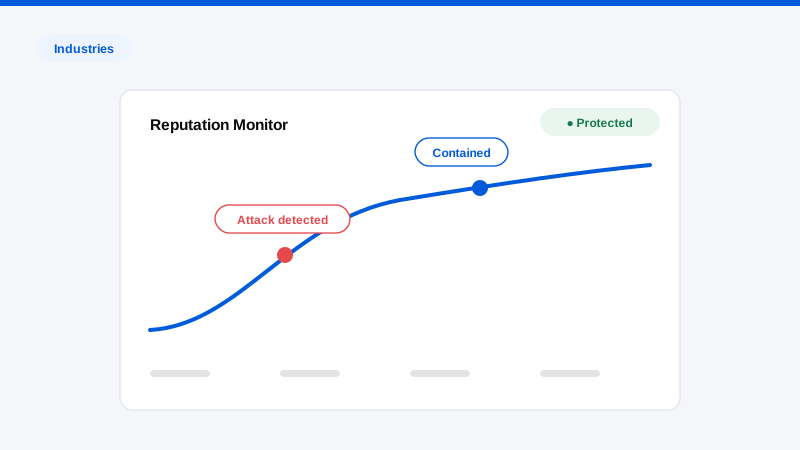
Monitor continuously. New reviews, new threads, and new impersonation accounts appear without warning, and early detection is the single biggest determinant of removal speed. Standing reputation monitoring across search, review platforms, and community forums, typically under an ongoing protection plan, turns reputation defense from an annual scramble into a quiet operational routine.
Respond fast when it counts. During a live episode (a review-bombing wave, a doxxing incident, a viral false claim in a parents’ group) hours matter. Established clients get incident response from a team that already knows their exposure map, rather than starting cold in mid-crisis.
Key takeaway: Professional protection is a cycle (audit, classify, remove, delist, monitor) run continuously. Schools that adopt it before a crisis handle crises as casework; schools that wait buy the same services under the worst possible conditions.
Why specialists beat DIY
Most schools first respond to harmful content in-house: the admissions director flags a review, the business officer submits a platform form, perhaps outside counsel sends a letter. The results are predictably poor, for reasons worth understanding.
Platform processes reward expertise and punish improvisation. Every removal venue has its own standards, forms, evidence expectations, and unwritten adjudication tendencies. Specialists work these systems daily and know what each venue accepts and how it actually decides. A school administrator encounters each system once, under stress, and learns its lessons at the school’s expense, a first filing that is vague or overreaching often hardens the platform’s position on that item permanently.
Legal threats frequently backfire in this sector. A demand letter to a parent reviewer or a community forum can escalate a private grievance into a public story. The letter itself gets posted, the community rallies against the school, and coverage of the dispute now outranks the original complaint. Knowing when legal pressure helps, when platform process is the better path, and when quiet delisting outperforms both is precisely the judgment schools are buying. (We are not a law firm; where litigation is genuinely the right tool, we work alongside your counsel and say so plainly.)
In-house response burns leadership attention at the worst moments. Removal casework is slow, procedural, and adversarial. Every hour a head of school or admissions director spends on it is an hour taken from families and faculty during exactly the periods, crises and admissions season, when leadership attention is scarcest.
Discretion is structurally easier for an outside firm. Schools need this handled quietly. A specialist firm operating under confidentiality keeps the school’s name out of direct correspondence with hostile posters and out of public disputes with platforms.
See what's out there before it becomes the story.Free confidential Exposure Scan: live results on a 15-minute call, yours to keep either way.
Book Your Free ScanWhy private schools choose Content Removal
Content Removal LLC is a removal-first firm: our entire practice is the identification and removal of defamatory, harassing, outdated, and unlawful content, executed by senior practitioners rather than ticket queues. Schools come to us for the combination this sector requires, discretion as a default posture, honest case assessment before any commitment, and documentation rigorous enough for board and counsel review.
Our assessments are blunt by design. We will tell you which items are strong removal candidates, which are delisting cases, which require patience, and which are legitimate opinion or accurate reporting that we will not pursue, because taking unwinnable or unethical cases would degrade the credibility that makes our filings effective everywhere else. We never promise outcomes; no honest practitioner can. What we commit to is the strongest available case for every qualifying item, pursued through the correct channel to conclusion, with transparent reporting throughout. Our case studies illustrate how that discipline translates into results.
For independent schools specifically, we protect the full surface: the school’s name, the head of school and senior administrators, faculty targeted by campaigns, review platforms and parent forums, alumni-community content, outdated news coverage, impersonation accounts, and the AI-generated answers parents increasingly rely on, under monitoring calibrated to the admissions calendar, when exposure matters most.
Frequently asked questions
Can a private school get fake or defamatory reviews removed?
Frequently, yes, when the review contains false statements of fact, comes from someone with no genuine relationship to the school, is part of a coordinated campaign, or violates the platform’s own policies. Success depends on the evidence assembled and the way the case is presented to each platform’s process. Genuine opinion from a real parent, however negative, is a different matter. It generally is not removable, and we will tell you that in the assessment rather than take your money to fail.
An old news story about a resolved incident still dominates our search results. What are the options?
Accurate reporting is rarely removable at the source, but the practical toolkit is broader than most schools realize: correction and update requests where the story has become materially misleading, delisting requests under search engines’ own policies for qualifying content, and structural work that ensures the story no longer defines the first page parents see. Which combination applies depends on the specifics, that determination is exactly what an initial assessment establishes.
A former community member is waging a sustained campaign against us. Can anything actually be done?
Usually more than the school assumes. Coordinated campaigns tend to leave patterns (recycled language, sock-puppet accounts, policy-violating conduct like harassment, impersonation, or doxxing) and those patterns are removal grounds that individual posts viewed in isolation don’t reveal. Campaign cases are built holistically: documenting the pattern, filing across platforms in parallel, and cutting off the infrastructure the campaign depends on. Persistence matters; campaigns that took months to build take sustained casework to dismantle.
When should a school engage a firm, after something happens, or before?
Before, and the reasoning is practical rather than promotional: monitoring catches new content in the window when removal is fastest, an existing exposure map turns crisis response from cold-start research into immediate action, and quiet delisting of old liabilities is best done in calm periods, not mid-incident. Schools that engage after a crisis get real help; schools that engage before one get better outcomes at lower total cost.
Admissions season is a referendum on your search results, and it is being conducted right now, silently, in households you will never hear from. A free, confidential Exposure Scan shows you exactly what those families are finding: live, on a 15-minute call, with the findings yours to keep either way. Book yours before the next inquiry cycle, and see your school the way prospective parents already do.