
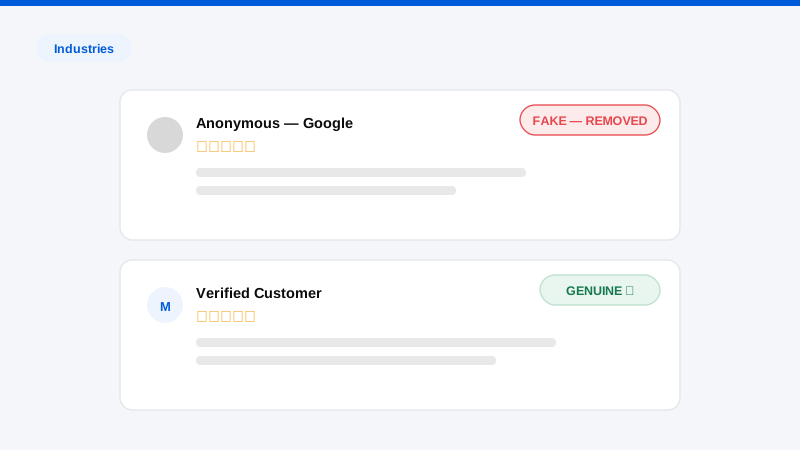
Reputation management for recruitment agencies is the practice of auditing, removing, and continuously monitoring the online content that candidates and hiring clients find when they research an agency (reviews, forum threads, “horror story” posts, and search results) so that the agency’s two-sided pipeline keeps flowing. Recruitment is the rare business that must pass reputational diligence twice on every placement: the candidate researches the agency before returning a recruiter’s call, and the client researches the agency before signing terms. A reputation problem visible to either side breaks the match, and the agency earns nothing.
No professional-services business generates negative content at the rate recruitment does, and the reason is structural rather than moral. An agency’s core output is rejection: for every placement, dozens of candidates were not chosen, and many of them experienced the process (often unfairly, sometimes accurately) as being ignored, ghosted, or used. Those candidates are digitally fluent, motivated, and standing on platforms built to receive their feedback. Add clients disputing fees, contractors disputing pay, and competitors in a commoditized market, and the recruitment agency operates under a steady rain of hostile content that most other industries see only in a crisis.
This guide defines that threat landscape, explains precisely how review floods and candidate horror stories convert into lost placements and lost clients, and lays out what professional, removal-first reputation management for recruitment agencies involves, and why agencies that treat it as a front-desk task keep losing ground to agencies that treat it as infrastructure.
What reputation management for recruitment agencies means
Reputation management for recruitment agencies means systematically controlling the agency’s presence across the surfaces both sides of the market check: Google reviews and the local pack, Glassdoor and Indeed employer profiles, Trustpilot, Reddit and niche career forums, “[agency] reviews” and “[agency] scam” search queries, and the AI-generated summaries candidates increasingly consult first. A removal-first program prioritizes getting policy-violating and defamatory content taken down or de-indexed at the source, before investing in suppression, because in recruitment the damaging content concentrates on exactly the queries that decide behavior, and content that is merely pushed down remains one scroll away from every diligent candidate.
The distinction from ordinary review management matters. Asking placed candidates for five-star reviews raises an average; it does not touch the fabricated review from someone the agency never worked with, the Glassdoor entry that mixes employee and candidate grievances into one misleading rating, or the forum thread titled “[agency] is a scam. Avoid.” Those require review-removal and defamation-removal work executed through each platform’s actual enforcement machinery, a different discipline entirely.
Key takeaway: Review generation and review removal are complementary but separate disciplines. Recruitment agencies need both, and the second is the one almost no agency has in-house.
Why recruitment agencies are targeted
The recruitment model produces attackers on four fronts at once, each with different motives and different platforms of choice.
Rejected and ghosted candidates. This is the volume driver. Candidates who felt strung along, ghosted after interviews, or pitched roles that didn’t exist convert frustration into one-star reviews and forum posts. The individual grievance is often understandable; the aggregate effect is a review profile that skews far more negative than the agency’s actual service quality, because placed candidates rarely review unprompted while aggrieved ones almost always do. Selection bias, not performance, writes the rating.
The horror-story genre. Career communities on Reddit and elsewhere maintain a standing appetite for recruiter horror stories, and threads naming specific agencies rank durably for “[agency] reviews” and “[agency] scam” queries. A single vivid story (accurate, exaggerated, or fabricated) can anchor a thread that shapes candidate perception for years, accumulating pile-on replies from people who never dealt with the agency at all.
Review-flood events. Recruitment agencies are unusually exposed to burst attacks: a layoff at a client whose employees blame the agency that placed them, a contractor pay dispute that spreads through a crew, a viral post that sends a community to the agency’s review profiles. Dozens of one-star reviews can land in days. Many from people with no direct relationship to the agency, which makes them policy-violating and removable, but only if challenged fast and correctly.
Platform-boundary confusion. Glassdoor and Indeed profiles blur internal employees, placed contractors, and candidates into one rating. A staffing agency’s Glassdoor score routinely reflects grievances about client worksites the agency doesn’t control. Clients doing diligence read the blended number at face value.
Client-side and competitor pressure. Fee disputes, guarantee-period disagreements, and poached-candidate accusations generate client-side complaints, while low switching costs and commoditized competition create incentive for fake negative reviews from rivals. Meanwhile, sophisticated clients run formal vendor diligence, MSP and procurement teams screen agencies before adding them to preferred-supplier lists, and visible reputational damage quietly disqualifies.
What’s at stake
The two-sided structure of recruitment means reputational damage compounds in ways single-sided businesses never experience.
Candidate-supply collapse is invisible and upstream. An agency’s real inventory is candidate willingness to engage. Candidates who search the agency after a recruiter’s outreach and find a hostile review profile simply don’t reply, and non-response is indistinguishable from ordinary passivity, so the agency never sees the cause. Falling response rates get blamed on the market, on the sourcing team, on the tooling. The reputational driver goes undiagnosed, sometimes for years, while the cost of every placement quietly rises.
Client diligence failures are silent and downstream. Hiring managers and procurement teams research agencies before signing terms and before every renewal. An agency with visible “scam” threads or a collapsed rating loses RFPs, preferred-supplier slots, and renewals without a stated reason. Worse, clients hold agencies to a brand-safety standard: the agency represents the client’s employer brand in the market, and no talent-acquisition lead wants their company’s roles marketed by an agency candidates distrust.
The flywheel runs in reverse. Recruitment economics run on a two-sided flywheel: strong candidate flow wins clients, strong roles win candidates. Reputation damage reverses it: weaker candidate response degrades delivery, degraded delivery costs client confidence, lost roles weaken candidate appeal. Each side’s decline feeds the other’s, which is why agencies that ignore early reputational damage often can’t identify the moment the slide began.
Recruiter hiring gets harder too. Agencies must also recruit their own staff, and prospective recruiters read the same Glassdoor profile clients do. Reputation damage thus hits all three populations the agency depends on (candidates, clients, and employees) through one search surface.
AI summaries harden the damage. Candidates and hiring managers increasingly ask AI assistants whether an agency is legitimate before engaging. These systems compress the agency’s review profile and forum presence into a few confident sentences; an agency whose index skews hostile receives a hedged or negative summary that ends diligence before it starts. Auditing what AI systems say about the agency is now part of protecting both sides of the funnel.
See what prospects find before they call you.Free confidential Exposure Scan: live results on a 15-minute call, yours to keep either way.
Book Your Free ScanWhat professional protection looks like
Professional protection for a recruitment agency is built for volume and speed, because the agency’s threat model is continuous low-grade fire punctuated by floods.
Two-sided exposure audit. The engagement begins by mapping what each audience actually finds: candidate-side surfaces (Google reviews, Glassdoor, Indeed, Reddit and niche forums, “[agency] reviews/scam” queries, autocomplete) and client-side surfaces (search results for the agency and its principals, Trustpilot, LinkedIn-adjacent content, AI summaries). The audit separates removable content from suppressible content and, critically for agencies, identifies which reviews come from people with no qualifying relationship to the agency, because that distinction drives the removal strategy.
Removal at the source. Fake, misattributed, and policy-violating reviews are challenged through each platform’s enforcement process with documented evidence: no candidate or client relationship, reviews aimed at a client worksite rather than the agency, coordinated-flood patterns, competitor fingerprints. Review floods get triaged as an event, platforms have specific mechanisms for coordinated-attack reports, and invoking them correctly can address a flood wholesale rather than review by review. Defamatory posts and horror-story threads are pursued through moderation escalation, policy-violation challenges, and host-level requests; where takedown isn’t achievable, de-indexing can pull the thread off the name queries where it does its damage.
Suppression built for both audiences. For residual content, suppression assets are engineered around both query families, candidate-side (“[agency] reviews,” “is [agency] legit”) and client-side (agency and principal names). Earned press coverage serves agencies doubly: it outranks hostile content and directly counters the legitimacy doubt that horror-story threads plant.
Standing monitoring with flood response. Recruitment is the clearest case in professional services for continuous monitoring backed by a Protection Plan with response capacity on standby. Floods are won or lost in the first days: fresh coordinated reviews are demonstrably anomalous and removable as a pattern, while the same reviews six months later look like organic history. An agency that discovers a flood at its next quarterly marketing review has already absorbed most of the damage.
Key takeaway: For recruitment agencies, the decisive capability is flood response, detecting a review pile-on within days and challenging it as a coordinated event while the pattern is still provable. That capability cannot be improvised mid-crisis; it has to be standing.
Why specialists beat DIY reputation management for recruitment agencies
Most agencies assign reputation to marketing or office management: reply to reviews, flag the worst ones, move on. The results are predictably poor, for reasons specific to the recruitment context.
Platform enforcement is a professional practice. Glassdoor, Google, and Trustpilot each apply different eligibility rules, evidence standards, and escalation paths, and their front-line moderation queues auto-reject generic flags. Knowing that a given review is challengeable because the author had no qualifying relationship, and how to document that without disclosing candidate data, is precisely the kind of judgment that develops only across hundreds of matters. Agencies flagging occasionally burn their strongest challenges on badly framed first attempts, and rejected flags make second attempts harder.
Public replies are a trap with extra teeth for agencies. Replying to a candidate review in any detail risks disclosing information about that person’s job search, a confidentiality breach in an industry that runs on discretion, and hostile threads treat recruiter self-defense as content. The safe posture is third-party removal work in which the agency never engages the attacker.
Internal teams cannot staff for floods. A coordinated pile-on demands immediate, platform-fluent response at exactly the moment the agency’s team is managing the underlying crisis. Specialist reputation-management support exists precisely so that capacity is on call rather than improvised.
See what prospects find before they call you.Free confidential Exposure Scan: live results on a 15-minute call, yours to keep either way.
Book Your Free ScanWhy recruitment agencies choose Content Removal
Content Removal LLC is a removal-first firm: our core practice is getting damaging content taken down, de-indexed, or corrected at the source, across the exact platforms where recruitment attacks live. Agencies choose us because we are built for their threat model.
We handle both sides of the agency’s exposure, candidate-facing review profiles and client-facing search results, as one engagement, including principal-level protection for founders and directors whose names appear in client diligence. We work review floods as coordinated events, not one flag at a time. We keep the agency out of the fight: no public replies, no direct engagement with attackers, nothing that touches candidate confidentiality, and we scope with candor, after the audit, we tell you which items are strong removal candidates, which are long shots, and which call for suppression, because outcomes in this field cannot be guaranteed and agencies should walk away from any vendor who says otherwise. We are not a law firm and do not give legal advice; where counsel belongs in the picture, we work alongside yours. Our case studies show how engagements run from audit to standing protection.
Key takeaway: The right partner for an agency covers both sides of the marketplace, treats floods as events, and pairs removal capability with monitoring, because in recruitment, the next attack is a matter of when.
Frequently asked questions
Can Glassdoor reviews about client worksites be removed from our profile?
Often they can be challenged. Glassdoor’s policies govern who may review an employer and what reviews may contain, and reviews from individuals describing a client’s workplace rather than the agency’s own conduct, or from people with no qualifying relationship at all, frequently fall outside those rules. Success depends on documenting the mismatch the way the platform’s process requires. No single review can be guaranteed removable, but misattributed worksite reviews are a recurring and frequently winnable category for staffing firms.
We just got hit with a wave of one-star reviews after a client’s layoff. What actually helps?
Speed and pattern documentation. A burst of reviews from people who were never agency candidates or clients is challengeable as a coordinated or policy-violating event, and platforms weigh recency and anomaly patterns heavily. The same reviews challenged months later read as organic history. This is exactly the scenario standing monitoring and on-call removal capacity exist for, and exactly the scenario that cannot be handled well starting from zero mid-flood.
Should we reply publicly to negative candidate reviews?
Sparingly and generically, if at all, and never with details. Any reply that references a specific person’s search, interviews, or placements risks breaching the confidentiality candidates and clients both expect from an agency. Removal, de-indexing, and platform enforcement do the substantive work without creating new exposure; public replies are cosmetic at best and self-harming at worst.
Does a small or niche agency really need standing protection?
Niche agencies often need it most. In a specialized vertical, one entrenched horror-story thread reaches a large share of the total candidate pool, and clients in the niche all see the same results. Scope scales with size, a boutique’s protection plan looks nothing like a national staffing firm’s, but the structural exposure is identical, and smaller firms have less pipeline cushion to absorb the damage.
Every placement your agency will make this quarter starts with two searches (one by the candidate, one by the client) and hostile content visible to either one quietly breaks the match. See what both sides are seeing: book a free, confidential Exposure Scan and walk through your agency’s live results on a 15-minute call. The findings are yours to keep either way.