
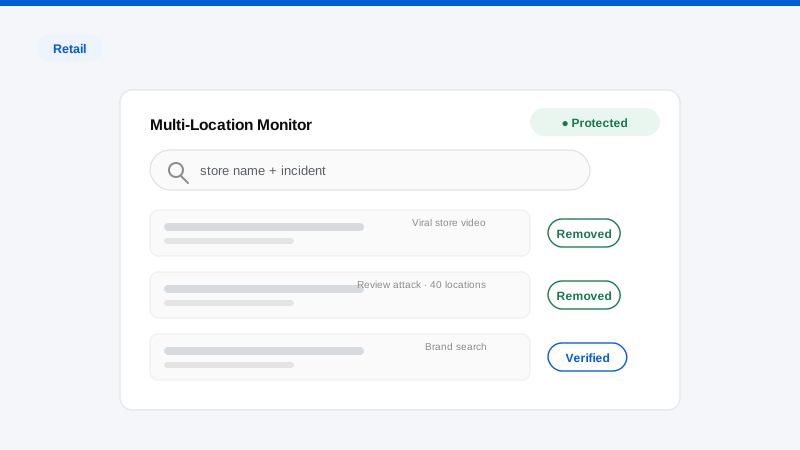
Reputation management for retail chains is the practice of controlling what customers, landlords, investors, and journalists find when they research a retail brand, any of its hundreds of locations, or its executives, and removing the damaging content that would otherwise let a single incident at a single store define the entire chain. Retail’s defining reputational feature is surface area: every location has its own review profiles, its own local search results, its own staff with phones, and its own daily stream of customer interactions that can be filmed, clipped, and posted. A chain with five hundred stores is not managing one reputation; it is managing five hundred and one (each location’s, plus the brand’s) and an attack on any node reaches the whole network within hours.
That asymmetry is what makes retail uniquely exposed. The brand spends decades and enormous budgets building a national identity, and a thirty-second video filmed in one aisle by one customer can attach itself to the brand name in search and social results indefinitely. The incident may involve one employee, one policy misunderstanding, one bad afternoon, but the content is indexed against the chain, and every future customer, franchisee, landlord, and job applicant who searches the name inherits it. This guide describes how these attacks operate against retail chains, what they cost across the P&L, why conventional PR and SEO responses fail, and what professional, removal-first protection looks like at chain scale. It is written for CMOs, heads of communications, general counsel, franchise leadership, and the executives whose own names trend alongside the brand’s when an incident goes viral.
Why retail chains are targeted
Retail combines massive public visibility with thousands of daily unscripted human interactions, a combination no other industry matches, and one that produces a distinctive threat landscape.
Viral incident videos are filmed inside your own stores. Confrontations between staff and customers, disputes over returns and policies, security stops, and moments of ordinary human friction are recorded daily on customer phones, stripped of context, and posted with captions engineered for outrage. The algorithm does the rest. Within hours, a local incident becomes a national story, the chain’s name is the hashtag, and the video begins ranking for brand searches. The follow-up (the context, the resolution, the apology accepted) never travels as far as the clip, and the clip never expires.
Location-level review attacks exploit the chain’s weakest point. Every store carries its own Google Business Profile and review surfaces, and each one is an unguarded door. A viral incident, a local controversy, or a coordinated campaign can flood dozens or hundreds of location profiles with one-star reviews from people who have never entered the stores: dragging down local rankings, poisoning map-pack results, and suppressing foot traffic market by market. Because the attack is distributed across hundreds of listings, most chains lack even the visibility to see its full shape, let alone respond to it.
Employee TikToks turn the back room into a broadcast studio. Current and former staff post behind-the-counter content: some affectionate, some damning. Videos alleging unsanitary conditions, mocking customers, exposing internal policies, or dramatizing quitting can pull millions of views precisely because they carry insider credibility. A single “what I saw working at [chain]” video can outperform the brand’s entire official channel and permanently join its search results.
Seasonal-hiring cycles produce Glassdoor and Indeed pile-ons. Chains hire and release tens of thousands of seasonal workers a year, and every cycle deposits a fresh layer of employer reviews. Many legitimate, some retaliatory, some fabricated, all indexed. Layoffs, scheduling disputes, and store closures trigger concentrated pile-ons that dominate the chain’s employer-search results just as the next hiring season begins, raising the cost and lowering the quality of every subsequent applicant pool.
Boycotts and political crossfire attach durable content to the brand. Retail chains are consumer-facing, ubiquitous, and symbolically useful, which makes them the default target when activists on any side need a corporate face for a cause. Campaign hashtags, petition pages, and call-to-action threads are engineered to rank for the brand name, and they remain in the index long after the controversy has been forgotten by everyone except the search engine.
Executives become the story’s face. When an incident trends, coverage and commentary migrate up the org chart within a news cycle. CEOs and founders are named, doxxed, meme’d, and petitioned against; their compensation, homes, and families become content. The executive’s personal search results are damaged in ways that outlast both the incident and their tenure.
What damaging content costs retail chains
The damage flows through mechanisms that rarely announce themselves on any single report.
Foot traffic and basket decisions are made at the search bar. Retail customers increasingly search a store or brand before visiting, for hours, for directions, for “is it worth it.” When that search returns a viral confrontation video, a one-star review wall, or a boycott thread, the visit silently doesn’t happen. Multiplied across hundreds of locations and millions of monthly searches, content-driven traffic erosion becomes a material revenue line that never appears as one.
Landlords, developers, and partners run diligence too. Premium retail locations are competitive, and landlords assess the reputational profile of prospective tenants, as do co-tenancy partners, licensors, and the brands a chain seeks to stock. Hostile search results become a quiet factor in lease negotiations, partnership terms, and which chain gets the flagship corner.
Franchise systems amplify every incident twice. For franchised chains, damaging content cuts in both directions: incidents at franchise locations attach to the national brand, and national controversies crater the local economics of every franchisee. Franchise development, selling new units, depends heavily on what prospective franchisees find when they research the system, and a search page full of incident coverage and franchisee disputes stalls unit growth directly.
Public chains wear it in the share price; private ones wear it in the deal terms. Analysts track viral incidents and boycott momentum as same-store-sales risk, and the market prices the headline before the quarter reports. Private chains meet the same content in lender diligence, sponsor diligence, and the risk-factors section of every transaction they attempt.
Regulators and plaintiffs’ lawyers monitor the same feeds. Viral videos alleging discrimination, safety lapses, or labor violations draw the attention of enforcement agencies and class-action firms, for whom trending content is effectively free case generation. The existence of an inquiry then becomes its own searchable story, compounding the original.
Hiring at scale gets more expensive with every negative layer. A chain hiring thousands of workers a year is running one of the country’s largest continuous recruitment campaigns, and every applicant searches the brand first. Employer-review pile-ons and viral workplace content measurably shrink applicant pools and raise wage requirements, a tax on every location’s labor line.
Why generic PR and SEO approaches fail
The instinctive corporate playbook (statement, media outreach, an SEO retainer to bury the bad results) was built for a slower internet and a single reputation. It fails at chain scale for structural reasons.
One brand-level response cannot cover five hundred local surfaces. PR operates at the national narrative level, but the damage lives in hundreds of location-level review profiles, local map results, and community groups that no press release reaches. The narrative may be managed while the local surfaces, where customers actually decide, remain saturated with the attack.
Suppression leaves the content live and re-armable. SEO burial does not remove the viral video or the review wall; it papers over them until the next incident, at which point every buried item resurfaces to form a “pattern” in fresh coverage. And AI assistants now draw on the full indexed record: a chatbot asked “what happened at [chain]” will happily summarize content that a suppression campaign pushed to page four.
Responding at brand level amplifies incidents that were still local. A national statement about a store-level video hands newsrooms a second-day story and confirms the incident as brand-defining. Often the strategically correct move is the quiet one, removal and de-indexing of the distortive content, which is precisely the move generalist agencies are not equipped to execute.
The professional sequence inverts the playbook: shrink the hostile record first, at the source, across every surface where it lives; then de-index what remains; and only then invest in visibility on cleared ground. That sequencing is the foundation of our brand protection practice.
What removal-first protection looks like
Removal-first protection for a retail chain runs a strict sequence (assessment, removal, de-indexing, monitoring) engineered for an organization with hundreds of exposure points.
Assessment across the full estate. The engagement begins with a chain-wide exposure audit: brand-level search results, every location’s review profiles, employer-review platforms, social and video platforms, and the personal search results of named executives: mapped, graded by severity and reach, and sorted by removability. At chain scale, triage is the strategy: knowing which hundred items matter most and which removal path each is eligible for. We run this as a free, confidential Exposure Scan, reviewed live with your team.
Removal at the source. Fabricated reviews, coordinated review attacks, policy-violating videos, impersonation accounts, defamatory posts, and doxxing content each have removal mechanisms under the hosting platforms’ own rules: inauthentic-behavior policies, harassment policies, impersonation policies, privacy policies. Specialists argue these in each platform’s own terms, at volume, with escalation paths learned across thousands of prior matters. The honest caveat, stated up front: platforms and publishers control removal decisions, and no credible firm guarantees a specific outcome. What changes with specialists is the hit rate, the speed, and how much of the target set falls.
De-indexing from search. Content that cannot be removed from its host can often be removed from search results (the layer where customers, landlords, and applicants actually encounter it) under search engines’ own policies for specific categories of harmful and personal content. For a chain, de-indexing at both brand-level and location-level queries closes the discovery paths that matter commercially.
Monitoring across every node. Retail attacks begin locally and scale fast; the defense is detection while the count is small. Continuous monitoring across brand and location search results, review surfaces, video platforms, employer-review sites, and AI-generated answers, paired with reserved removal capacity, means response begins within hours of the first post, not after the millionth view. Our Protection Plans keep this on a standing footing, which for a chain is the difference between an incident that stayed in one store and one that reached the earnings call.
Protecting the executives behind the chain
When a retail brand trends, its leadership trends with it. CEOs, founders, and even regional executives are named in coverage, targeted in comment sections, doxxed on activist channels, and impersonated in fake statements. Their compensation becomes a meme, their homes become content, and their families inherit the exposure.
This personal layer requires its own defense, because it lives on different surfaces with different removal paths: data-broker profiles exposing home addresses and relatives, doxxing posts, resurfaced litigation and personal records, impersonation accounts, and AI summaries that repeat all of it as established fact. Damaged executive search results outlast the incident and the tenure, following leaders into every board seat and role that comes after. Our digital executive protection practice handles this layer as a distinct discipline, and for retail chains we typically run it alongside brand protection as a single engagement, because attackers make no distinction between the logo and the person.
Frequently asked questions
A video filmed in one of our stores is going viral. Can it be removed?
Sometimes: it depends on what the video shows and how it is framed. Content that is materially deceptive, harassing toward identifiable employees, or in violation of the platform’s policies has genuine removal paths; accurate footage of a real incident generally does not, and the work shifts to de-indexing, containment, and preventing the clip from permanently defining brand searches. The realistic assessment comes first, before any effort is spent.
Dozens of our locations were review-bombed simultaneously. What can be done?
Coordinated review attacks violate the inauthentic-content policies of every major platform, and reviews from accounts with no genuine customer experience are removable in many cases. The work is evidence-driven and platform-by-platform: documenting the coordination pattern across locations and arguing it in each venue’s own terms. Handled quickly and systematically, review bombing is among the more addressable attack types, but at chain scale it requires tooling and volume experience that in-house teams rarely have.
Our employer reviews are dominated by seasonal-workforce pile-ons. Does that really matter?
It does: a chain hiring at scale pays for its employer-search results in every applicant pool, and reviews that are fake, retaliatory, or policy-violating are legitimate removal targets. The remainder is addressed at the search layer so that outdated pile-ons stop defining the brand for the next hiring season. This is diligence-facing content too: franchise prospects and partners read it alongside candidates.
Should each location manage its own online reputation?
Location teams should own service recovery, responding to genuine customer feedback. But attacks, coordinated campaigns, and viral content are network-level threats that individual store managers can neither see in full nor counter, and five hundred improvised local responses create risk rather than reducing it. The defensible model is centralized detection and removal with local teams handling the genuine relationships.
When is the right time to engage, during a crisis or before one?
Before, if the choice exists. Chains that engage pre-crisis enter the next viral moment with historical exposure already cleaned, monitoring already watching every node, and removal response starting within hours. Mid-crisis engagement still works, but the first days of a viral event are when removal and de-indexing have the most leverage, and standing capability is what makes those days usable.
Every customer, landlord, franchisee, and applicant who considers your chain this year will search it first, and they will search the location nearest them, too. Find out what all of those searches return before the next incident decides it. Our free, confidential Exposure Scan maps the damaging content attached to your brand, your locations, and your leadership, reviewed live on a 15-minute call, with the findings yours to keep either way.