
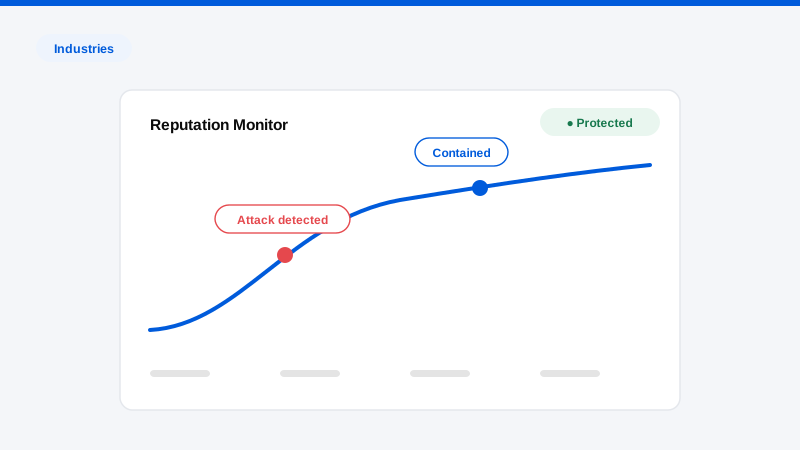
Reputation management for hospitals and healthcare systems is the enterprise discipline of protecting what patients, payers, physicians, and communities find when they research a hospital, its facilities, and its people, removing false and harmful content where platforms allow, containing viral incidents at the source, suppressing what cannot come down, and monitoring the system’s entire digital surface continuously. For a hospital, reputation is not one department’s problem. It moves patient volumes, physician recruitment, payer negotiations, bond narratives, and philanthropy, which is why reputation risk now appears on board agendas alongside cyber and compliance risk.
Hospitals present the largest and most complex attack surface in healthcare. A health system’s reputation is the sum of every facility, every employed and affiliated physician, every nurse with a social media account, every billing interaction, and every emergency department wait, any one of which can become the story that defines the system online, and unlike a solo practice, a hospital’s crises are newsworthy by default: a single incident can generate press coverage, review floods, and social media pile-ons simultaneously, each feeding the others.
This guide defines the threat landscape at the system level, lays out what is at stake through a board lens, and describes what professional, removal-first reputation protection looks like for healthcare enterprises, and why systems increasingly retain specialists rather than routing this through the marketing department.
Why hospitals are targeted
Hospitals draw online attacks and reputation damage at a scale and complexity no individual practice faces.
Every patient interaction is a potential public event. A health system conducts thousands of encounters daily, and a meaningful fraction end in frustration: waits, denials, billing disputes, outcomes families weren’t prepared for. Each carries some probability of becoming public content. At hospital volumes, low-probability events are certainties: the question is never whether damaging content will appear, only what and when. No individual practice faces this law-of-large-numbers exposure.
Viral incidents are the defining threat. A recorded altercation in a waiting room, a family’s account of a denied treatment, a photographed hallway bed, a nurse’s TikTok, hospital incidents are inherently filmable and emotionally charged, and platforms distribute them explosively. Local news amplifies what social media surfaces; social media amplifies what local news reports. A single incident can, within days, dominate the system’s search results, trigger a review flood across every facility, and become the reference point for AI-generated summaries of the institution.
Review floods punish institutions for single events. When an incident goes viral, strangers with no connection to the hospital flood its profiles with one-star reviews, a documented pattern across platforms. The flood hits every facility in the system, drags averages down in days, and persists long after coverage fades. This is not organic patient feedback; it is coordinated or contagion-driven inauthentic activity, and platforms treat it differently, when the case is properly made.
Staff conduct becomes institutional scandal. A clinician’s arrest, a nurse’s offensive post, a lawsuit against an affiliated physician, individual conduct attaches to the institutional brand instantly. The hospital inherits search results for people it may have already terminated, and coverage of a staff scandal can outrank everything the system publishes about itself. Years later, outdated content about long-departed staff still surfaces on the system’s queries.
Billing is a permanent grievance engine. Hospital billing generates more sustained public anger than any clinical issue: surprise bills, collections coverage, charity-care controversies. Billing narratives are uniquely durable because they are legible to everyone: readers who can’t evaluate a clinical complaint understand a five-figure bill perfectly.
Hospitals are institutional targets. Activist campaigns, labor disputes, disgruntled former employees, and politically charged controversies all treat the hospital’s online reputation as leverage. Some attacks aren’t about any incident at all; they’re about pressure.
Key takeaway: Hospitals face compound exposure (massive interaction volume, filmable incidents, review contagion, and staff-conduct inheritance) meaning damaging content is a statistical certainty. The differentiator between systems is not whether damage appears, but how fast and how completely it is contained.
What’s at stake for a healthcare system
Patient volumes follow perception. Healthcare consumerism is real: patients choose emergency departments, maternity programs, orthopedic centers, and elective procedures based on what they find online, and service-line volumes respond to reputation damage in ways that are difficult to trace and easy to underestimate. Because hospital margins concentrate in precisely the elective, choosable service lines, reputation damage lands disproportionately on the revenue that matters most.
Physician and nurse recruitment is a search-results problem. Every recruited physician, resident, and nurse researches the institution before signing. Visible scandal coverage, review floods, and staff-conduct stories raise the effective cost of every hire in a labor market where clinical talent is the binding constraint. Recruitment firms will not say “candidates are Googling you”; candidates simply decline.
The damage is board-level because the exposures are board-level. Reputation events at hospitals implicate the concerns boards already own: payer leverage in rate negotiations, philanthropy and capital campaigns, community standing that underwrites certificate-of-need and expansion politics, and the institutional narrative that rating agencies and lenders absorb along with the financials. A viral incident is never just a communications event; it is a balance-sheet event with a communications surface.
Crisis coverage never expires on its own. News archives, attorney-general press releases, and litigation coverage persist indefinitely and rank durably on institutional queries. A hospital can spend years rebuilding community trust while page one still leads with its worst week. Search engines have no statute of limitations, and neither do the AI systems trained on what search surfaces.
AI summaries institutionalize the record. Patients, recruits, and journalists now ask AI assistants to summarize hospitals. These systems compress whatever is prominent (incident coverage, review sentiment, scandal reporting) into confident institutional narratives repeated verbatim across thousands of queries. A system that has not addressed how AI describes it has outsourced its institutional narrative to whatever happened to rank.
See what patients find before they book.Free confidential Exposure Scan: live results on a 15-minute call, yours to keep either way.
Book Your Free ScanWhy hospital reputation management must be removal-first
Health systems typically respond to reputation damage with the tools they have: communications teams issue statements, marketing buys visibility, agencies publish content. All of this manages the narrative around damaging content while leaving the content itself untouched: live, ranking, feeding review averages and AI summaries, and waiting for the next news cycle to resurface it.
A removal-first posture inverts the sequence. Before asking “what do we say about this?”, it asks “does this content violate the policies of the platform hosting it, and can it come down?” Applied at hospital scale:
Review floods are contestable as floods. Reviews from individuals with no patient relationship, posted in coordinated waves around a news event, violate platform authenticity policies. The professional response is forensic: documenting the temporal cluster, account patterns, and content markers, and presenting the flood to platforms as the inauthentic event it is, facility by facility, at scale. This is review remediation as an enterprise workflow, and it can restore rating integrity in a way no volume of “responding with empathy” ever will. Where individual responses are warranted, they are drafted HIPAA-safe: no confirmation of any patient relationship, no treatment details, no PHI, ever. A health system’s greatest review-response risk is a well-meaning facility manager writing publicly about a patient’s visit.
False and defamatory content has enforcement paths. Fabricated accounts, impersonation pages, false-fact posts, and doctored media violate specific platform policies with specific escalation channels. Content Removal is not a law firm and provides no legal advice. We execute platform-side casework and coordinate with the system’s in-house and outside counsel when matters warrant formal action. See our defamation removal practice for how these cases are structured.
The long tail is removable more often than systems assume. Outdated staff listings, coverage of resolved matters, stale pages about departed physicians, superseded content on complaint boards, much of the accumulated sediment on a system’s queries can be removed, corrected, or deindexed rather than merely outranked.
Suppression is deployed where it belongs. Legitimate news coverage of real events generally cannot and should not come down; there, the correct tool is building the institution’s authoritative presence so accurate, current material dominates the results and the AI-visible record, search-results work as the second line, integrated with communications, never a substitute for removal where removal is available.
Key takeaway: Hospital communications teams manage what is said; removal specialists manage what remains findable. A system that does the first without the second wins each news cycle and still loses the permanent record.
What professional protection looks like for a healthcare system
At the enterprise level, professional reputation protection is a standing program with defined scope, ownership, and cadence.
System-wide exposure mapping. The engagement begins with an audit across the full surface: every facility’s profiles and reviews, search results for the system and its named leaders and high-profile physicians, news archives, complaint boards, social platforms, and AI assistant outputs. Systems consistently discover exposure they didn’t know they carried: orphaned facility listings, departed-physician content still attached to the brand, and third-party pages ranking on service-line queries.
Prioritized removal casework. Findings are triaged by damage and removability, then worked as cases: review-flood challenges by facility, defamation escalations, impersonation takedowns, outdated-content removals. Enterprise scale demands process (evidence standards, platform-specific playbooks, escalation ladders) rather than ad hoc reporting.
Incident-response integration. When an incident goes viral, the removal workstream runs parallel to communications from hour one: capturing the review flood as it forms (contemporaneous documentation strengthens platform cases), reporting policy-violating viral content early in its arc, and containing impersonation and pile-on accounts. Speed is decisive; floods are easiest to unwind while they are demonstrably anomalous.
HIPAA-safe response governance. We help systems standardize review-response practices across facilities so that no public reply ever confirms a patient relationship or discloses patient information, closing one of the most common self-inflicted compliance wounds in hospital reputation work.
Continuous monitoring under a Protection Plan. A hospital’s threat surface never sleeps, and detection speed determines containment cost. Protection Plans put the system’s facilities, executives, and key physicians under continuous monitoring with defined alerting, so review anomalies and emerging content are flagged in days, not discovered in a board packet. For systems managing active narratives, coordinated press and authoritative-content work strengthens the record that search and AI systems draw from.
Executive and physician protection. System reputation concentrates in people. Programs typically extend to the CEO, key service-line leaders, and high-visibility physicians, because an attack on any of them is an attack on the brand. Our physician-focused practice covers the individual-provider dimension in depth.
See what patients find before they book.Free confidential Exposure Scan: live results on a 15-minute call, yours to keep either way.
Book Your Free ScanWhy hospitals choose Content Removal
We do the layer nobody else in the stack does. Systems already have communications teams, marketing agencies, and law firms. What none of them do is platform removal casework at scale: the evidence-driven, policy-specific work of getting floods unwound, defamation escalated, and sediment cleared. Content Removal slots into the existing stack as the removal layer, coordinating with communications and counsel rather than duplicating them.
Enterprise process, specialist depth. Hospital engagements demand both: playbooks that scale across dozens of facilities, and platform-level expertise about which arguments move which platforms and how escalation actually works. That combination is our practice, refined across the engagements documented in our case studies.
Compliance-aware by construction. Every workflow we run for a health system is built for a covered entity: no PHI in evidence packages, no patient relationships confirmed in responses, governance that keeps facility-level staff from improvising in public. We are not a law firm and provide no legal advice, and we are disciplined about staying on our side of that line while working alongside counsel.
Honest assessment, no guaranteed outcomes. No firm can guarantee removal of any specific content, and enterprise buyers should treat outcome guarantees as a red flag. What we provide is triage a board can rely on: what is likely removable, what must be suppressed, what should simply be watched, with reporting that shows exactly what was done and what happened.
Discretion appropriate to the stakes. Engagements are confidential, and our work generates no public footprint suggesting the system has retained a reputation firm.
Key takeaway: Hospitals choose Content Removal because we supply the one capability their existing communications, legal, and marketing stack lacks, systematic removal of harmful content at the source, run as an enterprise program with compliance built in.
Frequently asked questions
Can a hospital get a review flood removed after a viral incident?
Often, substantially, because floods are inauthentic by nature. Reviews posted by people with no patient relationship, clustered around a news event, violate platform authenticity policies, and platforms act on well-documented flood cases. Speed and evidence quality drive outcomes: floods documented as they form are far easier to unwind than floods discovered months later. No specific removal can be guaranteed, but flood casework is among the most tractable categories in enterprise reputation work.
How should hospital staff respond to negative reviews without creating HIPAA risk?
By never confirming a patient relationship and never referencing any detail of any visit, no dates, no departments, no circumstances. Appropriate responses are brief, generic, and invite offline contact through official channels. The highest-risk pattern in hospital review management is a sincere, detailed public reply from facility staff; governance and templates exist precisely to prevent it. We help systems standardize this across every location.
News coverage of an old incident still dominates our search results. What can be done?
Legitimate news generally cannot be removed, but the surrounding record can be corrected and rebuilt: outdated and derivative content cleared where policies allow, authoritative current material developed so it ranks on the queries that matter, and the AI-visible record updated so summaries reflect the institution as it is, not as it was at its worst moment. The right mix depends on what specifically ranks, which is what an exposure audit determines.
Should reputation protection cover our executives and physicians, or just facilities?
Both, without question. Attacks concentrate on people (a named CEO, a physician in litigation, a nurse in a viral video) and person-level content attaches to the institutional brand immediately. Enterprise programs we run typically cover the system, its facilities, its executive team, and its highest-visibility clinicians as a single monitored surface.
Somewhere in your system’s footprint right now is content you haven’t found yet. Request a free, confidential Exposure Scan: in 15 minutes we’ll walk your team through the system’s live exposure (facilities, leaders, reviews, and AI summaries) with a candid triage of what can likely be removed. The findings are yours to keep either way.