
Reputation management for supplement brands is the discipline of controlling what health-conscious buyers find when they search a brand’s name next to the words that decide the sale (“scam,” “side effects,” “safe,” “legit”) and removing the hostile content that puts those words there. No consumer category is researched with more suspicion than supplements. The buyer is about to swallow your product, the category’s history has trained her to expect snake oil, and every trust surface she consults (search results, Amazon reviews, Reddit threads, and now AI assistants) is open to manipulation by competitors, copycats, and opportunists.
Supplement brands live and die on a paradox: the category’s low barriers to entry create the crowded, scammy landscape that makes buyers suspicious, and that suspicion is then weaponized against the legitimate brands trying to rise above it. A competitor seeding “is [brand] a scam” content, a coordinated Amazon review attack before your biggest sales week, a copycat product wearing your trade dress, an AI answer casually asserting safety concerns about your formulation, each exploits the buyer’s trained doubt, and each compounds in search results that never expire on their own.
This guide defines the supplement threat landscape as practitioners see it, explains the mechanisms by which it destroys revenue and retail standing, and lays out what professional, removal-first protection looks like, and why serious supplement brands retain a specialist firm rather than fighting review attacks with customer-service replies.
Why supplement brands are targeted
Supplement brands are targeted because the category concentrates every incentive for reputational attack: high margins, low product differentiation, purchase decisions ruled by trust signals, and a buyer base primed to believe the worst. In a market where formulations are similar and claims are constrained, reputation is the battlefield, so that is where competitors and bad actors fight.
“Scam” and “side effects” searches are the kill zone. Supplement buyers verify before they buy, reflexively searching the brand name with “scam,” “review,” “side effects,” or “FDA.” That behavior creates a predictable, high-value target: whoever controls those search results controls the sale. Competitors, affiliate marketers running “review” sites that funnel to rival products, and complaint-site operators all understand this, and they build content for exactly those queries. A single well-ranked “Is [Brand] a Scam? What They Don’t Tell You” page, often an affiliate funnel in disguise, can tax every sale the brand attempts for years.
Amazon review attacks are cheap, deniable, and devastating. For most supplement brands, Amazon is a primary revenue channel, and reviews govern everything there: ranking, conversion, ad efficiency, buy-box economics. That makes review sabotage the category’s favorite weapon, clusters of one-star reviews alleging side effects or fakery, timed to launches and peak seasons, seeded by competitors or paid services. Health-scare language is the attack of choice because it is unfalsifiable in the moment and maximally frightening to the next buyer reading it.
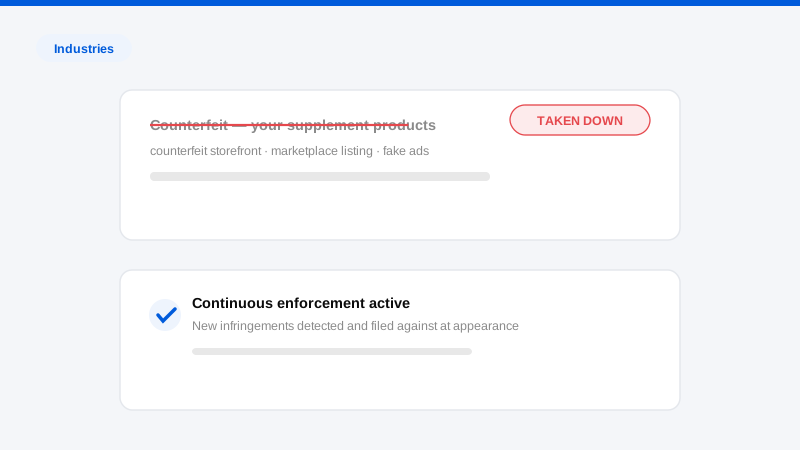
Copycat products convert your trust into their revenue. Supplement copycats operate at every level of brazenness: near-identical trade dress and names sold on the same marketplaces, counterfeit versions of the brand’s actual products, and fake storefronts running ads with stolen imagery. Because the buyer ingests the product, every copycat unit is a safety incident waiting to be attributed to your name, an adulterated capsule sold in your trade dress becomes your “side effects” complaint.
AI answers now issue safety verdicts. Buyers increasingly ask AI assistants directly: “Is [brand] safe?” “Does [product] work?” “[Brand] vs [competitor]?” Those answers are synthesized from the open web (the complaint threads, the attack reviews, the affiliate hit pieces) and delivered with the confident tone of a neutral expert. For an ingestible product, what AI systems say about your brand is now a frontline trust surface, and most brands have never audited it.
Key takeaway: In supplements, reputation is not adjacent to the product. It is the product’s precondition. The buyer’s doubt is structural to the category, and every attacker’s strategy is simply to aim that existing doubt at your name.
What’s at stake
What’s at stake for a supplement brand under reputational attack is the entire revenue mechanism, because in this category trust failures do not dent conversion. They zero it. Nobody “risks it” on a supplement that search results suggest is unsafe. The damage operates through four compounding mechanisms.
The verification search decides the sale invisibly. A buyer who finds a “scam” allegation or a side-effects thread does not complain, does not contact support, does not give the brand a chance to respond. She closes the tab and buys the competitor, often via the very affiliate page that manufactured her doubt. The brand experiences this as softening conversion and rising acquisition costs, and rarely traces it to the defamatory content sitting third in its search results.
Amazon’s flywheel spins both directions. Review scores feed ranking; ranking feeds sales velocity; velocity feeds ranking. A successful review attack doesn’t just deter readers. It degrades the algorithmic position the brand spent years and significant ad spend building, and the flywheel that compounded growth begins compounding decline. Elevated complaint rates can also trigger listing suppressions and account health issues at precisely the worst commercial moments.
Copycats manufacture your safety record. Every adulterated or substandard copycat unit sold in your trade dress generates authentic, sincere complaints against your brand: reviews, social posts, even adverse-event reports. Left running, a copycat operation writes a safety history you never earned, in the one category where safety history is everything.
Retail and platform gatekeepers read your search results. Buyers are not the only ones searching your brand plus “scam.” Retail category managers, marketplace compliance teams, payment processors, and ad platforms all run the same checks, and all of them de-risk by declining. A contaminated search landscape quietly costs distribution deals, ad account standing, and processing relationships the brand may never learn it lost.
See what buyers find when they search your brand.Free confidential Exposure Scan: live results on a 15-minute call, yours to keep either way.
Book Your Free ScanWhat professional reputation management for supplement brands looks like
Professional reputation management for supplement brands is removal-first: the objective is to make the hostile content (attack reviews, defamatory “scam” pages, copycat listings, stolen-imagery ads) cease to exist at the source, rather than to answer it, bury it, or advertise around it. In a category where a single health-scare claim can outweigh a thousand positive impressions, only absence actually solves the problem. The professional sequence has four layers.
Remove at the source. Policy-violating Amazon and platform reviews are challenged through each venue’s integrity process with the specific evidence that venue requires, the core craft of professional review removal, and a different discipline from replying politely in the seller console. Defamatory “scam” pages and false health claims are pursued through platform policy and defamation removal pathways. Copycat listings and counterfeit products come down through intellectual property enforcement; the stolen product photography and label imagery that make copycats and fake ads convincing are pursued through copyright infringement removal across marketplaces and ad networks; and fake storefronts are dismantled at the host, registrar, and payment-processor level.
De-index what resists removal. Complaint-site pages and affiliate hit pieces often sit on platforms structurally resistant to removal. While source removal is pursued, de-indexing from search engines severs that content from the “scam” and “side effects” queries where it does its damage. A hit piece that no longer ranks against your brand’s verification searches has lost its economic purpose.
Build authoritative press assets. Removal clears the kill-zone queries; authority must occupy them, or the next attacker refills the vacuum. Earned press placements in credible publications give the brand ranked, third-party-validated assets across its search landscape, and give AI systems better source material than the complaint threads they would otherwise synthesize.
Monitor continuously. Review attacks recur each season, copycats relist, affiliate hit pieces refresh, and AI answers drift as the web changes. Serious supplement brands run continuous monitoring across Amazon, review platforms, search results, ad libraries, and AI surfaces, with removal capacity standing ready. This is the rationale for an ongoing Protection Plan: in a category where trust is re-litigated on every transaction, protection must be standing infrastructure, not a crisis purchase.
Key takeaway: Suppression leaves the health-scare content alive for anyone who scrolls, and for every AI system that reads the whole web. Removal-first work eliminates the source, which is the only outcome that cleans search, reviews, and AI answers at once.
Why DIY reputation management for supplement brands falls short
Supplement brands typically discover their reputation problem through falling conversion or a ranking collapse, and reach first for familiar tools: customer service answers the reviews, the agency ships more content, someone files report forms into the void. These responses fail structurally.
Replying to attack reviews leaves them standing. A gracious public reply to a fabricated side-effects review validates its visibility. The correct venue is the platform’s integrity process, an evidentiary proceeding with narrow criteria and specific documentation standards that generic complaints do not meet. Specialists prevail because volume has taught them what each platform’s teams actually action, and how to escalate when the first pass fails.
Content marketing cannot outrank manufactured doubt. The “publish positive content” playbook assumes the buyer reads sequentially. She does not. She searches “[brand] scam” and reads what ranks for that query, which your blog posts never will. Suppression-oriented SEO is fragile against refreshed attacks and irrelevant to AI systems that ingest the hostile source regardless of its ranking.
One-at-a-time takedowns lose to networks. Copycat operators and review-attack services run portfolios. Removing one listing while the operator holds dozens is maintenance, not protection. Effective enforcement maps the network (shared sellers, infrastructure, payment rails) and dismantles it at the choke points, a capability no in-house team accumulates between product launches.
Your next customer is searching your brand plus "side effects" right now.Book a free confidential Exposure Scan: a specialist walks you through the live findings on a 15-minute call, and they're yours to keep either way.
Book Your Free ScanWhy supplement brands choose Content Removal
Supplement brands choose Content Removal because the firm’s core discipline is precisely this work: removing hostile content at the source, at volume, across the platforms where supplement revenue actually lives, and its track record includes the exact threat mechanics the category faces.
For Sweat, the fitness platform, Content Removal stopped a fraud operation on track to divert an estimated $10 million from the brand’s customers, impersonation and scam infrastructure targeting a health-and-fitness audience, dismantled at scale (see the Sweat case study). For Saski Collection, the firm dismantled the counterfeit operations trading on the brand, the copycat-and-stolen-imagery architecture supplement counterfeiters share. Client work spans consumer and enterprise brands including Danone, one of the world’s largest nutrition companies; the record is documented in our case studies.
Three commitments define the engagement for supplement operators. Outcomes are counted: reviews removed, listings down, pages de-indexed, copycats dead, reported transparently, including what remains pending. The health dimension is respected: enforcement is evidence-driven and precise, targeting fabricated and policy-violating content while leaving genuine customer experience alone, which is what keeps a brand’s disputes credible with platforms over years. Scope is honest: Content Removal is not a law firm, does not provide legal or regulatory advice, and does not guarantee outcomes, platforms decide their own cases. What the firm commits to is rigorous process executed by daily practitioners, and a standing monitoring perimeter so the next attack is caught at hour one rather than quarter three.
Frequently asked questions
Can negative Amazon reviews actually be removed?
Reviews that violate Amazon’s policies can be: fabricated experiences, competitor-seeded attacks, reviews of counterfeit or copycat units misattributed to your genuine product, and content breaching Amazon’s community guidelines are all challengeable through its integrity processes when the violation is documented to Amazon’s standard. Genuine reviews from real customers generally cannot be removed, and any vendor promising blanket removal should be avoided. The professional craft is the separation, forensically identifying the attack pattern, assembling the evidence, and pursuing removal systematically, listing by listing.
An affiliate “review” site ranks for our brand plus “scam” and funnels readers to a competitor. What can be done?
These pages are attackable on several fronts, depending on their content: demonstrably false claims may support defamation-based removal; stolen product imagery supports copyright enforcement; undisclosed affiliate relationships and deceptive claims can violate ad-network and platform policies that the page’s monetization depends on. Where the page resists source removal, de-indexing severs it from the search queries that give it value, and authoritative press assets compete for the same real estate. The right combination depends on the specific page, which is what an Exposure Scan establishes.
An AI assistant tells users our product has safety concerns. Is that fixable?
It is addressable, though no one can directly edit an AI model’s answers and no honest firm claims otherwise. AI responses synthesize the open web, so the practical lever is the source material: removing the complaint threads, attack reviews, and hit pieces the answer draws on, and building authoritative, well-ranked assets that give the systems better material. As the underlying web changes, AI answers tend to follow. Auditing and tracking those answers is part of modern reputation monitoring; treating them as unmanageable is simply leaving a frontline sales surface to your attackers.
We’re mid-attack right now, reviews tanking before our biggest sales month. What matters most?
Speed and sequence. Attack reviews compound through Amazon’s ranking flywheel, so every day of delay costs both current sales and algorithmic position that took years to build. The immediate work is forensic, documenting the attack pattern while the evidence is fresh, followed by systematic challenges through platform integrity processes and, where copycat product is involved, takedown of the source listings. In parallel, the brand’s search results are triaged for the “scam” and “side effects” queries buyers will run during the sales spike. Then the standing perimeter goes up, because attackers who succeed once return, and next time you want them caught at hour one.
Every buyer your marketing wins this week will run one final check before purchasing, your brand name, plus the word you least want beside it. Find out what that search returns before another campaign pays to send buyers into it. Book a free, confidential Exposure Scan: a specialist walks you through live results (search, Amazon reviews, copycat listings, AI answers) on a 15-minute call, and the findings are yours to keep either way.