
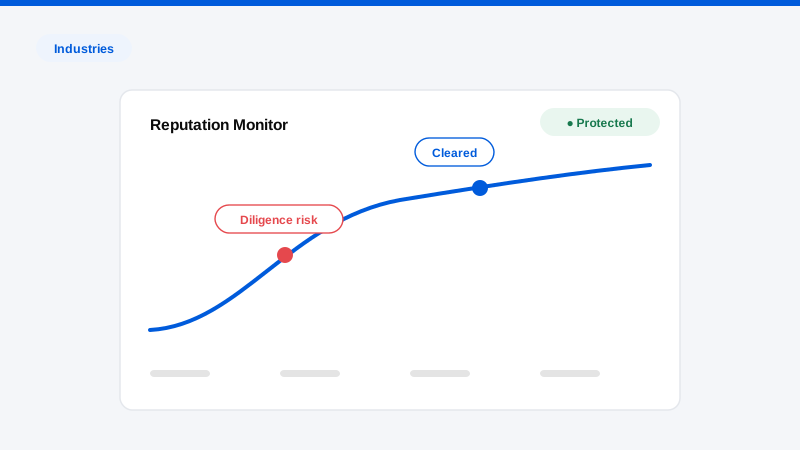
Reputation management for startup founders is the practice of governing the searchable record that investors, acquirers, senior hires, enterprise customers, and journalists consult before betting on you, and removing or containing the content in that record that silently reprices every one of those bets. Founders occupy a distinctive position in the reputation economy: at the earliest stages, the company has no product history, no revenue history, and no institutional track record. The founder’s record is the diligence file. You are not a person who happens to run the asset. You are the asset.
That concentration cuts both ways. A clean, credible record compounds into warm intros, faster closes, and better hires. A record carrying hostile content (a cofounder dispute that spilled into public view, coverage of a failed venture framed as a scandal rather than a lesson, a defamatory post from a former employee, an old controversy that never resolved) compounds too, in the opposite direction, and mostly in silence. Investors do not tell founders what the background search surfaced. They just pass, or they price it in.
This guide defines the threat landscape specific to founders, explains the mechanisms by which hostile content damages fundraising, hiring, and exits, and describes what professional, removal-first protection looks like, and why it succeeds where founder DIY and startup PR structurally cannot.
What reputation management for startup founders covers
Reputation management for startup founders is diligence preparation applied to the public record: auditing what investors, candidates, and AI systems find when they examine you, removing hostile content at its source wherever an avenue exists, remediating what remains findable, and monitoring continuously so new attacks are caught before they enter the record. It is distinct from PR, which adds content, and from legal action, which addresses only a narrow subset of cases. The rest of this guide details the threats this work defends against and the mechanisms that make it necessary.
Why startup founders are targeted
Founders accumulate hostile content through dynamics wired into startup life itself.
Startups manufacture adversaries at scale. Every startup’s normal operation produces people with grievances and platforms: laid-off employees during a downturn, customers of a product that pivoted away from them, vendors left unpaid by a company that died, competitors in zero-sum markets, and, most dangerous of all, former cofounders. Most stay quiet. Statistically, some will not, and the ones who speak have insider credibility that makes their content rank and spread.
Cofounder disputes are uniquely combustible. No falling-out generates more damaging content than a cofounder split. Both parties have deep documentary access, personal knowledge, and standing to be believed; disputes over equity, credit, and control routinely escalate into public accusations, litigation with searchable filings, and dueling narratives on social platforms. The content produced is detailed, credible-looking, and permanently attached to both names, and it surfaces in every future diligence process either party ever undergoes, regardless of who was right.
Failure is public and permanently archived. Most startups fail; that is the model. But coverage of a failure (the layoff story, the shutdown post-mortem, the “what went wrong at X” analysis) attaches to the founder’s name forever, and search engines do not distinguish between a good-faith failure and a disgraceful one. A founder can execute a responsible wind-down and still carry a search page that reads like a warning label, because failure coverage out-ranks and outlasts the quiet successes that follow.
The startup press runs on rise-and-fall narratives. Tech media’s most reliable genre is the fall from grace. Founders who accept profile coverage on the way up are building the archive that makes the fall story writable later, the higher the earlier praise, the stronger the incentive for a reversal piece. Visibility is not neutral; it is stored ammunition.
Anonymous platforms give every grievance a venue. Startup-adjacent forums, anonymous professional apps, and review sites let anyone (former employees, rejected candidates, shorts, cranks) publish accusations against named founders with no verification. The content is often thin, but it ranks, because founders’ names have search volume and these platforms have domain authority.
What’s at stake
For founders, hostile content converts into cost through mechanisms that operate at the exact moments of highest leverage.
VC diligence on the founder is standard, silent, and adverse-weighted. Before a term sheet, investors background the person: search history, litigation checks, reference calls, and increasingly AI-assisted adverse-media screening. The process is asymmetric by design. Its job is to find reasons to worry. Hostile content does not need to be proven, recent, or fair to function; it needs only to exist and be findable, at which point it becomes a discussion item in a partner meeting you are not in. The result is rarely a confrontation. It is a pass attributed to “fit,” a lower valuation, tighter terms, or a request for protective provisions that quietly price the perceived risk. Founders almost never learn which artifact did the damage.
Hostile content taxes every hire. Senior candidates diligence founders before joining: the decision to attach their career to yours is exactly the kind of decision people research. A record carrying an unresolved cofounder-dispute narrative or a toxic-workplace accusation shifts the candidate pool: the best-optioned candidates quietly withdraw, and the ones who remain negotiate harder. The company inherits the founder’s search results as a recruiting handicap no compensation package fully offsets.
Enterprise customers and partners screen the leadership. Procurement and partnership diligence at large companies includes counterparty risk review, and for a startup, counterparty risk includes the founder. Hostile content becomes an internal objection someone else has to champion past, and most sponsors will not spend the capital.
Old ventures reprice new ones. The failed-venture story from five years ago sits in the record when investors evaluate the new company. The mechanism is anchoring: whatever the search page says first is the frame the new pitch must overcome. Founders raising for venture two or three are, in practice, always raising against their own archive.
AI diligence hardens the record into verdicts. Investors and hiring candidates now routinely ask AI assistants about founders by name. These systems synthesize everything findable (dispute coverage, anonymous accusations, failure post-mortems) into confident prose summaries, repeated verbatim to anyone who asks. An allegation that a human reader might discount as one-sided arrives, via AI, as a neutral-sounding fact about you. The founders least aware of this layer are the most exposed to it.
Key takeaway: Founder diligence is silent and adverse-weighted: it exists to surface reasons for concern, and it never reports back. The only way to know what it finds, and to fix what it finds, is to run it on yourself first.
Run the diligence on yourself before your next investor does.Free confidential Exposure Scan: live results across search and AI answers on a 15-minute call, findings yours to keep either way.
Book Your Free ScanWhat professional protection looks like
Professional reputation management for startup founders is removal-first, diligence-oriented, and built around the reality that a founder’s record is examined most intensely at predictable moments: raises, launches, exits, and crises.
A diligence-grade exposure audit. The engagement begins by reproducing what an investor’s background process would produce: full search-result mapping across your name and venture names, litigation and filing visibility, anonymous-platform content, forum and social sediment from past disputes, coverage of prior ventures, and what AI assistants currently say when asked about you as a founder and as a person. The audit’s purpose is to eliminate surprise. You should never learn about an artifact from a term-sheet negotiation.
Source-level removal wherever an avenue exists. Defamatory posts, false anonymous accusations, policy-violating content, doxxing, and impersonation each have enforcement paths: platform policies, publisher processes, and search-engine remediation channels. Specialists in defamation removal know which claims each venue actually enforces, how to build the evidentiary submission the venue’s reviewers need, and how to escalate past frontline denial. This is where the professional gap is widest: individual founders filing public reports get templated refusals; structured, policy-mapped casework gets decisions.
Search-record remediation for the legacy narrative. Failed-venture coverage, resolved disputes, and outdated stories that no longer reflect reality are worked through search-result removal and remediation channels where available, and structurally displaced where not, so the record an investor reads leads with what you are building, not with the worst quarter of your last company. Suppression alone is a treadmill; suppression behind aggressive removal is a transition.
Cofounder-dispute containment. When a split turns public, speed and discipline decide how much permanent content gets created. Professional handling focuses on the artifacts (hostile posts, misleading framings, policy-violating disclosures) while you and your counsel handle the substance. We are not a law firm; where litigation or settlement is in play, we work alongside your attorneys, managing the public record while they manage the legal one. The worst outcomes in cofounder disputes belong to founders who litigated in public and left a permanent archive of the fight.
Continuous monitoring calibrated to your milestones. Hostile content clusters around announcements (funding news, launches, layoffs) because that is when your name has search volume and your adversaries have an audience. Standing monitoring catches the anonymous post, the brigade, or the resurfaced story in hours, when quiet removal is most achievable and before it enters the diligence record and the AI training corpus.
Executive-grade protection as a standing posture. Founders are executives with concentrated exposure, and the strongest position is the one built before the crisis: a clean baseline, live monitoring, and an established response capability. Founders who engage protection only after a term sheet is at risk are doing the same work under time pressure, with the damage already priced in.
Key takeaway: Every founder raise is also a referendum on the founder’s archive. The record can be prepared like any other part of the raise, or it can be discovered by the other side of the table first.
Your archive is part of your cap table story.See it the way a partner meeting will: free confidential Exposure Scan, 15 minutes, live results, yours to keep no matter what.
Book Your Free ScanWhy DIY and PR alone fail at reputation management for startup founders
Founders are builders, and the instinct to handle reputation problems personally, or to route them to the startup’s PR agency, is natural. Both approaches fail against hostile content, for reasons worth stating precisely.
Founder self-help burns the scarcest resource. Removal work is procedural, slow, and adversarial: platform policy mapping, evidence assembly, escalation cycles, follow-through over weeks. A founder doing this personally is spending company-building attention on work they will do worse than specialists, and doing it emotionally, about content that attacks them personally, which is how public replies, angry posts, and screenshot-able mistakes get made. Founder responses to attackers reliably become the story’s second act.
Public fighting creates permanent artifacts. Especially in cofounder disputes, every public statement, subtweet, and comment-section reply becomes new searchable content that survives the dispute itself. The parties who fare best in public splits are almost always the ones who said the least while professionals worked the record.
Startup PR adds; it cannot subtract. Your PR agency places funding announcements and secures press coverage, genuinely valuable work that has no mechanism for making a defamatory post, an anonymous accusation, or a failure narrative cease to exist. Diligence readers are not casual searchers; they read past page one, weight adverse items over promotional ones, and treat a pile of recent positive coverage sitting atop unresolved hostile content as exactly what it is. Publicity on an uncleaned record can even backfire by driving fresh search volume into the damaged results.
Sequencing is the whole game. Remove what can be removed, contain what cannot, then promote. Founders who invert the order (promote first, clean up after) fund the redistribution of their own worst content.
Why startup founders choose Content Removal
Content Removal LLC is a removal-first reputation firm, and founders are among the clients for whom that focus matters most, because a founder’s problem is almost never a lack of positive content. You have launch coverage, a company blog, a conference talk. The problem is the adverse artifact sitting in the diligence path. Making that artifact cease to exist, where achievable, is our entire practice.
We work the surfaces diligence actually reads. Search results, anonymous platforms, forums, litigation visibility, legacy coverage, and AI answers are handled as one connected engagement, because that is how an investor’s process consumes them. We can walk you through how comparable engagements have been structured before you commit to anything.
We are discreet by default. No announcements, no visible disputes, no signal to adversaries or to press. In fundraising ecosystems where everyone talks, the work is invisible; only the record changes.
We are honest about every item. Some content is removable, some is containable, and accurate coverage of real events generally stays. We do not promise outcomes, no reputable firm does, and we are not a law firm; where counsel is needed, we say so and integrate with yours. What you get is complete knowledge of the available avenues and full-effort execution of all of them, with straight answers about which category each artifact is in.
We stay through your milestones. Raises, launches, layoffs, exits, the moments your record is read hardest are the moments we are already watching. Standing protection built for executives and founders means the next anonymous post is met in hours, not discovered by an associate running your background check.
Frequently asked questions
An investor passed and I suspect something in my search results. How do I find out what they saw?
You reproduce the process. A diligence-grade exposure audit maps what a background search on your name actually surfaces (across search engines, anonymous platforms, litigation records visibility, and AI assistants) and identifies the artifacts most likely to function as adverse findings. Investors will not tell you what they found, but the record is inspectable, and once inspected, most artifacts fall into known categories with known avenues. The worst position is the common one: raising repeatedly against an archive you have never read.
My cofounder dispute produced public posts and press mentions. Can any of that be addressed?
Frequently, parts of it can. Posts containing false statements of fact, policy-violating disclosures, doxxing, or harassment have platform enforcement avenues; derivative rewrites and aggregations can be pursued individually; search-level remediation can address what remains findable. Coverage of real, documented events by established outlets is the hardest category and often stays. There, the work is ensuring the episode reads as a chapter, not the whole book. An audit sorts your specific artifacts into these categories before you spend on the wrong approach. Meanwhile, the single most valuable step is free: stop adding public commentary to the dispute.
Does coverage of my failed startup actually hurt the new raise?
It anchors it. Investors evaluating the new company search you, and failure coverage, especially framed as drama rather than post-mortem, becomes the frame your pitch must overcome before it is even heard. Whether it materially hurts depends on what ranks, how it is framed, and what an AI assistant says when asked about you; those are empirical questions an exposure scan answers. Where the framing is misleading or the coverage is derivative pile-on rather than original reporting, there are often meaningful avenues to shrink its footprint.
When should a founder engage, before raising, or only if something surfaces?
Before, by months if possible. Removal work has lead times (enforcement cycles, escalations, search reprocessing) and none of them respect your fundraise calendar. Engaging ahead of a raise means the record is clean before partner-meeting season, and monitoring is live when announcement-driven attention arrives. Engaging only after something surfaces means doing the same work while a live process hangs on the result. Every experienced practitioner will tell you the same thing: the cheap version of this work is the early version.
Your next raise, your next senior hire, and your eventual exit all begin with someone searching your name, and the record they find is being written right now, with or without your involvement. Book a free, confidential Exposure Scan and see your record the way a partner meeting, a candidate, or an AI assistant sees it. Fifteen minutes, live results, complete discretion, and the findings are yours to keep either way.