
Executive reputation management strategies for 2026 run as one command structure: search de-indexing and source removal to cut visibility, evidence-led defamation and false review takedowns, emergency leaked media removal, suppression of unremovable news and mugshot pages, dark web monitoring, positive content built to rank, social crisis protocols, review operations, AI-driven alerts and thought leadership that fills the search page first.
Key facts
- Work the source page and the search index in parallel rather than waiting on the publisher first.
- Build a falsity file with screenshots, timestamps, account IDs, transaction records and witness statements before contacting anyone.
- Leaked media needs simultaneous platform notices, host escalation, search suppression and reupload monitoring.
- Suppression assets must match the exact name query and mix owned properties with credible third-party publications.
Where ContentRemoval.com comes in. ContentRemoval.com executes the removal strategies in this playbook for executives under active pressure: de-indexing, source takedowns, defamation and false review removal, leaked media takedowns and dark web remediation, coordinated with counsel and communications so nothing moves in isolation. General counsel, chiefs of staff and board secretaries usually make the first call once a result is shaping a decision. A free 15-minute Exposure Scan maps what is removable, and the report is yours to keep. Get a Free, Confidential Exposure Scan or read how our reputation management work is done.
At 6:40 a.m., a board member searches your name before a vote. The first page shows a false allegation, a hostile post, and a cached document that should never have been public. By 9:00, counsel, investors, journalists, and your family can all be looking at the same material. That is how online reputation damage spreads in executive matters. Fast, unheralded, and with real commercial consequences.
A poor rating costs real business. So does one defamatory result that stays visible long enough to shape a hiring decision, delay financing, or trigger internal concern. Silence is read as weakness, or worse, admission. In high-pressure cases, reputation management is not a marketing exercise. It is a legal, technical, and strategic response to harmful visibility.
Start with speed and control. Preserve evidence. Identify every URL, mirror, repost, and indexed copy. Push for removal where the law, platform rules, or copyright allow it. Suppress what cannot be removed with stronger assets, better search positioning, and disciplined publication. If your team needs the mechanics of search suppression and removal, use this strategic guide to search result removal and de-indexing. On owned properties, make sure your technical team understand noindex robots.txt issues, because poor indexing controls can keep harmful or outdated pages alive longer than necessary.
This playbook is built for executives, founders, professionals, and public figures facing time-sensitive exposure. It prioritizes aggressive, legally grounded action, discreet escalation, and defensible execution across search, media, platforms, and private monitoring. Some of the methods below stop an active incident. Others harden your position so the next attack has less room to spread.
The goal is simple. Remove what you can. Bury what you cannot. Control what people find before it controls the outcome.
1. Search Engine De-indexing and Source Removal
If a harmful result is ranking now, start with the fastest path to reduced visibility. That usually means attacking both layers at once: the source page and the search index. Removing the article from a website is ideal. De-indexing it from Google or Bing is often the practical first win when the publisher is slow, hostile, anonymous, or offshore.
A disciplined de-indexing campaign turns on evidence and classification. Is the material defamatory, doxxing, non-consensual, infringing, outdated, impersonating, or unlawfully published? Each category has a different route. Search engines respond to structured submissions, legal orders, privacy complaints, and technical signals. Publishers respond to terms violations, copyright notices, counsel letters, and host escalation.
Execute both tracks at the same time
The common mistake is sequencing. Clients wait for a publisher response before engaging search engines, or they file search complaints without building a record against the host. That loses time. The stronger approach is to preserve the page, map every mirrored URL, identify the host, registrar, CDN, ad partners, and platform dependencies, then move in parallel.
Read this strategic guide to search result removal and de-indexing if you need the mechanics. On your own properties, make sure your team understand noindex robots.txt issues so internal pages don’t accidentally compound the problem.
Practical rule: Document every takedown request, every platform submission, every host escalation, and every search engine response. In a contested matter, the audit trail becomes leverage.
For an executive under attack, the target isn’t abstract reputation repair. It’s immediate reduction of discoverability, followed by pressure on the original source until the page is altered, restricted, or removed.
2. Defamation and False Review Takedowns
At 7:30 a.m., your general counsel forwards a one-star review accusing the company of fraud. By 8:00, sales has seen it. By 9:00, a journalist has quoted it. That is the window. Handle false reviews and defamatory posts as an evidence-led enforcement matter from the first hour.
The objective is removal, not debate. If a statement is false, isolate the exact allegation, preserve the record, and confront the platform or publisher with proof tied to its own rules. Vague complaints fail. Precise submissions, backed by documents and framed in legal terms, get results.
A poor rating costs real business. So do fabricated complaints, fake employee reviews, competitor smears, and posts designed to trigger regulatory concern or investor doubt. For executives, the problem is not only reputational. It is commercial and, in some cases, litigation-sensitive.
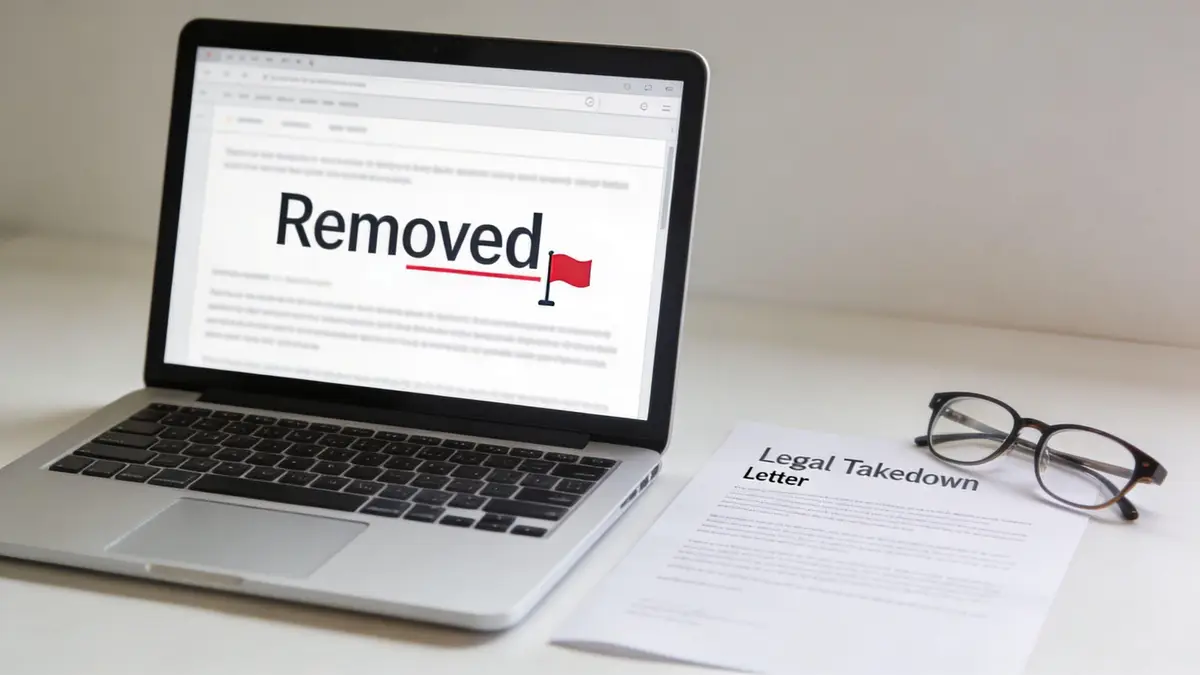
Build a falsity file before you contact anyone
Start with evidence that survives scrutiny. Capture screenshots, timestamps, account identifiers, URLs, transaction records, CRM entries, call logs, moderation history, and witness statements. If the reviewer was never a customer, prove it cleanly. If the post alleges misconduct, misbilling, discrimination, harassment, or criminal behavior, separate each factual claim and answer each one with records.
Opinion is harder to remove. False statements of fact are not. That distinction decides whether you have a platform complaint, a counsel letter, a pre-action demand, or a defamation claim.
Be disciplined in the first response cycle:
- Preserve the record: Save the page, profile, metadata if available, and any reply chain before edits, deletions, or reposts muddy the evidence.
- Classify the violation: Fraudulent review, impersonation, extortion, undisclosed competitor activity, false factual allegation, or disclosure of confidential information. The category determines the takedown route.
- Cite the exact rule: Quote the platform policy or publication standard being breached. Do not argue in generalities.
- Submit proof, not outrage: Attach invoices, booking records, employment files, compliance logs, or internal investigations that disprove the allegation.
- Escalate through counsel fast: Legal correspondence gets attention where customer support queues do not, especially if the post creates quantifiable harm.
- Work the full chain: If the account is part of a coordinated attack, identify linked profiles, repeat wording, timing patterns, and shared infrastructure.
False reviews often arrive in clusters. Treat that as a campaign, not a series of isolated complaints. File coordinated reports, press for account-level action, monitor for reposts, and preserve a single chronology of every submission and response. That record becomes pressure. It also puts you in a stronger position if the matter moves to injunctions, disclosure applications, or damages.
3. Leaked Image and Video Removal NCII Remediation
Leaked images, intimate media, and manipulated videos are emergency matters. Handle them like evidence. Save the URLs, preserve the timestamps, identify whether the content is native, mirrored, watermarked, cropped, or altered, and start removals immediately across every visible platform. Delay gives copycat accounts and archive sites time to spread the material.
This category has a second danger. What starts on visible platforms often migrates to private channels and closed communities. Generic reputation management strategies usually stop at mainstream sites. That is not enough for NCII, deepfakes, or extortion material.

Speed matters more than elegance
For high-risk leaks, you need simultaneous platform notices, host escalation, search suppression requests, and monitoring for reuploads. If criminal conduct is obvious, involve law enforcement while maintaining an encrypted evidence log and chain of custody. Don’t contact the uploader impulsively if extortion or stalking is in play. That can worsen the situation.
The literature gap here is serious. Most public guidance on ORM still overlooks coordinated multi-channel attacks, dark web distribution, and impersonation rings, even though those vectors are now part of the threat environment, as discussed in this analysis of the monitoring blind spot in online reputation strategy.
Remove first, investigate in parallel, and monitor continuously. Reputational harm from leaked media compounds every time a mirror goes live.
Executives should also plan for synthetic media. If a deepfake appears, preserve the original file and every derivative link. Platforms may treat manipulated intimate media, impersonation, and privacy violations under different rules. A removal team needs to classify each instance correctly or valuable time is lost in misfiled reports.
A strong NCII response is not one notice. It is an active campaign against every copy, every index, and every uploader identity tied to the release.
4. News Article and Mugshot Suppression
Some pages won’t come down. Old arrest coverage, mugshot pages, stale litigation reports, and sensational local articles can remain online long after the event has lost any public significance. In those cases, suppression is not cosmetic. It is the disciplined replacement of a hostile search environment with stronger, more current, more authoritative material.
Many firms underperform. They sell “brand building” when the client needs precision. You need to identify which negative results are weakest, which are legally challengeable, which are syndicated, and which can be outranked with targeted assets tied directly to the executive’s name.
Don’t fight every result equally
A low-authority mugshot page is not the same problem as a newspaper archive. Start by separating removable content from content that must be displaced. Then create search assets that belong in the results: executive bios, interviews, board profiles, thought leadership, speaking pages, verified social profiles, company leadership pages, and high-trust third-party features.
Use this strategic guide to removing news articles about an arrest when the issue involves arrest coverage or associated reporting. The legal and technical routes are different from standard review disputes.
Airmic observed that organizations often have “no framework for linking the strategic, operational and tactical aspects of reputational risk management,” a gap highlighted in Closing the Gaps on Reputational Risk Management. That gap shows up clearly here. Search suppression fails when legal, SEO, and communications teams operate separately.
Build your suppression stack with discipline:
- Name-match content: Assets must be tightly aligned with the search query you’re trying to control.
- Authority mix: Use both owned properties and credible third-party publications.
- Weekly adjustment: Watch ranking movement and reinforce pages that gain traction.
A negative article does not need to disappear to stop dominating the narrative. It needs to lose position, lose clicks, and lose salience.
5. Dark Web Monitoring and Remediation
At 6:30 a.m., your general counsel gets a screenshot from a broker channel offering employee credentials, draft contracts, and a folder labeled with your surname. That is how many reputation crises begin. Public search results come later, after the material has been copied, repackaged, and pushed into places journalists, litigants, competitors, and extortionists can reach.
Dark web monitoring is an early-warning function for executive risk. It tracks references to names, aliases, email domains, file hashes, credential dumps, impersonation kits, and stolen records across closed forums, marketplaces, paste sites, and encrypted communities. For CEOs, founders, family offices, and other high-visibility principals, this belongs in the core response plan, not in a quarterly security checklist.
Treat the issue as a combined legal, security, and reputation matter from the first alert. If leaked material surfaces, set one chain of command. Preserve evidence. Confirm what is authentic. Identify whether the source is an external intrusion, a vendor failure, an insider, or recycled material from an older breach. Then move on parallel tracks: contain access, harden exposed accounts, prepare takedown and preservation notices where they will have effect, and assess whether the material is likely to migrate into indexed search or mainstream social platforms.
Speed matters because underground exposure rarely stays underground for long.
For technical context on exposure testing and perimeter risk, review pentesting for external web applications. Reputational harm often starts with a preventable weakness: an exposed portal, weak access controls, a compromised mailbox, or a third-party environment with poor security discipline.
Do not ask your PR team to handle this alone. A proper remediation workflow answers five questions immediately: what was exposed, where it is circulating, who is amplifying it, what can be removed or frozen, and what defensive steps reduce secondary harm. In practice, that means credential resets, domain and account monitoring, impersonation reporting, fraud warnings to banks or counterparties, litigation hold notices, and targeted outreach to platforms or intermediaries that can disrupt redistribution.
You will not always get a clean takedown result from dark web sources. The objective is broader and more realistic: contain spread, preserve admissible evidence, reduce the value of the stolen material, and stop migration into public channels before the issue becomes a visible search and media problem.
If your team only watches Google alerts and social mentions, you are already late.
6. Proactive Positive Content Generation and SEO
A board member forwards you a screenshot at 6:40 a.m. The damaging result is still on page one, and the first two positive links underneath it are thin, outdated, and irrelevant. That is what failed reputation defense looks like.
Positive content and SEO are not a branding exercise. They are a suppression program built to win search real estate with stronger, better-supported assets. If you want harmful coverage, allegations, or stale legacy results to lose visibility, you need replacement pages that deserve to outrank them.

Publish assets that can actually rank
Search engines do not reward vague positivity. They reward relevance, authority, freshness, and technical quality. That means building pages around the exact name, issue set, and search intent that now defines the risk. An executive bio that omits the executive’s full search footprint is a wasted asset. A thought leadership article on a topic unrelated to the reputational threat is a wasted asset.
Start with owned properties you control fully. Executive profile pages should have clean metadata, structured data, fast load times, and copy written for actual branded searches. Then build corroboration across credible third-party domains. Interviews, conference speaker pages, association profiles, authored commentary, and accurate newsroom references help create a search result set that looks current, verified, and harder to displace.
A disciplined program usually includes:
- Executive profile pages: Updated bios on the company site, with full-name targeting, role clarity, and supporting references.
- Issue-aligned articles: Pieces tied to governance, compliance, litigation context, transactions, philanthropy, research, or sector expertise, depending on the threat.
- Third-party validation assets: Conference pages, professional memberships, podcast appearances, bylined articles, and quoted commentary on reputable sites.
- Technical SEO work: Internal link architecture, schema markup, canonical control, crawlability, title tags, and entity consistency across platforms.
Relevance decides whether this works.
If the problem is an old arrest reference, publish current, verifiable material tied to leadership, board service, charitable work, and present professional standing. If the problem is criticism around governance or conduct, publish substantive governance content, not generic company news. If the problem targets a founder personally, build assets around the founder’s name, role, expertise, and current record. Generic publishing does not suppress anything.
The objective is simple. Replace a weak search environment with one you control, support, and refresh. Strong suppression happens because the new assets are better, more trusted, and better optimized than the pages you want pushed down.
7. Social Media Monitoring and Crisis Response
At 6:40 a.m., a clipped video, a hostile thread, or a fake screenshot starts moving under an executive’s name. By 8:00, staff have seen it, counterparties are forwarding it privately, and a reporter is preparing an email. That is the timeline. If your first awareness comes from the press, you have already lost control of the opening phase.
Social platforms are where allegations harden into a public record. Sprout Social’s consumer research found that people want brands to respond quickly and transparently when issues surface. Executives should read that as an operational requirement, not a communications preference. Delay creates a vacuum. Rumor fills it.
The correct setup is disciplined and narrow. Monitor executive names, brand terms, product names, common misspellings, campaign hashtags, and threat-specific keywords tied to leaks, fraud, misconduct claims, or impersonation. Route alerts to a small response group with legal, communications, security, and leadership authority already assigned.
Response quality becomes evidence
A social response is not just audience management. It is evidence that may be screenshotted, quoted by journalists, reviewed by regulators, or attached to litigation correspondence. Khoros research on digital customer expectations shows that people judge organizations by how they respond in public channels. That judgment affects trust long after the original post falls out of the feed.
Before you watch the video below, keep one rule in mind. The first statement should establish control, preserve options, and avoid factual overreach.
A working social crisis protocol should include:
- Severity tiers: Separate workflows for complaints, coordinated attacks, impersonation, leaks, harassment, and allegations of illegal conduct.
- Pre-cleared holding language: Short statements for the first 30 to 60 minutes while facts are verified and legal risk is assessed.
- Channel control: One approved narrative, adapted carefully for LinkedIn, X, Instagram, media inquiries, and internal staff communications.
- Evidence preservation: Screenshots, URLs, account identifiers, timestamps, and engagement snapshots captured before content is edited or deleted.
- Escalation triggers: Clear thresholds for platform reports, cease and desist letters, outside counsel action, law enforcement contact, or direct outreach to stakeholders.
PwC’s Trust in US Business survey shows that trust turns on conduct during pressure events, not on polished messaging during calm periods. That is why speed alone is not enough. The priority is controlled speed. Issue a short, lawful, defensible statement. Secure evidence. Stop internal freelancing. Then decide whether the matter calls for platform enforcement, legal takedown action, or strategic silence while removal work proceeds.
8. Online Review and Feedback Management
At 7:15 a.m., your general counsel forwards a screenshot. A one-star review accuses the company of fraud, names an executive, and starts ranking for a branded search before your team is in the office. If you treat review management as a customer service chore, you will lose time, evidence, and control.
Reviews influence buying decisions because they are public, searchable, and persistent. They also shape how counterparties assess risk. Prospects read them. So do procurement teams, candidates, lenders, and reporters. A neglected review profile signals weak oversight.
Handle reviews as an exposure channel, not a vanity metric. That means triaging what can be resolved, what should be documented, and what must be challenged.
Use a clear operating model:
- Solicit reviews ethically: Ask after verified delivery or a completed matter, not at the start of an engagement.
- Classify fast: Separate routine dissatisfaction from factual inaccuracies, extortion attempts, impersonation, competitor attacks, and defamatory allegations.
- Respond with purpose: Public replies should correct the record, show control, and avoid admissions that create legal or regulatory risk.
- Move sensitive disputes offline: Provide a contact path for resolution, then take the detail out of the public thread.
- Escalate abusive content: Preserve screenshots, timestamps, account details, and URLs before filing platform complaints or legal notices.
Do not use canned apologies for every complaint. They read as evasive and can be used against you. If a review is false, say so precisely. If the matter involves privacy, regulated services, or pending legal action, keep the response narrow and disciplined.
Sector context matters. In healthcare, law, financial services, and other regulated fields, review handling intersects with confidentiality, privilege, recordkeeping, and advertising rules. Staff should know what they may acknowledge in public and what must go through legal review.
You also need monitoring that covers more than Google Business Profile. Industry directories, employer review sites, app marketplaces, and specialist forums often cause more reputational damage because they rank for high-intent searches. A disciplined reputation monitoring process for review sites and brand mentions helps teams catch patterns early and escalate the right cases.
Automation helps if it is tied to human judgment. An AI automation agency can route new reviews, flag suspicious language patterns, and trigger internal workflows, but removal decisions and public responses still need legal and reputational judgment.
Strong review management means two things. Resolve legitimate complaints quickly. Remove or suppress false, abusive, and strategically harmful content with equal speed.
9. AI-Driven Reputation Monitoring and Automated Alerts
Manual monitoring is too slow for a complex digital footprint. Senior executives are mentioned in news articles, niche forums, review sites, social feeds, video captions, copied bios, and malicious domains. If your team is still relying on periodic searches and inbox alerts, you’re operating with lag.
AI-based monitoring improves coverage and prioritization. It can scan for brand mentions, executive names, sentiment changes, impersonation signals, and language patterns that indicate an emerging campaign. Enterprise buyers are already moving in this direction. Gartner’s 2024 Digital Marketing Survey found that 67% of enterprise marketing leaders increased reputation monitoring budget allocations in 2024, with AI-powered alert and sentiment tools driving platform upgrade decisions, according to Fact.MR’s enterprise internet reputation management analysis.
Build alerts that your team can actually use
The value of AI is not volume. It is triage. You want automated systems that distinguish routine chatter from actionable risk, route serious issues to the right people, and reduce false alarms. A good setup uses brand-specific training data, severity tiers, and escalation rules tied to legal, security, and communications teams.
If you want a practical benchmark, review reputation monitoring services as a model for 24/7 coverage and alerting. You can also explore adjacent AI automation agency workflows to understand how automated routing and response systems are being deployed more broadly.
Cloud-based deployment is projected to account for about 20% market share in 2026, according to the same Fact.MR analysis. For executive reputation work, that matters because scalable monitoring needs real-time ingestion across search, social, marketplaces, and external sites.
Automated alerts are only useful if someone has authority to act when they fire.
The strongest AI monitoring programs don’t replace judgment. They make judgment fast enough to matter.
10. Executive Thought Leadership and Personal Branding
At 6:40 a.m., a board member searches the CEO’s name after a complaint, an old dispute, or a hostile post starts circulating. If the first page is thin, stale, or uncontrolled, the vacuum gets filled by critics, aggregators, and recycled allegations. That is a preventable failure.
Executive thought leadership is a defensive asset with offensive value. It gives you indexed, credible material that can compete with hostile coverage, frame judgment before a crisis hardens, and support counsel-led suppression work already underway. In practice, it helps investors, partners, journalists, and regulators find evidence of competence before they find noise.
As noted earlier, investors judge management quality in part by how a company handles pressure. An executive who has already built a public record of judgment, expertise, and consistency starts from a stronger position than one who appears online only through controversy.
Build an executive record that can hold up under stress
Treat personal branding like case preparation, not publicity. Every asset should serve search visibility, credibility, or message control. That means fewer vanity placements and more durable, high-authority publications tied to the executive’s actual remit.
Use a focused mix:
- Bylined articles: Publish on issues the executive can defend in detail, such as governance, regulatory risk, cybersecurity, capital allocation, privacy, or sector operations.
- Controlled interviews: Prefer formats with editorial discipline, strong audience relevance, and an opportunity to review framing in advance.
- Keynote appearances: Put the executive on stage where industry peers, customers, and trade press already pay attention.
- Board, association, and advisory roles: These third-party signals matter because they are harder to dismiss as self-authored promotion.
- Bio and profile architecture: Keep company bios, speaker pages, conference profiles, and professional platforms current, aligned, and search-optimized.
This work needs discipline. Pick three or four themes and repeat them until they are inseparable from the executive’s name. One strong speech should produce a transcript, a bylined article, short social excerpts, updated bios, and media talking points. Media training is part of the same program because careless phrasing creates fresh exposure and weakens legal and communications strategy.
Do not confuse visibility with control.
The right goal is to create a body of public material that is accurate, defensible, and strong enough to rank. That gives your team more than polish. It gives you assets that support suppression, weaken the impact of isolated attacks, and make adverse content look dated, unrepresentative, or unreliable.
For founders, chairs, and senior operators, personal reputation and enterprise reputation are tightly linked. If you want resilience under pressure, build the executive profile before the next incident forces the market to define it for you.
10-Point Reputation Management Comparison
| Strategy | Implementation complexity | Resource requirements | Expected outcomes | Ideal use cases | Key advantages |
|---|---|---|---|---|---|
| Search Engine De-Indexing and Source Removal | High, legal + technical actions | Specialized legal team, takedown workflows, monitoring tools | Rapid visibility reduction; removed URLs from SERPs | Defamation, copyrighted leaks, sensitive indexed content | Immediate discoverability reduction; multi-jurisdiction reach |
| Defamation and False Review Takedowns | High, legal proceedings and platform rules | Defamation counsel, evidence collection, platform liaisons | Removal or correction of false claims; restored credibility (variable timeline) | Libelous articles, malicious reviews, verified false statements | Restores trust; legal deterrence for repeat offenders |
| Leaked Image & Video Removal (NCII Remediation) | Medium-High, urgent escalations | Platform emergency channels, AI recognition, legal support | Swift takedowns; reduced re-sharing and privacy harm | Non-consensual intimate content, deepfakes, leaked media | Fast, discreet removals; privacy-focused protocols |
| News Article and Mugshot Suppression | Medium, blended SEO and outreach | Content creation, SEO, PR outreach, link-building | Negative pages pushed down; fresh context ranks higher | Outdated press, mugshots, unfavorable archived coverage | Controls narrative; improves SERP positioning over time |
| Dark Web Monitoring and Remediation | High, technical and legal complexity | 24/7 crawlers, human analysts, darknet partners (costly) | Early detection and containment of leaked data | Data breaches, doxxing, illicit data trafficking | Proactive threat detection; prevents public disclosure |
| Proactive Positive Content Generation & SEO | Medium, ongoing editorial program | Editorial team, SEO specialists, distribution budget | Improved organic visibility over months; stronger brand equity | Long-term reputation building, pre-emptive mitigation | Sustainable resilience; authoritative search presence |
| Social Media Monitoring & Crisis Response | Medium, real-time operations | Listening tools, dedicated response team, playbooks | Rapid containment and coordinated public response | Viral complaints, trending negative hashtags, executive incidents | Immediate mitigation; shows transparency and responsiveness |
| Online Review and Feedback Management | Low-Medium, systematic workflows | CRM integration, review automation, response staff | Higher ratings and improved customer satisfaction | Local businesses, e‑commerce, service providers | Boosts conversions; converts complainants into advocates |
| AI-Driven Reputation Monitoring & Automated Alerts | Medium-High, model tuning and integrations | ML/NLP platform, integrations (Slack/email), analysts | Scalable 24/7 alerts; earlier issue detection | Large brands, fast-moving sectors, digital risk teams | Scalable coverage; reduces manual monitoring effort |
| Executive Thought Leadership & Personal Branding | Medium, strategic, long-term effort | Media training, PR agency, content production, speaker bureaus | Enhanced executive credibility; stronger public trust | C-suite profile building, pre-emptive reputation defense | Humanizes brand; creates goodwill that cushions crises |
From Defense to Dominance Securing Your Reputation Long-Term
At 6:40 a.m., your general counsel sends a screenshot. A hostile post is ranking on page one. Reporters are calling. Staff have seen it. Investors will see it next. At that point, reputation management stops being a marketing exercise and becomes an executive control problem.
The companies that come through these moments intact do four things faster than everyone else. They preserve evidence. They remove what can be removed. They suppress what cannot. They coordinate legal, communications, security, and search strategy as one operation.
That is the long-term standard. A reputation program only works if it is built for pressure.
As noted earlier, active reputation management improves trust, retention, and recovery after a public hit. A documented crisis plan also cuts avoidable commercial loss. The point is straightforward. Delay gets expensive, and fragmented ownership makes delay more likely.
The same pattern shows up in spending decisions. Organizations are buying monitoring, removal, and search control tools because unmanaged digital exposure now carries direct cost. Boards understand that. So do regulators, counterparties, and plaintiffs’ lawyers. If your adverse content remains visible for weeks, the problem is no longer the post alone. It is the record of inaction around it.
Recovery is possible. It depends on response quality.
Handled properly, a reputational incident can be contained, legally narrowed, and pushed down before it hardens into a permanent search result. Handled poorly, it becomes a reference point that follows every financing, hiring decision, customer pitch, and media inquiry.
The ten strategies in this briefing should be run as a single command structure, not as isolated tactics. Source removal and de-indexing cut immediate visibility. Defamation, false review, and NCII workflows address unlawful material directly. Suppression, editorial publishing, and executive profile development rebuild search control over time. Dark web monitoring, social monitoring, review operations, and automated alerts give you early warning before a private problem becomes a public one.
Internal teams can handle routine review responses and some monitoring. High-risk matters need specialist execution, especially where legal process, platform escalation, search suppression, impersonation, leaks, and evidentiary preservation have to move in parallel. Firms such as ContentRemoval.com work across those channels under conditions where speed and discretion matter. For an executive under active pressure, that coordination usually determines whether the matter is contained quickly or continues to spread.
If you need a confidential action plan, contact ContentRemoval.com. Their team handles content removal, de-indexing, suppression, leaked media takedowns, dark web monitoring, and executive reputation protection with a coordinated legal and technical approach.
Frequently asked questions
What should an executive do first when a false allegation appears on Google?
Preserve evidence, then identify every URL, mirror, repost and indexed copy. Push for removal where law, platform rules or copyright allow it, file de-indexing requests with search engines at the same time, and suppress what cannot be removed with stronger assets. Document every submission and response, because the audit trail becomes your record.
Can a mugshot or old arrest article be pushed down in search results?
Yes, when it cannot be removed. Separate removable content from content that must be displaced, then build search assets tied tightly to the executive’s name: bios, board profiles, interviews, speaking pages and high-trust third-party features. Watch ranking movement weekly and reinforce the pages gaining traction.
How does dark web monitoring protect an executive’s reputation?
It tracks names, aliases, email domains, file hashes, credential dumps and stolen records across closed forums, marketplaces and paste sites before the material migrates into search or mainstream media. When something surfaces, one chain of command preserves evidence, confirms authenticity, contains access and prepares takedown and preservation notices.