
Reputation management for real estate agents is the discipline of controlling what prospective clients find when they search an agent’s name before deciding to list, buy, or refer. For an agent, this is not a side concern. Real estate is one of the few industries where the personal brand is the pipeline: the product being purchased is the agent (their judgment, their negotiation, their trustworthiness) and nearly every serious prospect runs a name search before the first conversation. What Google, Zillow, and increasingly AI assistants say about that name determines whether the phone rings.
The exposure is unusually personal. A hotel absorbs a bad review at the brand level; an agent absorbs it at the level of their own name, which follows them across brokerages, markets, and decades of career, and real estate transactions are emotionally and financially charged in a way few purchases are, the largest transaction of most clients’ lives, with ample room for disappointment that has nothing to do with the agent’s performance. When a deal goes sideways, the agent’s name is where the frustration lands publicly.
This guide defines the threat landscape agents face, what is at stake when damaging content attaches to an agent’s name, and what professional, removal-first protection looks like, the model Content Removal has built its practice on. It is not a how-to. Removal is specialist work, and the agents who protect their pipelines best are the ones who put specialists on it early.
Why real estate agents are targeted
Agents sit at the intersection of several forces that reliably generate hostile content.
Deals fail for reasons agents don’t control, and agents get blamed anyway. Financing falls through, appraisals come in low, inspections kill contracts, sellers reject fair offers, buyers lose bidding wars. The client’s disappointment is real; the attribution is often wrong. A one-star review that says “cost us our dream home” doesn’t footnote the lender’s underwriting decision.
Commission disputes convert to reviews. Disagreements over commission, cancellation of listing agreements, or dual-agency friction frequently end with a negative review as the closing move, or as leverage during the dispute itself.
The other side of the table reviews you too. Agents are among the few professionals routinely reviewed by people who were never their clients: the buyer on the other side of a hard negotiation, the seller whose lowball offer you rejected on your client’s behalf, the co-op agent who lost. Platforms rarely distinguish; a search result doesn’t either.
Competitor sabotage in referral-driven markets. Real estate is hyper-local and zero-sum. Fake negative reviews, hostile posts in local Facebook groups and Nextdoor threads, and whisper campaigns are a persistent low-level reality in competitive farm areas.
Deal-gone-wrong posts spread on named specifics. Beyond review platforms, disappointed parties post detailed accounts (on Reddit, on local forums, in community groups) naming the agent and narrating the transaction from one side. These posts rank well for the agent’s name precisely because they are specific, emotional, and engagement-rich, and they get quoted by AI assistants asked “is [agent name] good?”
Personal history rides along. Because the searchable asset is a personal name, everything attached to that name is in scope: an old lawsuit, a mugshot from a dismissed matter decades ago, a licensing complaint that was resolved, someone else’s misconduct under a similar name. Agents inherit search results that businesses never would.
Key takeaway: An agent can perform flawlessly and still accumulate damaging content, because reviews attach to disappointment, not to performance, and in real estate, disappointment is structurally guaranteed for someone in almost every transaction.
What’s at stake for an agent’s pipeline
The economics of agent reputation damage are unforgiving because of how real estate clients are acquired.
The name search is the silent gatekeeper. Referrals, the dominant source of agent business, do not arrive pre-committed. A referred prospect searches the agent’s name before calling, and a damaging result at that moment converts a warm referral into silence. The agent never learns it happened; the referral simply doesn’t call. Reputation damage in this business is measured in calls that never come.
Listing presentations are lost before they start. Sellers interviewing agents check reviews as due diligence. In a two-or-three-agent bake-off, a visible cluster of negative content is the tiebreaker, against you.
Zillow and Google profiles are ranking assets. Agent visibility on Zillow and in Google’s local results is influenced by review volume and score. Damage there doesn’t just deter readers; it reduces how often the profile is surfaced at all, cutting inbound lead flow at the source.
Damage compounds across a career. An agent’s name search is a permanent record that follows them through brokerage moves and market changes. Content ignored this year is content ranking next year, and content AI systems have absorbed the year after. Increasingly, prospects ask AI assistants to evaluate agents by name, and those systems synthesize whatever the record contains, which is why AI reputation protection has become part of serious agent-level work.
Team and brokerage spillover. For team leads and broker-owners, a name-level attack contaminates the team brand, recruiting, and every agent operating under the banner. Diligence by potential recruits and partners includes searching the principal’s name.
Key takeaway: Agents rarely see the damage happen. It shows up as referrals that never call, listing appointments that go quiet, and a pipeline that thins for no visible reason, because the name search filtered you out before contact.
See what prospects find before they call.Free confidential Exposure Scan of your name and profiles, live results on a 15-minute call, yours to keep either way.
Book Your Free ScanWhat professional reputation management for real estate agents looks like
Professional protection for agents is removal-first, and the ordering is the entire point. The default industry offering (suppression, meaning burying bad results under new content) leaves the damaging material live: still ranking for long-tail searches (“[agent name] complaints”), still visible to anyone who scrolls, still feeding AI answers. For a personal name that will be searched thousands of times over a career, buried is not fixed.
A removal-first engagement proceeds in sequence:
1. Full name-level exposure assessment. A systematic sweep of everything attached to the agent’s name: Zillow, Google, Realtor.com, Yelp, Facebook, Reddit, Nextdoor and local forums, news archives, court-record aggregators, and people-search sites. Agents typically know about one or two items; the sweep finds the full surface area, including duplicates and scraped copies that would resurface later.
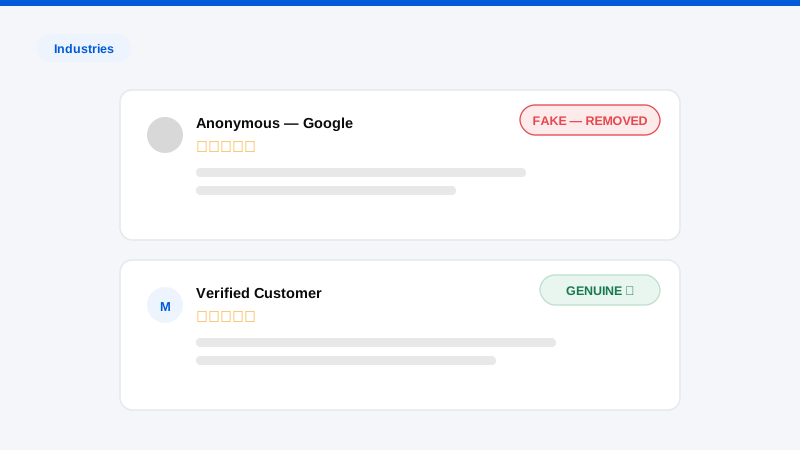
2. Removal of what violates policy, which is more than most agents assume. Reviews from non-clients, reviews about the outcome of a negotiation rather than the agent’s service, fake and competitor-sourced reviews, extortionate reviews, and defamatory factual claims all breach the published policies of Google, Zillow, and their peers. Our review removal practice converts those violations into enforcement outcomes: platform-specific evidence packages, correct policy framing, and escalation past automated triage. False accusations in posts and forums are pursued through defamation removal channels built for that content class.
3. Search-layer remediation for what can’t come down at the source. Old news items, forum threads on non-cooperative sites, and archival records can often be addressed where the harm actually occurs, the first page of results for the agent’s name, through de-indexing pathways and search result removal strategies targeted at the exact queries prospects run.
4. Asset-building and suppression, last. With removable content gone, remaining items are displaced by truthful, authoritative assets: profiles, transaction credentials, legitimate press where fitting. Suppression on a cleaned foundation is durable; suppression instead of removal is a treadmill.
5. Continuous monitoring and standing protection. New reviews post daily, forum threads revive, and people-search sites re-scrape. Reputation monitoring catches new items in hours, and our Protection Plans keep a team on standby that already knows the agent’s history, so the next hostile review is a routine ticket, not a weekend crisis before a listing presentation.
Key takeaway: For a personal brand, removal-first is the only defensible strategy. Suppression leaves the accusation live under your own name; removal ends the conversation.
Why specialists beat DIY for agents
Agents are negotiators by trade, and many try to handle removals themselves. The attempt fails in predictable ways.
Platform reporting systems are automated triage, not customer service. A report that doesn’t map to the platform’s internal policy taxonomy, with the evidence that platform’s reviewers actually credit, is rejected without human eyes, and a trail of failed reports can prejudice later, properly built attempts. Knowing what Google’s review policies actually prohibit versus what Zillow’s do, and how each escalation path behaves, is full-time knowledge.
Public responses are the second trap. Replying to a false review with a detailed rebuttal puts the agent in a public argument with a former client, visible to every future seller evaluating whether this agent is calm under pressure. Worse, a heated response can amplify an obscure post into a story. Specialists sequence action to resolve matters quietly, which is the outcome that actually protects the pipeline.
The third failure is opportunity cost. An agent’s hours convert directly to commission income. Weeks spent fighting a platform’s appeals process are weeks not spent prospecting: spent losing, in effect, twice.
Generalist marketing vendors don’t close the gap: agent-focused “reputation” products are overwhelmingly review-generation widgets plus suppression content. Removal, the discipline that eliminates the threat rather than redecorating around it, is what our case studies demonstrate, and it is a separate profession.
Your name is your pipeline.Find out what it's telling prospects with a free, confidential Exposure Scan, reviewed live with a specialist in 15 minutes, no obligation.
Book Your Free ScanWhy real estate agents choose Content Removal
Removal is the product. Content Removal LLC leads with eliminating damaging content and keeping it gone. Monitoring, protection, and asset-building are constructed around that core, never offered as a substitute for it.
Personal-name expertise. Agent matters are personal-brand matters: reviews, forum posts, news archives, court aggregators, and people-search sites all attach to one searchable name. We work all of those surfaces, not just the review platforms.
Discretion as a default. Agent reputation work is handled confidentially: no public disputes conducted in your name, no signature responses that advertise a problem, no case details shared without consent. In a referral business, quiet resolution is the only kind worth having.
Honest scoping, no promises. We are not a law firm, and we do not promise outcomes, removal decisions ultimately rest with platforms and publishers, and any vendor promising certainty is selling something else. What we commit to is professional execution by specialists who do this work daily, and a candid up-front assessment of what is realistically removable, what should be handled at the search layer, and what calls for asset-building instead.
Career-length protection. Through Protection Plans, agents and team leads get continuous monitoring of their name and profiles, priority response when something new appears, and a standing team that already knows their file, enterprise-grade protection scaled to an individual professional.
Frequently asked questions
Can a negative Zillow or Google review from an actual client be removed?
It depends on what the review says and does, not just who wrote it. Genuine-client reviews that contain false factual claims, disclose private information, use the review as leverage in a dispute, or violate other platform policies are frequently removable despite the underlying relationship being real. Reviews that are harsh but honest opinions generally are not, and part of a professional assessment is telling you which is which before any money is spent. Non-client reviews (the other side of a transaction, someone who never worked with you) violate policy on most platforms outright.
What about a Reddit or Facebook-group post naming me over a failed deal?
Forum and group content is handled through a combination of channels: platform policy review (harassment, doxxing, and defamatory factual claims are enforceable on both platforms), moderator pathways in local groups, and search-layer remediation so the post stops ranking for your name even where the source is uncooperative. These posts are also exactly the content AI assistants ingest when asked about you by name, which is why they’re treated as high priority rather than “just a forum post.”
I moved brokerages, does old negative content follow me?
Yes, because it attaches to your name, not your affiliation. That is also the argument for dealing with it now rather than hoping a move resets the record: search engines and AI systems accumulate; they do not forget on their own. An exposure assessment establishes everything currently attached to your name so that a move, a team launch, or a market expansion starts from a clean searchable record.
Is ongoing protection overkill for a single agent?
Single agents are the most exposed tier, not the least: no brokerage legal department, no PR support, and a personal name absorbing all damage directly. A standing arrangement means new content is caught within hours instead of being discovered by a prospect first, and the response is handled by people who already know your situation. For a business acquired one name-search at a time, that reaction speed is the whole game.
Find out what your name is saying about you
Every agent reputation problem starts small (one review, one thread, one archived article) and grows in the dark. The agents who never face the expensive version are the ones who look early. Start with a free, confidential Exposure Scan: a specialist runs a live sweep of what prospects, referral-checkers, and AI assistants currently find on your name, walks you through the results on a 15-minute call, and the findings are yours to keep either way. If your name is clean, you’ll know it. If it isn’t, you’ll know exactly what’s there and what a removal-first plan looks like.