
Reputation management for chefs and restaurateurs is the discipline of protecting the name that sits above the door, the personal reputation that investors underwrite, landlords vet, critics reference, and diners search before they book. In hospitality, the individual and the business are inseparable in a way almost no other industry replicates. A software company can survive its founder’s bad press. A chef-driven restaurant is its chef’s press. When hostile content attaches to the person, it attaches to every venue they touch: current, past, and future.
That inseparability is what makes the exposure in this industry so severe. A kitchen-culture accusation, a coordinated review attack, a feud that spills onto social media, a lawsuit filed by a former partner, each becomes part of the permanent searchable record for the chef’s name, and unlike a bad service night, the record does not reset. It follows the chef to the next opening, the next city, the next concept, and the next investor meeting, silently repricing every opportunity along the way.
This guide defines the threat landscape for chefs and restaurant operators, explains the mechanisms by which hostile content damages hospitality careers and businesses, and lays out what professional, removal-first protection looks like, and why it outperforms both personal effort and conventional restaurant PR.
What reputation management for chefs and restaurateurs involves
Reputation management for chefs and restaurateurs operates on two records at once: the personal record attached to the chef’s name and the commercial record attached to each venue. The two are linked everywhere it matters (review platforms, local press, search results, and AI summaries all cross-reference the person and the properties) so managing one without the other leaves the exposure intact.
In practice, the work spans four functions: removing hostile content at its source wherever an avenue exists, enforcing review-platform policies against fake and coordinated reviews, remediating the search record so old disputes stop defining current operations, and monitoring the full footprint continuously so new attacks are caught in hours. The rest of this guide details how those functions apply to the specific threats this industry produces.
Why chefs and restaurateurs are targeted
Hostile content in hospitality is not bad luck. It is produced by structural features of the industry, and chefs sit at the intersection of all of them.
The review economy invites weaponization. Restaurants live on review platforms to a degree no other business matches, and review systems are trivially abusable. A fired employee, a rival operator, an aggrieved diner, or an activist audience angry at something the chef said can flood a listing with one-star reviews in an evening. Worse, review attacks in this industry are personal and portable, when the grievance is with the chef rather than the venue, the attack follows the person. A chef who leaves a restaurant under a cloud and opens a new one frequently finds the new listing seeded with hostile reviews on opening week, written by people who have never eaten there. The venue changed; the target did not.
Kitchen culture is a standing story genre. Media coverage of hospitality has an established appetite for kitchen-culture exposés: toxic-workplace narratives, allegations from former staff, anonymous accounts of behavior behind the pass. Some of that reporting reflects real and serious problems; some of it is thin, one-sided, or driven by a single motivated source. The searchable record does not distinguish. Once a chef’s name is attached to an exposé, the story ranks for that name indefinitely, gets aggregated and rewritten across food media, and becomes the first thing every future hire, partner, and investor reads.
High staff turnover produces motivated narrators. Kitchens run on intense, hierarchical, high-pressure labor with constant turnover. Every departure, fair or unfair, creates a person with detailed inside knowledge, a grievance narrative, and access to review platforms, social media, and reporters. Most say nothing. It takes one.
Local press never deletes. Restaurant coverage is local news, and local news archives are permanent. A health-code story, a labor dispute, a police blotter mention, a closure framed as a failure, all remain searchable years after the underlying issue was resolved, corrected, or superseded. The chef’s name is the index key that keeps retrieving it.
Feuds are content. Hospitality is a small, hot-tempered industry, and chef feuds (with critics, with former partners, with other chefs) generate coverage and social pile-ons. A heated exchange that would evaporate in most industries becomes a permanent, searchable episode in this one.
What’s at stake
The costs of an unmanaged record in hospitality operate through specific, compounding mechanisms.
Investor and partner diligence prices the person, not just the P&L. Restaurant groups, backers, and landlords underwrite chef-driven concepts on the chef. Before money moves, they search. A record carrying an exposé, a review-war history, litigation coverage, or a publicized failed venture changes the terms: more control demanded, more contingencies, a lower valuation on the chef’s brand contribution, or a quiet pass with no explanation. In an industry where most concepts need outside capital or favorable leases to open, the searchable record is effectively part of the balance sheet.
Review damage converts directly and mechanically. Diners choose among nearby options with ratings side by side. A listing dragged down by a coordinated attack loses bookings to the restaurant next door every single night the attack remains unaddressed, and platform recommendation algorithms compound the loss by surfacing the damaged listing less often. Unlike most reputational harm, this one has a nightly cash cost.
The record follows the person across ventures. This is the defining mechanism of the niche. Close a venue, move cities, rebrand, launch a new concept, the chef’s name still retrieves the old content. Every new opening triggers a wave of searches (by press, by diners, by potential staff), and each wave redistributes the hostile record to a fresh audience at exactly the moment first impressions are being formed. A chef’s past coverage functions as an unremovable co-tenant in every future venture, unless it is actually removed.
Hiring quality erodes invisibly. Cooks and managers vet chefs before accepting jobs; a record carrying kitchen-culture allegations shrinks the applicant pool to those with fewer options. The kitchen’s talent level declines, the product declines, and the reviews follow, a slow mechanism connecting old content to new decline.
AI answers consolidate the worst of the record. Diners, journalists, and investors increasingly ask AI assistants about chefs and restaurants. These systems synthesize the full record (exposés, review controversies, feud coverage) into confident summaries. An unresolved accusation from years ago can surface in an AI-generated answer to a simple “tell me about this chef” query, stripped of context and delivered as settled fact.
Key takeaway: In chef-driven hospitality, the person is the collateral. Hostile content attached to a chef’s name reprices every venue, every deal, and every hire that name touches, which is why the record has to be managed at the level of the person, not the restaurant.
Investors, critics, and diners are all searching the same name, yours.Get a free confidential Exposure Scan: we review the live results with you on a 15-minute call, and you keep the findings either way.
Book Your Free ScanWhat professional protection looks like
Professional reputation management for chefs and restaurateurs is removal-first and person-centered: it treats the chef’s name as the asset under attack and works every surface where that name is searched, rated, or summarized.
A full-record exposure audit. The engagement begins by assembling what an investor’s diligence, a journalist’s background check, and a diner’s quick search would each find: search results for the chef’s name and every venue name, review platforms across all current and former listings, local-press archives, social sediment from past disputes, forum threads, and current AI answers. Operators are routinely surprised by the audit, partly by what exists, and partly by what still ranks years after they assumed it had faded.
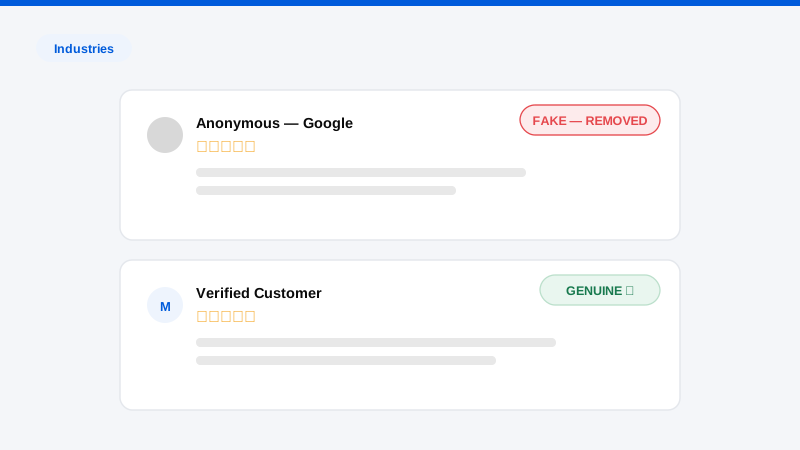
Review-platform enforcement, run as a campaign. Coordinated attacks, fake reviews, reviews from non-customers, and policy-violating content are pursued through each platform’s own enforcement channels, with the documentation, pattern evidence, and escalation persistence that platform reviewers actually respond to. Professional review removal is a distinct craft: knowing what each platform’s policies genuinely prohibit, how to demonstrate coordination or inauthenticity, and how to keep a case alive past the first templated denial. It is also ongoing work, because determined attackers return.
Defamation and false-statement removal. Blog posts, social accusations, and forum content that cross from opinion into false statements of fact are addressed through dedicated defamation-removal channels: platform policy enforcement, publisher processes, and search remediation. Where a matter genuinely requires legal action, we say so and work alongside counsel of your choosing; we are not a law firm and do not present removal work as a substitute for one.
Search-record remediation. Outdated, resolved, or misleading items ranking for the chef’s name are pursued through search-result removal and remediation avenues where they exist, and structurally suppressed where they do not, so that the first page reflects the current operation rather than the worst season of a career.
Continuous monitoring across the whole footprint. A chef’s exposure spans dozens of surfaces: every venue listing on every platform, plus the personal name across news, social, and forums. Professional monitoring watches all of it continuously, because the difference between catching a review attack at hour three and week three is the difference between containment and a repriced business.
Standing protection through openings and transitions. Attacks cluster at moments of visibility: openings, expansions, TV appearances, award seasons, and, above all, departures and disputes. Ongoing protection plans keep the baseline clean and the response instant through exactly those windows, instead of leaving the chef to hire help mid-crisis while the record compounds.
Key takeaway: A chef’s exposure is a portfolio: personal name, every venue, every platform, every archive. Protecting one listing while the rest stay unmanaged is how operators lose ground while believing they are defended.
Your next opening will be searched before it is tasted.Free confidential Exposure Scan: 15 minutes, live results across your name and venues, yours to keep whatever you decide next.
Book Your Free ScanWhy DIY and PR alone fail at reputation management for chefs and restaurateurs
Most operators respond to reputation damage with the two tools they already have: their own effort and their publicist. Both fail against hostile content, for structural reasons.
Owner responses escalate review wars. The instinct to answer an unfair review, especially a coordinated attack, publicly and forcefully is almost always counterproductive. Combative owner responses get screenshotted, shared, and written up; they convert a review dispute into a story, and the story outranks the reviews. The operators who fare worst in review attacks are usually the ones who fought back in public.
Platform enforcement is opaque to individuals. Flagging a fake review through the standard button is a low-probability act. Effective removal requires mapping each review to a specific policy violation, evidencing coordination patterns across accounts, and escalating through channels that are not visible on the public interface. Individual operators get one templated denial and give up; specialists run structured cases to decision-makers.
Hospitality PR cannot subtract. Restaurant publicists are excellent at openings, tastings, and coverage. None of that removes an exposé from search results, dismantles a review brigade, or corrects an AI summary. New coverage sits alongside hostile content; it does not displace it, and diligence readers, unlike casual diners, read past the first result. A publicity push during an unresolved reputation problem often makes things worse by driving search volume into a damaged record.
The economics favor early professional work. Every week a review attack stands, it costs covers. Every month an exposé ranks unaddressed, it compounds into aggregations, follow-ups, and AI ingestion. The cost of specialist engagement is fixed; the cost of the content is a running meter. Waiting is the most expensive strategy available.
Why chefs and restaurateurs choose Content Removal
Content Removal LLC is a removal-first reputation firm. For hospitality clients, that focus matches the actual problem: chefs rarely need more positive content. You have coverage, awards, full dining rooms to point to. What you need is for the hostile content to stop existing where possible, and to stop mattering where removal is not possible. That is the entirety of our practice.
We manage the person and the portfolio together. Your name, your current venues, your former venues, and your next concept are one connected exposure, and we work them as one engagement, because that is how investors, journalists, and algorithms connect them.
We are discreet by design. Removal work done properly leaves no trace: no public disputes, no statements, no signal to attackers or to press that anything is being managed. In an industry as small and talkative as hospitality, that discretion is not a courtesy. It is an operational requirement.
We are honest about outcomes. Some content can be removed; some can be contained; accurate coverage of real events generally stays, and no reputable firm guarantees results. What we provide is complete knowledge of the avenues that exist on each platform, full-effort execution of every one, and structured management of whatever remains. You will always know which category each item is in and why.
We stay through the moments that matter. Openings, expansion announcements, television appearances, partner disputes, staff departures. We are already watching when the attack starts, which is when protection is worth the most.
Frequently asked questions
Hostile reviews from a dispute at my old restaurant are appearing at my new one. Can that be addressed?
This pattern, the attack following the person to a new listing, is common and often actionable, because reviews of a venue the reviewer never patronized, posted as part of a carried-over grievance, tend to violate platform policies on relevance and authenticity. Success depends on documenting the pattern across accounts and time, framing it in each platform’s own policy language, and escalating persistently. That is specialist work, and it is exactly the kind of case where professional handling most changes the outcome. No specific result can be promised on any platform; every existing avenue can be fully worked.
A kitchen-culture story about me ranks for my name. Is anything possible, or is it permanent?
It depends on the content. False statements of fact, policy-violating material, and thin derivative rewrites have removal and remediation avenues; substantiated reporting by an established outlet generally does not, and we will tell you so directly. Even where the original stands, there is meaningful work: pursuing the syndicated copies and aggregations that multiply its footprint, remediating what ranks around it, and ensuring the story does not function as the sole summary of your career in search and AI answers. The audit determines which of those paths apply before you commit to any of them.
Do investors and landlords really search chefs before deals?
Vetting a chef-driven concept means vetting the chef. The name is the brand being underwritten, and searching it is the cheapest diligence step that exists. You should assume every prospective backer, partner, and landlord reads your record, and that none of them will tell you what they found; adverse findings surface as worse terms or silence, not as questions you get to answer. The practical response is to know your record before they read it, which is what an exposure scan is for.
When is the right time to engage, during a crisis or before one?
Before, without question. Removal work has lead times (platform review cycles, escalations, search reprocessing) and attacks cluster around visibility events you can see coming: openings, press features, award announcements. Engaging ahead of those windows means the record is clean before the traffic arrives and monitoring is live when the attack starts. Engaging mid-crisis still works, but every week of delay adds sediment that must then be removed at higher cost.
The name above the door is the most leveraged asset you own, and content you have never audited is quietly setting its price with every investor, critic, and diner who searches it. Book a free, confidential Exposure Scan and see your full record, personal name and venues together, the way diligence sees it. Fifteen minutes, live results, complete discretion, and the findings are yours to keep either way.