
Reputation management for consultants is the discipline of controlling what prospective clients find when they search a consultant’s name or firm, and removing the hostile threads, fake reviews, and smear content that would otherwise sit beside years of earned credibility. For consultants and consulting firms, the stakes are structurally higher than for almost any other professional service, because a consultant’s personal brand is not adjacent to the pipeline. It is the pipeline. There is no storefront, no inventory, no product demo that can outrun a bad first page of Google. There is a name, a track record, and whatever the internet says about both.
Consulting is also uniquely exposed to a specific class of attack: the credibility smear. Because consultants sell judgment and expertise, intangibles that clients cannot inspect before buying, the most efficient way to attack a consultant is not to criticize their work but to question their legitimacy. “Scam.” “Fraud.” “Fake guru.” A single forum thread built around one of those words, ranking for a consultant’s name, does not need to be true or even coherent to do its work. It only needs to exist at the moment a prospect is deciding whether to book the call.
This guide defines the threat landscape consultants and consulting firms face, traces exactly how search-visible attacks convert into lost engagements, and describes what professional, removal-first reputation management for consultants looks like, including why the solo operator’s instinct to handle it personally is usually the most expensive mistake in the sequence.
What reputation management for consultants actually is
Reputation management for consultants is the audit, removal, and ongoing monitoring of every search surface a prospect checks before engaging: the consultant’s name, the firm’s name, “[name] reviews,” “[name] scam,” social and forum results, image results, autocomplete suggestions, and AI-assistant summaries. The removal-first approach targets the damaging content itself (getting it taken down, de-indexed, or corrected at the platform level) before resorting to suppression, because in consulting the attacking content is usually specific, searchable, and sitting directly on the queries that decide deals. Burying it one position lower does not neutralize it; a diligent prospect scrolls.
This is a different service from the “personal branding” industry that dominates consultant marketing. Branding builds the positive surface. Removal-first reputation management deals with the negative surface (the defamatory thread, the fabricated review, the competitor’s smear page) that branding content cannot displace and should never be asked to. A consultant can publish weekly for a year and still watch a two-year-old “is [name] a scam?” thread hold its ranking, because forums and complaint sites carry domain authority no individual’s blog can outrank.
Key takeaway: Publishing more content is not a removal strategy. Hostile content on high-authority platforms holds its position against personal-brand publishing almost indefinitely; it has to be taken down or de-indexed, not out-blogged.
Why consultants are targeted
Consultants attract online attacks from four directions, and the pattern differs from other professions in one important way: the attacks aim at legitimacy rather than quality.
The “scam” thread economy. Forums, Reddit communities, and complaint boards host standing conversations in which any consultant, coach, or advisor with visible marketing gets interrogated: “Has anyone used [name]? Looks like a scam.” These threads are often started casually, sometimes by people who never engaged the consultant at all, and then accumulate speculation, secondhand claims, and pile-on replies. Because the thread’s title contains the consultant’s name plus a high-intent keyword, it ranks, often above the consultant’s own site for the exact query a skeptical prospect types. The consultant typically discovers it months later, after it has already been shaping close rates.
Competitor smears. Consulting niches are winner-take-most: a handful of names dominate each specialty’s search results and referral chatter. That concentration creates real incentive for sabotage: anonymous hostile reviews, burner-account forum posts, comparison content engineered to disparage, even fake “review” sites built around a competitor’s name. Attribution is hard by design, which is exactly why the attack format is popular.
Client disputes with a platform. Consulting deliverables are judged subjectively, engagements end ambiguously, and a client whose business didn’t improve can sincerely believe the consultant failed them. Unlike most professionals’ critics, an unhappy consulting client is often a business operator with an audience (a LinkedIn following, an email list, a podcast) and the dispute arrives in public with distribution attached.
Course, program, and mastermind blowback. Consultants who productize (courses, group programs, paid communities) multiply their surface area. Refund disputes and unmet expectations from low-touch products generate disproportionate hostility, and that hostility attaches to the consultant’s name, contaminating the high-trust advisory pipeline that actually pays the bills.
For consulting firms rather than solos, all of the above applies at two levels simultaneously: the firm brand and each visible principal. A prospect who searches the firm and finds nothing wrong, then searches the founding partner and finds a scam thread, has found something wrong with the firm. Principal-level exposure is firm-level exposure, which is why executive protection and firm protection are one program, not two.
What’s at stake
The economics of consulting make search-visible attacks unusually expensive, through mechanisms worth naming precisely.
Pre-call attrition. Consulting deals begin with a discovery call, and every discovery call is preceded by a search. Prospects who find hostile content do not book the call and do not explain why. The consultant’s calendar simply fills more slowly, and, because no one reports the deals that never appeared, the cause stays invisible. For a practice that runs on a handful of high-value engagements per year, losing even a small fraction of at-bats to pre-call attrition is the difference between a strong year and a bad one.
Price-integrity erosion. Consulting pricing rests entirely on perceived authority; there is no cost-of-goods floor. Prospects who arrive having seen negative content arrive skeptical, and skeptical prospects negotiate. Visible reputational damage converts directly into discount pressure, longer sales cycles, and smaller initial scopes, a tax on every deal that does close, stacked on top of the deals that didn’t.
Referral and platform gatekeeping. Consultants are hired through referrals, speaking slots, podcast appearances, and partner ecosystems, and every one of those channels has a gatekeeper who searches the name before extending the invitation. Event organizers and referral partners are protecting their own credibility; at the first sign of controversy they move to the next name on the list, silently. The consultant loses not one deal but a distribution channel.
Enterprise procurement screens. Consultants selling into large organizations face formal vendor diligence, procurement teams and sponsoring executives who search the firm and its principals before approving the engagement. An internal champion can survive a hard question about scope; almost no champion will spend political capital defending a vendor whose name searches badly.
AI-mediated first impressions. Prospects now routinely ask AI assistants about consultants before or instead of searching. These systems synthesize the index, scam threads included, into fluent, confident summaries, and a prospect who receives a hedged or negative AI answer may never look further. Monitoring what AI systems say about you has become part of pipeline protection, because the AI answer is increasingly the first impression that decides whether a search even happens.
See what prospects find before they call you.Free confidential Exposure Scan: live results on a 15-minute call, yours to keep either way.
Book Your Free ScanWhat professional protection looks like
Professional protection for a consultant or consulting firm is removal-first, name-centric, and continuous. The shape of the program follows the shape of the threat.
Full-surface audit. The engagement opens with a map of everything a prospect can find: name and firm searches, “[name] reviews” and “[name] scam” queries, forum and Reddit threads, review-platform profiles, social results, images, autocomplete, and AI-assistant answers. For consultants the autocomplete layer matters more than most realize, a name whose suggested completions include “scam” is losing prospects before a single result loads.
Removal at the source. Each hostile item gets an individual removal path. Defamatory threads and posts are pursued through the defamation-removal channels appropriate to each platform: policy-violation challenges, moderation escalation, host-level requests, and legal referral where the facts warrant it. Fabricated and policy-violating reviews are challenged through platform enforcement with documented evidence. Content that cannot be removed at the host can often be de-indexed from the search results where it actually does its damage. Forum content is genuinely difficult (anonymous authors, removal-resistant platforms) which is precisely where specialist experience separates from guesswork: knowing which communities’ moderators respond, to what framing, through which channel, and when de-indexing is the better lever than takedown.
Suppression and authority-building where removal ends. For the residue, professional suppression builds durable, high-authority assets around the consultant’s name queries. Earned press placement fits consultants particularly well: legitimate third-party coverage simultaneously outranks hostile content and directly rebuts the legitimacy attack at the heart of most consultant smears. A scam thread loses most of its force when it sits below credible independent coverage.
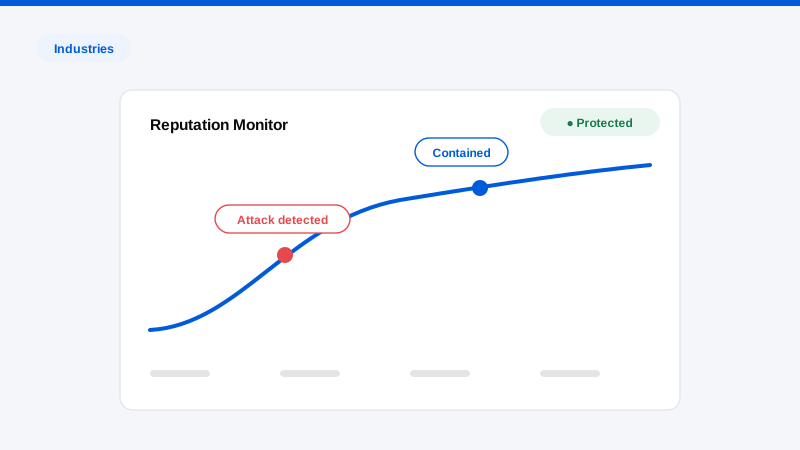
Standing monitoring and rapid response. Because new threads and reviews can appear any week, mature protection runs on continuous monitoring of name and firm terms with rapid-response removal capacity held on standby through a Protection Plan. Speed is decisive with forum content in a way it is nowhere else: a thread challenged in its first days has a handful of views and no reply momentum; the same thread six months later has hundreds of replies, backlinks, and an entrenched ranking. The difference between those two outcomes is monitoring.
Key takeaway: For consultants, response speed is the highest-leverage variable in the entire program. Hostile threads compound like interest, every month a thread stays up, it gets harder to remove and more expensive to outrank.
Why specialists beat DIY reputation management for consultants
Consultants advise clients for a living, so the reflex to self-manage a reputation problem is strong, and the failure mode is well worn.
Replying in the thread is the classic error. A consultant who shows up in a hostile forum thread to defend themselves confirms they’ve seen it, hands the thread fresh engagement that lifts its ranking, and produces quotable material for the pile-on. Forum culture treats the defended-against accusation as more credible, not less. The second error is the aggressive takedown demand sent personally, which, screenshotted, becomes the thread’s best content. The third is misdirected effort: months spent publishing SEO content to outrank a platform whose domain authority makes the contest unwinnable.
Specialists avoid all three because they work these exact channels daily: they know each platform’s actual enforcement pathways, they engage as a third party so the consultant never appears in the fight, and they can triage honestly (which items will come down, which should be de-indexed, which need suppression) before any effort is spent. Just as consultants tell clients that founder time is the most expensive resource in the building, a consultant’s hours are worth more in the pipeline than in a moderation queue. Full-service reputation management exists so the fight never touches the calendar.
See what prospects find before they call you.Free confidential Exposure Scan: live results on a 15-minute call, yours to keep either way.
Book Your Free ScanWhy consultants choose Content Removal
Content Removal LLC is a removal-first firm. Our practice is getting hostile content taken down, de-indexed, or corrected at the source, the work that personal-branding agencies and SEO retainers are not built to do. Consultants and consulting firms engage us for four reasons.
First, we work the platforms where consultant attacks actually live (forums, complaint boards, review platforms, social) through their real enforcement channels, with the framing and evidence each one responds to. Second, we keep the consultant out of the fight entirely: no public replies, no personally signed demands, nothing an attacker can screenshot. Third, we protect the name and the firm as one engagement, because prospects search both. Fourth, we are honest about odds: after auditing your exposure we tell you which items are strong removal candidates, which are long shots, and which call for suppression or press instead, because nobody can guarantee outcomes in this field, and the vendors who do are selling the guarantee, not the result. We are not a law firm and don’t provide legal advice; where counsel is warranted we work alongside yours. Our case studies show what these engagements look like in practice.
Key takeaway: Vet a reputation partner the way you’d tell a client to vet any vendor: methodology first (removal, not just publishing), discretion second, and candor about probabilities over promises, every time.
Frequently asked questions
Can a “scam” thread on Reddit or a forum actually be removed?
Sometimes: and when full removal isn’t achievable, partial remedies often are. Outcomes depend on the platform, the thread’s content, and whether specific posts violate site policies (defamation, doxxing, harassment, impersonation). The realistic toolkit includes moderator and platform escalation, removal of the specific violating posts that give a thread its teeth, de-indexing so the thread stops ranking for your name, and suppression. An honest specialist assesses the specific thread before predicting anything.
Someone is attacking me anonymously. Does anonymity make removal impossible?
No. Most removal work runs on platform policy, not on identifying the author, a post that violates a platform’s rules is removable regardless of who wrote it, and de-indexing does not require attribution at all. Unmasking an anonymous attacker is a separate legal process that sometimes matters for litigation; it is rarely a prerequisite for getting content down or off your name’s search results.
Should I respond to the thread to set the record straight?
Almost never in the thread itself. Public engagement adds ranking signals, confirms the thread has your attention, and generates new quotable material. The record gets set through removal, de-indexing, and authoritative third-party content that outranks and outweighs the attack, channels that work without feeding it.
I’m a solo consultant, not a firm. Is professional protection overkill?
Solos have the strongest case of anyone, because the name being attacked is the entire business. There is no firm brand to absorb the damage and no colleague’s pipeline to lean on while yours recovers. Scopes scale to the practice: a solo with one hostile thread needs a very different engagement than a firm with a coordinated smear, and a credible partner prices accordingly.
Somewhere right now, a prospect who heard your name on a podcast or from a referral is typing it into a search bar, and what they find in the next ten seconds decides whether you ever hear from them. Find out what that is before the next one looks: book a free, confidential Exposure Scan, live results for your name and firm, walked through on a 15-minute call, yours to keep either way.