
Reputation management for dentists is the discipline of protecting what prospective patients find when they search for a dentist or practice, removing false and harmful content where platforms allow it, correcting outdated material, suppressing what cannot come down, and monitoring the practice’s name so new attacks are caught early. For dental practices, this work sits closer to the revenue line than in almost any other field of medicine, because dentistry is the most review-driven specialty in healthcare.
Patients choose dentists the way they choose restaurants: they search a local query, scan the map pack, compare star ratings, and read a handful of recent reviews. There is no referral gatekeeper, no insurance steering strong enough to override a 3.6-star average, and no second chance at the three seconds a patient spends deciding which practice to call. When a dental practice’s online presence is damaged (by a fake review wave, a viral complaint, or a decade-old dispute still ranking on page one) the damage translates into empty chair time with an immediacy that other specialties never experience.
This guide lays out the specific threats dental practices face, what is genuinely at stake, and what professional, removal-first protection looks like, including why the practices that solve this durably hire specialists instead of asking the front office to handle it.
Why dentists are targeted
Dental practices attract a disproportionate share of online attacks and reputation damage, for reasons built into the economics and psychology of dentistry.
Money disputes become “reviews.” More than almost any other field of medicine, dentistry generates billing friction: out-of-pocket costs, insurance denials, disputed estimates, treatment plans patients perceive as upselling. A patient angry about a bill rarely frames the review as a billing complaint. It becomes “this dentist is a scammer,” “unnecessary procedures,” “they drill for profit.” Financial grievance dressed as clinical accusation is the signature dental attack, and it is devastating precisely because prospective patients cannot distinguish it from a genuine warning.
Fear and pain distort the narrative. Dentistry is one of the few fields where a normal, well-executed treatment can still involve discomfort, and where patient anxiety runs high before anyone touches a drill. Discomfort plus anxiety plus a surprise bill is the exact emotional formula that produces one-star reviews, regardless of clinical quality.
Local competition is unusually dense. In most markets, a dozen practices compete for the same map pack. That density creates real incentive for bad actors: fake negative reviews against competitors, astroturfed comparisons, and review-bombing campaigns are all documented behaviors in hyper-competitive local verticals, and dentistry is one of the most competitive local verticals in existence.
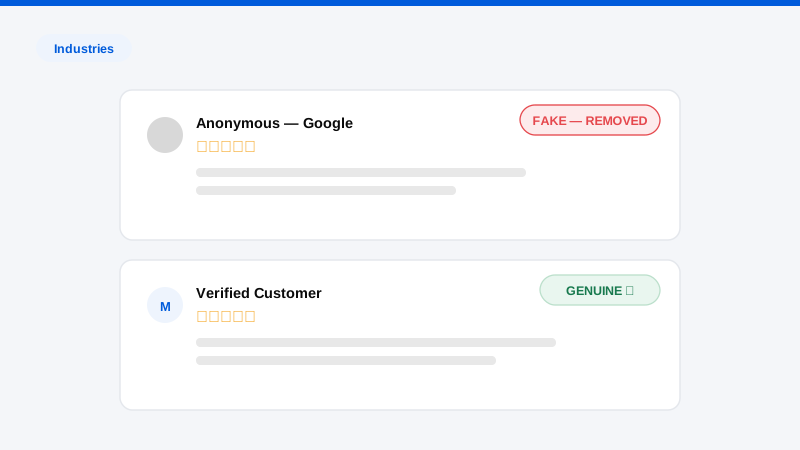
Fake review waves hit dentists hard. Because dental practices depend so heavily on ratings, they are attractive targets for coordinated fake-review attacks, from disgruntled ex-employees, from competitors, and occasionally from extortion operations that post negative reviews and then offer to remove them for payment. A wave of fabricated one-star reviews can drop a practice’s average overnight, and the platform’s automated systems frequently fail to catch it.
Old complaints outlive the practice that generated them. A dispute from years ago (a complaint about a departed associate, coverage of a long-resolved licensing matter, a forum thread about a previous owner of the same practice name) can sit in search results indefinitely. Search engines have no mechanism for “this was resolved” or “that dentist left in 2019.” The modern practice inherits the permanent record of its worst historical moment, and patients reading it have no way to know it is outdated.
Key takeaway: Dentists are targeted because dentistry combines high billing friction, high patient anxiety, and total dependence on local ratings, a combination that turns ordinary disputes into public attacks and makes those attacks unusually profitable for competitors and bad actors.
What’s at stake for a dental practice
Reviews are the booking funnel. For a dental practice, online reputation is not adjacent to patient acquisition. It is patient acquisition. The overwhelming majority of new patients arrive through local search, and local search presents ratings before it presents anything else. A damaged rating doesn’t just influence the decision; it usually ends it before the practice website is ever visited. The practice never learns which patients scrolled past, lost bookings from reputation damage are invisible in a way that makes the problem chronically underestimated.
Ratings gate visibility itself. Star ratings don’t just persuade patients: they feed the ranking systems that decide which practices appear in the local results at all. Reputation damage therefore compounds: worse ratings mean fewer impressions, fewer impressions mean fewer new reviews to dilute the damage, and the spiral continues until something intervenes.
Practice value is on the line. Dental practices are bought and sold on goodwill, and in 2026 goodwill is substantially a search-results page. DSOs and individual buyers run reputation diligence before acquisition; a practice carrying a fake-review wave or a page-one horror story sells slower and for less. Reputation damage is a balance-sheet problem, not just a marketing problem.
Staff and recruiting feel it too. Hygienists, associates, and front-office candidates research employers the same way patients research providers. A practice with visible reputation damage struggles to hire in a labor market where dental talent has options.
AI search is changing the calculus. Patients increasingly ask AI assistants for dentist recommendations and summaries. These systems synthesize review content, news, and forum posts into confident answers, and if the prominent material on a practice is negative or outdated, that is what gets synthesized. AI reputation is now a distinct exposure surface for local practices, and it rewards fixing content at the source rather than merely outranking it.
See what patients find before they book.Free confidential Exposure Scan: live results on a 15-minute call, yours to keep either way.
Book Your Free ScanWhy DIY reputation management for dentists fails
Most dental practices try to handle reputation damage in-house first, and the pattern of failure is consistent enough to describe in advance.
The front office flags a review and gets a form rejection. Platform review-removal processes look simple (there’s a “report” button, after all) but the button is the consumer-grade path, and it almost always returns an automated denial. Successful removals run through business-side channels with structured evidence: documentation that the reviewer was never a patient, that the content violates specific policy provisions, that the pattern indicates coordination. Building that case is a professional skill, and each platform’s process is different. Practices that burn their one obvious escalation on a badly framed report often make later, well-framed attempts harder.
Someone responds to a review and creates a HIPAA problem. The most dangerous DIY move in dental reputation management is the heated public reply. A response that confirms the reviewer was a patient, references their treatment, or discusses their account details can constitute an unauthorized disclosure of protected health information, converting a one-star review into a federal privacy issue and, frequently, a news story. Professional practice is the opposite: respond briefly and generically, without confirming any patient relationship or disclosing anything, while pursuing removal through proper channels. We advise every dental client on this discipline before a single takedown request is filed.
The agency solution buries instead of removes. Dental marketing agencies respond to reputation damage with the tool they have: more content, more profiles, more review generation. That work has value, but it leaves the harmful content live, waiting for the patient who searches the practice name plus “reviews” or “complaints,” feeding AI summaries, and ready to resurface whenever rankings shift. Suppression without removal is a lease on your own search results, renewed monthly, forever.
Nobody watches. Practices discover review waves weeks after they start, because no one’s job is to look. By then the rating damage is done, and the platform’s willingness to treat the wave as coordinated has diminished. Detection speed is half the battle, and DIY has no detection.
Key takeaway: DIY fails at both ends: removal attempts get denied for lack of platform-specific evidence, and public responses risk HIPAA exposure. The gap between the report button and an actual removal is exactly where specialists live.
What professional reputation management for dentists looks like
A professional engagement for a dental practice is structured, sequenced, and removal-first.
Exposure audit across every surface patients use. The engagement begins with a complete map: Google Business Profile and the review platforms that matter in dentistry, general search results on the practice and each named dentist, news archives, complaint boards, forums, and AI assistant outputs. Practices are routinely unaware of half their exposure, old listings under previous practice names, associate dentists’ individual results, and third-party pages ranking for “practice name + reviews.”
Review remediation, platform by platform. Fake, non-patient, mistaken-identity, and policy-violating reviews are documented and challenged through the correct channels with properly built evidence packages, including pattern analysis when the practice has been hit by a coordinated wave. This is the heart of review removal work, and it is done entirely without touching patient information: the case is built on platform policy and reviewer behavior, never on clinical records.
Defamation response for the serious cases. Accusations of fraud, unnecessary treatment, or misconduct that cross from opinion into false statements of fact are escalated through platform legal channels. Content Removal is not a law firm and does not provide legal advice; when matters warrant formal legal action, we coordinate with the practice’s counsel and execute the platform-facing work. Our defamation removal page describes how these cases proceed.
Cleanup of the old and outdated. Resolved disputes, stale news items, listings for departed associates, and superseded pages are pursued for removal, correction, or deindexing, the outdated content problem that quietly costs practices patients for years.
Suppression as the second line. Where content is legitimate and non-removable, the practice’s authoritative presence is built out so accurate material dominates what patients actually read. Suppression is always the fallback, never the strategy.
Continuous monitoring under a Protection Plan. Dental reputations are attacked on no schedule. Protection Plans keep the practice and its dentists under continuous monitoring, so a new fake-review wave or complaint thread is flagged within days and addressed while platforms are most responsive, and before the rating damage compounds.
See what patients find before they book.Free confidential Exposure Scan: live results on a 15-minute call, yours to keep either way.
Book Your Free ScanWhy dentists choose Content Removal
Removal is our core discipline, not an add-on. Most vendors serving dental practices are marketing agencies that treat reputation as a content problem. Content Removal is a removal firm: our practice is built on getting harmful content taken down at the source, with suppression reserved for what genuinely cannot come down. That ordering is the entire difference between managing a problem and ending it.
We know how review platforms actually decide. Years of removal work across Google and the health-review ecosystem means we know which evidence moves which platform, how to frame coordinated-attack cases, and when and how to escalate past the first denial. That institutional knowledge cannot be improvised by a practice manager with a support ticket.
HIPAA-safe by design. Every response template, evidence package, and takedown request we build for a dental client is constructed so no patient information is ever disclosed. We advise practices on responding to reviews without confirming patient relationships, protecting the practice while defending it.
Honest scoping, no guarantees. No firm can promise the removal of any specific piece of content, and any vendor guaranteeing outcomes is telling you what you want to hear. What we offer instead is a candid, experience-based read on what is likely removable and what isn’t, delivered before you commit, not after. Our case studies show real engagement arcs, and our medical practice page covers how we work with providers generally.
Built for practices, priced for practices. From single-location offices to multi-site groups, engagements scale to the actual exposure, with monitoring plans that fit a dental practice’s economics rather than an enterprise budget.
Key takeaway: Dentists choose Content Removal because we do the one thing dental marketing agencies can’t: make harmful content go away where platforms allow it, safely, without ever putting patient privacy at risk in the process.
Frequently asked questions
Can fake Google reviews of a dental practice actually be removed?
Frequently, yes, when the case is built correctly. Google prohibits fake engagement, off-topic content, and conflicts of interest, and it removes reviews that demonstrably violate those policies. The difference between denial and removal is usually the quality of the evidence and the channel used. Coordinated waves are a distinct case type with their own escalation path. No one can guarantee a specific removal, but the success rate of properly built cases bears no resemblance to the report-button experience.
An old complaint from years ago still ranks for our practice name. Is that fixable?
Often. Outdated content has several possible paths: removal at the source, correction or updating, deindexing requests where the content violates current platform or search policies, and, where none of those apply, suppression beneath current, accurate material. The right path depends on where the content lives and what it says, which is exactly what an exposure audit determines.
Should we respond to negative reviews at all?
Generally yes: briefly, professionally, and without ever confirming the reviewer was a patient or discussing any details of care. A calm, generic response signals attentiveness to prospective patients reading the thread. What a practice must never do is argue clinical or billing specifics in public; that path leads to HIPAA exposure. Response strategy and removal strategy should run in parallel, and we advise clients on both.
We think a competitor is behind our bad reviews. What can be done?
Coordinated and competitor-driven attacks leave patterns (timing clusters, account behavior, review histories) that can be documented and presented to platforms as evidence of policy-violating inauthentic activity. Platforms take coordination cases seriously when the pattern is properly demonstrated. Where conduct may cross legal lines, we coordinate with the practice’s own counsel while handling the platform-side work.
Every day the damage sits in your results, patients you never meet are choosing another chair. Request a free, confidential Exposure Scan: on a 15-minute call we’ll show you live everything patients find on your practice, what’s likely removable, and what protection would look like. The findings are yours to keep either way.