
Reputation management for health insurers is the practice of controlling what members, employers, brokers, regulators, and journalists find when they research a health plan or its leadership, and removing the damaging content that would otherwise define the company for an audience that already expects the worst. No industry starts from a deeper trust deficit. A health insurer is, in the public’s mental model, the company that says no at the worst moment of your life, and every piece of hostile content published about an insurer lands on that pre-built narrative and confirms it. The insurer’s actual record (the claims paid without friction, the appeals resolved, the care coordinated) generates no content at all, because satisfied members do not post. The visible record is the grievance record, and the grievance record is what search engines and AI assistants serve to everyone who asks.
The stakes of leaving that record unmanaged changed permanently when public anger at health insurance stopped being an abstraction. The industry has seen executive-targeted violence, open celebration of that violence online, and a sustained normalization of hostility toward named insurance leaders that has no parallel in any other sector. For health insurers, reputation management is no longer adjacent to security. It is the front end of it. The same unmanaged surfaces that cost the company employer accounts and member trust also expose its executives’ home addresses to people who have been told, repeatedly and approvingly, that those executives are villains.
This guide is written for chief communications officers, general counsel, corporate security leads, and the executive teams of health plans. It covers how hostile content accumulates around insurers, what it costs through the sector’s specific mechanisms, why the standard PR playbook fails against this threat profile, and what removal-first protection looks like, for the company, and for the named individuals who lead it.
Why health insurers are targeted
Health insurers face a threat landscape defined by moral outrage, the most viral emotion on the internet, and the hardest to counter with facts.
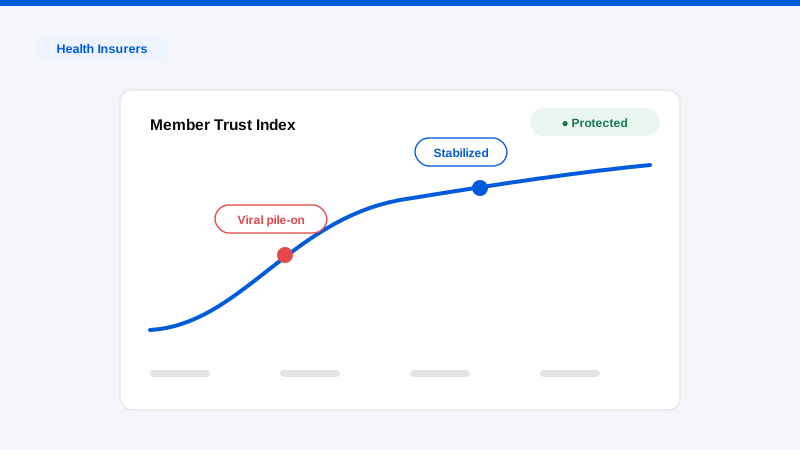
Denial-of-care stories are engineered by the medium to go viral. A member’s account of a denied claim (a screenshot of a denial letter, a video recorded outside a hospital, a thread about a sick child) combines every element social platforms reward: injustice, specificity, a sympathetic victim, and a faceless corporate villain. These posts routinely reach millions of views, generate news coverage, and become permanent search results for the insurer’s name. The eventual resolution (the appeal granted, the coding error corrected, the context that changes the story) is published to an audience of no one.
Review bombing converts each controversy into a durable rating. Every viral moment triggers coordinated one-star campaigns across review platforms, including from people who were never members. The aggregate ratings drop, hostile reviews rank first, and the damage persists into every broker comparison and employer evaluation for years. Review platforms have policies against inauthentic and off-topic reviews, but they enforce them for those who know how to ask.
Anger at the industry lands on named executives. Health-insurance executives are now targeted as individuals to a degree unmatched in any industry. Their names attract hostile commentary, their compensation becomes annual outrage content, their photos are turned into memes, and their personal information (home addresses, family members, daily patterns) circulates through data brokers into communities where violence against insurance executives has been openly celebrated. This is not a reputational problem with a security footnote; it is a security problem that begins in search results.
Regulatory and litigation artifacts feed evergreen hostile content. Market-conduct exam findings, fines, class actions over denial practices, and state insurance-department complaints are public records that content farms and advocacy sites excerpt into “insurer caught” articles: indexed permanently, stripped of resolution, resurfacing with each news cycle.
Ex-employee content carries insider authority. Claims processors, utilization-review nurses, and call-center staff who leave, especially after layoffs or disputes over denial metrics, post detailed accounts on employer-review platforms and social media: quotas, scripts, pressure. Whether representative or not, “insider confirms what you suspected” content is maximally credible to an audience primed to believe it.
Politicians and advocacy campaigns use insurers as narrative infrastructure. Health-insurance reform is a permanent political topic, and named insurers serve as the examples in speeches, hearings, documentaries, and campaigns. The company’s name is written into hostile content by actors with enormous distribution and no commercial relationship to the facts of any individual case.
What damaging content costs a health insurer
The costs run through every channel by which a health plan wins and keeps business, and now, through its security budget.
Employer and broker decisions absorb the visible record. Self-funded employers and the brokers and consultants who advise them research carriers before every placement. A search page dominated by denial horror stories, review bombs, and regulatory findings becomes a slide in a consultant’s deck and a hesitation in a CHRO’s mind. Group business is won and lost on trust in claims administration, which is exactly what hostile content attacks.
Member acquisition and retention track search sentiment. Individual and Medicare-eligible members comparison-shop online, where plan searches surface ratings, reviews, and horror stories alongside official content. During open enrollment, the industry’s compressed annual harvest, a viral denial story or bombed rating profile operates as anti-marketing at the moment of maximum consequence.
Regulators read the anger. Insurance commissioners, legislators, and their staffs see the same viral posts and coverage everyone else does. Public outrage translates into exam priorities, hearing invitations, and enforcement appetite; a plan whose search results read as a scandal file negotiates every regulatory interaction from a weakened position.
Provider-network dynamics harden. Health systems and physician groups in contract negotiations research the payer’s public standing, and a plan publicly framed as a claims-denier faces stiffer network negotiations, and occasionally public contract disputes in which the provider’s messaging lands on the insurer’s pre-built villain narrative.
Talent costs rise with the toxicity. Recruiting clinicians, actuaries, and technologists into an industry the internet vilifies is already hard; a specific employer whose search results are an anthology of outrage pays a premium in offers declined. Existing employees, and their families, read the same content, and sustained public hostility becomes a retention and morale drag no engagement survey fully captures.
Executive security costs become reputational costs, and vice versa. Post-2024, every large insurer carries elevated executive-protection spending. The digital layer is where that risk begins: exposed personal data, hostile content that names individuals, and online communities that celebrate targeting. Unmanaged digital exposure makes physical protection both more necessary and less effective, and the cheapest security measure available is removing the exposure itself.
AI assistants compress the grievance record into a verdict. Ask an AI assistant about a health insurer and it synthesizes the indexed record (viral denial stories, review bombs, and regulatory excerpts included) into a fluent, confident summary. Members ask before enrolling; brokers ask while comparing; journalists ask while drafting. The plan is summarized thousands of times daily by systems reading a record no one at the company has audited.
Why generic PR and SEO approaches fail for health insurers
Health plans have substantial communications operations. The persistent failure is that those operations were built for a fair fight, and this is not one.
You cannot out-publish moral outrage. Suppression strategies assume the negative content has ordinary engagement. Denial-of-care virality does not: it is re-shared, re-linked, and re-surfaced every time the industry is in the news, signals search algorithms read as permanent relevance. Corporate content about care coordination will never out-engage a crying parent’s video, and a strategy premised on outranking it is a strategy premised on arithmetic that does not hold.
Responding to individual stories is a trap. Privacy law prevents the insurer from telling its side of any member’s story, the company literally cannot say “here is what actually happened”, so public responses are confined to generalities that read as evasion and generate a second wave of coverage. The asymmetry is absolute: the accuser can say anything; the accused can say almost nothing. Removal and de-indexing under platform policies operate outside that asymmetry entirely.
Review-bombing recovery requires platform mechanics, not messaging. Bombed ratings are a policy-enforcement problem: identifying inauthentic, off-topic, and coordinated reviews and getting platforms to act on their own rules at volume. Communications teams are not built for that work; it is a specialist craft with platform-specific mechanics, and every month it goes undone the bombed rating compounds through another broker season.
Corporate fingerprints make everything worse. An insurer discovered filing takedowns against member complaints becomes a story worse than the complaints. Specialist intermediaries exist precisely so remediation is executed against policy-violating content, not member speech, and executed without the company’s name attached to the effort. This is what removal-first reputation management is for.
What removal-first protection looks like
Removal-first protection accepts what insurers cannot say publicly and works the layers where outcomes are actually decided.
Assessment. The engagement begins with a full exposure audit across the plan’s brands and every named executive: search results, news, social and video platforms, review platforms, forums, data brokers, and AI-generated answers. Each damaging item is classified by its realistic path (source removal, de-indexing, platform-policy enforcement, or containment) and executive exposure is mapped as its own workstream with security implications flagged. Most insurer clients begin with a free, confidential Exposure Scan; the executive-exposure findings alone typically justify the call.
Removal at the source. A meaningful share of the hostile surface violates platform policies: inauthentic and coordinated reviews, fabricated accounts, impersonation profiles, doxxed executive information, harassment and threat content, and posts crossing from protected opinion into false statements of fact. Each has a removal path, argued in the platform’s own terms at volume. The boundary is stated plainly: authentic member speech is generally not a removal target, removal decisions belong to platforms and publishers, and no credible firm guarantees a specific item will come down. What specialists change is the probability, the speed, and the share of the eligible set that falls.
De-indexing. Content that cannot be removed at the source can often be removed from search results, where broker comparisons and employer diligence actually happen. Search-engine policies covering exposed personal information and doxxing apply with particular force to executive-targeted content in this industry, and outdated-content mechanisms address artifacts that misstate resolved matters. For an executive whose home address circulates in hostile communities, de-indexing is a security control, not a communications tactic.
Monitoring. Insurer threat surfaces spike around open enrollment, rate filings, earnings, political news cycles, and any industry event that reignites public anger. Continuous monitoring across search, social, review platforms, data brokers, and AI answers catches new items at first appearance, and for this industry specifically, monitoring executive names for emerging hostility is a safety function. Standing Protection Plans pair that monitoring with reserved removal capacity, so response begins within hours, not after the item has hardened into permanence.
Protecting named executives as individuals
For health insurers, executive protection is the most urgent chapter of this entire discipline, and it deserves its own budget line.
The sector’s named leaders (CEOs, CMOs, claims and utilization-management executives) now operate under a threat model transformed by real-world violence and its open celebration online. Hostile content names them personally; memes and threads frame them as legitimate targets; and data-broker networks sell the address, family, and pattern-of-life information that converts sentiment into capability. Traditional executive protection secures the person; it does nothing about the searchable infrastructure that directs hostility toward them.
Digital protection for insurance executives means treating each name as a protected asset: aggressive, continuously-maintained removal of personal data from broker networks, for the executive and their household; takedown of impersonation accounts, doxxing content, and threats under platform policies; de-indexing of exposed personal information at the search layer; remediation of legacy content that keeps individual names attached to industry-wide anger; and continuous monitoring of each name across the surfaces where targeting sentiment forms, including AI-generated answers. This is the core of our digital executive protection practice, and for health insurers it should cover the full officer group, board members, and any employee publicly named in a viral incident, because virality chooses its own targets, and mid-level staff have been doxxed for appearing in a screenshot.
Security teams increasingly co-own this work with communications, which is correct: the digital layer is where physical risk begins, and shrinking it is the highest-leverage protective spend available.
Frequently asked questions
A denial-of-care story about us went viral. What can realistically be done?
The event is decomposed into its content items, and each is assessed. Authentic member speech is generally not a removal target, but viral events accrete a large penumbra of fabricated accounts, pile-on harassment, doxxing, impersonation, and false statements of fact, all of which have platform-policy removal paths. The remainder is contained at the search layer so it stops defining the company’s name. The realistic goal is that the event becomes one aging result rather than the permanent answer to who you are.
Our ratings were review-bombed after a news cycle. Can that be fixed?
Frequently, in substantial part. Review platforms prohibit inauthentic, off-topic, and coordinated reviews, and bombing campaigns leave identifiable patterns (timing clusters, non-customer reviewers, copied language) that platforms will act on when the case is built to their standards and pressed through the right channels. It is volume work with platform-specific mechanics, which is why it belongs with specialists. Legitimate negative reviews from actual members stay, and should.
Our executives are receiving threats and being doxxed. Where does removal fit next to physical security?
In front of it. Physical protection manages the last hundred feet of a risk that forms online: exposed addresses, hostile framing, and celebratory communities. Removing data-broker records for executives and their households, taking down doxxing and threat content, and de-indexing exposed information shrink the targeting surface itself. Every serious protective detail in this industry now wants the digital layer cleaned, because it makes everything else they do more effective.
Can we do this in-house? We have large legal and communications teams.
Those teams are essential and remain in their lanes, but platform removal is a distinct volume craft, and an insurer filing takedowns under its own name creates discoverable trails and a potential second scandal. Specialists bring accumulated platform mechanics, speed that internal review cycles cannot match, and distance between the company and the effort. Most insurer clients pair internal teams with us: they own strategy, counsel, and member communications; we own the content surface.
What is the first step?
A free, confidential Exposure Scan: a complete map of the damaging content attached to your plan and your leadership, including data-broker exposure for named executives and your AI-answer profile, reviewed live on a call, with findings yours to keep either way. For insurers, the scan doubles as a security assessment of the executive team’s digital exposure, and that alone typically changes how leadership prioritizes this.
Your members, your regulators, and, soberingly, your executives’ would-be antagonists are all reading the same unmanaged record. Book a free, confidential Exposure Scan and see exactly what they see, before the next open enrollment, the next news cycle, or the next escalation.