
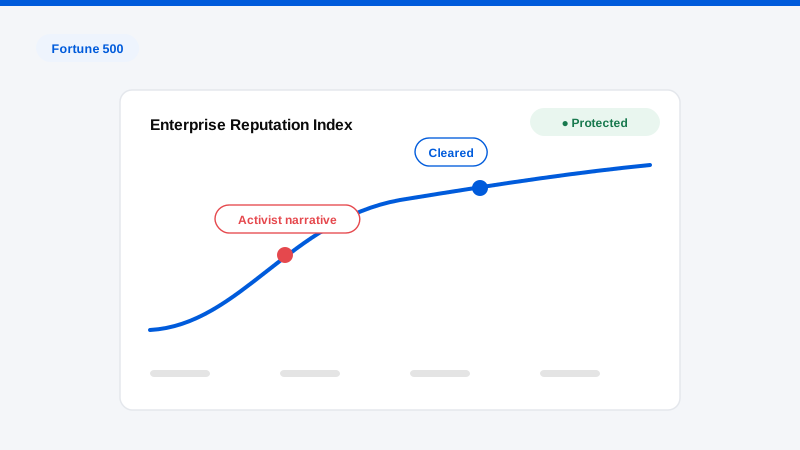
Reputation management for Fortune 500 companies is the practice of controlling what investors, regulators, journalists, enterprise customers, and senior candidates find when they research the company or its leadership, and removing the damaging content that would otherwise shape billion-dollar decisions before anyone from the company enters the room. At enterprise scale, reputation is not a communications concern; it is a balance-sheet item. It is priced into the cost of capital, embedded in procurement scores, weighed in board searches, and read aloud, verbatim, by AI assistants to anyone who asks what kind of company this is.
The paradox of the Fortune 500 is that enormous visibility does not mean control. A large-cap company generates thousands of search-indexed pages a year (earnings coverage, analyst notes, product press) and yet the results that decide outcomes are often the hostile ones: the boycott hashtag that trended for a weekend three years ago, the layoff coverage that still outranks the recovery, the anonymous review pile-on, the short-seller report with the company’s name in its title. Scale attracts adversaries, and adversaries publish. The question is not whether damaging content exists about a Fortune 500 company; it is whether anyone is systematically working to remove, de-index, and contain it, or whether the company has quietly conceded that layer of the battlefield.
This guide is written for general counsel, chief communications officers, corporate security leads, and the executives whose names appear in the coverage. It describes how attacks on enterprise reputations actually operate, what they cost through mechanisms most companies never trace back to search results, why the standard PR-and-SEO playbook underperforms at this scale, and what a removal-first alternative looks like in practice.
Why Fortune 500 companies are targeted
The largest companies in the world are targeted precisely because they are the largest. Every constituency with a grievance, a thesis, or an agenda understands that attacking a household name generates attention that attacking a mid-cap never will.
Activist campaigns treat the company’s name as a stage. Environmental, labor, political, and social campaigns select Fortune 500 targets deliberately: the brand’s recognition guarantees coverage, and the campaign’s content (petition pages, campaign microsites, coordinated social threads) is engineered to rank for the company’s name. Long after the campaign itself winds down, its artifacts remain indexed, framing the company for every future searcher who never saw the context or the resolution.
Boycott hashtags outlive the boycott. A viral boycott moment may burn out in days, but the explainer articles, aggregated tweet roundups, and “why people are boycotting” listicles it generates are durable search assets. They resurface every time the company is in the news for anything, and they are exactly the kind of content AI assistants synthesize when a user asks about the company’s controversies.
Layoff and restructuring coverage compounds. Workforce reductions at a Fortune 500 company are national news by default. The coverage clusters (announcement stories, employee-reaction pieces, follow-up analysis) and it dominates the company’s recent-news footprint at precisely the moment when customers, candidates, and partners are searching. Anonymous employer-review platforms then absorb the anger: departing employees post detailed, bitter accounts that rank for years and greet every senior candidate the company tries to recruit.
Short-seller reports weaponize search placement. Activist short reports are written to rank. Their authors title them with the company’s name, seed them across finance media, and rely on the fact that a report alleging accounting irregularities or governance failures will sit in the company’s search results through every subsequent earnings cycle, regardless of whether its claims survive scrutiny.
Executive impersonation and fabricated content scale with fame. CEOs and CFOs of household-name companies are impersonated constantly: fake investment endorsements, cloned social profiles, deepfaked video, fraudulent “interviews” promoting scams. Beyond the fraud harm, this content pollutes leadership search results with associations, the CEO’s name beside “scam”, that diligence screens and journalists inevitably surface.
Employee-review pile-ons follow every controversy. When a Fortune 500 company has a public bad moment, its review-platform pages become a venue for coordinated venting, including from people who never worked there. The aggregate rating drops, hostile reviews rise to the top, and the damage persists into every recruiting conversation for years.
What damaging content costs a Fortune 500 company
At enterprise scale, reputational damage rarely presents as a single catastrophic loss. It presents as friction, millions of small, silent taxes applied across every function that touches the outside world.
Enterprise procurement reads search results as risk data. B2B buyers at other large companies run reputational screens on strategic vendors, and their procurement and third-party-risk platforms ingest adverse media automatically. A search page carrying unresolved controversy content becomes a flag in a vendor risk score, which becomes a harder question in an RFP, which becomes a lost deal the sales team attributes to pricing.
The cost of capital absorbs headline risk. Institutional investors, lenders, and rating analysts factor perceived controversy exposure into their models. ESG and governance screens surface adverse media mechanically. Persistent hostile content does not need to be true to be priced; it needs only to be findable.
Short-seller and activist content moves the stock while it ranks. A short report that stays on page one for the ticker or company name keeps its thesis in front of every retail and institutional researcher indefinitely. Even after rebuttals, the report’s search persistence gives the bear case permanent distribution the bull case has to re-earn quarterly.
Talent acquisition pays the review-platform tax. Senior candidates, the ones with options, research exhaustively. A leadership team trying to recruit a division president against a backdrop of one-star pile-ons and layoff coverage pays for it in declined offers, longer searches, and compensation premiums no one ever books as a reputation cost.
Regulators and litigators read the same pages. Plaintiffs’ firms mine hostile coverage for class-action theories. Regulatory staff form impressions from the visible record before the first meeting. Congressional staffers prepping a hearing pull the same search results as everyone else. Unmanaged content becomes the raw material of formal proceedings.
AI assistants now compress the record into a verdict. When a customer, journalist, or analyst asks an AI assistant about the company, the model synthesizes the indexed record, including the boycott explainers and the short report, into a fluent summary delivered as fact. For a Fortune 500 name, that summary is generated thousands of times a day, and no communications team is in the room for any of them.
Why generic PR and SEO approaches fail at enterprise scale
Every Fortune 500 company already has communications firepower: agencies of record, in-house teams, crisis retainers. The persistent gap is that all of that machinery is built to add content, and the problem is content that needs to be taken away.
Suppression cannot outrun an enterprise news footprint. The standard SEO-suppression play, publish positive assets until negatives sink, assumes a manageable volume of results. A Fortune 500 name returns millions of results and generates fresh coverage daily; hostile items with strong engagement signals re-rank persistently, and news-tab and AI-answer surfaces ignore suppression entirely. Burying a determined negative under owned content is a strategy that large companies outgrew the moment they became large.
PR responses amplify what they answer. Statements, rebuttals, and counter-narratives are sometimes necessary, but each one creates new indexed content restating the allegation. Communications teams are trained to win the news cycle; the search page is not a news cycle. It is an archive, and archives are won by removal and displacement, not by argument.
In-house teams create discoverable trails. When corporate employees file removal or de-indexing requests directly, they create records connecting the company to the effort, records that can surface in litigation discovery or become a story themselves (“Company X tried to scrub the internet”). Specialist intermediaries exist partly to keep remediation from becoming the second scandal.
Nobody owns the whole surface. Legal owns defamation, communications owns press, security owns threats, HR owns review platforms, IT owns impersonation. Hostile content does not respect those lanes, a single campaign spans all five, and content that falls between owners falls to no one. Removal-first reputation management exists to own the entire surface as a single problem.
What removal-first protection looks like
Removal-first protection inverts the standard sequence. Instead of starting with what the company can publish, it starts with what can be made to disappear, because a removed item is worth more than any number of items published on top of it.
Assessment. The engagement begins with a comprehensive exposure audit: every damaging item ranking for the company name, brand names, ticker, and leadership names, across search engines, news surfaces, review platforms, forums, social platforms, video, data brokers, and AI-generated answers. Each item is classified by the removal, de-indexing, or containment path it is actually eligible for, a triage that determines where effort will produce results and where it would be wasted. A free, confidential Exposure Scan is how most enterprise clients see this map for the first time, and the findings routinely surprise teams who believed they had full visibility.
Removal at the source. More is removable than enterprise legal teams generally assume. Defamatory posts, fake and policy-violating reviews, impersonation accounts and cloned sites, fabricated executive content, doxxed personal information, and coordinated inauthentic campaigns all have removal paths under platform policies, paths that are argued platform by platform, in each platform’s own terms, by specialists who have run the process at volume. Honest scoping matters here: removal decisions belong to platforms and publishers, and no credible firm guarantees a specific outcome. What specialists change is the probability, the speed, and the share of the target set that falls.
De-indexing. Content that cannot be removed from its host can often be removed from search results, the surface where procurement screens, diligence analysts, and journalists actually encounter it. Search engines maintain policies covering exposed personal information, doxxing, and other categories that apply more often than in-house teams realize, particularly to content targeting executives. De-indexing closes the discovery path even when the page persists.
Monitoring. Enterprise attack surfaces regenerate. New reviews, new campaigns, new impersonations, and new AI-answer drift appear weekly, and the economics of response favor speed overwhelmingly: an item challenged in its first hours is one post, not a narrative. Standing Protection Plans pair continuous monitoring across all surfaces with reserved removal capacity, so response begins within hours of detection rather than after the item has been screenshotted into permanence.
Protecting named executives as individuals
The most dangerous gap in enterprise reputation programs is the space between the company and the people who lead it. Corporate communications defends the logo; nobody defends the names.
A Fortune 500 CEO’s name is searched constantly, by journalists, activists, proxy advisors, board-search firms, and occasionally by people with genuinely threatening intent. What those searches return is typically unmanaged: data-broker profiles listing home addresses and family members, old litigation stripped of context, viral moments, impersonation accounts, and hostile commentary that attaches to the executive personally and follows them across roles. When public anger at the company spikes, it lands on these individuals, and the pre-existence of exposed personal data is what converts online anger into physical-security risk.
Executive protection in the digital layer means treating each named leader as a distinct protected asset: removing personal data from broker networks before it can be weaponized, eliminating impersonation and fabricated content, de-indexing doxxed information, cleaning up legacy items that predate the current role, and monitoring each name continuously, including in AI-generated answers, where a model’s summary of an executive increasingly functions as their first reference check. This is the core of our digital executive protection practice, and at the Fortune 500 level it properly extends to the full officer group, board members, and in higher-risk cases, executives’ families.
The companies that handle this well fold executive digital protection into corporate security budgets, alongside physical protection, because the two are now the same threat surface, and the digital layer is where the targeting begins.
Frequently asked questions
Can a short-seller report or activist campaign content actually be removed?
The campaign gets decomposed into items, and each item is assessed against the removal path it is eligible for. Elements that cross into false statements of fact, impersonation, misuse of personal information, or platform-policy violations can be attacked directly; protected opinion and accurate reporting are contained instead, de-indexed where eligible, displaced where not. No credible firm promises to erase a determined adversary’s campaign, but its search visibility can be systematically reduced until it stops being the first thing researchers find.
We have an agency of record and in-house comms. Why would we need a removal specialist?
Because those teams are built to publish, and this problem requires the opposite skill. Content removal is a volume craft (platform-specific mechanics, escalation paths, and precedent knowledge that accumulate only across thousands of matters) and running it in-house creates discoverable trails connecting the company to the effort. Most enterprise clients keep their agencies exactly as they are and add removal as a separate, quiet workstream.
How do you handle negative press from legitimate news outlets?
Accurate journalism about genuine events is generally not removable, and any firm claiming otherwise should be shown the door. What is achievable: correcting factual errors through publisher processes, de-indexing content that violates search policies, removing the syndicated and scraped copies that multiply a story’s footprint, and ensuring the original becomes one aging result rather than the defining one. The assessment stage separates what can come down from what must be contained.
Our executives are being impersonated in investment scams. Is that in scope?
Yes, and it is among the most tractable categories. Impersonation accounts, cloned websites, fake endorsement content, and fraudulent messaging groups violate the policies of essentially every platform that hosts them, which creates direct removal paths that do not depend on identifying the fraudsters. The work is in running those takedowns at volume and speed, and in monitoring so replacements are caught at first appearance.
Where does a company start if there is no active crisis?
With visibility. A free, confidential Exposure Scan maps every damaging item attached to the company and its leadership, reviewed live, with the findings yours to keep regardless of what you decide. Companies that engage before a catalyst enter their next proxy season, product cycle, or crisis with a clean file and a standing response capability instead of a scramble.
Every material decision made about a Fortune 500 company this year (by an investor, a procurement team, a regulator, a candidate, or an algorithm) will be preceded by a search the company does not see. Find out what those searches return. Book a free, confidential Exposure Scan and see the full map of your company’s and your leadership’s exposure before someone else does.