
Company reputation management in the UK is the ongoing protection of commercial trust, executive credibility and digital visibility across search, reviews, news, social platforms and AI outputs. It works through three levers: legal action where content is false and seriously harmful, platform and host takedowns for rule breaches, and search de-indexing or suppression when the source stays up.
Key facts
- The DMCCA can fine up to 10% of global annual turnover for non-compliance around fake reviews.
- UK GDPR works as a removal tool when personal data is exposed, republished without basis or used for harassment.
- Defamation is powerful but rarely the fastest first move; platform and privacy routes often act sooner.
- Specialist firms begin takedown actions within 24 to 48 hours; traditional PR and legal channels can take weeks.
Where ContentRemoval.com comes in. ContentRemoval.com works the removal side of UK company matters: fake review takedowns, impersonation, leaked personal data and de-indexing of hostile results for the company and the directors named alongside it. General counsel, the board’s PR adviser or the founder’s chief of staff usually make first contact. A free 15-minute Exposure Scan maps what is removable and by which route, and the report is yours to keep. Get a Free, Confidential Exposure Scan or read how our reputation management work is done.
On a Saturday morning, you search your company name because a board member has just texted: “Have you seen this?” A hostile article is ranking. A complaint thread is spreading. New one-star reviews have appeared in a pattern that doesn’t look organic. Your general counsel is out. Your PR agency wants to “prepare messaging” on Monday. Your investors won’t wait until Monday.
This illustrates the situation in company reputation management uk. It isn’t a brand workshop. It’s live risk containment under public scrutiny.
When this hits, the damage doesn’t stay neatly online. Staff see it and start speculating. Commercial partners ask quiet questions. Recruiters hear from candidates who are suddenly unsure. At home, your family starts reading things they should never have had to see. Executives often discover very quickly that the internet doesn’t care about office hours, committee approval, or the distinction between corporate and personal reputation.
Most firms are still set up for an older model. They assume the problem is perception and the answer is comms. Sometimes it is. Often it isn’t. If the issue is defamatory content, impersonation, false reviews, leaked personal data, or AI systems repeating distorted narratives, then the answer is not another holding statement. The answer is a coordinated legal, technical, and search strategy executed fast enough to stop the spread.
The UK market is especially unforgiving because trust is already fragile, regulation has tightened, and AI now republishes reputational damage at scale. If you run a company, sit on a board, or carry the public profile of the business yourself, you need a defence model built for speed, evidence, and removal. Not just response.
The Weekend Crisis A Modern Executive’s Reality
That pattern is common because digital attacks don’t arrive as a single event. They arrive as a stack. One post becomes a search result. One search result prompts reviews. Reviews trigger internal anxiety. Internal anxiety leaks outward.
What happens in the first hours
A reputation crisis rarely begins with a dramatic press inquiry. It usually starts with small signals that compound fast:
- Search contamination: Senior stakeholders google the company or the executive and see the wrong result first.
- Review distortion: A burst of suspicious feedback makes a real customer problem look bigger than it is.
- Narrative drift: Employees, clients, and partners fill information gaps with assumptions.
- Personal exposure: Founders and directors often find their names, history, or private details pulled into the story.
The executive mistake is predictable. People slow down at the exact moment they need to move. They call separate advisers, wait for each to review, and lose the only window that matters.
Practical rule: If harmful content is live, indexed, and being shared, treat it like an active breach. Triage first. Debate later.
Why standard business processes fail
Weekend escalation exposes the weakness in most corporate setups. Legal wants certainty. PR wants alignment. Leadership wants reassurance. None of that removes a live threat.
A hostile article ranking for your company name can alter every conversation you have next week. If you’re fundraising, hiring, selling, or dealing with regulators, delay becomes part of the damage. The market reads silence as weakness and sloppy rebuttal as panic.
This is why experienced executives stop asking, “Who writes the statement?” and start asking, “Who can get this down, delisted, corrected, or displaced before the market hardens around it?”
Defining Company Reputation Management in the UK
Most executives have been taught the wrong definition. They think reputation management sits somewhere between PR, marketing, and customer service. That view is obsolete.
In the UK, reputation now belongs with risk, legal exposure, executive protection, and enterprise value. The companies that still treat it as a communications function are defending a strategic asset with the wrong tools.

Trust is measurable, and it has fallen
The UK backdrop matters. RepTrak’s analysis reveals that corporate reputation in the UK plunged nearly 9 points from a pre-COVID Strong score of 76.2 to an Average rating in H1 2023, driven by Products & Services at 20.5%, Conduct at 16.7%, and Citizenship at 15.5%, as reported via The Harris Poll UK’s corporate reputation and customer experience index.
That should change how the C-suite thinks about the issue. If trust has weakened across the market, your margin for error is thinner. You cannot assume goodwill will absorb a digital hit. For many companies, there isn’t enough surplus goodwill left.
The same broader UK picture shows why this matters commercially. The 2025 Corporate Reputation Index by The Harris Poll UK, based on tens of thousands of consumer evaluations, a vast number of datapoints, and thousands of nationally representative UK consumers, ranks companies on dimensions including Character, Trust, and Trajectory. It places Lego, Lush, Patagonia, and Sony at the top, and the implication is obvious: markets reward organisations that look trustworthy now and credible in the future.
This is not just PR with better monitoring
PR can help shape a narrative. It cannot, on its own, remove a leaked document, stop impersonation, force review compliance, or de-index harmful search results. Those problems sit at the intersection of platform policy, search mechanics, regulation, and legal strategic advantage.
That’s why I advise boards to treat reputation the way they treat cyber risk. You need monitoring, escalation paths, external specialists, evidence handling, and decision rights. You also need to separate two jobs that many firms wrongly combine:
| Function | What it does | What it doesn’t do well |
|---|---|---|
| Public relations | Messaging, stakeholder communications, media handling | Removing harmful content at source |
| Legal counsel | Assessing claims, letters, court strategy, regulatory interpretation | Fast multi-platform takedown execution |
| Digital reputation defence | Removal, suppression, monitoring, search control, platform escalation | Replacing broader corporate communications strategy |
A lot of executives also need to understand that corporate and personal authority now overlap. CEO visibility affects company trust. Search results for a founder or director often become proxy due diligence on the business itself.
For a useful external perspective on the broader idea of reputation management that builds trust, the principle is sound. Trust is built through consistency. In the UK market, though, high-stakes situations also require active defence when consistency is attacked in public.
The correct definition
Company reputation management uk is the ongoing protection of commercial trust, executive credibility, and digital visibility across search, reviews, news, social platforms, and AI outputs.
That includes three disciplines at once:
- Prevention: monitoring, governance, review controls, executive footprint management.
- Intervention: takedowns, legal escalation, de-indexing, suppression.
- Recovery: rebuilding accurate search results and restoring confidence with stakeholders.
If you still classify this as a marketing subcategory, your company is under-protected.
Navigating the UK’s Legal and Digital Minefield
Most leaders approach UK regulation defensively. They see rules, obligations, and risk. That’s too passive. In reputation defence, regulation also provides a strategic advantage.
The right question isn’t “what are we allowed to do?” The right question is “which legal and platform mechanism gives us the fastest credible route to neutralisation?”
DMCCA changed the stakes
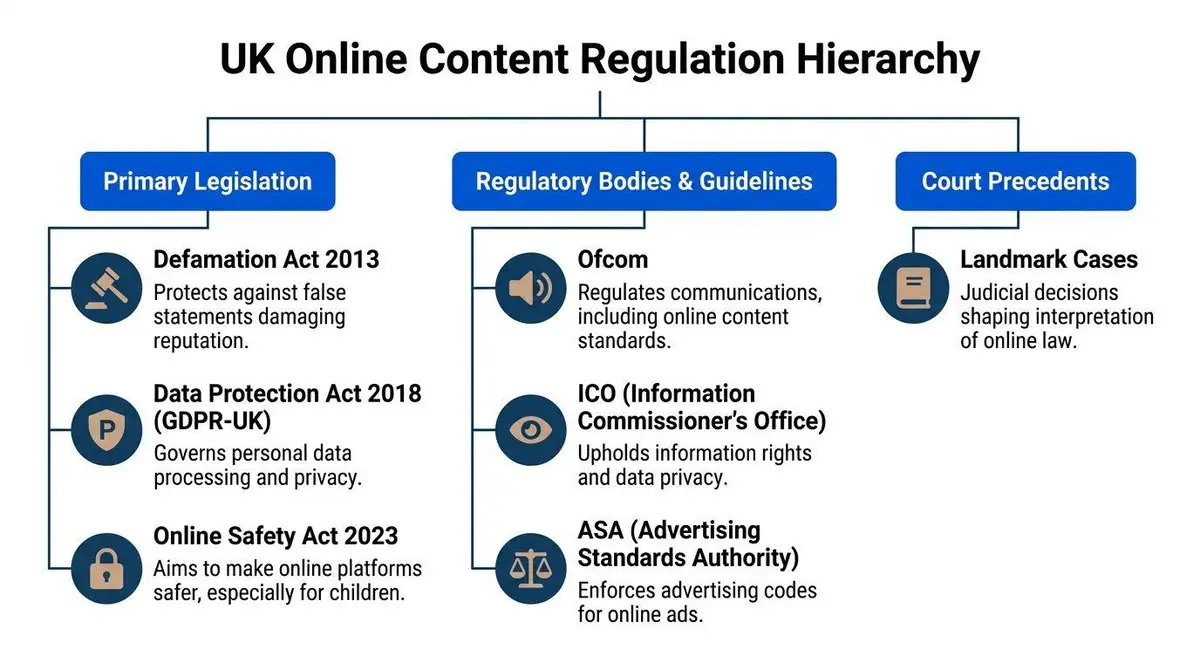
The most immediate board-level issue is fake review exposure. The Digital Markets, Competition and Consumers Act can impose fines of up to 10% of global annual turnover for non-compliance, particularly around fake reviews, and RepTrak reports that 45% of consumers now use tools like ChatGPT for recommendations, which means reputational distortion can move from a review platform into AI-generated summaries very quickly, as noted in RepTrak’s UK reputation insights and trends.
That creates two obligations at once. First, you need to ensure your own review practices are clean. Second, you need a rapid process for identifying and challenging false or manipulated review activity targeting your business.
If your team still treats reviews as a junior marketing problem, fix that. Reviews now sit inside a legal, platform, and AI visibility system.
GDPR is not just a compliance burden
Executives often think of GDPR only as an internal governance issue. In reputation defence, it can also be a removal tool.
When personal data has been exposed illegitimately, republished without a proper basis, or combined with harassment, impersonation, or doxxing behaviour, data protection arguments can become more effective than broad objections about unfairness. The issue is evidence. You need to identify precisely what personal data appears, who controls it, why its processing is unlawful or excessive, and what harm flows from continued publication.
That work has to be precise. Vague complaints fail. Structured notices perform better.
For a more detailed legal-operational view, executives dealing with this should review this strategic guide to navigating online content removal laws.
Defamation is powerful, but not always first
Defamation law matters when a statement is false and causes serious harm. But it is not automatically the fastest first move.
Sometimes the best route is legal. Sometimes it’s a host complaint, a platform impersonation report, a privacy-based notice, or a search engine request tied to specific policy grounds. If you choose defamation because it sounds strongest, but the content could have been removed more quickly through platform or data protection channels, you’ve lost time for no reason.
Move on the mechanism with the best combination of speed, credibility, and enforceability. Not the mechanism that sounds most dramatic in the boardroom.
A practical decision view
Use this simple framework when harmful content appears:
| Situation | Primary route | Why |
|---|---|---|
| Fake reviews or manipulated review activity | DMCCA and platform complaints | Fastest route where review integrity rules are in play |
| Leaked personal details or intrusive personal data | GDPR and privacy-based notices | Strong when the issue is unlawful processing or overexposure |
| False allegations causing serious harm | Defamation, sometimes alongside platform action | Stronger where falsity is clear and damage is material |
| Impersonation or account misuse | Platform terms and identity evidence | Usually faster than litigation |
| Indexed but hard-to-remove content | Search de-indexing or suppression strategy | Useful when source removal is blocked or delayed |
The minefield is real, but it isn’t random. UK company reputation management works when counsel, digital operators, and executive decision-makers stop acting sequentially and start acting in parallel.
Establishing Proactive Digital Fortifications
The best crisis response starts before the crisis exists. If your company only looks at reputation when someone forwards a damaging link, you’re already late.
Serious companies build an always-on detection layer. Think of it as a reputational security operation. It watches search, reviews, news, forums, social channels, and executive mentions for drift, impersonation, leakage, and coordinated attacks.
What a real monitoring stack covers
A proper defence system is broader than media alerts. It should include:
- Search surveillance: branded queries, executive-name queries, and recurring checks on what appears for high-intent reputation searches.
- Review intelligence: unusual patterns, duplicated language, review bursts, and gaps in response handling.
- Social and forum monitoring: not just mainstream platforms, but complaint sites, anonymous communities, and niche industry spaces.
- Leak and exposure detection: signs that private data, internal documents, or executive identifiers are circulating.
- AI output review: regular prompts against major recommendation engines and LLM interfaces to detect narrative contamination.
This is why many teams benefit from a dedicated reputation monitoring system rather than relying on ad hoc screenshots and inbox alerts. Monitoring has to be systematic or it becomes theatre.
Fortification means governance, not just software
Tools matter, but governance matters more. Someone needs authority to classify risk, preserve evidence, and trigger action without waiting for a full executive meeting.
I usually recommend a compact internal structure:
- One accountable executive who owns escalation.
- One legal lead who can assess exposure quickly.
- One external specialist channel for takedowns and search action.
- One evidence protocol so screenshots, URLs, timestamps, and account details are preserved properly.
Without that structure, monitoring just gives you earlier anxiety.
A dashboard does not defend a company. A decision system does.
The board-level benefit
Proactive fortification reduces chaos. It gives leadership a cleaner distinction between noise and threat.
That matters because not every criticism deserves intervention. Some issues require customer service, some require silence, and some require immediate removal. Monitoring helps you classify correctly before the internet does it for you.
In practice, the companies that manage reputation well aren’t calmer because they face fewer attacks. They’re calmer because they know what they’re looking at, who is handling it, and what happens next.
Executing a Rapid Response Crisis Playbook
When harmful content goes live, the first question is not what to say. It’s what to stop.
Most internal crisis processes are too slow because they are built around consensus. They schedule calls, gather views, and draft polished language while the damaging material gets indexed, screenshotted, and summarised elsewhere. That is exactly backwards.

Speed matters more than elegance
The hard reality is already documented. Traditional PR and legal channels are often too slow, taking weeks to act, while a single negative article or malicious review can inflict irreversible damage within 48 hours. Specialist firms address this by beginning takedown actions within 24 to 48 hours, according to Deloitte’s reputation management guidance.
That should settle the internal argument. If your process takes days to start, your process is broken.
The first 48 hours should look like this
A strong crisis playbook does four things quickly.
Triage the threat
Not all bad content is equal. A review on a minor site is not the same as an indexed article ranking for your CEO’s name. The first task is to rank the issue by visibility, credibility, and spread potential.
Ask:
- Is it indexed?
- Is it on a domain that journalists, investors, or clients trust?
- Is it targeting the company, the executive, or both?
- Is it false, private, manipulated, or merely hostile?
- Is it being copied elsewhere?
This isn’t philosophical. It determines your route.
Preserve evidence before you engage
Do not rush into public replies before preserving the record. Capture URLs, timestamps, screenshots, account identifiers, and source relationships. You may need them for defamation, privacy complaints, platform escalation, or a host notice.
A lot of companies damage their own case by responding publicly before securing evidence. They alert the attacker, trigger edits, and lose the original publication trail.
Run parallel workstreams
The old model is linear. Legal reviews first. PR drafts second. Technical action later. That wastes time.
The correct model is parallel:
| Workstream | Immediate action |
|---|---|
| Legal | Assess falsity, privacy issues, review manipulation, and notice grounds |
| Technical | Map hosts, platforms, account ownership, and indexing status |
| Search | Identify ranking exposure and whether de-indexing or suppression is needed |
| Stakeholder control | Prepare narrow, factual communications only where necessary |
If a fake article is live, you may need host escalation, search strategy, and executive shielding all at once.
Limit your public footprint
Executives often make matters worse by over-explaining. Publicly arguing with malicious content gives it oxygen. It can also create discoverable inconsistencies that hurt later legal or platform action.
Keep statements narrow. Correct only what must be corrected. Don’t validate a fringe publication by treating it like the Financial Times.
For situations involving fabricated narratives, this executive-focused guide on how to deal with a fake news story about you is a sensible starting point.
The wrong instincts to avoid
The common failures are familiar:
- Committee paralysis: too many approvals, not enough action.
- Message obsession: endless drafting before any containment.
- Single-channel thinking: acting only in PR or only in legal.
- Emotional response: public rebuttals written under pressure.
- No reupload plan: removing one item and then relaxing too early.
If the threat is spreading faster than your internal process can move, bypass the process and use your emergency route. That’s what emergency routes are for.
A rapid response playbook is not aggressive for the sake of it. It is disciplined. The aim is containment, then neutralisation, then recovery.
The Levers of Content Removal and Suppression
When an executive is targeted, confusion usually starts here. People know there are “options,” but they don’t know which one to pull first. That uncertainty costs time, and in UK company reputation management, time is the variable you control least once a story starts moving.
The cleaner way to think about it is to separate the available levers by objective. One lever is designed to establish falsity and harm. One lever is designed to exploit platform and host rules. One lever is designed to reduce visibility when source removal won’t happen quickly. You often use more than one, but not in the same proportions.
Executives and high-profile individuals face what has been described as a “Legal-Digital Divide”, where UK defamation law, GDPR takedown requests, and specialist digital removal services all involve different evidence requirements, timelines, and success paths, as discussed in this overview of UK reputation management gaps.
Lever one is legal action
Legal action is the sharpest instrument when the content is false, serious, and materially damaging. If a publication has alleged misconduct that did not happen, or presented fabrication as fact, defamation can be the right route.
What legal action gives you is force. It creates a formal record. It raises the stakes for the publisher. It can also support later negotiations with hosts, platforms, or search engines because you’re no longer presenting a mere complaint. You’re presenting a substantiated legal position.
What it does not always give you is speed.
If the issue is a rogue post on a low-quality site, or a cluster of abusive social accounts, legal process may be too slow as a standalone tactic. You can spend valuable time preparing a textbook case while the content is copied elsewhere and starts ranking.
Use legal action first when these conditions are present:
- The statement is clearly false
- The harm is serious and commercially meaningful
- The publisher has enough standing or visibility to justify the effort
- The evidence is strong enough to support a decisive challenge
If those conditions aren’t present, legal strategy may still matter, but it shouldn’t always lead.
Lever two is platform and host-level takedown
This is often the fastest operational route. Most damaging content breaches some rule other than “this is unfair.” It may involve impersonation, harassment, manipulated reviews, privacy violations, disclosure of personal data, non-consensual use of images, or terms-of-service abuse.
That matters because platforms respond more readily to rule breaches they can verify than to broad disputes about truth.
A fake LinkedIn profile impersonating an executive is not primarily a PR problem. It is an identity abuse problem. A review campaign coordinated by a competitor is not just “negative sentiment.” It is potentially fraudulent or manipulative platform activity. A post exposing a home address is not merely unpleasant. It is a privacy and safety issue.
Here is the practical comparison:
| Route | Best used for | Main advantage | Main limitation |
|---|---|---|---|
| Platform takedown | Impersonation, harassment, fake reviews, policy breaches | Often faster and more discreet | Limited by platform interpretation |
| Host notice | Clear policy or legal violations on independent sites | Can pressure the infrastructure layer | Some hosts are slow or permissive |
| Privacy or GDPR request | Personal data misuse, overexposure, intrusive publication | Strong where personal data is central | Weak if the issue is framed purely as opinion |
This is also the area where specialist operators outperform generalist advisers. They know how to package evidence for each platform, who to notify, how to sequence notices, and when to escalate beyond the obvious reporting form.
This is the one place where I’ll name a provider. ContentRemoval.com handles source removal, de-indexing, false review takedowns, and impersonation matters across websites, search engines, and social platforms. That’s operationally different from a PR agency writing statements or a law firm sending one letter and waiting.
Lever three is search suppression and de-indexing
Sometimes the source stays up. That doesn’t mean you’ve lost.
If harmful material cannot be removed quickly at source, the next objective is to make it hard to find. Search suppression and de-indexing strategies focus on reducing visibility for branded and executive-name searches so the damaging content stops defining first impressions.
This is not cosmetic work. Search result control affects who sees the material during due diligence, hiring checks, sales conversations, and investor research.
Use this lever when:
- The publisher is uncooperative or anonymous.
- The content is legally awkward but still harmful.
- The article is old, low-quality, or contextless but still ranking.
- You need immediate visibility management while another action proceeds.
Which lever first
The wrong approach is ideological. Some advisers always litigate. Some always push content down. Some always ask the platform nicely. None of those fixed preferences is serious.
The right approach is situational. Ask three questions in order:
- Can this be removed at source quickly and credibly?
- If not, can we reduce its visibility before it spreads further?
- What combination creates pressure without increasing exposure?
That final point matters. Sometimes the quiet route is the best route. Senior executives often don’t need a public fight. They need the issue neutralised with as little collateral visibility as possible.
The best tactic is not the most aggressive one. It’s the one that removes the threat with the least additional attention.
The fundamental operating logic behind modern company reputation management uk. Choose the lever that matches the facts, then move before the internet turns a contained problem into accepted history.
Choosing Your Defence Partner A Framework for Leaders
When the pressure is on, many executives hire the wrong adviser because they hire the most familiar category. They call the PR agency they already know. Or the corporate law firm already on retainer. Both may be useful. Neither automatically solves a digital reputation attack.
The market gap is real. A December 2023 CIPR survey found reputation risk was in the top five concerns for UK business leaders, yet over one-third lacked in-house PR expertise and 40% did not retain a PR firm, according to the CIPR business leaders survey. That tells you two things. Leaders are worried, and many are structurally underprepared.
What to ask before you appoint anyone
If you’re evaluating a defence partner, stop asking broad questions like “have you handled crises?” Ask operational questions that expose capability.
Ask about speed
If a firm can’t explain how quickly it begins action, it probably doesn’t have a real takedown operation.
Ask:
- What happens in the first day after instruction?
- Who handles platform notices, host escalation, and search exposure immediately?
- How do you preserve evidence before content changes or disappears?
Ask about UK-specific competence
You need someone who understands the UK blend of review regulation, privacy rights, and defamation thresholds. Generic “online reputation” language is not enough.
Ask:
- How do you decide between legal action, GDPR-based requests, and platform enforcement?
- How do you handle fake review exposure under the current UK environment?
- What is your approach when the executive and the company are both named?
Ask about discretion and persistence
Removal is one thing. Preventing recurrence is another.
Ask:
- How do you monitor for reuploads or mirror posts?
- What happens if the first route fails?
- Can you coordinate legal, technical, and search measures without turning the matter into a louder public dispute?
The partner categories are not interchangeable
A simple distinction helps:
| Adviser type | Useful for | Usually weak on |
|---|---|---|
| PR firm | Messaging, media relations, stakeholder briefing | Source removal, platform escalation, de-indexing |
| Traditional law firm | Defamation, formal notices, litigation posture | Fast cross-platform operational execution |
| Specialist digital risk firm | Takedowns, suppression, monitoring, coordinated escalation | Broader brand campaigns and press management |
That doesn’t mean one replaces the others. It means one should lead depending on the threat. If the core issue is a live piece of harmful content, your lead adviser should be the one built to remove or neutralise digital material, not the one built to write about it elegantly.
The standard for leadership
Your standard should be simple. Can this partner reduce risk fast and with evidence? If not, keep looking.
A good initial consultation should feel like a strategic assessment. It should identify the threat architecture, map the likely removal routes, flag where legal strategic advantage matters, and tell you what needs to happen first. It should not sound like generic brand advice, and it should not begin with a social content calendar.
Reputation defence in the UK has become too technical, too legal, and too immediate to outsource casually. If your name, your board, or your company is exposed, choose a partner built for contested online environments. Not one built for polished commentary after the fact.
If you’re dealing with harmful search results, fake reviews, impersonation, leaks, or defamatory content, start with a confidential assessment at ContentRemoval.com. The right first move is usually not more publicity. It’s a precise plan to remove, suppress, and contain the threat before it becomes the permanent version of your story.
Frequently asked questions
Can a UK company get fake reviews removed?
Yes, through platform complaints backed by evidence of manipulation, and the DMCCA now puts review integrity under a legal framework with serious penalties. You also need to make sure your own review practices are clean before you challenge anyone else’s.
Is defamation the best route for removing a false article in the UK?
Only when the statement is clearly false, the harm is serious and commercially meaningful, and the evidence is strong. If the content could come down faster through a host notice, a GDPR-based request or a platform impersonation report, leading with defamation loses time.
Should a UK executive use their PR agency or a law firm for online attacks?
Both may help, but neither is built for fast cross-platform takedowns. PR handles messaging, a law firm handles claims and letters, and a specialist digital risk firm handles removal, suppression and monitoring. Whoever leads should match the live threat.