
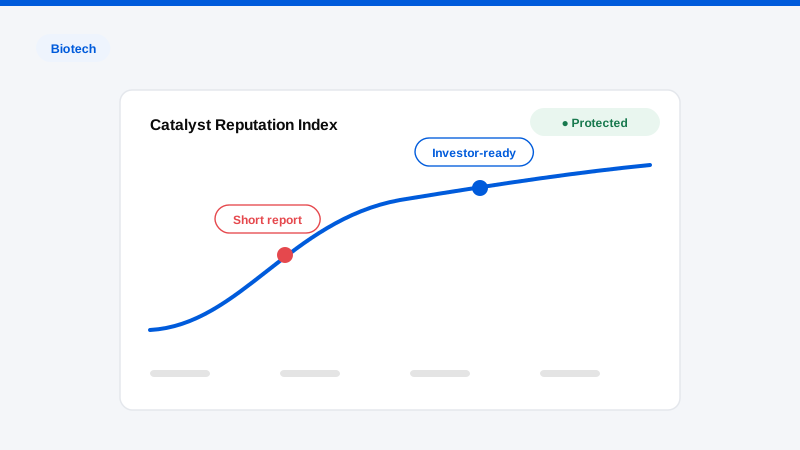
Reputation management for biotech companies is the practice of controlling what investors, partners, regulators, journalists, and scientific peers find when they research a company, its programs, or its founders, and removing the damaging content that would otherwise decide financing and partnership outcomes before management ever presents. Biotech is uniquely exposed because it is a trust business with a thin public record: for most of a company’s life it has no product, no revenue, and no customers, only data, a story, and the credibility of the people telling it. When an adversary attacks that credibility online, there is almost nothing standing in front of the attack, and the hostile version becomes the top result for a name that was barely searched before.
That thinness is the defining vulnerability. A commercial-stage pharmaceutical company has decades of coverage that dilute any single hostile item. A clinical-stage biotech might have forty meaningful search results total, which means one anonymous short report, one science-fraud allegation, or one bitter Glassdoor thread can occupy a third of the visible record overnight, and be the first thing every crossover fund analyst, business-development scout, and prospective hire reads for years. In a sector where companies live or die on their next raise, the search page is not a communications concern. It is a financing document that anyone can edit except the company.
This guide is written for biotech CEOs, founders, CFOs, heads of investor relations, and the general counsel who inherit these problems mid-crisis. It covers how attacks on biotech reputations actually work, what they cost through the sector’s distinctive mechanisms (binary catalysts, syndicate diligence, partnership screens) why the standard PR playbook fails at this scale, and what removal-first protection looks like for a company whose most valuable asset is believability.
Why biotech companies are targeted
Biotech attracts a specific and sophisticated set of adversaries, because the sector combines volatile valuations, information asymmetry, and founder-dependent stories, the exact conditions under which hostile content pays.
Binary catalyst events create windows where content moves money. Biotech valuations hinge on discrete events (data readouts, FDA decisions, partnership announcements) and in the weeks around a catalyst, sentiment is leverage. Anonymous accounts, message-board campaigns, and timed hit pieces appear precisely when the audience is largest and most nervous. The content does not need to be true to work; it needs to rank during the window, and its authors know it.
Anonymous short reports are engineered for search permanence. Activist shorts targeting biotech publish reports titled with the company’s name, alleging failed science, misleading data presentation, or management misconduct. The report is seeded across finance media and social platforms, and its search placement outlives the trade: long after the position is covered, the report remains a top result, re-read at every subsequent financing and partnership diligence.
Science-fraud allegations are cheap to make and brutal to carry. Post-publication review forums, anonymous tip blogs, and social-media threads scrutinizing figures and data have exposed genuine misconduct, which is precisely why an unfounded or exaggerated allegation is so damaging. “Data integrity questions” attached to a company’s lead program, however thin the basis, is a phrase no investor forgets having read, and the allegation ranks for the program, the company, and the named authors indefinitely.
Founders absorb attacks personally. In founder-led biotech, the founder’s name is the company’s collateral. Adversaries know this and target accordingly: attacks on academic history, disputes with former collaborators resurfaced as scandal, litigation from a prior venture stripped of context, personal-life content weaponized into character evidence. High-profile industry frauds have made “visionary founder” a suspicious phrase, and hostile content leans on that suspicion deliberately.
Former insiders carry credibility and grievances. Failed programs, layoffs after data misses, and founder splits are structural features of biotech, and they generate ex-employees with insider vocabulary, equity resentments, and durable venues: employer-review platforms, science forums, and reporters’ inboxes. A handful of detailed posts alleging cherry-picked data or a toxic lab can dominate a small company’s search presence precisely because the company publishes so little itself.
Trial-site and patient-community content escapes all controls. Patient forums and social groups discussing trial experiences generate unvetted accounts of adverse events and site frustrations. Most of it is honest; some is mistaken or malicious; all of it is indexed, and none of it passes through any process the company can see.
What damaging content costs a biotech company
In biotech, reputational damage converts into financial outcomes through short, direct paths.
Financing diligence is a search for reasons to pass. Every raise (venture round, crossover, IPO, follow-on) begins with investors researching the company and its people, and institutional diligence includes adverse-media and background screens as standard practice. An unresolved hit (a fraud allegation, a hostile thread, a short report) becomes a line in an internal memo, and in a capital market with hundreds of comparable stories competing for the same dollars, a line in a memo is a pass. The company never hears why; it hears “not leading this one.”
Catalyst-window content moves the price that determines the raise. For public biotechs, hostile content circulating into a readout affects the share price that sets the next offering’s terms. Dilution taken at a price depressed by a narrative, rather than by data, is a permanent transfer of the company’s value to the attack’s timing.
Partnership and M&A screens read the same record. Business development teams at large pharma screen prospective partners’ reputations alongside their science, and licensing committees are conservative by construction. Between two comparable assets, the one whose search page carries misconduct allegations loses, and never learns that was the margin.
Scientific credibility gates everything downstream. Key opinion leaders deciding whether to advise, investigators deciding whether to open sites, journals and conference committees deciding what to feature, all research the company and its founders. Contaminated search results raise the price of every scientific relationship the company needs.
Recruiting against a hostile record costs equity and time. Biotech competes for scarce scientific and clinical talent against better-funded rivals. Candidates research obsessively before betting years of their careers on a company’s survival, and a search page carrying fraud adjacency or culture horror stories converts directly into declined offers and larger grants.
AI-generated answers now front-run the data room. When an analyst asks an AI assistant to summarize a biotech company or its founder, the model synthesizes the visible record, short-report framing and anonymous allegations included, and delivers it as neutral fact. For thin-footprint companies, a single hostile source can dominate that synthesis entirely. The first diligence meeting now happens inside a chat window, before anyone signs an NDA.
Why generic PR and SEO approaches fail for biotech
Biotech companies reaching for the standard reputation playbook discover it was built for a different problem.
Thin footprints break suppression math. SEO suppression assumes the company can generate enough authoritative content to outrank the negative. A clinical-stage biotech cannot: it has little news, strict limits on what it can say about pipeline programs, and a hostile item with strong engagement will hold rank against corporate content indefinitely. On a forty-result footprint, suppression is arithmetic that does not work.
Disclosure rules constrain the counter-narrative. A public or fundraising biotech cannot freely rebut allegations about its science without navigating securities-law and regulatory constraints on forward-looking and promotional statements. Adversaries publish instantly; the company responds through counsel, weeks later, carefully, and the search page reflects the asymmetry. Removal work does not have this problem: it proceeds under platform policies, on the platform’s clock, without the company making public statements at all.
Rebutting anonymous attacks amplifies them. A formal response to an anonymous short report or forum campaign creates fresh indexed content restating the allegations, often outranking the original. The attacker’s content gets a second distribution wave, courtesy of the target.
Nobody inside the company can own this. A 60-person biotech has no corporate-affairs apparatus; the CEO, CFO, and GC absorb reputation crises on top of their actual jobs, during the exact windows (raises, readouts) when their time is most valuable, and insiders filing removal requests directly create discoverable trails connecting the company to the effort. Specialist reputation management exists so the fight happens off the leadership team’s calendar and without its fingerprints.
What removal-first protection looks like
Removal-first protection works from a principle that matters doubly for thin-footprint companies: one hostile item removed from a small search page changes that page more than ten items added to it.
Assessment. The engagement begins with a full exposure audit across the company name, program names, ticker, and every founder and named executive: search results, finance and science forums, employer-review platforms, social and video platforms, data brokers, and AI-generated answers. Each damaging item is classified by the path it is actually eligible for (source removal, de-indexing, correction, or containment) producing a map of what can realistically change and in what order. Most biotech clients start with a free, confidential Exposure Scan, often in the quiet period before a raise, and the map routinely reshapes how leadership prioritizes the problem.
Removal at the source. A meaningful share of hostile biotech content violates the policies of the platforms hosting it: defamatory posts and fabricated allegations, fake or policy-violating employer reviews, impersonation accounts, doxxed founder information, and coordinated inauthentic campaigns around catalysts. Each has a distinct removal path, argued in the platform’s own terms by specialists who have run the process at volume. The honest caveat comes first: removal decisions belong to platforms and publishers, and no credible firm guarantees a specific item will come down. What specialists change is the probability, the speed, and the share of the target set that falls.
De-indexing. Content that cannot be removed at the source can often be removed from search results, the surface where diligence actually happens. Search engines’ policies covering exposed personal information, doxxing, and related categories apply frequently to founder-targeted content, and outdated-content mechanisms address stale artifacts that misstate the current record. For a founder whose home address circulates alongside allegations, de-indexing closes the discovery path even where the page persists.
Monitoring. Biotech attacks cluster around catalysts, which are scheduled and public, meaning defense can be scheduled too. Continuous monitoring across search, forums, review platforms, data brokers, and AI answers catches new items at first appearance, and standing Protection Plans reserve removal capacity so response begins within hours. Entering a readout window with monitoring already live is the difference between handling one post and inheriting a narrative.
Protecting founders and named executives as individuals
For most biotechs, the founder’s name is searched more than the company’s, by investors running key-person diligence, by journalists, by prospective hires, and by adversaries choosing the softest target. Attacking the founder is attacking the company at its least defended point.
Founder-targeted exposure typically includes data-broker profiles listing home addresses and family members, resurfaced disputes from academic or prior-venture history, litigation records stripped of context, impersonation accounts, and hostile commentary that attaches to the person and follows them across every future venture. Because biotech founders’ credibility is the asset investors are actually underwriting, this content operates as a permanent tax on every financing, and because catalyst windows concentrate attention, it resurfaces at exactly the wrong moments.
Executive protection in the digital layer treats each founder and named officer as a distinct protected asset: systematic removal of personal data from broker networks, takedown of impersonation and fabricated content, de-indexing of doxxed information, remediation of legacy items predating the current company, and continuous monitoring of each name, including in AI-generated answers, where the model’s summary of a founder now functions as an unsigned reference letter read before every first meeting. This is the core of our digital executive protection practice, and for founder-led companies it is not an adjunct to corporate protection. It is the majority of it.
Frequently asked questions
Can an anonymous short report about our company be removed?
The report is decomposed into items, and each is assessed for the path it is eligible for. Elements crossing into false statements of fact, market manipulation indicators, impersonation, or platform-policy violations can be attacked directly; protected opinion is contained instead: de-indexed where eligible, displaced where not, with scraped copies and amplification content removed to shrink the footprint. No credible firm promises to erase a short campaign, but its search visibility can be systematically reduced until it stops being the first thing diligence finds.
Someone is spreading science-fraud allegations about our data. What are the options?
Allegations published on platforms (forums, social networks, blogs) are assessed against those platforms’ policies on defamation, harassment, and fabricated claims, which frequently provide removal paths that do not require public engagement with the allegation. Where the venue is a legitimate post-publication review process, the answer runs through scientific channels, and we say so plainly. The critical move is the item-by-item assessment before any response, because the wrong move, a public rebuttal that amplifies, is worse than no move.
We are three months from a data readout. Is it too late to start?
No, but the order of operations changes. A pre-catalyst engagement prioritizes the fastest-moving work: data-broker removal for founders, takedown of existing policy-violating content, de-indexing of eligible items, and live monitoring through the window so anything new is caught within hours. The full cleanup continues after the catalyst. Companies that start ninety days out enter the window meaningfully harder to attack than companies that start the week the hit piece drops.
Our footprint is tiny, is that an advantage or a problem?
Both, and the engagement uses the advantage. Thin footprints are why single hostile items dominate biotech search pages, but they are also why removal produces outsized results: deleting one item from a forty-result record changes the page in a way that is essentially impossible for a Fortune 500 name. For most biotech clients, a modest number of successful removals and de-indexings transforms the entire first page.
What does this cost for a clinical-stage company watching its runway?
Engagements are scoped from the Exposure Scan, which is free and confidential. You see the full map and the realistic treatment plan before spending anything. Scope tracks the actual exposure: a founder-focused cleanup is a different engagement from a catalyst-window defense. Most clients weigh the cost against the terms of their next raise, which is the correct comparison, and conclude the search page is the cheapest financing document they can fix.
Before your next raise, someone on the other side of the table will search your company and your founders, and increasingly, they will ask an AI to summarize what it finds. Book a free, confidential Exposure Scan and read your own diligence file before they do.