
CEO reputation management is a different discipline from generic executive reputation work, and conflating the two is how chief executives end up under-protected at exactly the moments that matter. Every senior leader has an exposure surface. Only the CEO’s name functions as a tradable proxy for the company itself: priced into the stock, cited in the sales cycle, weaponized by adversaries, and quoted by AI assistants as if it were the company’s own voice. When the market, the press, or a short-seller wants to tell a story about the business, they tell it through the person at the top.
That asymmetry changes the math on everything. An unflattering search result about a divisional VP is a personnel-file problem. The same result attached to a CEO’s name moves customer conversations, employee retention, financing terms, and, for public companies, the tape. It also changes the correct strategy: a CEO cannot out-publish a motivated adversary with blog posts, and burying a hostile narrative under content leaves the ammunition intact for the next activist letter or diligence pass. The work has to start with removing what can be removed, hardening what remains, and building a standing defense that operates at crisis speed rather than agency speed.
This guide covers what is genuinely distinct about the CEO’s position: the halo effect that couples a personal name to enterprise value, the adversaries who attack through that coupling, why response speed is the variable that decides outcomes, the succession and exit moments where a name is re-underwritten from scratch, and how to structure protection when the corporate comms team cannot, structurally, be your only line of defense.
The CEO halo: when a personal name carries enterprise value
Markets and buyers personify companies. Analysts write about the CEO’s credibility as an input to multiple. Enterprise customers justify vendor selection partly on their read of the person running the vendor. Candidates decide whether to join a company based on what a weekend of searching says about its leader. This “halo” is an asset when it is clean, and a single point of failure when it is not, because damage to the name transmits instantly to everything the name endorses.
The transmission channels
The coupling is concrete, not metaphorical. A damaging item attached to a CEO’s name propagates through at least four channels simultaneously: the capital channel (investor screens, adverse-media checks in every financing and every fund’s ongoing monitoring), the commercial channel (procurement and buying-committee research on vendor leadership), the talent channel (every serious candidate’s search before signing), and the narrative channel (journalists and analysts, who search a CEO’s name before every story and inherit whatever frame page one hands them). One bad artifact, four simultaneous leaks.
Why the halo makes suppression uniquely inadequate for CEOs
For a private individual, pushing a bad result to page two solves most of the practical problem, because casual searchers stop there. Almost nobody researching a CEO is casual. Fund analysts, investigative journalists, short-sellers, and opposing counsel go ten pages deep, run dated-range queries, and pull the archived versions. Suppression hides content from the audience that matters least while leaving it fully available to the audience that matters most. This is the core reason our CEO and executive practice is built removal-first: for this audience, content that still exists is content that will be found and used.
Key takeaway: A CEO’s adversaries and underwriters do not stop at page one. For every audience capable of hurting you, suppression is cosmetic; only removal changes what a determined researcher finds.
Adversarial narratives: activists, short-sellers, and motivated opponents
Most reputation content assumes damage is accidental, an old article, a bad review. CEOs face something rarer and more dangerous: professionally constructed narratives built by parties with a financial or strategic interest in the CEO’s diminishment. Activist investors seeking board seats, short-sellers publishing thesis reports, litigation opponents shaping the jury pool of public opinion, and occasionally displaced insiders, all of them understand that the cheapest way to attack a company is to attack the credibility of its chief executive.
These campaigns follow a recognizable arc, and defending against them requires knowing where in the arc you are:
Seeding
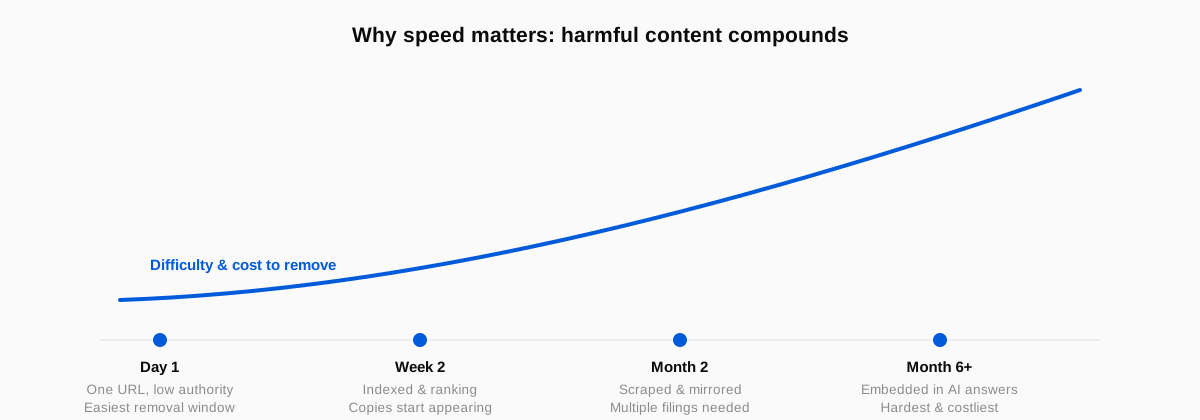
Adversarial narratives rarely debut in major outlets. They are seeded where editorial standards are lowest and removal leverage is highest: anonymous blogs, pseudonymous forum posts, low-tier “news” sites that accept placed content, coordinated social accounts. The seeding phase is the cheapest moment to intervene: policy-violation takedowns, platform enforcement, and defamation-content removal pathways work best before anything reputable has cited the material. Most CEOs never see this phase because nobody is watching for it.
Amplification and laundering
Seeded material gets laundered upward: aggregators repost it, social amplification manufactures the appearance of organic concern, and eventually a legitimate journalist cites the “growing questions.” Once a credible outlet touches the story, the removal calculus changes entirely, which is precisely why detection during seeding, via continuous reputation monitoring tuned to the CEO’s name and predictable attack queries, is worth more than any amount of post-hoc response.
Permanence
Uncontested, the narrative hardens into the record: it ranks for the CEO’s name, enters diligence databases, and gets absorbed into the training corpora that AI assistants draw on, at which point a chatbot will summarize the short thesis as background fact to anyone who asks about you. Reversing permanence is possible but slow: source-level removals, publisher corrections and updates, de-indexing of what remains, and remediation of AI-generated answers as models refresh.
Key takeaway: Adversarial narratives are cheapest to kill at the seeding stage and most expensive after permanence. The entire economics of CEO protection is a race to move interventions earlier in that lifecycle.
Know what an activist or short-seller would build their file from.Free confidential Exposure Scan of your name across search, forums, brokers, and AI answers, reviewed with you live in 15 minutes, findings yours to keep.
Book Your Free ScanCrisis speed: the variable that actually decides outcomes
In a CEO reputation event, the substantive facts matter less to the outcome than most leaders expect, and the clock matters more. Search engines and social platforms reward early velocity: the framing that dominates the first news cycle becomes the headline that ranks, the snippet that autocomplete learns, and the summary that AI assistants repeat for years. A correction issued in week three is an appendix to a story whose ranking has already consolidated.
This has hard implications for how protection must be structured:
- The infrastructure must pre-exist. Owned assets (an authoritative personal site, verified profiles, current structured bios) built during peacetime give you publication channels that already rank on day one of a crisis. Trying to stand these up mid-event is like buying insurance from inside the burning building.
- The escalation map must pre-exist. Which platform contacts, which removal mechanisms, which counsel, which decision-maker at the company, decided in advance, because a 48-hour internal debate about who owns the response is the response.
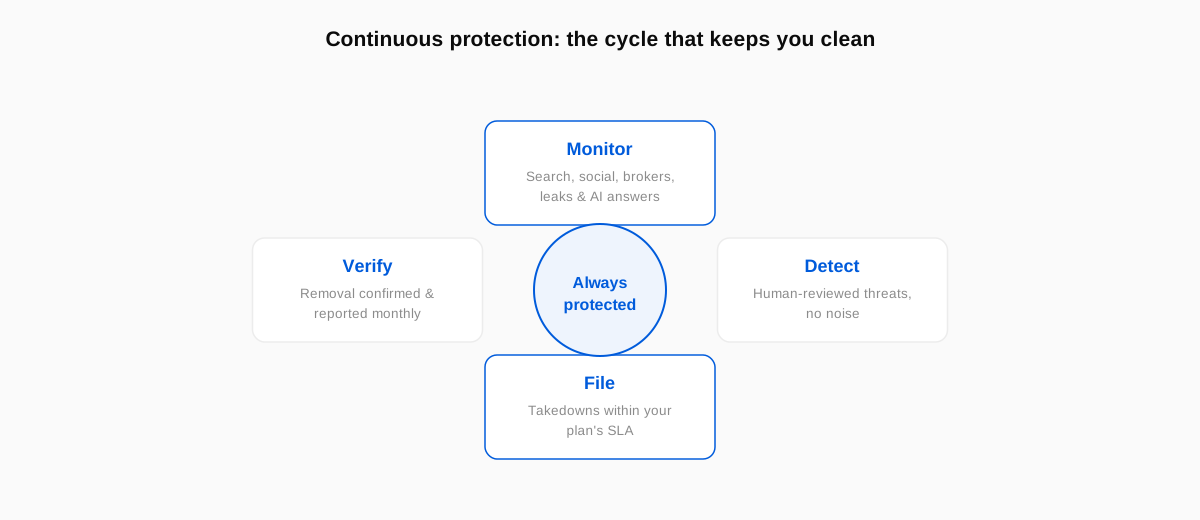
- Detection has to run at adversary speed. Daily manual Googling misses the seeding phase entirely. Continuous monitoring across search, social, forums, and AI answers is the difference between contesting a narrative and reading about it.
This standing-readiness model (monitor, detect, remove, reinforce, repeat) is the operating loop our Protection Plans run for chief executives:
Succession, exits, and the moments a CEO’s name gets re-underwritten
A sitting CEO’s reputation is partially sheltered by the company’s own gravity: corporate press, investor coverage, and the company website dominate the name’s search results. That shelter disappears at exactly the career moments when scrutiny peaks.
Taking a new seat
Boards hiring a CEO commission the deepest background work in commercial life: professional investigators, adverse-media sweeps, off-list referencing, and increasingly a review of what AI assistants say about the candidate. Material that the previous company’s ranking gravity had buried resurfaces the moment the corporate shelter is gone. The time to clean the record is before the search firm calls, not after; a serious candidate audits their own name with the same tools the investigators use.
Selling, stepping down, or going public
M&A processes and IPO diligence put the CEO’s personal record inside the data room in all but name. Underwriters, acquirers’ counsel, and insurers screen the individual. An issue surfaced by the other side mid-process is negotiating leverage against you; the identical issue, found and resolved by your side a year earlier, is nothing. We routinely see engagements that exist only because a transaction is 12 to 18 months out and the principal wants the record cleaned while there is still time for removals to complete.
Life after the corner office
Former CEOs discover that the corporate shadow that once dominated their search results decays quickly, and what rises in its place is whatever else the record holds, including the one bad quarter, the litigation, the activist campaign. Board portfolios, fund-raising for the next venture, and advisory work all re-run the diligence gauntlet with none of the old shelter. Post-tenure is when continuous protection matters most and is most often cancelled.
Personal defense vs. the corporate comms team
Chief executives often assume they are covered because the company has a communications function. The comms team is necessary and structurally insufficient, for reasons that are nobody’s fault:
- Divergent client. Corporate comms represents the company. In any scenario where the company’s interest and the CEO’s interest can diverge (board disputes, succession fights, departures, litigation where the company is also exposed) the CEO is unrepresented by design. Ask any executive who has been “transitioned.”
- Divergent toolset. Comms teams do media relations and messaging. Source-level removal (publisher negotiation, platform policy enforcement, de-indexing damaging URLs, broker suppression at scale, AI-answer remediation) is specialist work no in-house comms function staffs.
- Divergent scope. The comms team does not manage the CEO’s home address on people-search sites, the spouse’s broker profiles, or the decade-old personal matter that predates the company. That surface is personal, permanent, and portable across jobs, so its defense should be too.
- Discretion. Some matters a CEO reasonably prefers not to route through employees who have colleagues, successors, and exit interviews. A personal engagement with an outside specialist, under NDA, keeps the file outside the building.
The functional model is a division of labor: corporate comms owns the company’s story and press relationships; a personal removal-first partner owns the CEO’s permanent record and the surfaces comms never touches; counsel owns legal remedies; and the three coordinate through a pre-agreed protocol when events overlap.
Your company's comms team protects the company. Who protects you?Book a free confidential Exposure Scan: a 15-minute walkthrough of everything attached to your name that a board, buyer, or short-seller would find.
Book Your Free ScanChoosing a partner for CEO-level work
The vetting bar for a CEO engagement is higher than for general reputation work, because the failure modes are worse: a leaky vendor is itself a reputation event, and an over-promising one burns the calendar you needed for real remediation. Beyond the basics (removal capability you can verify, no guaranteed outcomes, transparent pricing) press on the dimensions specific to this tier:
Adversarial experience, not just cleanup experience
Removing a stale article is a different sport from operating against a funded, motivated adversary who replaces content as fast as you remove it. Ask prospective partners how they handle coordinated campaigns: detection during seeding, platform escalation paths, sequencing removals so the adversary learns as little as possible, and coordination with litigation counsel. Vague answers here predict a partner who will be learning on your crisis.
Speed you can contract for
Ask for the operating cadence in writing: monitoring frequency, time-to-alert, time-to-first-action on a new threat, and who is reachable at 11 p.m. on a Friday, because that is when short reports drop. A partner whose real cadence is a monthly report is a chronicler, not a defender.
Confidentiality with real engineering behind it
At this level, “we’re discreet” is not an answer. Look for named-individual access controls on your file, no offshoring of sensitive work, contractual non-disclosure that survives the engagement, and a firm that will decline to confirm you are a client to anyone. Ask how they would respond to a journalist asking whether you have engaged them; the correct answer is a policy, recited without hesitation.
Alignment with shrinking the problem
Suppression-model economics reward your problem persisting; the vendor bills monthly to hold content down forever. Removal-first economics reward elimination, in our practice, every removal is quoted per link in writing after the free Exposure Scan, and full Protection Plans are sized to the surface being defended, stepping down as the surface shrinks. Market-wide you will find everything from DIY tools to five-figure retainers; whatever you choose, make sure the incentive points toward less problem, not perpetual management of the same one.
Frequently asked questions
How is CEO reputation management different from ordinary executive reputation management?
Three ways: adversaries (CEOs attract professionally constructed attacks (activists, short-sellers, litigation opponents) not just organic negativity), audience depth (the people researching a CEO go far past page one, which makes suppression-only strategies cosmetic), and coupling (damage to the name transmits directly to enterprise value, financing, sales, and hiring). The work therefore weights early detection, source-level removal, and crisis-speed response far more heavily.
Can you remove a short-seller report or activist material about me?
Sometimes at the edges, rarely at the core, and no honest firm will promise otherwise. Primary reports from established research shops are generally protected speech and resistant to removal; the realistic targets are the derivative layer: seeded amplification content, policy-violating posts, false statements that cross into defamation (pursued with independent counsel), and stale coverage that outlets will update or de-index once matters resolve. The strategic goal is to strip the narrative’s supporting structure and deny it permanence in search and AI answers, which is achievable, rather than to erase the original, which usually is not.
Should the company or I personally engage the firm?
Both models work; the deciding question is whose interests the engagement must survive. Company-funded coverage is appropriate for the enterprise-facing surface and can extend to the whole leadership team. A personally retained engagement is the right structure for the permanent personal record, the material that follows you across roles, and for any scenario where your interests and the company’s could ever diverge. Many of our CEO clients run both, deliberately separated.
When should a CEO start this work?
Before it is needed, for structural reasons: removals take months, owned assets need time to rank, and monitoring only pays off if it is running before the seeding phase of an attack. The practical triggers we see are a transaction 12 to 18 months out, a new-role search beginning, a first activist or short position appearing in a peer company, or simply a board asking the question. If you are reading this during an active event, start anyway. The lifecycle can still be interrupted before permanence.
The name on the door is being underwritten continuously, by investors, buyers, candidates, journalists, and now by AI models answering questions you will never see asked. Find out what the record says before someone with adverse interests does. Book a free, confidential Exposure Scan: 15 minutes, your full surface across search, brokers, forums, and AI answers, walked through live, and the findings are yours whether or not we ever work together.