
Reputation management for cosmetic and hair clinics is the practice of controlling what prospective patients find when they research a clinic, its surgeons, and its procedures, removing false and damaging content where platforms allow it, suppressing what cannot come down, and monitoring the clinic’s name across the forums, review sites, and search results where cosmetic patients actually make decisions. For hair transplant and cosmetic clinics, this work is inseparable from sales: these clinics serve the most research-intensive, comparison-driven patients in all of elective medicine, and the research happens almost entirely on territory the clinic does not control.
A hair transplant or cosmetic procedure patient does not choose a clinic the way a patient picks a dentist. They spend weeks or months comparing: reading forum threads, watching results videos, weighing domestic clinics against medical-tourism destinations, and searching every candidate clinic’s name alongside words like “scam,” “ruined,” and “regret.” The entire market runs on peer testimony hosted on third-party platforms: hair restoration forums, Reddit communities, review aggregators, and social media. When something damaging sits in that ecosystem (a horror-story thread, a smear planted by a competitor, a years-old dispute) it intercepts patients at the exact moment of decision, and the clinic never learns how many consultations quietly evaporated.
This guide defines the specific threat landscape for cosmetic and hair clinics, what is at stake in a comparison-shopped market, and what professional, removal-first protection looks like, including why clinics competing in this environment retain specialists rather than leaving it to marketing.
Why cosmetic and hair clinics are targeted
The structure of the cosmetic and hair restoration market produces attack patterns that other medical fields rarely see.
Forum horror stories are the market’s native currency. Hair restoration and cosmetic-procedure communities are among the oldest and most active patient forums on the internet, and their most durable content genre is the cautionary tale: grafts that failed, hairlines that look unnatural, revisions of another clinic’s work, procedures the poster regrets. These threads rank for clinic-name queries for years, accumulate replies indefinitely, and carry enormous credibility precisely because they read as peer testimony rather than marketing. A single detailed horror thread (accurate, exaggerated, or fabricated) can shadow a clinic for a decade, and because forum culture is anonymous, there is often no way for a reader to know whether the poster was ever a patient at all.
Medical tourism warfare cuts in every direction. The hair transplant market in particular is globally contested: domestic clinics compete against overseas destinations on price, and overseas clinics compete against domestic ones on volume and results claims. That competition has produced a documented smear economy, “warning” threads about destination clinics, country-level scare content, astroturfed comparisons, and fake patient accounts running down rivals. Domestic clinics get framed as overpriced; international clinics get framed as dangerous; and individual clinics on both sides get targeted with fabricated disaster stories. A clinic can be attacked simply for being on the wrong side of someone else’s positioning.
Comparison shoppers search for the negative on purpose. Cosmetic and hair patients don’t stumble onto damaging content. They hunt for it. “Clinic name + reviews,” ”+ scam,” ”+ botched,” ”+ Reddit,” ”+ lawsuit” are standard steps in this market’s due-diligence ritual, often performed for every clinic on the shortlist. This is the crucial difference from most local businesses: content invisible to a casual searcher is fully visible to a cosmetic patient, because the patient is running exactly the queries designed to surface it.
Results photography invites disputes and theft. The market runs on before/after imagery, which creates two exposures: accusations, fair or manufactured, that a clinic’s photos are misleading, and outright theft of a clinic’s results imagery by competitors or content farms, sometimes recaptioned as another clinic’s failures. Both distort the record patients rely on.
Aggressive sales reputations attract aggressive backlash. Segments of this industry are known for hard-selling consultations and financing pressure, and patients burned anywhere in the category arrive angry at the category. Clinics inherit distrust generated by their worst competitors, and any billing or refund dispute is ready-made to become a “scam” narrative online.
Key takeaway: Cosmetic and hair clinics operate in the only medical market where prospective patients systematically search for negative content by name, where anonymous forums are the trusted source of record, and where global competitors have a financial incentive to write the horror stories themselves.
What’s at stake for a cosmetic clinic
The shortlist is where revenue lives or dies. Cosmetic and hair patients build shortlists and eliminate candidates through research. Damaging content doesn’t need to convince anyone of anything. It only needs to be the tiebreaker between two comparable clinics. In a market where every patient is comparing, a single prominent horror thread functions as a standing discount on the clinic’s conversion rate: consultations that would have booked simply don’t, and the loss never appears in any report.
High ticket sizes concentrate the damage. Hair transplants and cosmetic procedures are four- and five-figure decisions. Each patient diverted by a search result represents substantial revenue, and in hair restoration, often a multi-procedure relationship. The economics that make these patients valuable make each interception expensive.
Surgeon and clinic reputations are entangled. Patients in this market research the operating surgeon by name, not just the clinic, and forums track surgeons across the clinics they’ve worked at. A surgeon’s damaged search profile suppresses the clinic’s bookings; a departed surgeon’s old controversies can keep surfacing on the clinic’s queries as outdated content that no longer reflects who holds the scalpel.
Forum content compounds instead of fading. Unlike a news cycle, a forum thread is a living document: each new reply bumps it, each bump reinforces its ranking, and thread titles (“STAY AWAY from…”) become the de facto search snippet for the clinic’s name. Left alone, the problem does not decay. It accrues.
AI answers now do the comparison for the patient. Prospective patients ask AI assistants to compare clinics, summarize reputations, and assess safety, questions these systems answer by synthesizing exactly the forum and review content where smears and horror stories live. Content a clinic dismissed as a buried old thread can resurface as a confident sentence in an AI answer. AI reputation is now part of the battleground whether a clinic engages with it or not.
See what patients find before they book.Free confidential Exposure Scan: live results on a 15-minute call, yours to keep either way.
Book Your Free ScanWhy reputation management for cosmetic clinics must be removal-first
The standard marketing-agency answer (publish content, collect reviews, outrank the bad stuff) fails in this market for a structural reason: you cannot outrank content from a patient who is searching for it specifically. Suppression reshuffles page one for casual queries. Cosmetic patients don’t run casual queries; they run “clinic name + scam”, and for that query, the smear is the most relevant result on the internet. The only outcome that protects the clinic from a determined comparison shopper is the content coming down.
A removal-first approach works through the damage at its source:
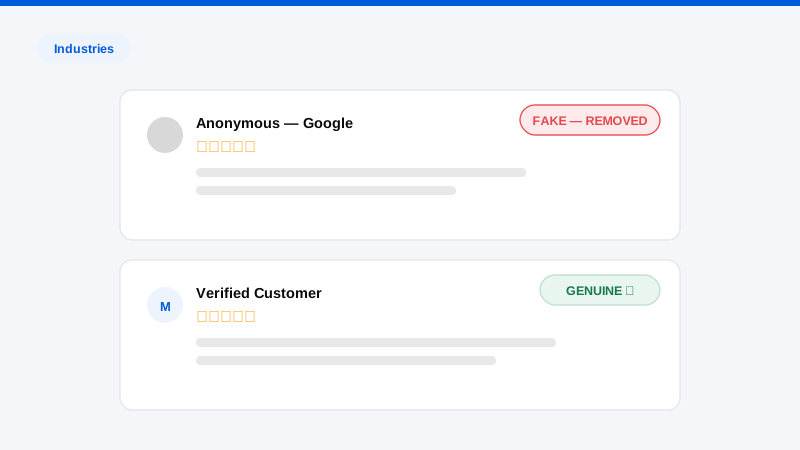
Fake and policy-violating reviews are challenged, not buried. Reviews from non-patients, competitor-planted content, and coordinated waves violate platform authenticity rules. Properly documented (account patterns, timing, content markers) these are contestable through business-side channels, which is the substance of professional review removal. A removed fake review stops counting against the rating forever; a buried one keeps subtracting stars indefinitely.
Defamatory forum and social content has enforcement paths. False statements of fact (fabricated patient stories, invented outcomes, “scam” accusations untethered to any transaction) can be pursued through platform reporting, forum moderation processes, and legal-request channels. Forums are the hardest platforms in this industry, and they are hard in platform-specific ways: each has its own moderation culture, evidentiary expectations, and escalation realities. This is precisely where specialist experience separates from guesswork. Content Removal is not a law firm and does not provide legal advice; where formal action is warranted, we coordinate with the clinic’s counsel and run the platform-side execution. See our defamation removal practice for how these cases proceed.
Stolen and misused results imagery supports takedowns. A clinic’s before/after photos reposted by competitors, recaptioned as failures, or scraped into content farms implicate copyright and platform authenticity policies, enforceable grounds that generic reputation vendors rarely think to use.
Outdated disputes can be cleared. Resolved refund disputes, complaints about long-departed staff, superseded pages from a previous clinic name, the sediment that comparison shoppers still find, is pursued for removal, correction, or deindexing.
Suppression covers the remainder. Content that is legitimate and non-removable is answered by building the clinic’s authoritative footprint so accurate, current material dominates both search results and the record AI systems summarize. Second line, never first.
Key takeaway: In a market where patients search “clinic name + scam” as a routine step, suppression is a strategy for hiding content from people who aren’t looking for it. Removal is the only strategy that survives contact with how cosmetic patients actually research.
What professional protection looks like for cosmetic and hair clinics
A professional engagement in this market is built around its distinctive terrain: forums, global competition, and named-surgeon exposure.
Deep-web exposure audit. The audit maps everything a comparison shopper can reach: search results for the clinic and every surgeon, the major hair-restoration and cosmetic forums, Reddit, review platforms, complaint boards, video platforms, image search, and AI assistant outputs: across the ”+ scam,” ”+ reviews,” ”+ Reddit” query patterns this market actually uses. Clinics are routinely unaware of the threads doing the most interception, because those threads rank on queries the clinic never runs on itself.
Triage by damage and removability. Not all bad content is equal. The audit separates what is intercepting patients now, what is likely removable under platform policy, what warrants defamation escalation, and what should be suppressed or simply monitored, so effort flows to the content that is actually costing consultations.
Removal casework, platform by platform. Review challenges, forum escalations, imagery takedowns, and outdated-content removals are run as documented cases with platform-appropriate evidence, escalated past first-line denials where warranted. Progress is reported as case status, not vague “improvement.”
HIPAA-safe response discipline. Cosmetic and hair clinics are medical providers, and public responses are drafted accordingly: never confirming a patient relationship, never discussing treatment details, no PHI under any circumstances. A clinic arguing the specifics of a patient’s procedure in a forum thread has converted a reputation problem into a compliance problem. We make sure that never happens.
Rebuilding the authoritative record. Where removal isn’t available, the clinic’s legitimate footprint (surgeon credentials, verified results content, authoritative profiles) is developed so that accurate material wins the queries and feeds the AI summaries. Where fitting, coordinated press placement gives the clinic’s record independent, credible anchors.
Continuous monitoring under a Protection Plan. Forum threads bump, review waves land, and smears appear on no schedule. Protection Plans keep the clinic, its surgeons, and its procedure-plus-location queries under continuous monitoring, so new content is caught in days, while threads are short, reviews are contestable as fresh anomalies, and the damage is still containable.
See what patients find before they book.Free confidential Exposure Scan: live results on a 15-minute call, yours to keep either way.
Book Your Free ScanWhy cosmetic and hair clinics choose Content Removal
Removal is the product, not the upsell. Most vendors courting cosmetic clinics sell lead generation and content marketing, with “reputation” as a bullet point that means review widgets. Content Removal’s core practice is getting harmful content taken down, the capability this market’s threat profile actually requires, with suppression deployed deliberately where removal isn’t available.
We know the forum terrain. The platforms that decide cosmetic-clinic reputations (niche forums, Reddit, review aggregators) are the hardest platforms in reputation work, and effectiveness on them is a function of accumulated casework: which arguments each venue responds to, how moderation actually behaves, when escalation helps and when it backfires. That knowledge is our stock in trade.
We protect clinics and surgeons as one surface. Engagements cover the clinic brand, each operating surgeon’s name, and the query patterns where they intersect, because that is how patients research and how attackers aim. Our medical practice page covers the provider-level dimension across healthcare.
Compliance-aware throughout. Every response, evidence package, and takedown request is built for a medical provider: no patient information, ever, anywhere in the process.
Straight answers, no guarantees. No firm can guarantee the removal of any specific thread, review, or post, and in an industry that has heard every sales pitch, we compete on candor: a clear-eyed assessment of what is likely removable and what isn’t, before any commitment. Our case studies show how engagements actually run.
Key takeaway: Clinics choose Content Removal because the content costing them consultations lives on platforms marketing agencies can’t touch, and removal casework on exactly those platforms is what we do all day.
Frequently asked questions
Can a forum horror-story thread about our clinic be removed?
Sometimes: and it depends on what the thread actually contains and where it lives. Threads with false factual claims, posts from accounts with no genuine patient relationship, policy-violating content, or misused imagery can support removal or moderation cases; purely opinion-based accounts from real patients are harder and may call for a suppression-and-monitoring approach instead. Forums vary enormously, and honest triage, not a blanket promise, is the professional starting point. No specific removal can ever be guaranteed.
We suspect a competitor or overseas clinic is behind negative content about us. Is that addressable?
Frequently, yes. Competitor-driven content tends to leave patterns (account behavior, timing, phrasing reuse, cross-platform repetition) that can be documented and presented to platforms as inauthentic activity, which they prohibit regardless of who is behind it. Attribution is not required to win a policy case; the pattern evidence often is. Where conduct may cross legal lines, we coordinate with your counsel while running the platform-side work.
Our before/after photos are being used by another clinic. What can be done?
Misappropriated results photography typically supports takedown claims on copyright and platform-authenticity grounds, pursued through each hosting platform’s processes. These are often among the more tractable cases in this industry when properly documented, and worth acting on quickly, because stolen results imagery misleads the very patients comparing you against the thief.
How is this different from the SEO work our marketing agency already does?
Your agency’s work makes good content more visible; it does not make damaging content go away. Removal casework operates on the harmful content itself (challenging fake reviews, escalating defamation, clearing outdated disputes, taking down stolen imagery) which is a different discipline with different skills, channels, and outcomes. The two are complementary: removal clears the record; marketing then has a clean record to amplify.
Every comparison shopper on your next month’s consult list is running your name through the same searches right now. See what they see: request a free, confidential Exposure Scan and we’ll walk your live results (clinic, surgeons, forums, and AI answers) on a 15-minute call, with an honest read on what can likely come down. The findings are yours to keep either way.