
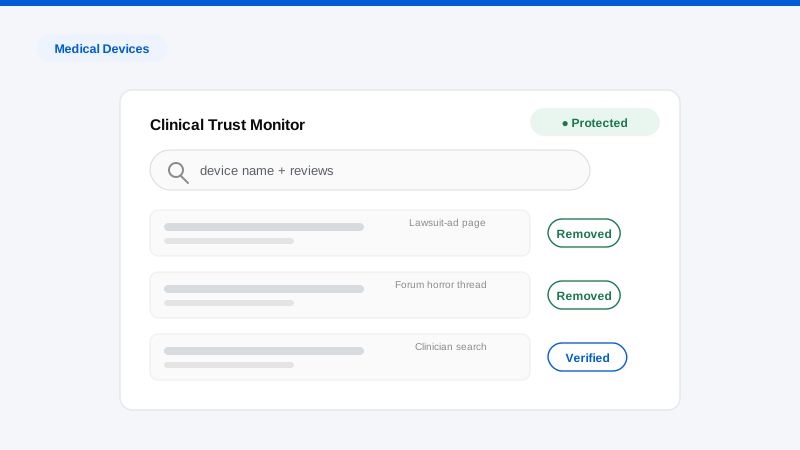
Reputation management for medical device companies is the practice of controlling what surgeons, hospital procurement committees, distributors, investors, and patients find when they research a device maker, its products, or its leadership, and removing the damaging content that would otherwise decide clinical adoption before the first sales conversation happens. Medical devices occupy a distinctive trust position: the product goes inside people, or keeps them alive, or both. That intimacy means negative content about a device company is not processed the way negative content about a software vendor is. A patient-forum horror story, a recall headline, or a wall of lawsuit advertising attaches to the company with a moral weight that ordinary corporate criticism never carries, and it ranks with a durability that ordinary corporate criticism never achieves.
The structural problem is asymmetry of record. A device company’s successes are invisible by design, millions of uneventful implantations and procedures generate no content at all, while its failures generate everything: recall notices, adverse-event coverage, plaintiff-firm advertising engineered to rank for the product name, and patient communities where the worst outcomes are, understandably, the loudest voices. The search results for a device or its maker are therefore a systematically unrepresentative sample of its actual clinical record. Left unmanaged, that unrepresentative sample is what every surgeon, value-analysis committee, and prospective hire reads as the truth.
This guide is written for device-company executives, general counsel, market-access leads, and communications teams, and for the named leaders whose personal search results absorb the company’s controversies. It covers how hostile content accumulates around device makers, what it costs through the sector’s specific mechanisms, why the standard PR-and-SEO playbook underperforms here, and what removal-first protection looks like when it is built for clinical trust.
Why medical device companies are targeted
The device sector’s threat landscape is shaped by one fact: its negative events are legally monetizable at scale, which means an entire industry exists to keep them visible.
Lawsuit-advertising content is engineered to own your product’s search results. Mass-tort law firms and lead-generation networks build content operations around device litigation: settlement-mill websites, “injured by [device]?” landing pages, sponsored placements, and video ads, all optimized to rank for the product name and its misspellings. This content is professionally SEO’d, continuously refreshed, and financially motivated to outlast the litigation itself. For some devices, plaintiff-firm content occupies more of page one than the manufacturer does.
Recall coverage persists long after the recall resolves. Recalls (including voluntary, limited, and low-severity actions) generate headlines that strip the nuance: class designations, affected-lot specifics, and completed remediations disappear, while “COMPANY RECALLS DEVICE” remains indexed for a decade. Searchers cannot distinguish a labeling correction from a life-threatening defect, and the coverage does not help them try.
Patient-forum horror stories are vivid, sympathetic, and permanent. Patients who suffered complications (from any cause, device-related or not) tell their stories in health forums, social groups, and review threads. These accounts are emotionally powerful, rank well because they attract engagement, and are amplified by plaintiff-firm networks that mine them for leads. The millions of patients whose devices worked never post at all, so the visible patient record skews catastrophically negative regardless of the device’s true performance.
Adverse-event databases feed decontextualized content. Public adverse-event reporting exists for good reasons, but raw report data (unverified, unadjudicated, and explicitly not evidence of causation) gets excerpted by content farms and advocacy sites into “thousands of injuries linked to” articles that outrank every careful explanation of what the data actually means.
Whistleblower and ex-employee narratives carry insider weight. Device companies run on field forces and manufacturing teams, and departures (especially after territory changes, layoffs, or compliance disputes) produce ex-insiders with credibility and grievances. Employer-review platforms and reporters’ inboxes give them venues, and “former employee alleges” content attaches to the company and its named executives durably.
Executives inherit all of it personally. The CEO and division presidents of a device company become the searchable faces of every recall and lawsuit. Their names accrue litigation coverage, congressional-hearing clips, compensation stories framed against patient-harm narratives, and, through data brokers, home addresses and family details available to anyone the coverage has angered.
What damaging content costs a device company
The costs run through the specific chokepoints of the device business: clinical adoption, institutional procurement, and regulated trust.
Surgeon and clinician adoption is a search away from stalling. Physicians research devices before adopting them, and increasingly they research the company behind the device. A search page dominated by lawsuit ads and complication stories creates hesitation no sales rep can fully talk through, and clinicians, whose own reputations ride on their device choices, default to caution. The rep hears “we’re staying with our current vendor”; nobody says “we read the forums.”
Hospital value-analysis committees screen reputation as risk. Procurement at hospital systems and group purchasing organizations formally evaluates vendor risk, and adverse media is part of the file. Litigation clouds, recall history framing, and controversy coverage become notes in a committee packet, and committees, which answer for patient safety, treat reputational smoke as disqualifying far more readily than price differences.
Litigation content generates litigation. Plaintiff-firm advertising does not merely reflect lawsuits; it recruits them. Ranked lawsuit-ad content converts searching patients into claimants, which enlarges the litigation, which funds more advertising, a self-reinforcing loop in which the company’s search results function as opposing counsel’s client-intake funnel.
Investor and acquirer diligence prices the visible record. Device valuations, for public companies and acquisition targets alike, discount litigation and reputational overhang. Diligence teams screen adverse media as standard practice, and an unmanaged record of recall coverage and misconduct allegations widens every discount and lengthens every negotiation.
Talent and distribution partners read the same pages. Top surgeons weighing consulting and design relationships, distributors weighing portfolio additions, and senior candidates weighing offers all research the company first. A hostile record raises the price of every relationship the company needs.
AI assistants now summarize the skewed record as fact. When a patient asks an AI assistant “is [device] safe?” (and they do, before consenting to procedures) the model synthesizes the indexed record: lawsuit ads, forum horror stories, and recall headlines included. Clinicians and committee members ask similar questions. The company is being summarized to its most consequential audiences by systems reading a record it has never audited.
Why generic PR and SEO approaches fail for device companies
Device companies that respond with conventional communications tools discover the tools were not built for adversaries with law degrees and ad budgets.
You cannot out-SEO an industry that funds SEO with contingency fees. Suppression strategies collapse against plaintiff-firm content because the adversary is a professional content operation with direct financial returns on ranking. Firms reinvest settlement proceeds into more content targeting the same product names. Corporate blog posts do not outrank an industry whose business model is outranking you.
Regulatory constraints mute the response. Device promotion is regulated; claims require substantiation; and legal review slows every public statement. Companies cannot freely publish “the device is safe” content in response to attack narratives, while the attackers operate under no equivalent constraint. Removal work sidesteps the asymmetry: it proceeds under platform policies, not through public counter-messaging.
Engaging patient communities backfires. Corporate responses inside patient forums (even careful, compassionate ones) read as intrusion and routinely become their own story. The correct treatments for forum content are triage and removal of the policy-violating subset (fabricated accounts, competitor astroturfing, harassment, doxxing) and search-layer containment of the rest, executed quietly, without the company’s name in the thread.
Fragmented internal ownership loses the whole. Legal owns litigation content, regulatory owns recall communications, HR owns employer reviews, security owns threats, communications owns press. Lawsuit-ad networks, scraped adverse-event content, forum narratives, and executive doxxing fall between the lanes. Removal-first reputation management exists to hold the entire hostile-content surface as one accountable problem.
What removal-first protection looks like
Removal-first protection for a device company starts from the recognition that its search results are an unrepresentative sample, and that the fastest way to correct a skewed sample is to remove the items that were never legitimate in the first place.
Assessment. The engagement opens with a full exposure audit across company, brand, and product names, including misspellings and litigation-driven variants, and every named executive: search results, news, plaintiff-firm and lead-generation networks, patient forums and social groups, employer-review platforms, video platforms, data brokers, and AI-generated answers. Each damaging item is classified by its realistic path: source removal, de-indexing, correction, or containment. Most device clients begin with a free, confidential Exposure Scan, and the mapping of the lawsuit-ad ecosystem alone (who is ranking for what, funded by whom) is typically revelatory for leadership.
Removal at the source. A substantial share of the hostile-content surface violates platform policies or legal standards: fabricated patient accounts and astroturfed forum content, fake and policy-violating employer reviews, impersonation accounts, defamatory posts crossing from opinion into false statements of fact, deceptive advertising content violating platform ad policies, scraped and duplicated adverse-event articles, and doxxed executive information. Each category has its own removal mechanics, argued platform by platform by specialists who have run the process at volume. The honest caveat is stated up front: removal decisions belong to platforms and publishers, and no credible firm guarantees a specific item will come down. What specialists change is the probability, the speed, and how much of the target set falls.
De-indexing. Content that cannot be removed from its host can often be removed from search results, the layer where adoption and procurement decisions actually form. Search-engine policies covering exposed personal information and related categories apply frequently to executive-targeted content, and outdated-content mechanisms address stale recall artifacts that misstate the current record. De-indexing closes the discovery path even when the page persists.
Monitoring. The device-sector threat surface regenerates predictably (around recalls, litigation milestones, earnings, and adverse-event news cycles) and plaintiff-firm content operations publish continuously. Ongoing monitoring across search, forums, review platforms, ad networks, data brokers, and AI answers catches new items at first appearance, and standing Protection Plans pair that monitoring with reserved removal capacity so response begins within hours. Against adversaries who publish for a living, episodic defense is no defense.
Protecting named executives as individuals
Device-company executives absorb the sector’s controversies personally, and the exposure compounds across their careers. A CEO who led a company through a major recall carries that coverage in their name’s search results into every subsequent role; a division president named in litigation coverage is re-judged by it at every board search, and because patient-harm narratives generate genuine anger, device executives face the same escalation path the broader healthcare industry now takes seriously: data-broker profiles exposing home addresses and family members convert online hostility into physical-security risk.
Executive protection in the digital layer treats each named leader as a distinct protected asset: systematic removal of personal information from data-broker networks, takedown of impersonation accounts and fabricated content, de-indexing of doxxed and eligible personal content, remediation of legacy coverage that misrepresents the executive’s actual record, and continuous monitoring of each name, including in AI-generated answers, where a model’s summary of an executive now functions as the first reference check for boards, journalists, and counterparties. This is the core of our digital executive protection practice, and for device companies it should extend to the officer group, board members, and the clinical leaders who front safety communications.
The teams that do this well fund it as corporate security, not communications, because the digital layer is where targeting begins, and cleaning it is the cheapest protective measure in the portfolio.
Frequently asked questions
Can lawsuit-advertising content targeting our device be removed?
Some of it, and the assessment tells you which. Plaintiff-firm content that violates platform advertising policies, makes deceptive claims, misuses trademarks, or fabricates affiliations has removal and takedown paths; compliant attorney advertising generally does not, and we say so plainly. The realistic program combines removal of the violating subset, containment of the rest at the search layer, and continuous monitoring, because this adversary republishes. The goal is shrinking the footprint from dominant to residual, not pretending it can be erased.
Old recall coverage still dominates our search results years after remediation. What can be done?
The regulatory record itself is public and stays public. What is addressable is the ecosystem around it: scraped and duplicated articles that multiply the footprint, stale content that misstates the recall’s current status, outdated cached versions eligible for search-engine refresh processes, and the ranking dominance of years-old headlines over the current record. The realistic outcome is that a clinician researching the company today finds its present, not a permanent replay of its worst quarter.
Patient forums are full of horror stories about our device. Can we do anything without making it worse?
Yes: the key is that everything happens off-forum. The content is triaged: fabricated accounts, astroturfing, harassment, and policy-violating posts have removal paths through the platforms themselves; authentic patient experiences are generally left alone as a matter of both policy and prudence, and are addressed at the search layer instead. What we counsel against, firmly, is corporate engagement inside the communities. It converts a content problem into a news story.
A former employee is making misconduct allegations online. Is that removable?
It depends on venue and content, which is what the assessment determines. Posts crossing into defamation, confidentiality violations, fabricated claims, or platform-policy breaches have removal paths; protected speech and legitimate whistleblower channels do not, and pretending otherwise creates legal risk rather than removing it. We work alongside employment counsel in these matters. They own the legal strategy; we own the content surface.
How do we start without committing to a program?
With a free, confidential Exposure Scan: a complete map of the damaging content attached to your company, products, and executives, including the lawsuit-ad ecosystem and your AI-answer profile, reviewed live, with findings yours to keep either way. Device companies typically discover at least one exposure category leadership had never seen. The scan is the fastest way to know what a removal-first program would actually change.
Every surgeon who considers your device, every committee that scores your file, and every patient who searches before consenting will read a record you did not choose, assembled by adversaries who publish for a living. Book a free, confidential Exposure Scan and see that record the way your market sees it, before the next decision is made on it.