
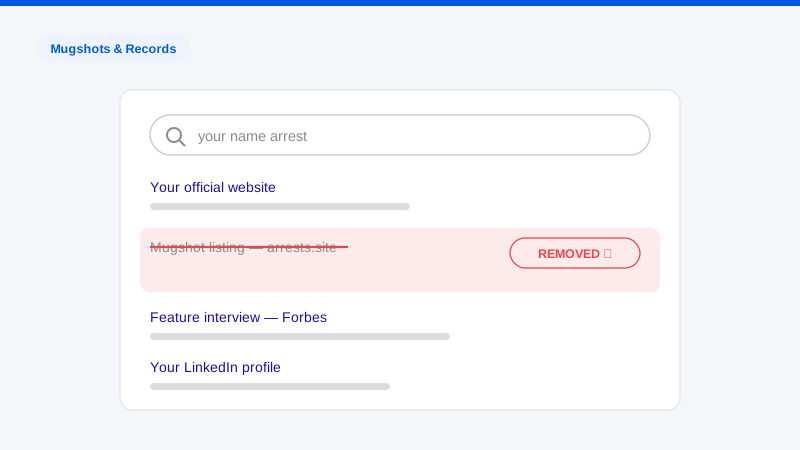
For most people, the mugshot problem is not really a website problem. It is a Google Images problem. The aggregator site hosting your booking photo might get a few dozen visitors a month, but the moment someone types your name into Google and clicks the Images tab, that photo is the first thing they see, framed in a grid, stripped of context. If you need to remove mugshots from Google Images, you are dealing with two separate systems, the website that hosts the photo and the search index that surfaces it, and a durable fix has to address both.
We file these removals every day, and the single most common mistake we see is attacking only one half of the problem: people either get the source site to delete the photo and wonder why it still appears in image search for weeks, or they get a search result suppressed and wonder why the photo resurfaces through a different site. This guide lays out the full mechanics, how mugshots get into Google Images, every removal pathway Google actually offers, the correct order of operations, and where professional leverage genuinely changes outcomes.
One honest note before we start: search de-indexing and source removal on clear grounds succeed at high rates, but nobody outside Google controls Google. Anyone promising unconditional, instant deletion from image search is overselling. What follows is what actually works.
Why mugshots dominate Google Images results
Understanding the mechanics helps you fight them. Mugshot aggregators are engineered for image search: they publish booking photos with your full name in the file name, alt text, page title, and URL, on pages with almost no other content competing for relevance. Meanwhile, most private individuals have very few publicly indexed photos tied to their full name. Google Images ranks what it has, and for many people, the mugshot is the highest-relevance, best-labeled image of them on the open web. That is why a single arrest can own the entire first row of image results.
This also explains the good news: because your image results are usually a thin field, removing or suppressing one dominant image changes the landscape quickly. This is a winnable fight.
The two-front strategy: source removal and index removal
Every effective campaign to remove mugshots from Google Images runs on two fronts:
Front one: the source. Get the photo deleted from the website hosting it. When the source file is gone, Google’s index eventually reflects that, the image result 404s and drops out. Source removal is the permanent fix, and the tactics are the standard mugshot playbook: statutory demands for expunged and sealed records, dismissal documentation, publication-policy violations, and hosting-provider escalation. Our mugshot removal practice covers this front in depth.
Front two: the index. Get Google to remove or refresh the image result itself. This matters for two reasons. First, Google can be persuaded to act even when a source site refuses, under specific published policies covered below. Second, even after a successful source removal, the image can linger in the index until it is recrawled; Google’s refresh tools close that gap in days instead of weeks.
Skipping either front leaves the job half done. The complete playbook for the search side of this lives in our Google removal practice area.
Google’s actual removal pathways for mugshots
Google will not remove an image just because it is unflattering. It removes images under specific published policies, and mugshots frequently qualify under more than one.
The exploitative removal practices policy
This is the big one. Google’s policy allows removal of content, explicitly including images on sites with exploitative removal practices, where the site charges for removal or otherwise monetizes takedowns. The policy was aimed substantially at the commercial mugshot industry. If the site hosting your booking photo demands a fee to take it down, that demand itself is your grounds: you can request that Google remove the pages and images from its results regardless of whether the site ever cooperates. Requests are filed through Google’s removal request forms with documentation of the site’s practices. In our experience, clear-cut cases under this policy are among the most reliable removals in the field.
Outdated content and cached images
After a source site deletes the photo, use Google’s Refresh Outdated Content tool. You submit the URL of the dead page or image; Google verifies the content is gone and drops the stale result. This is the tool that closes the gap between “the site removed it” and “Google stopped showing it.” It only works after source removal. It is a refresh mechanism, not a takedown mechanism. We cover this workflow in detail in our guide to removing outdated content.
Legal removals
Where a court order, applicable statute, or valid copyright claim exists, Google’s legal removal channels apply. Copyright rarely fits mugshots (booking photos are typically government records, and you are not the photographer), but court orders and statutory grounds arising from sealing or expungement can support legal requests. Whether you have such grounds is a question for an attorney, we are not a law firm, and where legal instruments are involved, our legal content removal team works alongside your counsel to execute the takedown side.
What Google will not do
Google will not remove accurate, policy-compliant editorial content, a news photo attached to legitimate reporting, simply on request. It will not act as an arbiter of whether your arrest “should” be public, and it does not offer a general right-to-be-forgotten mechanism for US users. Knowing where the walls are keeps you from wasting months on requests that cannot succeed, and points you toward the fronts that can.
When removal is blocked: image suppression
Occasionally a photo sits on a target that will not come down. Most commonly a news article about a case that ended in conviction. When removal is genuinely unavailable, the remaining lever is suppression: publishing well-labeled, high-quality images of yourself that outcompete the mugshot in your name’s image results.
This works because of the thin-field dynamic described earlier. Professional headshots on a personal website, a properly configured LinkedIn profile, bylined articles, speaker pages, and profiles on high-authority platforms: each one, labeled with your full name in the file name and alt text, gives Google a better-signaled image to rank. Over weeks to months, the mugshot is pushed off the first rows, which is where nearly all attention lives. Suppression is slower and less absolute than removal, and we always exhaust removal pathways first, but for blocked targets it is the difference between a mugshot at position one and a mugshot nobody scrolls far enough to find.
Step by step: how to remove mugshots from Google Images
Here is the order of operations we use, adapted for doing it yourself:
- Inventory every instance. In an incognito window, search your name in Google Images, plus variants with your city, state, and the words “arrest” and “mugshot.” For every mugshot result, record two URLs: the image file URL and the hosting page URL. Repeat on Bing; other engines matter too.
- Establish your legal posture. Dismissed, expunged, sealed, or standing? If you might qualify for expungement, consult an attorney before doing anything else. It upgrades every subsequent step.
- Check each host site for exploitative practices. If any site charges a removal fee, screenshot the demand. That is evidence for a Google policy removal.
- Attack the sources. Send removal demands citing whatever applies: state mugshot statutes, expungement or dismissal documentation, or the site’s own stated removal policy. Escalate non-responders to their hosting providers.
- File with Google in parallel. Submit exploitative-practices removal requests for qualifying sites now. Do not wait on the source campaign. These pathways are independent.
- Refresh the index after each source win. As sites remove the photo, run each dead page and image URL through the Refresh Outdated Content tool so the results drop within days.
- Sweep the secondary copies. Check data broker and people-search profiles for the arrest photo or record and clear those separately. They refeed search results if ignored.
- Re-audit at 30 and 90 days. Confirm the results are gone, catch stragglers, and watch for republication on new domains.
- Build the positive image layer. Regardless of removal success, publish well-labeled photos of yourself on authoritative profiles so your image results have depth going forward.
Where professional help actually changes the outcome
We will be direct about where a firm like ours adds value and where it does not. If you have one mugshot on one site with an expungement in hand, you can very likely handle it yourself with the steps above and some patience.
Professionals earn their fee when the problem has scale or resistance: photos scraped across many domains, offshore hosts that ignore demands, sites that resurface content, filings that get denied for documentation mistakes, and the coordination burden of running source removals, Google filings, refresh requests, and broker cleanup in the correct sequence. We file these requests daily, which means we know which grounds each platform actually honors, how to document a request so it is not kicked back, and when an escalation to a host or registrar will move a stubborn target. On a performance basis, you pay when the image comes down, and the full search-results side of your name, beyond images, can be addressed through our search results removal service in the same campaign.
Keeping the result: monitoring for republication
One more practitioner’s warning before the FAQ. A successful campaign to remove mugshots from Google Images is a snapshot, not a permanent state. The commercial mugshot ecosystem periodically spawns new scraper domains, and a booking photo that came down from six sites can surface on a seventh a year later, freshly indexed, freshly ranked. The countermeasure is routine: re-run your name through image search quarterly, keep your documentation (expungement orders, dismissal paperwork, prior removal confirmations) organized so repeat filings are fast, and act on new instances early, before they accumulate ranking strength. Clients with ongoing exposure risk typically handle this through monitored protection plans rather than manual checks, but either way, the principle is the same: the first removal campaign is the expensive one, and vigilance keeps it that way.
Frequently asked questions
How long does it take to remove mugshots from Google Images?
Policy-based Google removals typically resolve in days to a few weeks after a properly documented filing. Source-site removals range from days (statutory compliance) to weeks (negotiated or escalated). After a source removal, the refresh tool usually clears the stale image result within days. A realistic end-to-end window for a multi-site campaign is several weeks, with the most visible results often improving early.
The website deleted my mugshot but it still shows in Google Images. Why?
Because Google’s index is a snapshot, not a live view. Until Google recrawls the dead page, the old image result persists. Submit the page and image URLs through Google’s Refresh Outdated Content tool to force the update rather than waiting out the crawl cycle.
Can Google remove a mugshot if the website refuses to?
Yes, in defined circumstances. Most importantly when the site charges for removal, which triggers Google’s exploitative removal practices policy. Google removes the site’s pages and images from search results even though the file remains on the host. The photo still exists at the source, but it stops appearing where people actually look.
Will a Google removal cover Bing and other search engines?
No. Each engine maintains its own index and its own removal processes. Bing has comparable pathways and honors similar grounds, but you must file separately. Source removal is the only step that fixes every engine at once, which is why the two-front strategy leads with it.
Start by finding out exactly what Google is showing, and from where. Our free exposure scan inventories every mugshot instance across image search, web results, and data broker profiles, identifies which removal pathway applies to each, and gives you an honest, itemized assessment before you spend a dollar.