

An executive reputation management service is a defensive discipline that combines legal strategy, technical removal and monitoring to control how a leader appears online. It differs from PR, which builds positive coverage, by dismantling harmful content through source removal, search de-indexing, defamation remediation, leaked media and NCII response, and dark web monitoring, then watching for reappearance.
Key facts
- Source removal deletes content at the publishing site; de-indexing removes the link from search while the page may remain.
- Suppression displaces accurate but damaging results with authoritative bios, articles and profiles rather than removing them.
- A credible firm works under NDA, integrates legal capability and can show anonymized cases resembling yours.
- Providers promising 100% removal are a warning sign and often rely on black-hat tactics that backfire.
Where ContentRemoval.com comes in. ContentRemoval.com is this kind of service: removal-first work for executives, founders and family offices covering source takedowns, de-indexing, leaked content and impersonation response, and continuous monitoring, coordinated with your counsel under NDA. The executive, their general counsel or chief of staff usually makes the first call. A free 15-minute Exposure Scan maps what is removable across search, platforms and hosts, and the report is yours to keep. Get a Free, Confidential Exposure Scan or read how our reputation management work is done.
An executive reputation management service operates as a specialized security detail for a leader’s digital life. It is a defensive discipline employing a synthesis of legal strategy, technical precision, and strategic communication to control how an executive is perceived online. This is not a function of marketing or public relations; it is a tactical operation to identify and neutralize threats such as defamatory articles, leaked proprietary data, and damaging falsehoods that endanger both personal authority and corporate valuation.
Why Executive Reputation Is a Critical Corporate Asset

An executive’s reputation is not a vanity metric. It is a high-value corporate asset with a direct and quantifiable impact on financial performance. Key business outcomes (investor confidence, market capitalization, talent acquisition, and strategic partnerships) are intrinsically linked to the perceived integrity of a company’s leadership.
When a leader’s digital profile is compromised, the financial and operational consequences are immediate. A single defamatory story, a coordinated smear campaign, or a resurrected past indiscretion can erode trust, depress stock value, and jeopardize critical business negotiations.
Beyond the Limits of Conventional PR
Traditional public relations and legal teams are often ill-equipped to contend with the velocity and anonymity of modern digital attacks. PR is engineered to build positive momentum, not to surgically dismantle negative content. Legal action, conversely, is frequently too slow and cost-prohibitive to effectively counter a digital crisis that unfolds over hours, not months.
Executive reputation management fills the critical gap where these disciplines are deficient. It brings a specialized armamentarium built for the asymmetric, fast-paced reality of the digital domain.
The fundamental problem is that a digital attack (whether false, misleading, or private information weaponized for public consumption) operates outside the established rules of corporate engagement. It demands a response that is equally agile, technical, and legally assertive.
This constitutes a proactive defense, not merely reactive damage control.
The Specific Threats Executives Face
The risks targeting modern executives are distinct and demand specialist intervention. These are not generic brand complaints; they are focused assaults designed to dismantle personal credibility and professional authority.
Adversaries, including disgruntled former employees, competitors, or activist groups, can launch systematic attacks using fabricated reviews, defamatory blog posts, and manipulated social media accounts. The weaponization of leaked confidential information (private emails, sensitive internal documents, or personal photos) is a common tactic to manufacture scandal and disrupt business operations. Furthermore, historical negative content, such as old news articles or past legal issues, can be exhumed and re-contextualized to inflict present-day reputational harm. The advent of generative AI enables adversaries to create highly realistic yet fraudulent content, from news articles to deepfake audio and video.
Confronting these threats requires more than a press release. It necessitates a firm that has mastered source content removal, search engine de-indexing, and aggressive legal takedowns. For any professional, reputation is currency. As experts in Personal Branding for Consultants affirm, a strong personal brand attracts high-value opportunities, a principle that applies exponentially to corporate leaders.
When your authority is challenged, professional intervention is non-negotiable. One must understand how to properly invest in your online reputation with a clear, defensible strategy. Protecting this asset ensures the stability of your leadership and your organization.
Deconstructing Your Digital Defense Strategy

A serious executive reputation management service is not a reactive fire-suppression measure. It is a sophisticated defense system designed to systematically dismantle digital threats and restore control over one’s own narrative. Understanding the components of this system is essential to confronting the threats you face.
The objective is to transition from a purely defensive posture to one of proactive command over your digital presence. This involves a playbook of specialized tactics, each selected after a rigorous analysis of the specific threat vector. We do not merely react to a crisis; we methodically neutralize it while fortifying digital defenses against future attacks.
Such expert intervention is rapidly becoming a necessity, not a luxury. The global market for enterprise reputation management is projected to expand from $4.3 billion in 2023 to an estimated $9.8 billion by 2032. This growth is not a trend; it is a definitive market signal that protecting digital identity is now a core business function.
Source Removal Versus De-Indexing
At the core of any digital remediation are two fundamental tactics: Source Removal and De-indexing. Confusing them is a common error, but understanding the distinction is critical to a successful strategy.
Source Removal is the definitive solution. It entails the complete eradication of harmful content from the website where it was originally published. This is analogous to locating and destroying the original negative document. It is the optimal path for content that violates a platform’s terms of service, infringes upon copyright, or is demonstrably illegal.
De-indexing, by contrast, targets search engines like Google. This process removes the link to the damaging content from search results. While the content may technically persist on an obscure website, it becomes effectively invisible to the public. It is a tree falling in a forest with no one to hear it.
Consider the analogy: Source Removal demolishes the building, while De-indexing removes all roads leading to it. For most executives, de-indexing is remarkably effective, as the vast majority of online users never venture past the first page of search results.
This distinction is paramount. Pursuing source removal can be a protracted process if a site owner is uncooperative. De-indexing is often a faster, more pragmatic method to immediately stanch the damage while a permanent solution is engineered. A true expert knows precisely which tool to deploy for the specific challenge.
Defamation Remediation and Leaked Media Removal
When confronting an organized attack, a more aggressive posture is required. Defamation Remediation is a full-scale legal and technical counter-offensive designed to dismantle coordinated smear campaigns. This involves tracing false claims back to their origin, mapping their dissemination across blogs, social media, and forums. A critical step is documenting malice by gathering evidence that proves the attack was coordinated, providing the necessary legal leverage. Armed with this evidence, we employ copyright laws (such as the DMCA), court orders, and direct legal pressure to compel web hosts and platforms to remove the defamatory material.
A related, and more urgent, discipline is Leaked Media and NCII (Non-Consensual Intimate Imagery) Removal. This is an emergency response protocol that leverages deep platform relationships and technical expertise to act in hours, not days. The objective is containment: to stop the dissemination of private data, corporate secrets, or personal photos before they achieve viral spread.
Of course, a robust defense includes preparing for public scrutiny. Practical Media Training for Executives equips leaders to navigate challenging interviews and protect their brand, a critical component of any comprehensive strategy.
Dark Web Monitoring as an Intelligence Tool
The most effective reputation strategies do not wait for a problem to appear on the front page of Google. They actively seek threats in the digital underworld. Dark Web Monitoring serves as an early-warning system. It involves scanning the hidden corners of the internet, illicit forums and marketplaces, where stolen data and malicious plans are frequently bought and sold.
By monitoring these channels, we can identify threats before they surface publicly. This could range from an actor attempting to sell your company’s hacked credentials to chatter about a planned reputational attack. This intelligence enables a preemptive response, transforming a potential crisis into a non-event. It is a vital component of actively managing your digital footprint in a world of asymmetric threats.
Calculating the ROI of Professional Reputation Management
Too many executives perceive reputation management as a discretionary PR cost, an item for consideration when budgets allow. This is a fundamental miscalculation. Professional reputation management is not an expense; it is a critical investment in value preservation, with a return that is both tangible and substantial.
The financial calculus is straightforward: the cost of remediating a reputational crisis will always be an order of magnitude greater than the cost of preventing one. Viewed through the lens of risk mitigation and asset protection, the decision to invest becomes self-evident.
A controlled online presence directly influences the metrics that drive enterprise value. Removing a false news article, neutralizing a coordinated attack of negative reviews, or containing a leaked document is not simply a PR exercise. It is an action to prevent measurable losses in customers, partners, and investors. When conducting due diligence, stakeholders are no longer just examining your company; they are examining you. A clean, authoritative digital footprint for an executive builds confidence and removes friction from the transactions that define a company’s trajectory.
The Direct Impact on Market Capitalization
The link between an executive’s public image and a company’s stock price is direct and often brutal. A personal scandal, whether real or fabricated, can trigger an immediate and catastrophic stock devaluation. Investors react viscerally, not only to the incident itself but to the perceived instability and lack of judgment it signals.
In a single trading day, a sudden crisis can vaporize hundreds of millions, or even billions, in market value.
This is where proactive executive reputation management serves as essential financial armor. By continuously monitoring for threats, dismantling smear campaigns before they achieve virality, and shaping the search landscape, these services protect shareholder value. The cost of a comprehensive reputation defense is a rounding error compared to the financial devastation a single, unmanaged online crisis can inflict upon a public company.
The online reputation management market is not a niche service; it is a rapidly expanding financial necessity. Projections show it will grow from an estimated $7.75 billion in 2026 to $14.01 billion by 2031. The reason is clear: 70% of buyers will move to a competitor after reading just one negative story. You can find more data on the financial costs of reputation neglect on MordorIntelligence.com.
This explosive growth tells a clear story: the market now understands that reputation is a tangible asset that must be managed and defended with the same seriousness as any other financial instrument.
The financial bleeding from a compromised reputation is not abstract. It appears in quantifiable terms on the balance sheet.
Financial Impact of Unmanaged Online Threats
| Threat Vector | Potential Financial Impact | Reputation Management Solution |
|---|---|---|
| Negative News & Smear Campaigns | 10-30% drop in stock price; investor confidence collapse; C-suite termination. | De-indexing, content suppression, and positive content fortification. |
| Defamation & Fake Reviews | 15-25% loss in new business revenue; B2B partner attrition; damaged brand equity. | Legal takedowns, platform-level review removal, and search result control. |
| Leaked Private Media/Data | Multi-million dollar regulatory fines; extortion demands; irreversible personal and professional damage. | Rapid content removal from source and search engines; dark web monitoring. |
| Poor Search Results | Difficulty securing funding; top talent recruitment failure (50%+ of candidates reconsider). | Search engine optimization (SEO) to promote authoritative assets and demote negative ones. |
As the table illustrates, ignoring these threats is not a viable strategy. The investment in a professional defense is fractional compared to the quantifiable damage that can result.
Securing Talent and Preventing Attrition
Beyond market value, an executive’s reputation is a powerful force in attracting, and retaining, top-tier talent. The best professionals in any field conduct their due diligence. Before considering an offer, they search for the CEO, the board members, and their prospective manager. If those search results surface controversy, scandal, or indications of a toxic culture, the most sought-after candidates will simply look elsewhere.
This creates a hidden but enormous cost: failed recruitment expenditures, loss of institutional knowledge when senior staff depart, and a diminished competitive edge when innovation cannot be attracted.
A positive, professional online presence for your leadership team sends a powerful signal: this is a stable, healthy, and forward-thinking organization. It reassures candidates and current employees that they are part of a team led by credible, respected figures. A tarnished executive reputation does the opposite. It poisons the culture, increases employee turnover, and makes filling critical roles nearly impossible. The investment in maintaining a pristine executive profile pays for itself in human capital alone.
The Engagement and Threat Neutralization Process
When confronting a digital crisis, you require a clear, swift, and confidential path to resolution. Engaging an executive reputation management service is not a leap of faith; it is a structured, tactical operation. Transparency is key to providing the confidence necessary when pressure is high.
The process begins with a confidential assessment, not a sales pitch. This initial consultation is protected by a non-disclosure agreement (NDA), ensuring every detail you share about the reputational threat remains secure. This is an intelligence-gathering phase, where we establish a complete picture of the situation.
Threat Triage and Strategy Formulation
With a confidential foundation established, the first operational step is threat triage. Deep experience is critical here. Not all negative content is equivalent; a defamatory blog post and a leaked internal document require entirely different playbooks. Our team analyzes and prioritizes each threat based on its visibility, potential for damage, and legal vulnerabilities.
This analysis informs a precise action plan. We do not provide cookie-cutter solutions. Instead, you receive a detailed strategy outlining the exact legal and technical tactics to be employed, the expected timeline for each action, and the metrics for success. You are provided with a clear roadmap to neutralize the threats against you.
This diagram breaks down how we convert a threat into a measurable result.
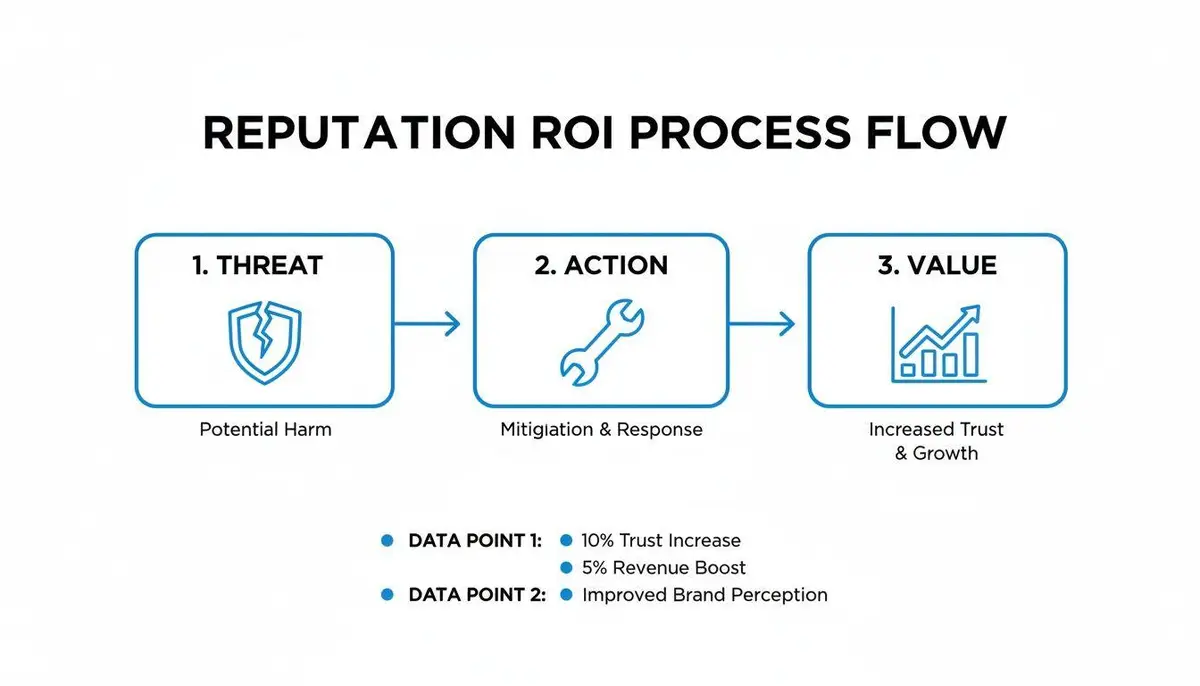
As illustrated, our process is one of direct intervention, taking decisive action that converts a digital liability into a controlled asset.
Action and Removal Execution
Upon your approval of the strategy, we move immediately. Speed is a critical component of effective threat neutralization. In most cases, we deploy initial takedown actions, de-indexing requests, or legal notices within 24 to 48 hours of engagement. This rapid response is designed to stanch the bleeding and contain the problem before it can proliferate.
Our specialists then execute a range of powerful tactics:
- Direct Source Removal: We engage website owners, hosting companies, and platform administrators directly, leveraging their own policies and specific legal arguments to achieve permanent deletion of the damaging content.
- Search Engine De-indexing: If content cannot be removed at the source, we petition search engines like Google to remove the URL from their results, rendering it practically invisible to the public.
- Legal Injunctions: For severe cases of defamation or copyright infringement, our legal partners are prepared to seek court orders that legally compel the removal of the content.
The objective is always to regain control. An adversary may attempt to spread false information, but a swift, overwhelming response dismantles their platform, reclaims the narrative, and restores your authority.
This is not a passive “wait and see” approach. It is an active, assertive campaign to reclaim your digital presence. We track every action and provide continuous progress updates.
Continuous Monitoring and Proactive Prevention
Eliminating the immediate threat is only the first phase. True reputation security requires a persistent defense. Following the initial remediation, we activate proprietary monitoring technology, which functions as a 24/7 digital sentry.
This system constantly scans the public web, social media, and the dark web, searching for any reappearance of removed content or the emergence of new threats. If a negative item is detected, our team receives an immediate alert and moves to neutralize it before it can gain traction. This proactive shield ensures the results we achieve are permanent, converting a one-time fix into a lasting state of security.
Vetting Your Reputation Management Partner
Selecting an executive reputation management service is a mission-critical decision. This is not akin to hiring a marketing agency. The right choice results in a quiet, discreet resolution. The wrong choice can make a bad situation catastrophically worse.
The partner you select must be more than a vendor; they must function as a discreet, specialist unit that becomes an extension of your most trusted inner circle, operating with the precision and confidentiality of a top-tier law firm.
The cost of inaction is staggering. Research indicates a single negative online mention can deter 30 customers. Analysts project that by 2026, 25% of a company’s market value will be directly tied to its reputation. This high-stakes environment is fueling explosive growth, with the reputation management market expected to reach $22.18 billion by 2032. As you can discover in the full enterprise ORM market report, this boom attracts both seasoned experts and dangerous opportunists. Your task is to differentiate them.
Integrated Legal and Technical Expertise
The first non-negotiable requirement: the firm must integrate legal authority with deep technical expertise. A standard PR agency is not structured for this conflict. They excel at crafting positive narratives but possess no power to dismantle negative ones.
A true specialist firm has lawyers in-house or on retainer. This is not for appearances. This structure provides the shield of attorney-client privilege and, more importantly, unlocks the legal instruments required to force content offline. These instruments include copyright claims (DMCA), court orders, and direct legal challenges that compel hosts and publishers to act. This is fundamentally different from sending a polite email requesting a takedown.
A Track Record of Verifiable Success
Any company can make bold claims. A credible firm will provide evidence to substantiate them.
Do not hesitate to request specific, verifiable examples of their work. While client identities will be confidential, they should be able to provide anonymized case studies that mirror your situation. Inquire about their experience with high-profile individuals and family offices, as these engagements demand a level of sophistication and discretion far beyond typical business reputation repair.
Look for a history of removing damaging content from major news outlets, high-authority domains, and review platforms, not merely an obscure blog. Their track record must demonstrate an ability to handle complex, coordinated attacks, not just isolated incidents.
The most reliable indicator of a firm’s competence is its ability to articulate a clear, logical strategy tailored to your specific threat. Avoid any provider who relies on vague promises or technical jargon without explaining the ‘why’ behind their proposed actions.
Ironclad Confidentiality Protocols
From the first point of contact, every interaction must be governed by absolute discretion. A serious firm will insist upon a mutual non-disclosure agreement (NDA) before any sensitive details are shared. This is not a formality; it is a reflection of their entire operational security posture.
Ask pointed questions: How is my data handled? How are our communications secured? How is my identity shielded during engagement with adversaries or web hosts? The firm must act as your secure buffer, ensuring your name is never exposed in the course of the engagement. Our guide on how to find a legitimate online reputation management company provides a deeper analysis of vetting these critical security measures.
Warning Signs of Unqualified Providers
Finally, you must be able to identify the red flags that signal incompetence or, worse, outright danger. Be on high alert for any provider offering a “100% removal guarantee.”
The internet’s complexity makes such a promise inherently dishonest. It is often the sign of a firm that will either fail spectacularly or resort to high-risk “black-hat” tactics to create an illusion of success. These dangerous shortcuts include creating fake positive websites to “bury” negative results, using automated spam to manipulate search rankings, or launching frivolous counter-attacks that only attract more attention.
These tactics almost always backfire, inviting more negative scrutiny and potentially causing your own digital assets to be penalized by Google. A true professional delivers a strategy, not a magic trick. They offer precision and sustainable results, not reckless guarantees that create more problems than they solve.
Frequently Asked Questions About Executive Reputation Services
When under digital assault, there is no time for ambiguity. You require clarity. Here are direct answers to the questions we hear most frequently from executives and their legal counsel.
What Distinguishes an Executive Reputation Service from a PR Agency?
The distinction lies in offense versus defense. A public relations agency is your offensive unit, structured to proactively shape your narrative and secure positive media. Their function is to create good news.
An executive reputation management service is your specialized defense. We are engaged when a digital threat materializes. Our entire focus is neutralizing damaging content through a combination of technical skill and legal strategy. Our work involves content removal, where we surgically extract defamatory articles and fake reviews; search engine de-indexing, to render damaging content invisible on Google; and dismantling attacks by taking apart smear campaigns and shutting down impersonation accounts. PR builds your public profile. We protect it by removing the negative attacks that threaten to destroy it. We operate in a technical and legal capacity that traditional PR firms are not equipped to handle.
How Quickly Can Negative Content Be Removed?
The timeline is contingent upon the nature of the content, its hosting location, and the specific legal avenues available. The primary differentiator of a specialist firm is the speed of initial action.
For clear-cut violations on major platforms (such as copyright infringement, impersonation, or leaked private information) we typically initiate action within 24 to 48 hours. In many of these instances, resolution can be achieved swiftly.
More complex situations, such as a defamatory article on a major news outlet or a smear campaign distributed across numerous blogs, require a more intricate, multi-layered strategy and thus a longer timeline. Any firm promising a one-size-fits-all timeline is not being transparent. We provide a clear, tiered action plan after assessing the damage, prioritizing the most visible and harmful content for immediate containment.
Is It Possible to Erase Something from the Internet Permanently?
The objective is not literal “erasure,” which is often technically infeasible. The true objective is to achieve digital control. This means rendering unwanted information so difficult to find that it becomes irrelevant to the public, investors, and business partners. This is achieved through two primary methods: Source Removal and De-indexing.
Source Removal is the ideal outcome, where the content is completely deleted from its publishing website.
De-indexing involves removing the content from search engine results. While the page may still technically exist, if it cannot be found on Google, its capacity for harm is neutralized.
For the vast majority of our clients, de-indexing is an incredibly effective and often faster solution. Since over 90% of people never look past the first page of Google, removing a damaging link from that critical space takes away its influence.
Even if an adversary possesses the direct link, the content is effectively removed from the public conversation. We then implement continuous monitoring to ensure it does not reappear on search engines or get reposted.
What Is the Difference Between Suppression and Removal?
Knowing when to use the scalpel versus the shield is a mark of true expertise. Suppression and removal are entirely different strategies.
Removal is the surgical act of getting content taken down from a site or de-indexed from search engines. This is our primary strategy for content that is clearly defamatory, violates platform rules, infringes on copyright, or is subject to a court order.
Suppression is a strategy of displacement. Instead of removing the negative item, we create and promote a portfolio of positive, authoritative content, such as professional biographies, thought leadership articles, and positive news mentions. The goal is to push the negative results so far down in the search rankings that they become practically invisible.
A specialist firm uses removal for clear violations and suppression for more nuanced cases, such as a negative news story that is factually accurate but damaging. Often, the optimal approach is a combination of both to achieve total control over your search results.
What Legal and Confidentiality Protections Are in Place?
For our firm, discretion is the foundation of our operations. From the initial contact, all communications are protected by a strict non-disclosure agreement (NDA), which legally binds us to complete secrecy.
When your legal counsel is involved, all our communication is shielded by attorney-client privilege. This creates a fortified channel for strategy and execution without risk of exposure.
Throughout the process, we act as your discreet agent, shielding your identity from website owners, platform administrators, and any hostile parties. This legal framework not only guarantees your privacy but also provides the standing to issue takedown demands and pursue legal action in a way that would be impossible to do on your own.
When your reputation and legacy are at stake, you require a partner with a proven record of delivering under pressure. The team at ContentRemoval.com specializes in the discreet, powerful, and rapid intervention that high-profile leaders require. If you are facing a digital threat, contact us for a confidential assessment.