
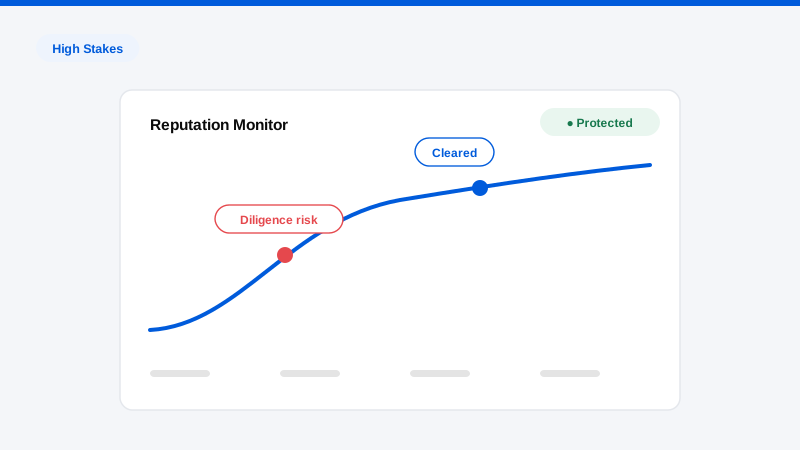
Online reputation in mergers and acquisitions is the body of search results, press coverage, adverse-media records, and AI-generated summaries that a counterparty’s diligence team compiles about a company and its leadership before a transaction closes. It is examined as systematically as the financials, and it is examined earlier, often before the first substantive conversation. In an M&A process, what Google and the AI assistants say about a founder, a CEO, or a company is not background noise. It is diligence material, and it gets priced.
Most sellers prepare their data room for months. Almost none prepare their search results. Yet the acquirer’s counsel, the private equity firm’s operating partners, the lender’s compliance function, and the board members approving the transaction will all run the same searches, and the adverse-media screening platforms they subscribe to will surface every lawsuit, regulatory mention, negative article, and forum thread attached to the principals’ names, regardless of age, accuracy, or resolution.
This guide explains how reputational material actually moves through an M&A process, why the window to address it closes at the letter of intent, and what professional, removal-first protection looks like for principals and companies heading into a transaction. It is written for owners, founders, executives, and the family offices and advisors who prepare them.
What online reputation in mergers and acquisitions actually covers
When deal teams talk about reputational diligence, they mean something broader than a Google search, although the Google search happens too, and it happens first.
A typical process touches four layers:
Adverse-media screening. Acquirers, their counsel, and their financing sources run principals and entities through commercial screening databases that aggregate news archives, court records, sanctions lists, and regulatory actions. These platforms are built for recall, not fairness. A dismissed lawsuit, a settled dispute, an article later corrected, a case of mistaken identity with a same-named individual, all of it surfaces in the report, stripped of context.
Open-web search. Junior associates, investment committee members, and board directors search the company name, the founder’s name, and combinations like “founder name + lawsuit,” “company + fraud,” and “company + reviews.” The first page of results becomes, functionally, the reputational summary of record.
AI-assistant summaries. Increasingly, the first thing a counterparty sees is not a list of links but a synthesized answer. Deal professionals now ask AI assistants directly: “What should I know about [founder]?” “Are there any controversies involving [company]?” These systems compress whatever is indexed (including stale, one-sided, or false material) into a confident paragraph. If the underlying content is bad, the AI answer is bad, and it reads as settled fact.
Human channels. Reference calls, industry chatter, and expert networks. These are harder to influence directly, but they are heavily shaped by what the participants have already read online. Search results seed the questions people ask.
The critical point: none of these layers distinguishes between what is true and what is merely indexed. Diligence teams are trained to flag, not to adjudicate. An unresolved flag becomes a question; a question becomes a condition; a condition becomes a price adjustment, an escrow, an expanded rep and warranty, or a quiet decision to pursue the other target instead.
Key takeaway: In M&A, your search results are diligence documents. They will be read by people whose job is to find reasons to renegotiate, and who face no penalty for over-weighting a negative result.
What deal diligence does to your search page, and to AI answers
There is a second-order effect that most sellers never anticipate: the deal process itself changes your search footprint.
Once a process begins, search volume around the company and its principals rises. Bankers, buyers, lenders, journalists who cover the sector, employees who sense something is happening, all of them start searching. Search engines respond to that demand. Older negative content that had drifted to page three can climb back onto page one because engagement signals suggest renewed relevance. A dormant forum thread gets fresh replies. A years-old article gets new inbound links from a deal-rumor aggregator. The very act of being acquired resurrects material you thought was buried.
If the transaction leaks or is announced, coverage of the deal becomes a new indexing event. Reporters writing the announcement story search the principals’ names and cite what they find, which means an old controversy can be laundered into fresh, authoritative coverage with a current date, resetting its ranking power for years.
AI systems compound this. When a model is asked about a company in the middle of deal speculation, it draws on the freshly re-engaged corpus, and negative material that has just been recirculated is exactly what gets synthesized into the answer. A buyer’s investment committee member asking an assistant for “risks associated with acquiring [company]” may receive a summary that leads with an allegation the seller considered ancient history.
This is why timing dominates everything else in transactional reputation work.
Timeline dynamics: the pre-LOI window is the only real window
Reputational work in M&A obeys a hard clock, and the clock favors early movers.
Before the process (6 to 12 months out). This is the cleanup window. Removal efforts (challenging defamatory content at the source, working with publishers on outdated or corrected material, de-indexing where legal and platform mechanisms allow, and clearing data-broker records that feed screening databases) take time. Publishers deliberate. Platforms review. Search engines re-crawl on their own schedule. Work started here completes quietly before anyone is looking.
Pre-LOI (weeks to months out). Buyers are forming their first impression. Anything removed or corrected before their initial screening simply never enters the deal record. Anything still visible becomes a diligence item that must then be explained, documented, and negotiated, a far more expensive proposition than its quiet resolution would have been.
Between LOI and signing. The scrutiny is now active and adversarial in structure, even in friendly deals. Visible changes to a principal’s search footprint during confirmatory diligence can themselves draw attention. The work that remains possible here is narrower and must be handled with far greater discretion, in coordination with deal counsel.
Post-announcement. The footprint is now part of the public deal narrative. Removal remains possible (content that is defamatory, outdated, or unlawfully published does not become untouchable because a deal was announced) but every remaining week of visibility has already done its work on price and terms.
Key takeaway: Every category of removal gets harder, slower, and more conspicuous as the deal advances. The material you clear before the LOI never has to be explained to anyone.
Heading into a process? See your diligence file before the buyer builds it.Free confidential Exposure Scan: live results on a 15-minute call, covered by strict confidentiality.
Book Your Confidential ScanWhat professional protection looks like
Professional transaction-readiness work is removal-first: the priority is making harmful material cease to exist at its source or cease to be findable, rather than merely arguing against it. Suppression-only strategies leave the underlying content intact for adverse-media platforms and AI training pipelines to find, which is precisely where deal diligence looks.
Phase one: the exposure audit. A systematic mapping of everything a diligence team will find, search results across the principals’ names and known variants, news archives, court-record aggregators, complaint boards, forums, data-broker profiles, and what the major AI assistants currently say when asked about the company and its leadership. The output is, in effect, the buyer’s file, built before the buyer builds it.
Phase two: removal and correction. Each item is triaged by achievability and deal relevance. Defamatory content is challenged through platform legal processes and publisher channels. Outdated coverage (resolved disputes, dismissed cases, superseded facts) is addressed with publishers under their correction and unpublishing standards. Copied and scraped material is traced to every mirror, because removing one copy of a damaging page while six aggregators still host it accomplishes little. Data-broker records that feed screening databases are cleared and kept clear. Where litigation-grade remedies are appropriate, the work proceeds alongside the client’s counsel. We are not a law firm, and the removal strategy is coordinated with, never substituted for, legal advice.
Phase three: the affirmative record. Removal narrows what diligence finds; press assets shape what fills the space. That means an accurate, substantial, well-sourced body of material about the principals and the company (credentialed profiles, authoritative bios, earned and owned press) published early enough to carry independent ranking weight before deal-driven search volume arrives. This is not spin; diligence teams discount spin instantly. It is making sure the accurate record is the findable record.
Phase four: monitoring through close. From process launch to closing, continuous monitoring watches for new publications, resurrections of old content, forum activity, and shifts in AI-assistant answers about the principals. In a live deal, the difference between learning about a new negative item in hours versus weeks is the difference between managing it and explaining it to an investment committee.
Why specialists beat DIY and PR alone
Sellers usually reach for one of two inadequate tools.
The first is doing it themselves, a founder emailing a publisher, an assistant filing platform forms. Publishers and platforms process removal requests through specific standards, and requests that miss those standards are denied and logged; a denied request can make the same item harder to remove later through the proper channel. Worse, an artless approach during a live process creates a record of the seller attempting to alter their public file mid-diligence, a fact pattern no deal lawyer wants to discover.
The second is PR alone. Communications firms are essential for the deal narrative, but PR is an addition strategy: it publishes new material. It does not remove the lawsuit coverage from the screening database, the defamatory post from the complaint board, or the stale allegation from the AI assistant’s answer. Adverse-media platforms do not care how good the new coverage is; they surface the flag regardless. Removal and PR are complements, and the removal has to come first, because content that still exists will keep resurfacing through every new channel that indexes it.
Specialist removal work is a distinct discipline: publisher unpublishing standards, platform legal frameworks, de-indexing mechanisms, data-broker suppression cycles, syndication tracing, and the operational security to do all of it without creating a story. In an M&A context it also demands fluency in deal timelines and confidentiality, knowing what can be done pre-LOI that cannot be done during confirmatory diligence, and how to sequence work so it completes before scrutiny peaks.
Key takeaway: PR fills the page; removal clears the file. Diligence teams and screening databases read the file.
The cleanup window closes at the LOI.A free, confidential Exposure Scan shows you (live, on a 15-minute call) exactly what a diligence team will find, under strict confidentiality.
Book Your Confidential ScanWhy clients call Content Removal
Content Removal LLC works on one side of this problem, and works it deeply: making harmful, false, outdated, and unlawfully published content go away, and keeping the record clean through the moments when it matters most. Founders and executives preparing for a sale, family offices readying a portfolio company for exit, and the bankers and attorneys who advise them bring us in because transactional reputation work rewards exactly what we are built for: removal-first strategy, source-level results rather than cosmetic suppression, and absolute discretion.
Engagements are confidential by default. We operate quietly alongside deal counsel and communications advisors, on the deal’s timeline, and we are candid at the outset about what is achievable and what is not: no one can guarantee a specific removal, and any firm that promises one is telling you what you want to hear. What we commit to is a rigorous, professionally executed pursuit of every legitimate avenue, sequenced against your transaction, with monitoring and ongoing protection that extend through close and beyond.
Frequently asked questions
When should reputational cleanup start relative to a planned sale?
As early as the transaction is contemplated, ideally six to twelve months before a process launches. Publisher decisions, platform reviews, de-indexing, and search re-crawling all run on their own clocks, and none of them can be compressed on demand. Work begun early completes invisibly; work begun after the LOI competes with active diligence scrutiny. If your timeline is shorter, the work is still worth doing. The triage simply becomes more aggressive about what can realistically resolve before signing.
Will removing content look like we’re hiding something from the buyer?
Removal work is not concealment of disclosable facts, what must be disclosed in a transaction is a legal question for deal counsel, and nothing in reputational work changes those obligations. What professional removal addresses is content that is false, defamatory, outdated, misleading, or unlawfully published: material that misstates the record rather than constitutes it. Done properly and early, the work is also simply invisible, content addressed before diligence begins never appears in anyone’s file. During a live process, we coordinate closely with counsel on what is prudent to pursue and when.
The negative coverage about our founder is old and was resolved. Does it still matter?
In diligence, more than almost anywhere else, because adverse-media screening tools are built to surface historical items without regard to resolution, and AI assistants synthesize old coverage into present-tense summaries. A dispute settled years ago can read, in a screening report or an AI answer, as an open question. Old, resolved matters are often among the more tractable removal and correction targets precisely because their outdatedness can be documented to publishers and platforms.
Can you guarantee the buyer’s diligence comes back clean?
No: and no legitimate firm can. Some content is lawful, accurate, and firmly hosted, and the honest answer is that it will be managed rather than removed. What we provide is a clear-eyed map of your exposure, professional execution against every item where a legitimate removal, correction, or de-indexing path exists, an affirmative record built to withstand scrutiny, and monitoring so nothing new arrives unnoticed. In practice, that combination changes what a diligence file contains, but it is work, not magic, and we will tell you which is which before you engage us.
If a transaction is on your horizon, this year or next, the single most valuable step is knowing what a buyer’s team will find before they look. Book a free, confidential Exposure Scan: a 15-minute call where we walk your actual search and screening exposure with you, live, under strict confidentiality. No obligation, no file created, no one notified. Just the map, before the other side draws it.