
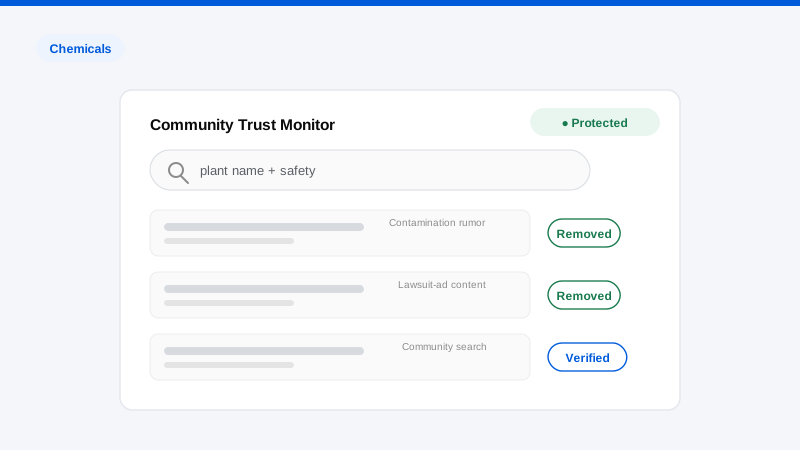
Reputation management for chemical companies is the practice of controlling what industrial customers, regulators, plant communities, insurers, investors, and journalists find when they research a chemical manufacturer, a facility, a product line, or the executives who lead them, and removing the damaging content that would otherwise define the company in every diligence process, permit hearing, and community meeting before it can present a single fact. The chemical industry operates under a permanent perception deficit: the public cannot evaluate its science, fears what it cannot evaluate, and has been conditioned by decades of high-profile contamination stories to assume the worst. That means fear-based content about a chemical company does not need evidence to rank, spread, or persuade. A rumor in a community Facebook group, a lawsuit advertisement naming a product, or a decades-old incident story can dominate the company’s search results indefinitely, and the audiences that decide the company’s future, from procurement teams to permitting boards, all begin their research in exactly those results.
The sector’s reputation problem is also structurally unfair in a specific way: chemical companies are B2B businesses judged by B2C fear. Their customers are sophisticated industrial buyers, but the content shaping their search results is written for frightened consumers: contamination scares, toxic-exposure narratives, plant-explosion coverage. The companies that defend themselves effectively have stopped trying to out-publish that fear and started removing the content that never had a right to exist in the first place.
Why chemical companies are targeted
Chemical manufacturers accumulate hostile content from several distinct sources, each with its own mechanics and staying power.
Contamination fear content spreads without evidence. Claims that a facility has poisoned groundwater, air, or soil ignite instantly in local media and community channels because the alleged harm is invisible, involuntary, and directed at families. Testing, regulatory review, and remediation timelines run in years; the fear content ranks from day one. Even allegations that are ultimately disproven remain indexed under the company and facility name, and few outlets cover the exoneration with the energy they covered the accusation.
Plant-incident coverage becomes the facility’s permanent identity. A flare event, a leak, a fire, an emergency-response drill mistaken for the real thing: each produces coverage, dramatic imagery, and social amplification that outlives the incident by decades. Search a facility’s name years later and the incident is still the lead story, read by every prospective employee, neighbor, and customer as though it happened last week. Industry-wide incidents compound the effect: a disaster at any chemical plant revives coverage and anxiety around all of them.
Lawsuit-advertising content industrializes the fear. Mass-tort marketing is a content industry of its own: law-firm landing pages, paid ads, and recruitment content built around product names and alleged exposures, engineered to rank for exactly the searches customers and communities run. This content is produced at scale, optimized professionally, and refreshed continuously, meaning a chemical company’s product searches can be dominated by claimant-recruitment pages presenting untested allegations as established harm.
Community Facebook groups incubate rumors beyond the company’s sight. The decisive conversations about a plant increasingly happen in local groups the company never sees, where an odd smell becomes a leak, a routine flare becomes an explosion, and a plume of steam becomes a toxic release, each version screenshot-shared and occasionally surfacing into local news. By the time corporate communications learns of a rumor, it has often been local common knowledge for weeks.
Activists and ESG campaigns target the license to operate. Environmental campaigns compile allegation dossiers, rank facilities on emissions claims, pressure customers and investors to disengage, and produce durable online infrastructure timed to permit renewals and expansions. Some of this is legitimate advocacy; some of it traffics in fabrication, exaggeration, and defamation, and search engines do not distinguish.
Executives and plant managers are targeted personally. Site leaders become the named face of every incident and rumor; executives are blamed personally in campaign materials and litigation publicity; and data-broker networks expose home addresses and family details of people who live in the very communities where tensions run highest. During contentious periods, that exposure escalates into harassment and genuine security concern.
What damaging content actually costs a chemical company
B2B procurement runs reputational diligence. Industrial customers, distributors, and formulators evaluate suppliers through structured diligence that increasingly includes reputational and ESG screening, and the people running those screens search the supplier like anyone else. A search profile dominated by contamination allegations, incident coverage, and mass-tort advertising gives a risk-averse procurement team an easy reason to qualify a competitor instead. Supply agreements are lost this way silently, with no debrief and no second chance.
Permits and expansions are decided in public. Air and water permits, expansions, and new-facility siting all pass through public processes in which regulators and elected officials operate under community scrutiny. A facility whose search results scream danger raises the political cost of every approval; hearing rooms fill, conditions multiply, and timelines stretch. For capital projects, permitting delay is one of the most expensive outcomes a content problem can produce.
Insurance and capital reprice the narrative. Insurers, lenders, and investors read the same search results, and visible incident and allegation content feeds directly into premiums, coverage terms, ESG screens, and cost of capital. For public companies, contamination narratives and mass-tort publicity translate into valuation pressure and vulnerability during raises; for private ones, they surface in every M&A data room.
Talent avoids what it fears. Chemical companies compete for engineers and operators against industries with cleaner search results. Candidates, and their families, research the employer and the specific plant, and a facility whose top results are fires and lawsuits loses applicants it never knew about. Community hiring, the lifeblood of plant operations, suffers most.
Community trust converts to operational friction. A plant community that distrusts the operator produces more complaints, more inspection triggers, more opposition at every hearing, and less benefit of the doubt during the next incident. Hostile online content is both the symptom and the fuel: it hardens each new resident’s first impression before the company ever engages them.
Why generic PR and SEO approaches fail in chemicals
The standard toolkit (community newsletters, sustainability reports, review responses, and SEO suppression) underperforms against this sector’s threat model for structural reasons.
Fear content wins the algorithm. Contamination stories, incident footage, and lawsuit content earn clicks, shares, and dwell time at rates no corporate-safety page can approach, and search engines reward exactly those signals. Suppression campaigns that try to bury fear under owned media are betting against both the algorithm and human psychology, and they lose slowly while billing monthly.
Corporate reassurance has negative credibility. On questions of contamination and safety, audiences systematically discount the operator’s own statements, a company insisting its plant is safe often persuades no one and hands local media a fresh angle. Public engagement with rumors also elevates them: the correction introduces the allegation to audiences who had never heard it.
Lawsuit-advertising cannot be out-published. Mass-tort marketers are professional content operations with recruitment economics behind every page; competing with them for rankings on product-name searches is a war of attrition against an adversary who profits from the fight. What generic vendors miss is that advertising content is regulated, and content that misrepresents, fabricates, or violates platform advertising policies has removal paths that suppression never touches.
The rumor layer is invisible to corporate tools. Monitoring built for brand mentions misses closed community groups, local dialect, and colloquial facility names, which is where the decisive content actually starts.
Above all, generic approaches never ask the first question that matters: what here can simply be removed? Fabricated contamination claims, defamatory attacks, impersonation accounts, doxxing of plant staff, policy-violating ads, manipulated imagery, and outdated content with legal or platform remedies, none of it is addressed by publishing more newsletters.
What removal-first protection looks like
Removal-first reputation management starts from the premise that deleted content is the only content that stops doing damage: it cannot rank for the facility name, cannot be screenshot into a community group, and cannot be cited in a procurement screen. Content Removal structures chemical-sector engagements in four phases.
Assessment. The engagement begins with a complete map of exposure across every audience that matters: corporate, facility, and product-level search results; incident and contamination coverage; lawsuit-advertising ecosystems around product names; community-channel rumor content; activist campaign infrastructure; impersonation and manipulated content; and the personal search results and data-broker exposure of executives and site leadership. Each item is graded for severity, audience, and removability: does it fabricate, defame, dox, impersonate, or violate platform, advertising, or search-engine policy or applicable law? Most companies begin with a free, confidential Exposure Scan, which converts a diffuse sense of unfair coverage into a prioritized, factual inventory.
Removal. Removable content is pursued at the source through the correct channel for each item: platform policy enforcement against fabricated claims, harassment, impersonation, and doxxing; advertising-policy and regulatory channels against violating lawsuit-recruitment content; legal process where content is defamatory or publishes private information; and direct engagement with site operators, group administrators, and publishers where that is the effective route. Each channel has distinct evidence standards, and chemical-sector cases often require translating technical facts into the form a platform reviewer or court can act on, a specialist skill, not a form-filling exercise.
De-indexing. Some content survives at the source: offshore hosts, abandoned pages, sites built to resist takedowns. Where it violates search-engine policies or applicable law, it can often be removed from search results even though the page persists. For a sector whose critical audiences all research through search, de-indexing removes most of the content’s operational force: the procurement analyst, the permitting official, and the anxious new neighbor simply no longer encounter it.
Monitoring. Chemical-sector threats run on external clocks: permit renewals, incident anniversaries, mass-tort campaign cycles, and the permanent background hum of community channels. Continuous monitoring covers company, facility, and product search results, executive and site-leader names, rumor-prone community channels, data-broker reappearance, and new advertising content, so threats surface in hours, when removal is fastest and before rumors harden into local fact. Our Protection Plans exist to keep that posture standing between incidents rather than rebuilding it after each one.
Removal-first is not removal-only, and the boundary is principled: accurate reporting, genuine community concern, and lawful advocacy are not removal targets. The objective is to eliminate the violating layer (fabrication, defamation, doxxing, impersonation, policy-breaking advertising) so the company engages the legitimate remainder on a field that is no longer tilted.
Protecting chemical executives and plant leadership as individuals
The personal layer of chemical-sector reputation has a characteristic most industries lack: the targeted individuals usually live in the communities where the anger concentrates. Plant managers, EHS leaders, and executives are searched by regulators, journalists, neighbors, and litigants, and what those searches return follows them to the grocery store, the school board meeting, and the next job.
The threat pattern is recognizable: site leaders named personally in incident coverage and community rumor threads; executives cast as villains in campaign materials and litigation publicity; harassment that spikes after every flare, odor event, or headline; defamatory content that persists across decades and employers; and home addresses and family details exposed through data-broker networks to anyone angry enough to look. For leaders of facilities in inflamed communities, that exposure is a physical-security concern, not a vanity issue.
A serious program treats each named leader as a protected asset: full personal search audits; systematic removal of addresses, family information, and personal records from people-search and broker networks, with continuous re-suppression as records regenerate; takedown of doxxing and harassment content; platform and legal action against defamation; and standing monitoring of every covered name so new threats surface within hours. This is the core of our digital executive protection practice, and for chemical-company leadership it belongs alongside plant security in the corporate-security portfolio.
Company and personal reputations also compound each other: a plant manager whose name searches return harassment content is weakened at every community meeting, and a company drowning in contamination narratives stains every leader’s record. Defending both continuously is materially more effective than defending either in crisis.
The strategic case for acting before the next incident
Every chemical company has a next event coming: a flare, an odor complaint, a permit renewal, a mass-tort filing, an anniversary story. What determines the damage is the search landscape the event lands on. A company that enters it with clean, monitored results and protected leadership absorbs one news cycle and recovers. A company that enters with years of accumulated fear content watches the new event fuse with the old into a single narrative of danger: the one procurement teams, regulators, and neighbors will find first for the next decade.
Removability decays with time. A fabricated contamination claim challenged in its first days is one contained case; a year later it has been cited, screenshotted, and absorbed into local memory. Doxxing removed in hours is an incident; in weeks it is mirrored. The economics of this work overwhelmingly favor early, quiet, continuous action over crisis response.
If you are responsible for communications, legal, EHS, or security at a chemical manufacturer, distributor, or specialty producer, the rational first step is precision about what is actually out there. A free, confidential Exposure Scan maps the damaging content attached to your company, facilities, products, and people, identifies exactly what can be removed, and gives you a factual basis for action, before the next incident finds the old content waiting to amplify it.
Frequently asked questions
Can coverage of a real plant incident be removed?
Accurate reporting of a genuine incident generally cannot be removed, and pursuing it would be the wrong strategy. What can often be addressed is the surrounding layer: fabricated or exaggerated claims, manipulated imagery, defamatory attacks, impersonation accounts, and outdated content that misstates long-resolved matters. An assessment separates the coverage a company must manage honestly from the content it can eliminate outright.
Lawsuit ads dominate searches for our product name. Is anything actionable?
Sometimes, yes. Mass-tort advertising is subject to advertising regulations and platform policies, and content that misrepresents facts, fabricates claims, violates ad rules, or infringes trademarks can have removal or enforcement paths that generic SEO never touches. Lawful attorney advertising will remain, but stripping out the violating layer and addressing the surrounding ecosystem can change the search landscape materially. This requires case-by-case analysis rather than blanket promises.
Rumors about our plant keep starting in local Facebook groups. What can be done?
Content in community groups that fabricates claims, harasses employees, doxxes staff, or impersonates the company can violate platform policies and be actionable, and monitoring can surface rumors within hours instead of weeks. Legitimate community concern is not a removal target, but early detection changes what is possible, both for removal of violating content and for the company’s own engagement decisions.
Our plant manager is being harassed online after an incident. How should we respond?
Treat it as a security matter and move quickly. Harassment and doxxing violate platform policies and often the law, creating immediate takedown paths, and the underlying personal data can be removed from the broker networks that make targeting easy. Continuous monitoring of the individual’s name should follow. Speed matters: this content is easiest to contain before it spreads and is mirrored.
How does this fit with our community-relations program?
They are complements, not substitutes. Community relations builds the genuine relationship (plant tours, local hiring, honest engagement) while removal-first protection eliminates the fabricated and violating content that poisons the environment those efforts operate in. The best-protected chemical companies run both continuously, with removal handled quietly by specialists working alongside counsel and security.