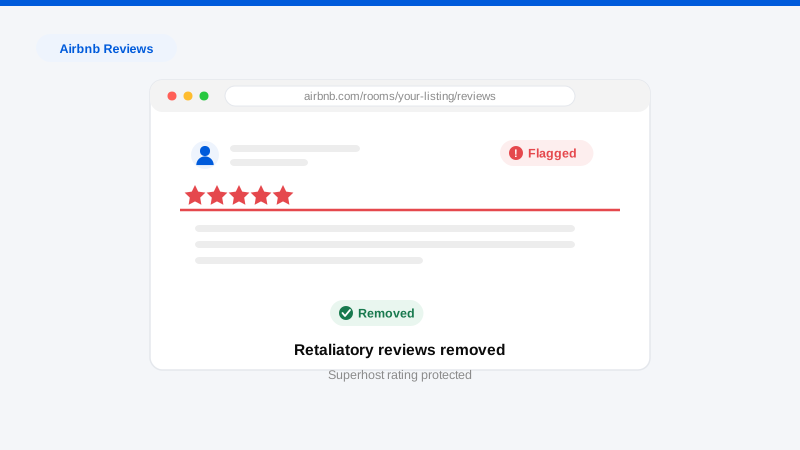
Airbnb removes reviews that violate its Reviews Policy, a policy unusually favorable to hosts who know it, because it explicitly prohibits the two abuses hosts suffer most. First, review extortion: a guest may not use a review, or the threat of one, to extract a refund or a free night, and reviews connected to such demands are removable. Second, retaliation: the policy bars reviews left because a host enforced a rule (reported a party, charged for damage, declined an off-platform deal) a named, reportable category since Airbnb’s 2022 policy update. What Airbnb will not remove is a genuine guest’s unflattering account of a genuine stay. This page, part of our review removal hub, covers the host playbook.
Can this Airbnb review be removed?
A review is a legitimate removal candidate when it violates the Reviews Policy:
- Extortion or incentivized content. The guest demanded a refund, discount, or favor with the review as leverage. Preserve the thread; Airbnb’s messaging history is your best evidence.
- Retaliation for rule enforcement. The review followed your damage claim, party report, extra-guest charge, or refusal to break the rules. The policy names this pattern.
- No genuine stay behind it. Reviews require a qualifying reservation and actual experience; reviews from third parties who never stayed, or describing a different listing, violate the relevance rules.
- Irrelevant content. Reviews centered on things unrelated to the stay (a political rant, a dispute from another platform, your personal life) breach the relevance requirement.
- Content violations: discriminatory language, threats, or private information (your full name and address published to intimidate).
- Violations described by the review itself: a guest recounting their own party or rule-breaking while one-starring you has often written your evidence for you.
Not removable: an honest guest’s genuine disappointment: cleanliness they found lacking, noise, a listing that didn’t match expectations. Airbnb protects that, and repeated meritless disputes weaken your standing for the real ones.
What Airbnb actually removes, and how the system works
Airbnb’s review machinery has host-relevant quirks. Reviews are double-blind: neither side sees the other’s until both submit or the 14-day window closes, which limits tit-for-tat but means a retaliation review often lands as a surprise on day 13. Removal runs through reporting the review to Airbnb support, citing the specific Reviews Policy provision violated; agents evaluate against the policy and the reservation’s message history, which is why keeping every interaction on-platform is the highest-value habit a host can build. Decisions can be re-escalated with new evidence, but nobody (no host tier, no ad spend) buys a removal. The policy is the whole game.
The removal process, step by step
- Keep everything on-platform, always. Airbnb reads its own message threads as primary evidence. A demand made by text or at the door is deniable; the same demand in Airbnb messaging decides cases.
- Preserve the incident record. Photos of damage, timestamps, the party report, the AirCover claim, the declined refund demand.
- Report the review through its flag option or host support, citing the exact policy ground: extortion, retaliation, irrelevance, or content violation. Three factual sentences tied to the message thread outperform a narrative of grievance.
- Connect the dots for the agent. “Guest demanded a full refund on day 2 (messages of March 4), I declined per policy, review posted March 6 repeating the demand” is a case an agent can approve without guesswork.
- Re-escalate with structure if declined. First-line decisions are inconsistent; a calm re-escalation attaching thread excerpts and quoting the policy language frequently reverses them.
- Respond publicly while you wait. A short, factual host response, no counterattack, protects future bookings whatever the removal outcome.
The evidence we build
Airbnb cases are decided on the reservation record, so we build files an agent can verify in minutes: the message thread annotated to the demand or rule-enforcement moment; the timeline aligning your damage claim with the review’s posting; documentation of the incident itself (photos, AirCover claim numbers, neighbor complaints); pattern evidence for guests who review serially after failed refund demands; and the exact Reviews Policy language each fact violates. For hosts under sustained attack, we add cross-account forensics and escalate the pattern as one case rather than five.
What doesn’t work
- Retaliatory reviews of the guest. You’re subject to the same policy; a revenge review gets removed and undermines your credibility in the dispute that matters.
- Angry public responses. Future guests read your response as a preview of their host. One calm paragraph, or nothing.
- Taking the fight off-platform. Calls and texts create no evidence Airbnb will weigh, and off-platform refund deals violate the terms you’ll later need to invoke.
- Paying the extortionist. The demand recurs: and the payment itself, made off-platform, weakens your standing. Report the demand instead; documented extortion is a strong case.
- Mass-disputing every critical review. Support tracks host dispute history; meritless reports tax the credibility of your legitimate ones.
Get a Free, Confidential Exposure Scan
Timelines and honest success expectations
Straightforward reports resolve in days; contested cases and re-escalations run one to several weeks. Honest odds: extortion and retaliation reviews with on-platform message evidence are removed with genuinely good consistency. The policy is explicit, and the evidence standard is met or it isn’t. Reviews from real stays expressing real dissatisfaction essentially never come down; a removal-guarantee pitch from any vendor should end the conversation. Where removal fails, a professional response plus steady booking volume dilutes the outlier. Multi-channel hosts should audit Google reviews of their property and, for serviced stays, Tripadvisor, attacks migrate, and the evidence file you built for Airbnb usually transfers.
Frequently asked questions
Can a host pay Airbnb to delete a bad review?
No. No host tier, subscription, or advertising relationship includes review removal. Reviews come down only for Reviews Policy violations, through support reports backed by reservation evidence, or when the guest deletes it.
A guest demanded a refund or they’d leave a bad review. What do I do?
Decline in Airbnb messaging so the demand and refusal are on the record, then report the thread to support immediately, before the review posts if you can. If it appears, cite the extortion provision with message timestamps. These are among the platform’s most reliably removed reviews.
Can I remove a review left after I charged a guest for damage?
Often, yes. Reviews left in retaliation for legitimate rule enforcement (damage claims, party reports, extra-guest charges) violate the Reviews Policy. The case turns on sequence: document that the claim preceded the review and that the review responds to it.
Does a removed review still affect my rating?
No: removal deletes the star rating along with the text, and your average recalculates. That’s why pursuing clear violations is worth it even on a listing with hundreds of reviews: one 1-star among 200 still moves a 4.9.
The guest broke house rules and then left one star. Does that help me?
Frequently. A review describing the guest’s own violation (the party they threw, the extra guests they hid) supports a retaliation report and, where they demanded concessions, an extortion report. Their words plus your on-platform documentation make the cleanest case file possible.
A retaliation review can cost a host Superhost status, search ranking, and a season’s bookings. Our free, confidential exposure scan maps every damaging review across Airbnb, Google, and the OTAs, tells you what’s honestly removable, and walks you through our process before you spend anything.