
Brand protection for beauty brands is the discipline of removing the counterfeit products, fake reviews, and viral misinformation that trade on a cosmetics brand’s name, with a urgency other industries do not face, because in beauty, counterfeits are not just lost revenue. They are products consumers put on their skin. A fake handbag disappoints its buyer; a fake serum can burn her face, and she will hold your brand responsible, publicly, with photographs.
That safety dimension changes everything about how the threat landscape works for beauty and cosmetics brands. It raises the stakes of every counterfeit listing, because each one is a potential injury attributed to your name. It supercharges the reputational mechanics, because “this product ruined my skin” is among the most shareable claims on the internet, true or not, counterfeit-caused or not, and it collides with the industry’s greatest strength: beauty is built on social proof, on reviews and influencer trust, which means the same channels that build a beauty brand fastest are the channels through which it can be destroyed fastest.
This guide defines that landscape (counterfeits, review fraud, and influencer-driven pile-ons) explains what is genuinely at stake for a cosmetics brand, and lays out what professional, removal-first protection looks like and why serious beauty brands retain a specialist rather than improvising.
Why beauty brands are targeted
Beauty brands are targeted because the category combines high margins, small and easily copied physical products, and purchase decisions driven almost entirely by social proof, a combination that rewards counterfeiters, fake reviewers, and bad-faith content creators simultaneously.
Counterfeiters love cosmetics economics. A prestige moisturizer or viral lip product sells for many multiples of its manufacturing cost, ships in a small box, and is identified by its packaging, which can be photographed, copied, and reproduced far more easily than the formulation inside. Counterfeit cosmetics operations fill convincing packaging with whatever is cheap, and sell it through marketplace listings, social commerce, and cloned storefronts dressed in the brand’s own campaign imagery. Every viral product launch, every item that sells out or trends on TikTok, creates unmet demand that counterfeit networks are structured to intercept within days.
Review systems are the category’s currency, so they attract forgers. Beauty purchases are researched purchases: shade matching, skin-type compatibility, before-and-after evidence. That makes reviews disproportionately powerful, and disproportionately attacked. Brands face fake negative reviews seeded by competitors and bad actors, review sections poisoned by customers who unknowingly bought counterfeits from third-party sellers, and coordinated review attacks timed to launches. The counterfeit-review interaction is especially vicious: a fake product sold through a hijacked marketplace listing generates authentic-sounding one-star reviews (“broke me out,” “smells wrong,” “obviously fake”) that attach to the genuine product’s listing and follow the brand everywhere.
Influencer dynamics cut both ways. No industry is more creator-driven, which means no industry is more exposed to creator-driven pile-ons. A single video alleging a product is harmful, a formulation is “toxic,” or a brand behaved badly can cascade through stitch-and-react mechanics into thousands of derivative posts within days, regardless of whether the original claim was accurate, exaggerated, or based on a counterfeit unit. The pile-on then hardens into search results: “brand name + lawsuit,” “brand name + dangerous,” autocomplete suggestions that greet every future customer.
Key takeaway: Beauty’s growth engine (viral products, review-driven purchasing, creator amplification) is the same machine that counterfeiters and bad actors exploit. The brand’s marketing success directly funds its threat landscape.
What’s at stake
What’s at stake for a beauty brand facing counterfeits and coordinated negativity is the one asset the entire category runs on: consumer trust in what the product will do to their body. That trust is slow to build, instantly transferable to competitors, and uniquely fragile because the harm narrative in beauty is physical.
Safety incidents attributed to your brand. When a customer is injured by a counterfeit (an allergic reaction, chemical burns, contamination) she does not know it was counterfeit. She knows your name was on the jar. The complaint, the photos, and the warning-to-others post all cite your brand, feed review platforms and forums, and become permanent search results. Counterfeit cosmetics thus convert directly into an apparent product-safety record you never earned.
Search and AI contamination at the moment of purchase. Beauty buyers search before they buy: “is [product] legit,” “[brand] reviews,” “[product] side effects.” Increasingly they ask AI assistants the same questions, and AI-generated answers synthesize whatever the open web contains: counterfeit complaints, pile-on content, fake reviews. A brand whose search and AI surfaces have been contaminated loses customers silently, at scale, at the exact moment of decision.
Retail and marketplace standing. Marketplaces suspend listings with elevated complaint rates; retailers reconsider brands with visible safety controversies. Counterfeit-driven complaints and review attacks put wholesale relationships and marketplace privileges at risk, an operational injury on top of the reputational one.
Launch economics. Beauty lives on launches, and launches are when attacks concentrate: counterfeits appear within days of a viral moment, review attacks time themselves to release windows, and pile-ons feed on launch visibility. A contaminated launch doesn’t just underperform. It burns the marketing spend that created the demand the attackers intercepted.
See what buyers find when they search your brand.Free confidential Exposure Scan: live results on a 15-minute call, yours to keep either way.
Book Your Free ScanWhat professional brand protection for beauty brands looks like
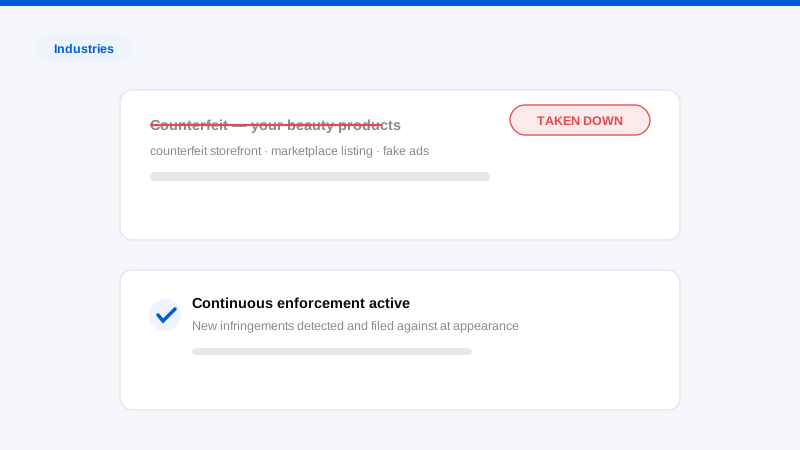
Professional brand protection for beauty brands is removal-first: the goal is to make counterfeit listings, fake reviews, and defamatory content cease to exist at the source, because in a category with genuine safety stakes, suppression and spin are not just inadequate, they leave dangerous products on sale. The professional sequence has four layers.
Remove at the source. Counterfeit listings come down at the marketplace level; cloned storefronts are dismantled at the host, registrar, and payment-processor level; stolen product photography and campaign imagery, the assets that make fakes convincing, are pursued through copyright infringement removal across platforms and ad networks. Fake and policy-violating reviews are challenged through each platform’s integrity processes as part of dedicated review removal work, and false, defamatory claims are addressed through defamation removal pathways. This is intellectual property enforcement executed as an operational discipline: the right evidence, to the right team, through the right channel, at volume.
De-index what resists removal. Some hostile content sits with slow hosts or reluctant platforms. While source removal is pursued, de-indexing from search engines cuts that content off from the “is it legit” and “side effects” searches where it does its damage. A counterfeit complaint no buyer can find has lost most of its power to redirect a purchase.
Build authoritative press assets. Removal clears the negative; credibility must fill the space. Earned press placements in publications with real authority give a beauty brand ranked assets that dominate its search results, so the research journey ends in vetted coverage of the brand’s actual story, not in a vacuum that the next pile-on will fill.
Monitor continuously. Counterfeit networks relist, review attacks recur, and the next viral video is always a possibility. Serious beauty brands run continuous monitoring across marketplaces, review platforms, ad libraries, social channels, and search, with rapid-response removal when something appears. This is the logic of an ongoing Protection Plan: in a launch-driven category, protection has to be standing infrastructure, not an emergency purchase made mid-crisis.
Key takeaway: In beauty, removal-first is also safety-first. Every counterfeit listing removed is a potential injury prevented, and every prevented injury is a one-star safety complaint that never gets written.
Why DIY brand protection for beauty brands falls short
Most beauty brands first attack this problem with the tools at hand: the ecommerce manager files marketplace reports, the social team flags fake accounts, the PR agency drafts a statement about counterfeit awareness. Each effort is rational; together they fail, for structural reasons.
In-house takedowns lose to industrialized infringement. Counterfeit cosmetics operations run networks: hundreds of listings, rotating storefronts, bulk-registered domains. An in-house generalist reporting listings one at a time is mowing a lawn that regrows overnight, without the platform relationships or evidentiary practice that determine whether reports are actioned in days or ignored for months.
PR cannot remove anything. A generic PR or marketing agency responds to a counterfeit-safety crisis with communications: warnings, statements, content. None of it takes a single dangerous product off sale. Worse, a public “beware of fakes” campaign can seed the very association, brand name next to the word “fake”, that the brand needs to escape. Communications have a role, but only on ground that removal has already cleared.
Review disputes are a specialist craft. Review platforms have narrow, specific criteria for removal, and generic complaints bounce. Knowing which reviews are actionable, what evidence each platform requires, and how to escalate is exactly the kind of accumulated operational knowledge that separates a specialist firm from a well-intentioned internal effort.
Counterfeit listings don't wait for your next launch, neither should you.Get a free confidential Exposure Scan: live results walked through on a 15-minute call, and the findings are yours to keep either way.
Book Your Free ScanWhy beauty brands choose Content Removal
Beauty brands choose Content Removal because dismantling infringement and misinformation ecosystems at the source is the firm’s core discipline, and because its track record includes exactly the consumer-brand threats beauty faces.
For Saski Collection, the label founded by Tammy Hembrow, Content Removal dismantled the counterfeit operations trading on the brand: replica listings, cloned storefronts, and the stolen-imagery infrastructure that powered them (see the Saski case study). For Sweat, the fitness platform, the firm stopped a fraud operation on track to divert an estimated $10 million from the brand’s customers, the same customer-facing fraud mechanics that cloned beauty storefronts use. Client work spans consumer and enterprise brands including Danone; the full record is in our case studies.
The engagement model is built for how beauty brands actually operate. Removal-first execution means outcomes are measured in listings down, storefronts dead, fake reviews removed, and search results clean, not in sentiment reports. Launch-aware protection means monitoring and response capacity are in place before a drop, when attack probability peaks. Discretion means enforcement happens quietly, without a public spectacle that would amplify the problem. And honesty about scope means the firm is clear about what it is not: Content Removal is not a law firm, does not give legal or regulatory advice, and does not guarantee outcomes. It commits to rigorous process, transparent reporting, and a standing perimeter that catches threats early.
Frequently asked questions
How do we know if the negative reviews on our products are from counterfeit units?
Common signals include clusters of complaints about smell, texture, or packaging inconsistent with your genuine product; reviews concentrated on marketplace listings served by third-party sellers; and complaint spikes that follow the appearance of unusually cheap listings. A proper investigation maps the sellers, test-purchases where warranted, and connects the review pattern to its source, which then determines the removal strategy: counterfeit listings down first, then the review record challenged with evidence that the units were not genuine.
Can fake or unfair reviews actually be removed?
Reviews that violate platform policies (fabricated experiences, competitor sabotage, reviews of counterfeit units misattributed to the genuine product, content that breaches the platform’s own guidelines) can be challenged and are frequently removed. Genuine reviews from real customers generally cannot be, and no honest firm will tell you otherwise. The professional work is separating the two, documenting the violations to each platform’s standard, and pursuing removal systematically rather than firing off generic complaints that get ignored.
A creator posted a viral video making false claims about our product. What can be done?
It depends on the content. Demonstrably false factual claims may violate platform misinformation or defamation policies; videos using your stolen imagery or misrepresenting counterfeit units have additional removal pathways. Equally important is the ecosystem around the video (the derivative posts, the search results, the AI answers it seeds) which is addressed through removal, de-indexing, and authoritative press assets. What a specialist will not do is advise a public fight with the creator, which usually feeds the cycle.
When should a beauty brand start this, after a problem, or before?
Before, if possible. The brands that suffer least are the ones with monitoring and enforcement infrastructure already running when the viral moment, launch, or attack arrives, because counterfeits and pile-ons compound daily, and removal begun on day two is worth far more than removal begun in month three. That is the purpose of an ongoing Protection Plan. If the problem has already arrived, the same logic applies: the best day to start was before launch; the second-best day is now.
Somewhere right now, a customer is deciding whether your product is safe to put on her skin: based on what search, reviews, and AI answers show her. Find out what that is. Book a free, confidential Exposure Scan: a specialist walks you through live results (counterfeit listings, review integrity, viral content, AI answers) on a 15-minute call, and everything we find is yours to keep, whatever you decide next.