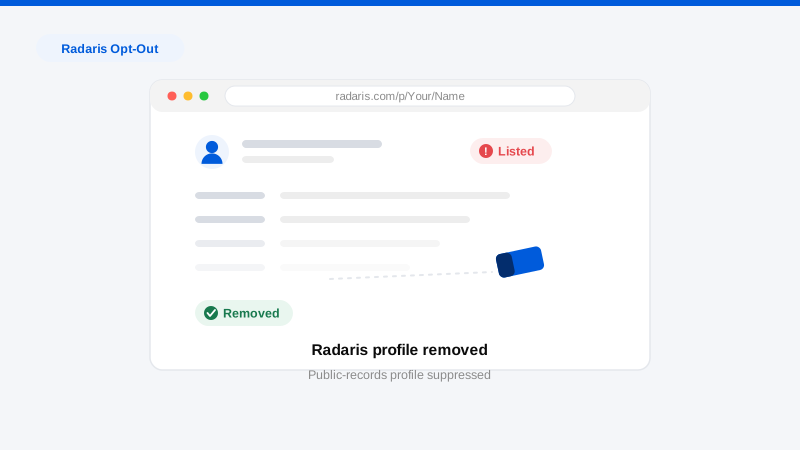
You can remove your profile from Radaris for free, but it is one of the more demanding opt-outs in the people-search industry. The self-serve route requires finding your profile, claiming it through a Radaris account, and verifying a code sent to your phone before you can make the profile private and remove its records. The alternative route, emailing Radaris customer service with your profile URL and a removal request, avoids account creation but is slower and less predictable. Either way, plan for more friction than the one-click opt-outs at sites like TruePeopleSearch. Radaris profiles are unusually detailed and rank stubbornly in Google, so the effort is worth it, and as with every data broker, removal is per-site suppression, not deletion of the records feeding it. Both routes are below, step by step.
What does Radaris publish about you?
Radaris builds deep public-records profiles: full name and aliases, age, current and historical addresses going back decades, phone numbers, email addresses, relatives and associates, employment and business affiliations, property records, and links to court and license data. Its pages are long, keyword-dense, and structured in a way that ranks well for name searches, which is why a Radaris profile so often sits on page one of your own Google results. The data comes from aggregated public records and commercial sources; Radaris originates none of it. That means your profile exists without any action by you, and removing it leaves the same source data supplying Whitepages, Spokeo, Intelius, and the rest of the ecosystem.
Anyone can request removal of their own profile at no cost. What Radaris demands that easier brokers don’t is identity friction: an account, and a phone number that can receive a verification code.
How to opt out of Radaris, step by step
Route 1: the self-serve control flow (faster, more friction):
- Find your profile. Search your name at radaris.com and narrow by state and city. Note every profile that’s yours, including name variants, each is handled separately.
- Open the profile and choose to control it. From the profile page’s menu, select the option to control or manage this profile (Radaris frames removal as “controlling” your information).
- Create a Radaris account. Use a dedicated or masked email address: you’re registering with a data broker.
- Verify by phone. Radaris sends a code to a phone number you provide to confirm you’re the person claiming the profile. This step is mandatory for the self-serve route; use a number you can receive texts or calls on.
- Make the profile private / delete specific records. Once the profile is claimed, use the privacy controls to hide the profile and remove its information from public view.
- Repeat for each additional profile, and re-search after a week to confirm.
Route 2: the written request (slower, no account):
- Copy the exact URL of each profile that’s yours.
- Email Radaris customer service (the contact address is listed on the site’s contact and privacy pages) requesting removal of those URLs, stating that you are the subject of the records. California and other covered-state residents can frame it as a formal privacy-law deletion request, which obligates a documented response.
- Keep copies of your correspondence, and follow up if nothing changes within two weeks.
How long does Radaris removal take?
Self-serve removals generally take effect within about 48 hours of completing phone verification, though allow a week before judging. Written requests are slower, days to weeks depending on volume and whether you invoke a state privacy law. Then comes the familiar lag: Google keeps serving cached copies of removed Radaris pages until re-crawl, which the Refresh Outdated Content tool can accelerate. End to end, expect two to six weeks before your Radaris presence is gone from both the site and search results.
Get a Free, Confidential Exposure Scan
Why do Radaris listings come back?
For the same structural reasons as every broker, amplified by Radaris’s depth. The site continuously ingests public records; new data (a move, a filing, a new number) can rebuild a profile your earlier removal doesn’t cover. Name variants live as separate profiles, and because Radaris profiles aggregate decades of history, even a small fresh record can resurrect a substantial page. Meanwhile the sources keep feeding every other people-search site, several of which trade data among themselves. Suppression on one site, once, was never going to be the end state. The durable approach (sweep the ecosystem, then re-check on a schedule) is laid out in our guide to removing personal data from the internet, and if your concern extends beyond broker listings, start with deleting yourself from the internet.
Or we handle 100+ brokers for you
Radaris is the argument for managed removal in miniature: account creation, phone verification, per-profile claiming, and a re-listing cycle, multiplied across 100+ sites, each with its own version of the friction. Our data broker removal service absorbs all of it: we locate every profile under every variant of your name, execute each site’s removal process, verify the results, and re-monitor continuously so anything that resurfaces is suppressed again. For clients with ongoing exposure (executives, HNW families, anyone with a stalking or harassment concern) continuous suppression is a built-in component of our Protection Plans, alongside monitoring and content-removal coverage.
Frequently asked questions
Is Radaris removal free?
Yes. Both the self-serve control flow and the written request cost nothing. Never pay Radaris or a third party for a single-site removal; paid services make sense only for full-ecosystem, maintained suppression.
Do I really have to give Radaris my phone number?
For the self-serve route, yes. The verification code is how Radaris confirms you’re the profile’s subject. If that’s unacceptable, use the written-request route instead, which trades the phone step for a slower timeline. A VoIP number you control can also satisfy the verification.
Why is Radaris harder to opt out of than other people-search sites?
Radaris structures removal as “claiming and controlling” your profile rather than a simple suppression form, which adds account and verification steps. The practical effect is that fewer people complete it, one reason Radaris profiles linger in search results long after people have cleared easier sites.
My Radaris profile is gone but still shows in Google. Why?
Google is displaying its last crawl of the page. Submit the dead URL through Google’s Refresh Outdated Content tool to trigger re-crawling. If the profile itself is still live, the removal didn’t complete, re-run the flow or escalate in writing.
Can I remove a family member’s Radaris profile?
The self-serve flow is built for the profile’s subject. For a family member, either sit with them through the verification step or submit a written request as their authorized agent, state privacy laws explicitly allow authorized-agent deletion requests.
Will my Radaris profile come back after removal?
It can, when new public records or commercial data arrive under your name. Re-check quarterly. If you’d rather never log back into a data broker again, continuous re-monitoring and re-suppression is exactly what our managed service exists to do.
Radaris takes more patience than any other mainstream people-search opt-out, but it’s doable this week, free. Keeping it done, across every broker, permanently, is the part worth delegating. Request a free, confidential Exposure Scan to see your full broker exposure, or read how our process works first.