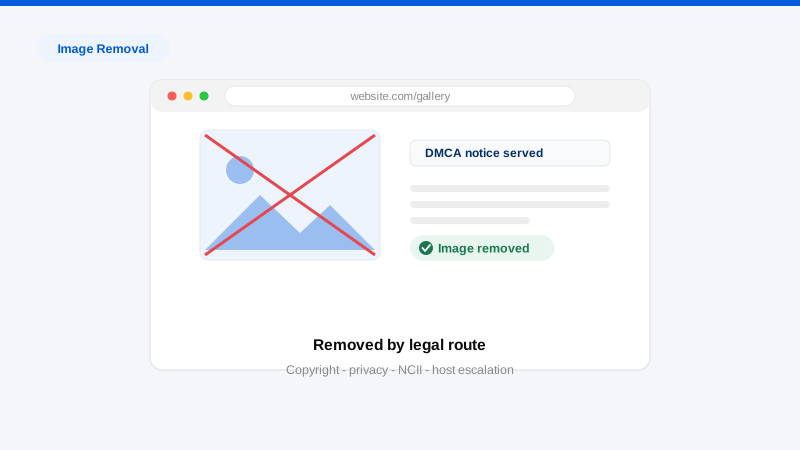
To remove a picture from a website legally, you match the image to the right legal basis and send the demand to the right party. There are four main routes: copyright (you or someone assignable to you took the photo, the strongest and fastest route via a DMCA notice), privacy and likeness rights (the image exposes private facts or exploits your identity commercially), non-consensual intimate image (NCII) laws (criminal and civil remedies in nearly every U.S. state, plus dedicated platform channels), and terms-of-service enforcement (the site’s own rules prohibit the content). Most successful removals use the strongest available route first and escalate from publisher to host to search engine.
Route selection is the whole game. The most common mistake we see is arguing “I don’t like this photo of me”, which has no legal force, when the same person holds an ironclad copyright claim they never thought to use.
Which legal grounds qualify for image removal?
Copyright: the workhorse. Copyright belongs to whoever took the photograph, not whoever appears in it. If you took the image (a selfie counts), or you can get the photographer to assign rights or send the notice, the DMCA gives you a formal takedown mechanism that hosts must honor to keep their liability protection. This covers a huge share of real cases: stolen profile photos, scraped product images, reposted personal pictures. Note the flip side: if someone else took an unflattering photo of you, copyright belongs to them, and you need a different route.
Privacy and likeness rights. State laws vary, but recognized claims include public disclosure of private facts, intrusion, and misappropriation of likeness. The last one is particularly effective when your image is used in advertising or to endorse something without consent. False-light and defamation claims apply when an image plus caption conveys a false impression; our defamation removal practice handles that overlap, and our defamation case study shows how documented falsity resolves cases platforms initially ignore.
NCII laws. Intimate images shared without consent are unlawful nearly everywhere in the U.S., and federal law now requires covered platforms to operate rapid takedown processes for reported NCII. These cases move fastest of all image matters because every major platform and host has a dedicated channel. If this is your situation, our revenge porn team handles it with urgency and discretion. See the revenge porn case study for how these engagements run.
Terms-of-service violations. Even without a legal claim, most platforms prohibit harassment, impersonation, and posting others’ personal images. A TOS report costs nothing and often works, but it’s discretionary, which is why it’s the supplement, not the strategy.
What generally does not qualify: unflattering but non-private photos taken in public, images attached to legitimate news reporting, and photos you consented to at the time. For those, de-indexing and suppression are the honest tools. See removing images from Google.
The step-by-step removal process
- Preserve evidence first. Screenshot the page, capture the URL and date, and save the image file. If matters escalate legally, you’ll need proof of publication.
- Establish your strongest basis. Who took the photo? Is it intimate? Is it being used commercially? Does it reveal private information? Rank your claims; lead with copyright or NCII when available.
- Identify the publisher and the host. A WHOIS lookup and the site’s own DMCA/abuse pages tell you who to serve. Many harmful sites hide ownership but still have identifiable hosts and CDNs that accept notices.
- Send the right instrument to the publisher. For copyright: a complete DMCA notice: identification of the work, the infringing URL, a good-faith statement, an accuracy statement under penalty of perjury, and your signature. Accuracy matters: knowingly false DMCA claims carry liability, which is why “just DMCA everything” is bad advice. For privacy/NCII/TOS: a demand or report citing the specific law or policy. Our DMCA takedown service drafts and serves these correctly.
- Escalate to the host. If the publisher ignores you, serve the hosting provider’s designated agent. Hosts remove infringing and unlawful content routinely because their safe-harbor protection depends on it.
- De-index in parallel. Google removes NCII, personal-financial data, and (for minors and other qualifying categories) personal images under its own policies, and processes DMCA notices against search results. This doesn’t delete the source but removes its audience while you work the source.
- Monitor for re-uploads. Removed images reappear: scrapers, mirrors, forum reposts. Reverse-image monitoring catches copies early, when takedowns are fastest. This is the core of our image theft protection service, and the broader cleanup lives under erase online images.
Get a Free, Confidential Exposure Scan
Honest timelines and success expectations
DMCA takedowns at cooperative U.S. hosts typically complete in two days to two weeks. NCII removals on major platforms often process within days. Privacy and likeness demands run weeks, since they depend on persuasion or counsel rather than a statutory mechanism. Offshore hosts, imageboards, and sites built on ignoring notices take longer and sometimes require CDN-level, registrar-level, or search-level pressure instead of source removal.
Realistic expectations: copyright and NCII cases succeed at high rates; privacy-based demands succeed often but not reliably; public-interest and news imagery rarely comes down and no honest practitioner promises otherwise, and a legal disclosure: we are a content removal firm, not a law firm, for litigation or formal legal advice, retain counsel; we regularly work alongside our clients’ attorneys.
Frequently asked questions
Can I remove a picture of me if someone else took it?
Not through copyright: the photographer owns that. Your levers are privacy law (private facts, intimate images), likeness/misappropriation if it’s used commercially, platform TOS reports, and negotiation with the poster. One practical shortcut: photographers will often assign rights or send the DMCA notice themselves if you ask.
Is it legal to send a DMCA notice myself?
Yes: the DMCA is designed for rights holders to use directly. But notices must be complete and truthful: the statements are made under penalty of perjury, and knowingly misrepresenting a claim creates liability. Incomplete or overreaching notices are also simply ignored, which is why professionally drafted notices clear faster.
The website has no contact information. Now what?
Go up the stack. Identify the host through WHOIS and DNS records and serve its abuse or DMCA agent; if the host is unresponsive or offshore, CDN providers, domain registrars, and search engines each offer pressure points. Sites that seem untouchable usually depend on at least one U.S.-reachable service provider.
Can I force Google to remove a picture from search results?
For qualifying categories, yes: NCII, images of minors, personal-financial data, and copyright-infringing results all have removal processes, and de-indexing removes nearly all of an image’s audience even though the source file remains. For non-qualifying images, source removal followed by a refresh request is the path, details in our remove images from Google guide.
What if the image keeps getting re-uploaded?
Treat it as a monitoring problem, not a one-time removal. Reverse-image scanning plus rapid repeat notices keeps re-uploads short-lived, and hosts ban repeat infringers when notices are consistent. This ongoing coverage is exactly what our image theft protection and Protection Plans are built for.
If an image is hurting you, the first step is a precise map of every copy and the strongest legal route for each. Request a free, confidential Exposure Scan and see how our process works. You’ll know what’s removable, how, and how fast before spending anything.