
A YouTube video removal request succeeds on classification. YouTube runs separate tracks for copyright, privacy, harassment, impersonation and other legal complaints, each with its own evidence standard. Preserve the video URL, channel, title, description and comments first, choose the ground YouTube can verify fastest, then file a short factual request with proof that matches that single violation.
Key facts
- YouTube received copyright removal requests for over 16 million videos in 2022, with automated review before takedown.
- YouTube Studio offers a scheduled copyright takedown that gives the uploader time to remove content before a strike.
- Defamation usually needs legal substantiation beyond a platform form, privacy is often the stronger route for exposure.
- In one reported quarter, 22% of appealed removals were reinstated, though appeals were 1.9% of removals.
Where ContentRemoval.com comes in. ContentRemoval.com selects the removal ground before anything is filed, builds the evidence record and manages the dispute afterward, including counter-notices, re-uploads on affiliated channels and copies spreading to other sites and search results. Counsel, a communications lead or the person’s chief of staff usually brings us in. A free 15-minute Exposure Scan maps the video, its copies and the viable route for each, and the report is yours to keep. Get a Free, Confidential Exposure Scan or read how our YouTube content removal work is done.
A damaging YouTube video rarely arrives at a convenient moment. It appears before a board meeting, during fundraising, in the middle of a divorce, after a termination, or just as a journalist starts asking questions. The first instinct is to report it immediately. That instinct is understandable. It’s also how people waste precious time.
A YouTube video removal request succeeds or fails before you ever touch a form. The decisive issue is classification. If you call a privacy problem a copyright problem, or a defamation problem a harassment problem, you push your case into the wrong workflow and invite rejection. YouTube doesn’t operate as a general complaints desk. It runs separate removal tracks, each with its own standards, evidence burden, and escalation logic.
That distinction matters because the platform handles removal at extraordinary scale. YouTube received copyright removal requests for over 16 million videos in 2022, and its system includes automated review before takedown is finalized, according to YouTube’s copyright removal help documentation. Reviewers and systems don’t reward emotion. They reward fit, clarity, and documentation.
The right way to approach this is clinical. Identify the legal basis. Preserve the evidence before the uploader edits or deletes anything. Draft a narrow, fact-heavy request. Choose the enforcement path that matches your actual objective, whether that’s quiet compliance, rapid removal, or groundwork for escalation if the uploader fights back.
Practical rule: Panic creates bad filings. Precision creates leverage.
If you’re dealing with a video that threatens your reputation, your family’s privacy, or your company’s value, treat the matter like a live dispute file, not a customer service complaint. That mindset changes everything. It changes what you collect, what you say, what you omit, and what you do next if YouTube rejects or delays the request.
Introduction A Framework for Control
Most clients arrive with the same question: “How do I get this taken down?” That’s the wrong first question. The better question is: What exactly is this video violating, and what proof will YouTube accept for that specific violation?
That sounds technical because it is. YouTube separates copyright, privacy, and other legal complaints for a reason. Each path is designed for a different kind of harm. A rushed filing can lock you into weeks of avoidable delay, especially if you submit under the most convenient category instead of the most defensible one.
Stop reacting and start triaging
Start with three immediate actions.
- Freeze the evidence. Save the video URL, channel URL, title, description, visible comments, and screenshots showing the video in context.
- Define the harm precisely. Is the problem stolen footage, exposure of private identity, false factual accusations, impersonation, or targeted abuse?
- Decide your outcome. Do you want quiet removal, a copyright strike, preservation for litigation, or a record that supports broader platform action?
That third point is where inexperienced filers make costly mistakes. If your goal is de-escalation, you may choose a notice path that gives the uploader a chance to remove the content. If your goal is strong enforcement, your filing should reflect that from the start.
Why legal fit matters more than speed
A YouTube reviewer isn’t evaluating whether a video feels unfair. They’re evaluating whether your submission satisfies the platform’s standard for the lane you chose. If you submit a copyright complaint about a video that mainly harms you through false statements, don’t be surprised when the request goes nowhere.
A removal request is strongest when the legal theory and the evidence point to the same conclusion without any interpretation gap.
You also need discipline in how you write. Don’t flood the form with every grievance you have against the uploader. Don’t narrate the relationship history. Don’t explain how stressed you are. State the violation, identify the exact material at issue, and attach proof that directly supports that claim.
The framework I use with high-risk clients
When a matter is urgent, I reduce it to four decisions:
| Decision | What you need to determine | Why it matters |
|---|---|---|
| Ground | Copyright, privacy, harassment, impersonation, defamation, or another legal route | This determines the workflow |
| Evidence | What documents, originals, IDs, timestamps, or archives you can produce | This determines credibility |
| Enforcement posture | Scheduled notice or immediate pressure, where available | This shapes the response |
| Escalation path | Counter-notice, repeat uploads, legal follow-up, wider monitoring | This protects the result |
Control starts when you stop asking, “Where’s the report button?” and start asking, “What case am I making?”
Choosing Your Grounds for Removal
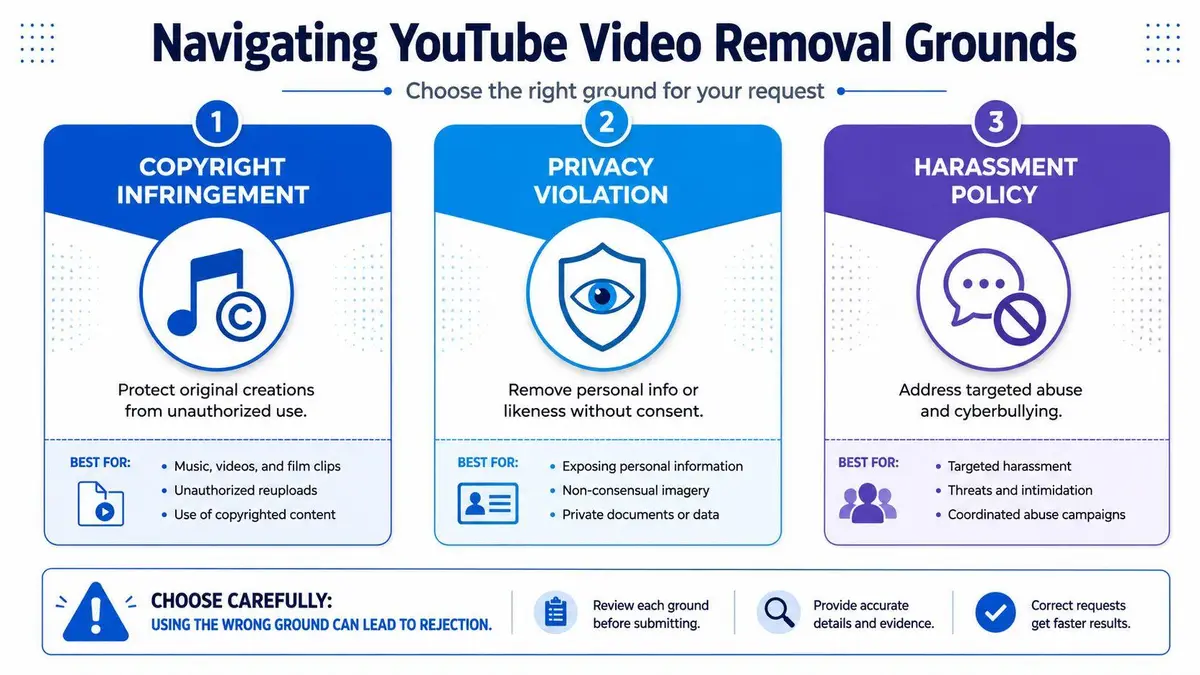
The strategic mistake I see most often is miscategorization. People assume YouTube will sort it out for them. It won’t. YouTube’s own help materials distinguish copyright removal from other legal processes and make clear that the right route depends on whether the harm is reputational, privacy-related, or IP-related. That’s not academic. In 2025, over 6% of videos requested for removal through the public webform were flagged as abusive copyright removal requests, according to YouTube’s legal and copyright guidance. Wrongly labeling your complaint can make you look careless or abusive.
The categories that actually matter
Copyright infringement is the cleanest route when the uploader used your original video, audio, imagery, or other protected material without authorization. It’s structured, formal, and usually the most predictable path if ownership is clear. If your issue involves copied footage or unauthorized extracts, review a more detailed copyright infringement removal process. Rights holders dealing with monetization leakage should also find Content ID royalty gaps, because missing revenue and removal strategy often overlap.
Privacy violation fits when the video exposes your likeness, personal information, or private circumstances without consent. This route works best when you can show you are identifiable and explain why the content intrudes on privacy in a concrete way. The strongest privacy complaints are specific. They identify what appears on screen, why it’s private, and why the publication causes real-world risk.
Harassment and cyberbullying is narrower than many people think. Being insulted isn’t enough on its own. You need to show targeted abuse, malicious conduct, or content designed to humiliate, threaten, or incite mistreatment. This is one of the more subjective routes, which means your documentation needs to be organized and contextual.
The harder categories
Defamation creates the most confusion. Clients often say, “The video is full of lies, so YouTube has to remove it.” That’s not how this usually works. Defamation often requires stronger legal substantiation than a platform form can provide, and many matters move more effectively through formal legal pressure or court-backed process rather than a standard complaint lane.
Impersonation is different. If a channel is posing as you, your executive team, or your brand in a way that misleads viewers, this route can be useful. The core issue is deception. You need side-by-side proof showing the account is presenting itself as you or as an authorized representative when it is not.
YouTube removal grounds at a glance
| Ground | Best For | Key Requirement | Strategic Note |
|---|---|---|---|
| Copyright | Stolen video, audio, clips, or images | Proof you own or control the original work | Best when ownership is clean and documented |
| Privacy | Personal likeness or information used without consent | Proof of identity and a clear privacy interest | Stronger than defamation when the harm is exposure |
| Harassment | Targeted abuse or humiliation | Pattern, targeting, and harmful context | Weak if you only show isolated criticism |
| Defamation | False factual claims damaging reputation | Evidence of falsity, often legal support | Usually not ideal as a first self-service filing |
| Impersonation | Fake channels or deceptive identity use | Proof of your real identity or brand authority | Valuable when audience confusion is obvious |
Choose the ground that YouTube can verify fastest, not the one that best captures your outrage.
Executing the Removal Request Process
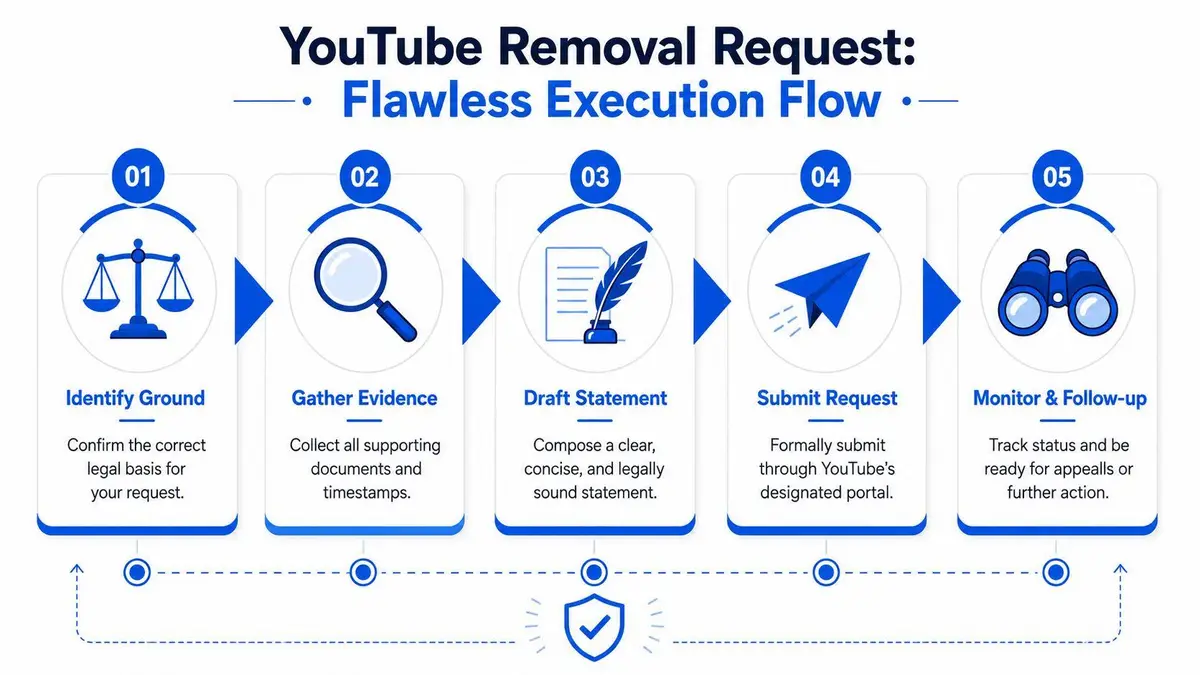
Once you have chosen the right ground, filing becomes an exercise in control. A weak submission under the right category still fails. A disciplined submission under the right category gives YouTube a clean reason to act.
Use the platform workflow properly
For copyright complaints, use YouTube Studio’s formal removal path and choose your remedy carefully. YouTube allows a scheduled request that gives the uploader time to remove the content before a strike is issued, as explained in YouTube Studio’s copyright takedown options. That choice is strategic, not administrative.
The filing steps themselves are straightforward. Open the copyright tools in YouTube Studio, identify the infringing video, select the removal option, and submit a written claim supported by documents YouTube can verify quickly. The mechanics are simple, but the quality of your submission determines the outcome.
If you chose privacy, impersonation, or harassment as your ground, stay inside that lane. Do not turn a privacy request into a general rant about reputational harm. Do not bury the actionable violation under emotional background. Review teams look for a policy or legal trigger they can confirm fast.
Draft like counsel, not like a complainant
Your statement should be short, factual, and built around proof. Use a structure like this:
- Identify the right at issue: “I own the original footage appearing at timestamps X to Y.”
- Name the violation clearly: “This upload reproduces that footage without authorization.”
- Point to verifying evidence: “The original publication appears at [your source], with matching timestamp comparisons attached.”
- State the requested action: “I request removal through YouTube’s copyright takedown process.”
Keep adjectives out of it. Keep threats out of it. Keep unrelated accusations out of it.
If the same video, clip, or allegations are spreading beyond YouTube, pair the platform filing with a broader strategy for removing videos from other websites. That prevents you from winning one platform battle while losing control of the wider distribution problem.
Scheduled notice or immediate removal
This is the decision many people get wrong.
A scheduled takedown works best when the uploader is likely to comply, when you want the content down without provoking a larger dispute, or when preserving a lower-conflict record matters. It can solve the problem discreetly.
Immediate removal is the right call when the video is causing active harm, the uploader has shown hostile intent, or delay gives the content more time to spread. It is more aggressive, and sometimes that is exactly what the situation requires.
Assume an antagonistic uploader may re-upload, edit the video, shift it to another channel, or file a counter-notification. Choose your filing posture with that risk in mind.
For repeat offenders, account-level consequences can influence strategy. The Electronic Frontier Foundation’s explanation of YouTube’s copyright strike system outlines why a formal takedown can carry broader pressure than a polite request. Sometimes a quiet cure is enough. Sometimes you want the strike on record.
Assembling and Preserving Critical Evidence
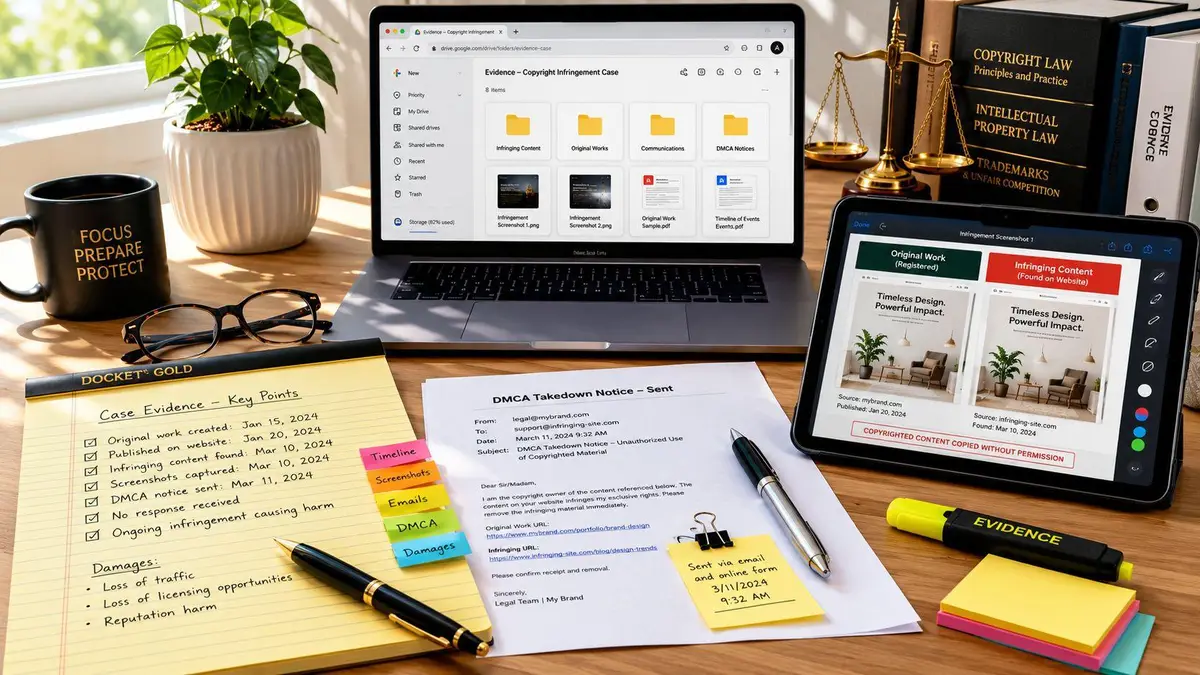
Weak evidence ruins strong claims. That’s true in legal disputes generally, and it’s especially true on YouTube where the uploader can change titles, alter descriptions, trim footage, or delete the video once they sense pressure.
Build a proper case file before filing
For copyright, collect the original source file, publication links, drafts if needed, and timestamp comparisons showing the overlap. If the original work was licensed under limited terms, keep the agreement ready. If another party owns the work and you control enforcement, preserve the authorization documents that let you act.
For privacy claims, identify the exact frames where you appear, the personal data shown, and the reason the content violates your privacy. If identity verification is required, prepare it carefully and redact anything not necessary for the complaint. Precision matters more than volume.
For defamation-related disputes, separate opinion from fact. Mark the exact statements you say are false. Pair each with documentary proof of falsity. If the harm involves business allegations, preserve contracts, letters, public records, or internal documents that directly rebut the claim.
Preserve the disappearing context
The video itself is only part of the file. Capture the surrounding page and channel environment.
- Archive the video page: Save dated screenshots of the title, thumbnail, description, and visible engagement context.
- Record all URLs: Keep the video URL, channel URL, any playlist URL, and links to mirrored uploads.
- Capture timestamps: Note the exact moments where the violating material appears.
- Save visible comments: Comments can prove audience confusion, targeted harassment, or reputational harm.
- Store version history: If the uploader edits the video or title, preserve each change you observe.
That diligence protects you if the uploader claims the material never appeared, edits the most damaging portion after notice, or moves the same content to another account.
Keep evidence usable for escalation
A clean evidence file isn’t just for YouTube. It supports follow-up with counsel, investigators, employers, investors, or other platforms if the matter expands.
The simplest discipline is to keep one folder with dated subfolders, one timeline document, and one master index of links and screenshots. That sounds mundane. It isn’t. In a disputed removal case, organization often determines whether your next move is fast and credible or slow and chaotic.
A useful walkthrough of evidence thinking appears below.
> Good evidence does two jobs. It proves what happened, and it proves it before the uploader had a chance to rewrite the record.The Aftermath Timelines Appeals and Monitoring
Submitting the request gives people false comfort. They think the matter is now in YouTube’s hands. That’s a mistake. The period after filing is when you need the most discipline, because outcomes can change and hostile uploaders rarely stop at one post.
In one quarter reported by YouTube and covered by Tubefilter, users appealed 109,000 removal decisions and 24,000 videos were reinstated, a 22% reinstatement rate. But appeals were still only 1.9% of the 5.9 million videos removed in that period, which shows reversals happen but remain uncommon. The same reporting noted 2.1 million channels were removed in that quarter, with 89.1% tied to spam, underscoring how industrial YouTube’s enforcement environment is. See Tubefilter’s summary of YouTube appeal and reinstatement data.

What to expect after submission
For straightforward matters, platform action may arrive relatively quickly. For legally dense cases, the process can take longer and may involve silence while the case sits in review. Don’t confuse silence with rejection. But don’t confuse submission with resolution either.
Your job after filing is to monitor four things:
| Watchpoint | Why it matters |
|---|---|
| Video status | Removal, partial edit, reinstatement, or no action |
| Uploader response | Counter-notice, public retaliation, or migration to another channel |
| Re-uploads | Same content often returns under altered titles or cropped edits |
| Search visibility | Even after source removal, cached mentions or embedded copies may remain |
The right posture after a takedown
If the video comes down, preserve proof that it was removed. Then continue watching for copies. A determined actor often tests variations such as mirrored clips, shortened excerpts, title changes, or uploads through affiliated accounts.
If the uploader appeals or counters, treat that as a second-stage dispute, not an administrative annoyance. Re-check your original file immediately. Confirm that ownership, privacy basis, or factual support remains intact. If there’s any weakness, fix the larger strategy before you answer.
A takedown is an event. Reputation defense is a system.
That system includes ongoing searches, image and video matching where available, review of related channels, and broader monitoring beyond YouTube if the dispute has public attention. Clients who stop at the first removal often end up back in the same crisis a week later.
When to Engage Professional Removal Specialists
A bad specialist can make a bad video harder to remove.
Clients often call after they have already filed three weak requests under the wrong theory, alerted the uploader, and created a paper trail that undercuts the stronger claim they should have used first. That is the true reason to bring in help early. The value is not clerical. It is strategic judgment before the next move locks you into a weaker position.
Cases that should not stay DIY
Bring in specialists when you cannot state the exact removal ground in one clean sentence. If the video mixes copyright infringement, false allegations, harassment, private information, and impersonation, you are no longer dealing with a simple platform form. You are choosing the theory that will control the evidence standard, the wording of the request, the chance of escalation, and the risk of a counter-response.
Professional help is warranted when:
- The basis for removal is unclear: You know the video is harmful, but you have not pinned down whether the strongest path is privacy, copyright, impersonation, harassment, or another claim.
- The issue extends beyond YouTube: The same content appears across channels, websites, forums, or search results.
- The uploader is organized or persistent: Anonymous operators, repeat uploaders, and coordinated campaigns require more than one filing.
- The stakes are personal or commercial: Executives, family offices, founders, and public figures often need discretion, speed, and disciplined handling.
- A failed first attempt will hurt you: Pending deals, litigation, media scrutiny, employment issues, and custody disputes leave little room for sloppy submissions.
What a specialist actually changes
A serious removal team improves the outcome in three ways.
First, it selects the right ground before filing. That is the decision many self-managed cases get wrong. A weak privacy claim can damage a strong impersonation claim. A rushed copyright notice can trigger avoidable resistance if ownership is not documented cleanly. The form is not the strategy.
Second, it builds the record properly. That means preserving the video, channel details, timestamps, comments, account identifiers, and off-platform spread in a format that supports the chosen claim instead of muddying it.
Third, it manages the dispute after submission. That includes escalation, response planning, and containment if the uploader reposts, counters, or tries to expand the attack.
I recommend reviewing this guide for evaluating professional content removal services before you hire anyone. Look for legal judgment, disciplined process, and discretion. Avoid firms that sell confidence without explaining how they choose the removal basis.
One option in this category is ContentRemoval.com, which works on source removal, search result suppression, impersonation, leaked content, and platform takedowns across YouTube and other online channels. That broader scope matters because the video itself is often only one part of the problem.
My blunt recommendation
Hire help the moment the case stops being obvious.
If the video threatens your income, financing, family, licensing, or litigation position, do not test theories by trial and error. File it yourself only when the legal ground is clear, the proof is clean, and you are prepared for a counter-notice or repost campaign. If any of those conditions is missing, escalate fast. Early expert intervention usually costs less than repairing a weak filing strategy after the uploader has been alerted.
If you need a discreet, high-urgency plan for a YouTube video removal request, contact ContentRemoval.com for a confidential assessment. We’ll help you identify the correct legal basis, preserve the evidence properly, and decide whether the matter calls for platform action, search result suppression, or a broader reputation defense strategy.
Frequently asked questions
Which removal ground should I pick for a YouTube video about me?
The one YouTube can verify fastest with your evidence, not the one that best captures your outrage. Copyright fits stolen footage with clean ownership, privacy fits your likeness or personal data used without consent, impersonation fits a channel posing as you, and defamation usually needs legal support rather than a self-service form.
Should I use YouTube’s scheduled takedown or immediate removal?
Scheduled notice suits an uploader likely to comply when you want the content gone without provoking a wider dispute. Immediate removal suits active harm, hostile intent or a situation where delay lets the video spread. Either way, assume the uploader may re-upload, edit or file a counter-notification.
What happens after I submit a YouTube removal request?
Watch four things: the video’s status, the uploader’s response, re-uploads under altered titles or cropped edits, and search visibility including embeds and cached mentions. If the uploader counters, re-check your original evidence before replying, and if the video comes down, preserve proof and keep monitoring for copies.