
Reputation management for tour operators and travel agencies is the discipline of controlling what prospective travelers find when they search an operator’s name, and removing the hostile content that converts research into abandonment. No businesses live more completely inside their search results than tour operators, DMCs, travel agencies, safari and expedition companies, and group-travel brands. The product is intangible, prepaid, and consumed far from home; the entire purchase decision rests on trust established through a screen. When a traveler searches “[operator] reviews” or “is [operator] legit,” the results page is the storefront, the salesperson, and the closing argument all at once.
That dependence creates a uniquely brutal exposure profile. A single trip-gone-wrong story told vividly enough can outrank years of flawless operations. A TripAdvisor attack (one determined reviewer, or a coordinated handful) can reset a decade-old rating in a week. A “scam” thread posted during booking season can erase the exact bookings that carry the operator through the year, and because most tour operators are small relative to the platforms that host their reputations, the damage is asymmetric: the operator has no leverage, no visibility into the process, and no margin for a lost season.
This guide defines the threat landscape for tour operators and travel agencies, explains the mechanisms by which hostile content destroys booking flow, and describes what professional, removal-first protection looks like. It is deliberately not a how-to, removal is precision work where clumsy attempts entrench the content they target, but a map of the terrain, written for owners and executives deciding how to protect the season.
Why tour operators and travel agencies are targeted
Tour operators absorb hostile content through channels built into the structure of the business.
Trip-gone-wrong virality. Travel failure is the internet’s favorite story genre: high emotion, vivid detail, a villain, and a lesson. When a trip goes wrong (a missed connection cascade, a substituted hotel, a guide dispute, a weather cancellation, a medical evacuation) the traveler’s account is inherently compelling content, and platforms reward it. A single long-form post on Reddit, a TikTok series, or a Facebook-group warning can be shared into every travel community where the operator’s future customers research. The operator’s side (contracts, force majeure, the refund actually paid) never travels with the story.
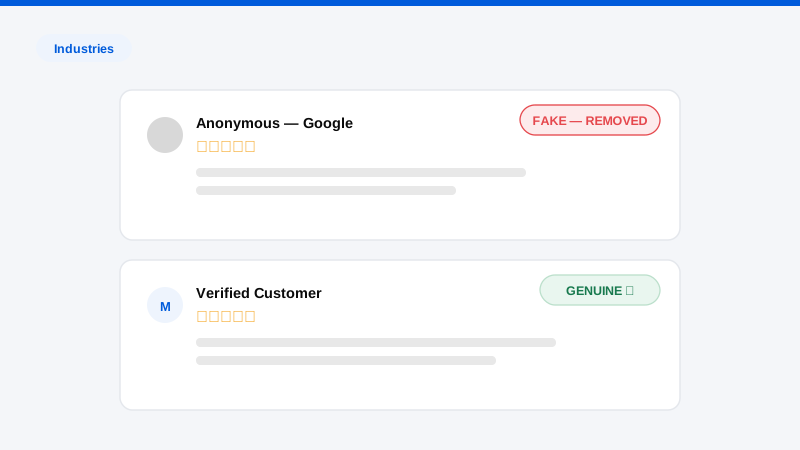
TripAdvisor and review-platform attacks. For tour operators, a review profile is not marketing collateral; it is the balance sheet of trust the entire business draws against. That concentration makes it a target. Hostile reviews arrive from travelers with inflated grievances, from serial complainants leveraging for refunds, from competitors in crowded destination markets, from terminated guides and agents, and occasionally in coordinated floods after a dispute goes viral. Because prospective travelers read the worst reviews first, a small number of hostile entries reshapes conversion even when the average holds. Identifying the removable portion (policy-violating, fabricated, conflicted, or coordinated reviews) is the core of professional review removal, and it is evidence work, not complaint-form work.
“Is [operator] legit” searches. Every unfamiliar travel brand triggers the same pre-purchase query family: “is [operator] legit,” “[operator] scam,” “[operator] complaints.” These queries exist whether or not any negative content does, travelers type them by default, and whatever content answers them inherits the booking decision. A five-year-old forum thread, a single ripoff-report entry, or an unresolved complaint-board listing can sit as the standing answer to the exact question every new customer asks. This is the most consequential search real estate in the industry, and most operators have never once checked what occupies it.
Refund-dispute and chargeback content. Tours are prepaid and cancellation terms are complex, so refund disputes are endemic, and refund disputes produce durable content: complaint-board entries, consumer-advocacy threads, warning posts in destination Facebook groups. These items rank hard for “[operator] refund” and feed directly into the “legit” query family, long after the underlying dispute is resolved.
Seasonal timing amplification. Tour-operator damage is not evenly distributed across the calendar. Hostile content that surfaces during booking windows, when the year’s revenue is being decided, does multiples of the harm the same content would do off-season. Adversaries know this; disputes and attacks cluster exactly when operators can least afford them, and a threat that would be an annoyance in the shoulder season becomes existential in January.
Key takeaway: Tour operators are targeted where they are structurally weakest: on platforms they do not control, through query patterns travelers run by default, at the precise moments of the calendar when the damage converts directly into a lost season.
What’s at stake when the results page turns hostile
For tour operators, hostile content does not damage the brand in the abstract. It interrupts the booking sequence at specific, observable points.
Conversion interception at the moment of doubt. Travel purchases follow a research ritual: discovery, brand search, review check, “legit” check, purchase. Hostile content positioned anywhere in that sequence intercepts the traveler at peak hesitation, when they are actively seeking a reason not to send money to a company they have never met, for a trip they cannot inspect, in a place they have never been. Unlike a storefront business, a tour operator gets no second chance at a walk-by; the abandoned search is silent and permanent.
Season-scale revenue loss. Because bookings concentrate in windows, a hostile item ranking during those windows taxes every campaign, every referral, and every repeat-customer recommendation simultaneously. Operators feel it as unexplained softness, inquiries that stop converting, and often discover the cause months later, when the season is already lost.
Partner and trade diligence. Tour operators live in networks: tourism boards, DMC partnerships, hotel allotments, consortia memberships, insurance and bonding relationships, OTA listings. Partners run diligence, and unresolved “scam” content or complaint patterns quietly costs allotments, listings, and invitations the operator never knows it was considered for.
Review-platform dependence risk. When a platform rating drops (through attack, flood, or dispute) the damage propagates everywhere that rating syndicates: search snippets, OTA displays, map listings. An operator’s most valuable asset sits on infrastructure it does not control, governed by policies it has never read, adjudicated by processes it cannot see. Professional removal work is, in large part, the discipline of operating those processes expertly on the operator’s behalf.
AI-assistant answers. Travelers increasingly ask AI assistants directly: “Is [operator] trustworthy? What do reviews say?” The assistants synthesize whatever the index holds (the viral thread, the complaint-board entry, the attack reviews) into a confident verdict delivered before the traveler ever reaches the operator’s site. Content that is removed exits those verdicts; content merely outranked often does not, which is why AI reputation protection now belongs in every operator’s program.
See what travelers and members find first.Free confidential Exposure Scan: live results on a 15-minute call, yours to keep either way.
Book Your Free ScanWhat professional reputation management for tour operators and travel agencies looks like
Professional reputation management for tour operators and travel agencies is removal-first, and in this industry, the distinction from the standard “ORM” package is stark. The standard package sells suppression: publish blog posts and press releases until the bad results slip to page two. For tour operators, suppression-as-strategy fails three ways at once. Review platforms and complaint boards carry more authority than anything a small operator can publish, so the burial rarely holds. The “legit” query family surfaces hostile content by topic, regardless of what ranks for the brand name. And AI assistants read the whole index, not just page one. Content that is removed is gone from all three surfaces. Content that is buried is waiting.
A professional engagement is built from these disciplines:
Booking-path exposure mapping. The audit replicates the traveler’s actual research ritual: brand queries, review platforms, the full “legit/scam/complaints/refund” family, destination forums and Facebook groups, complaint boards, video platforms, and AI-assistant outputs, for the operator’s brand, trade names, and key principals. Operators are consistently surprised: the content doing the most damage is usually not the content they knew about.
Evidence-backed review removal. Every major platform prohibits specific review categories: fabricated experiences, reviews from non-customers, undisclosed conflicts (competitors, former staff, agents), extortionate reviews tied to refund demands, and coordinated campaigns. Specialists document the violation (account forensics, timing patterns, booking-record cross-checks, extortion correspondence) and present cases through the platform escalation channels where they are genuinely evaluated. This is the craft at the center of the practice: the difference between a denied web-form report and a removed review is almost always the quality of the evidence file and the channel it enters through.
Defamation-pathway coordination. Fabricated trip narratives, false “scam” accusations, and invented safety claims often cross from opinion into provable falsehood. Defamation-based removal proceeds through demand strategy and, where warranted, court-order and de-indexing pathways, coordinated with the operator’s counsel. Content Removal is not a law firm and does not provide legal advice; our role is identifying which content supports a legal pathway, assembling the record, and executing removal and de-indexing once counsel acts.
Complaint-board and index remediation. Complaint-board entries and stale dispute content are addressed through the boards’ own resolution and removal mechanisms where available, followed by search-result remediation: clearing cached copies, stale snippets, and orphaned URLs so the “legit” query family reflects what actually remains rather than what once existed.
Season-aware monitoring. Because timing multiplies damage, continuous monitoring is calibrated to the operator’s calendar: heightened vigilance entering booking windows, rapid-response capacity standing by, and every new item assessed within hours, while it is one post with no replies, the moment quiet resolution is most achievable.
Reinforcement, in its proper place. Once removable content is removed, owned assets and legitimate review generation consolidate the results page. Suppression is the finishing step of a full reputation management program, never the substitute for removal it is so often sold as.
Key takeaway: For a tour operator, the strategic question is not “how do we look better than the complaint thread?” It is “does the complaint thread need to exist at all?” Removal-first work asks that question first, of every hostile item, and only then invests in what remains.
Why specialists outperform DIY and generic agencies
Most operators first fight hostile content themselves: replying to reviews, filing platform reports, posting rebuttals. The instinct is understandable and the results are reliably poor, for structural reasons.
Platform processes are opaque and precedent-driven. The web-form report an owner files enters a queue built to say no; the evidence-backed case a specialist files enters an escalation path built to evaluate. Knowing which policy fits, what evidence a given platform’s reviewers require, and how to appeal a wrongful denial is judgment accumulated across thousands of cases, and a failed amateur attempt creates a denial record that makes the professional case harder.
Public responses feed the content. An owner’s defensive reply bumps the thread, adds quotable material, and signals that attacks land. Review-gating and fake-positive schemes, the desperate operator’s temptation, violate platform policy and consumer-protection rules, and detection converts a review problem into a penalty problem. Specialists work through channels that resolve content without touching its engagement metrics or the operator’s standing.
And DIY sees only what it knows about. Owners fight the review they saw; the professional engagement begins by mapping the exposure they have never seen, the destination-forum thread from 2021, the complaint-board entry answering “is [operator] legit,” the AI summary quoting both.
See what travelers and members find first.Free confidential Exposure Scan: live results on a 15-minute call, yours to keep either way.
Book Your Free ScanWhy tour operators and travel agencies choose Content Removal
Content Removal LLC is a removal-first firm, and tour operators engage us because their problems are removal problems.
Review removal is a core practice, not a feature. Evidence-backed platform cases across TripAdvisor, Google, Trustpilot, and the OTA review ecosystems are daily work for our practitioners, the exact venues where operator damage concentrates. Anonymized accounts of this work, published only with client consent, appear in our case studies.
Season-aware engagement design. We scope and sequence work against the operator’s booking calendar, so the highest-impact items are addressed before the windows that decide the year, and monitoring intensity rises when the stakes do.
Honest scoping, no guaranteed outcomes. No ethical firm guarantees removals, and operators burned by vendors promising exactly that will find the opposite here: a pre-engagement classification of what is removable, what is remediable, and what must be contained and outweighed, so budget goes against reality. Our standards are covered in our press section.
Right-sized standing protection. Tour operators rarely need enterprise apparatus; they need vigilance and fast hands. Our Protection Plans deliver exactly that: continuous monitoring, season-calibrated alerting, and on-call removal capacity, so the attack review posted Friday night is being documented before Monday, not discovered in March when bookings go soft.
One firm for the whole surface. Reviews, forums, complaint boards, search snippets, AI answers, and the defamation cases that occasionally underlie them, one coordinated program, rather than a review vendor here and an SEO agency there with the real threats falling between.
Key takeaway: Operators choose Content Removal because we defend the thing their business actually runs on, the results page a stranger sees before sending money, with the one method that permanently changes it: legitimate removal, executed expertly, backed by standing watch.
Frequently asked questions
Can bad TripAdvisor reviews really be removed?
Some can: the ones that violate platform policy: fabricated experiences, non-customer reviews, undisclosed conflicts, extortion tied to refund demands, coordinated attacks. Authentic negative reviews from real travelers generally cannot be removed, and any vendor promising otherwise is selling fiction. The professional contribution is the evidence file and the channel: documenting the violation to the platform’s actual standard and presenting it where cases are genuinely evaluated. In attack and dispute scenarios, the removable portion is often larger than operators assume, but only an honest assessment, item by item, can say.
A “scam” thread about us ranks for our brand name. What are the options?
Threads are assessed on three tracks: platform-policy violations within the thread (false factual claims, personal data, conflicted authors, brigading), legal pathways where content is provably defamatory (coordinated with counsel), and index remediation for cached or syndicated copies. Where a thread survives all three, the strategy shifts to containment, resolving the visible dispute where possible, and consolidating the surrounding results so the thread loses its monopoly on the “legit” query. Which track applies is a case-by-case judgment; that judgment is the service.
How fast should we act when something hostile appears?
Within hours, ideally, speed is the largest controllable variable in this work. A hostile item in its first hours has one URL, no replies, no syndication, and no cached copies; every one of those facts changes within days, and each change narrows the removal options. This is the practical case for standing monitoring over episodic cleanups: the operators who fare best are the ones already watching when the post goes up, especially during booking season when the cost of a slow week is measured in departures.
We’re a small agency. Is professional protection overkill?
Small operators carry the most concentrated risk in the industry: thin search footprints where one hostile item owns the brand query, seasonal revenue where one bad window costs the year, and no in-house capacity to fight platform processes. Protection scaled to a small operator, baseline cleanup plus monitoring and on-call response, is modest infrastructure against the one event that small operators historically do not survive: a hostile item ranking through a booking season. The question is not whether the business can afford protection; it is whether it can absorb the season that protection exists to prevent.
Every tour operator’s next booking begins with a search the operator will never see, and the results page either closes the sale or quietly kills it. The free, confidential Exposure Scan shows you that page the way travelers, partners, and AI assistants see it: live results on a 15-minute call, findings yours to keep either way. Book it before the season does the audit for you.