
Reputation management for TV personalities and presenters is the practice of governing the permanent, searchable record that networks, producers, advertisers, and audiences consult before every contract renewal, casting decision, and brand deal, and removing or containing the content in that record that puts your on-air career at risk. Television talent occupies a unique position: your face is your brand, your likability is your product, and your employment is conditioned, often contractually, on the public’s continued goodwill. No other profession writes the audience’s opinion directly into the employment agreement.
That structure creates an exposure most presenters only understand after something goes wrong. A tabloid story from years ago, a social media pile-on that trended for an afternoon, a misquoted interview, a fabricated blind item, none of it expires. It sits in archives, ranks in search results for your name, and gets re-read by every executive who inherits your show, every advertiser reviewing the talent roster, and every AI assistant asked to summarize who you are. The story cycle ends; the record does not.
This guide defines the threat landscape for on-air talent, explains the mechanisms by which old and hostile content damages television careers, and describes what professional, removal-first protection looks like, and why it succeeds where publicists and personal effort structurally cannot.
Why TV personalities and presenters are targeted
On-air talent attracts hostile content through incentives that are built into the media economy itself.
Your name is traffic. Tabloids, gossip aggregators, and content farms monetize attention, and recognizable faces generate it reliably. A negative story about a known presenter outperforms a positive one, so the editorial incentive tilts negative by default. Once one outlet publishes, aggregators republish, and a single thin story becomes a dozen search results, each one an independent piece of content that must be addressed independently if it is ever to come down.
Parasocial audiences personalize everything. Viewers form one-sided relationships with the people on their screens. When a presenter says something an audience segment dislikes (a joke, an opinion, a perceived slight) the reaction is personal, emotional, and public. Social pile-ons form fast, generate quotable outrage, and get written up by the same outlets that monetize your name, converting a transient mood into permanent articles.
Your visibility invites fabrication. Blind items, anonymous forum threads, fake quotes, manipulated screenshots, and now AI-generated images and audio all target recognizable people because recognition is what gives fabricated content its reach. A fake story about an unknown person spreads nowhere; the same story about a morning-show host spreads everywhere.
Rivals and exes have a market for their claims. Television is competitive, contract-driven, and full of departures. Former colleagues, former partners, and former staff know that outlets will pay attention to claims about on-air talent. The mere existence of that market means accusations reach print that would never survive scrutiny in any other context.
The industry’s own vetting is continuous. Unlike most careers, where diligence happens at hiring, television talent is effectively re-vetted constantly, by networks at renewal, by producers at casting, by advertisers at every campaign, by PR teams before every appearance. Each vetting cycle is a fresh reading of your search results. Content that was survivable last season is re-evaluated every season.
What’s at stake
The consequences of unmanaged hostile content for on-air talent operate through concrete, career-defining mechanisms.
Morality clauses convert perception into contract risk. Most talent agreements include conduct or morality provisions that allow the network to suspend or terminate if the talent’s public standing threatens the program or its sponsors. Critically, these clauses are typically triggered by perception and publicity, not by proven facts. A sustained pile-on or a resurfaced tabloid story can create clause-relevant pressure regardless of underlying truth, because the contractual question is not “did this happen” but “is this person now a liability.” The searchable record is the evidence file in that internal conversation.
Advertisers price talent risk in silence. Sponsors and brand partners review talent before campaigns and during controversies. When search results for a presenter carry unresolved hostile content, the brand’s easiest decision is to choose different talent, no confrontation, no explanation, just a booking that goes elsewhere. Presenters experience this as a cooling pipeline and rarely learn the cause.
Tabloid archives function as permanent case files. A tabloid story does not need to be current to do damage; it needs only to rank. Archived stories resurface at exactly the wrong moments (a new show announcement, a contract negotiation, an awards campaign) because those are the moments people search your name in volume. The archive turns every career high point into a redistribution event for your worst coverage, and syndication means the same story may live on dozens of domains, each requiring its own removal or remediation effort.
Pile-ons leave sediment. The trending moment passes in days, but it leaves behind news write-ups, commentary videos, compilation threads, and “controversy explained” articles. This sediment is what future searchers actually find. A presenter can survive the storm and still lose to the sediment for years afterward.
AI systems compress your record into a verdict. Producers, journalists, and brand teams increasingly ask AI assistants about talent during preparation and vetting. These systems synthesize the entire searchable record (tabloid archives, pile-on sediment, forum speculation) into a fluent summary that reads as fact. If the record contains unresolved hostile content, the AI’s answer inherits it, and delivers it with unearned confidence to everyone who asks.
Key takeaway: Television careers are governed by clauses and decisions that respond to perception, not proof. The searchable record is where perception is manufactured, which makes governing that record a contractual survival issue, not a vanity project.
Networks and advertisers are reading your record. Read it the way they do.Get a free confidential Exposure Scan: live results walked through on a 15-minute call, and the full findings are yours regardless.
Book Your Free ScanWhat reputation management for TV personalities and presenters must govern
The exposure surface for on-air talent is broader than most presenters realize, because different audiences consult different layers of it.
Tabloid and aggregator archives. Original stories plus their syndicated copies, “throwback” rewrites, and photo-gallery repackagings. Volume is the weapon: one incident can occupy multiple first-page results.
Social sediment. Quote-tweet storms, compilation threads, subreddit archives, and reaction videos preserved long after the platform mood moved on.
Fabricated and manipulated content. Fake quotes attributed to you, doctored screenshots, AI-generated images and audio, and impersonation accounts, a category growing faster for on-screen talent than for any other profession, because your face and voice are abundantly available as raw material.
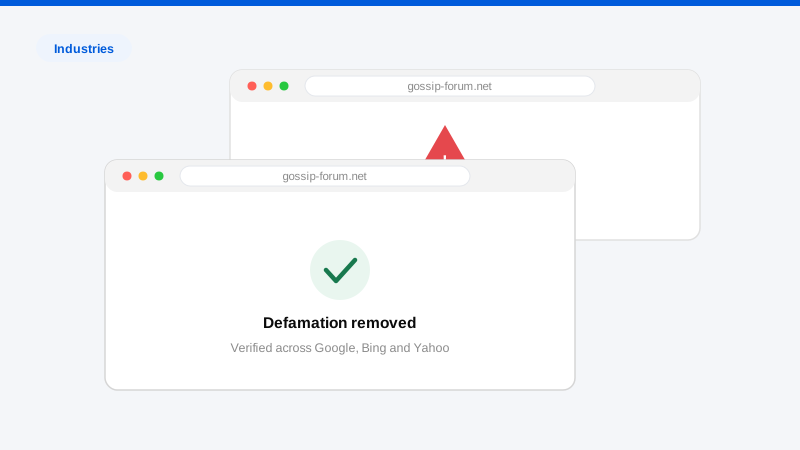
Defamatory publications. Blog posts, gossip-site entries, and forum accusations that cross from opinion into false statements of fact, the category where dedicated defamation removal work applies most directly.
Review and rating surfaces. Shows, podcasts, and live tours all carry review pages that can be brigaded by audiences angry at the presenter rather than the product.
The AI summary layer. What assistants say when asked “who is [your name]” and “has [your name] been involved in any controversies”, the newest layer, and the one consulted with the least skepticism.
A professional engagement audits all of these together, because your evaluators experience them together.
What professional protection looks like
Professional reputation management for TV personalities and presenters is removal-first, archive-aware, and continuous, because the record it protects is permanent and the vetting against it never stops.
A complete exposure audit before anything else. The work starts by building the same file a network’s standards team or an advertiser’s agency would build: every ranking result for your name, every archived story and its syndicated copies, the social sediment, the fabricated material, and the current AI answers. Presenters are consistently surprised by what this surfaces, not because the content is new, but because it never appeared in their own personalized searches.
Source-level removal wherever an avenue exists. Defamatory posts, policy-violating content, fabricated media, and impersonation accounts each have enforcement paths: platform policies, publisher standards processes, and search-engine remediation channels among them. Specialists know which claims each venue actually acts on, how to document violations in the language the venue’s own reviewers use, and how to escalate past the first refusal. This is the core distinction between professional removal work and hopeful form-filling.
Archive and syndication tracing. When a story has propagated, removal or remediation of the original is only the start. Professionals trace the syndication tree (copies, rewrites, aggregations) and pursue each node, because the search algorithm does not care which copy of the story it ranks.
Structured management of what cannot be removed. Legitimate press coverage of real events generally stays. There, disciplined record management governs the frame: ensuring the record that ranks is accurate, current, and proportionate, so a single bad season does not function as your permanent biography.
Continuous monitoring calibrated to broadcast rhythms. Attacks and resurfacings cluster around premieres, renewals, and appearances. Around-the-clock monitoring catches a forming pile-on, a fresh fabrication, or a resurrected archive story in its first hours, when quiet containment is still possible, instead of after it has re-entered the record.
Coordination with your existing team. On-air talent already has agents and publicists. Removal specialists do not replace them; we handle the layer they are not built for, making hostile content cease to exist, so that the publicity operation runs on clean ground. The strongest press strategy in the industry cannot outrank a record it refuses to clean.
Key takeaway: Publicists manage the story of the week. Removal specialists manage the record of your career. On-air talent needs both, and the record work has to come first, because everything the publicist builds sits on top of it.
The next contract conversation starts with a search.See what it finds before they do: free confidential Exposure Scan, live results on a 15-minute call, yours to keep either way.
Book Your Free ScanWhy DIY and PR alone fall short in reputation management for TV personalities and presenters
Presenters usually discover the limits of self-help and publicity at the worst possible moment, mid-crisis. The limits are structural.
Personal responses feed the machine. A presenter who engages a pile-on, corrects a tabloid on social media, or spars with an anonymous account is generating fresh, quotable content for the outlets that monetize their name. The response becomes the follow-up story. Trained restraint plus professional back-channel work removes content; visible fighting multiplies it.
Platform processes are opaque to outsiders. Removal outcomes turn on venue-specific policy knowledge, evidence framing, and escalation persistence. An individual filing a public report gets a templated denial; a specialist running a documented, policy-mapped submission through the correct channel gets a decision from someone empowered to make one. The gap between those outcomes is the profession.
Publicity cannot subtract. A publicist’s tools add content: interviews, profiles, placements. Against a defamatory post or a fabricated image, addition is not a remedy. The hostile item remains fully operative for every evaluator who finds it, and controversy consistently out-engages promotion. Worse, a publicity push increases search volume on your name, which redistributes the very content it was meant to bury.
Crisis-only engagement misses the window. The cheapest moment to remove content is early, before syndication, before sediment, before AI ingestion. Talent that only seeks help mid-crisis pays the compounding cost of every week the record went unmanaged. The presenters who fare best are under standing protection before anything happens.
Why TV personalities choose Content Removal
Content Removal LLC is a removal-first reputation firm, and on-air talent is a niche where that focus pays for itself. Presenters do not lack positive content. You are on television. What you lack is anyone whose actual job is to make the hostile content in your record cease to exist. That is our job, and it is all we do.
We handle the record, discreetly, end to end. Tabloid archive copies, defamatory posts, fabricated media, impersonation accounts, pile-on sediment, and AI answers are worked as one connected engagement, under strict confidentiality. Done properly, the work is invisible: no announcements, no visible disputes, no signal to attackers, just a record that gets cleaner.
We tell you the truth about each item. Some content can be removed; some can only be contained; legitimate coverage of real events generally stays. We are not a law firm, we do not promise outcomes, and we will not pretend an item is removable to win an engagement. What we commit to is complete knowledge of the avenues that exist and full-effort execution of every one of them, and we can show you how engagements have been structured for situations like yours.
We integrate with your representation. Agents, managers, publicists, and, where a matter requires it, your attorneys all stay in their lanes. We occupy the lane none of them are built for.
We stay on watch. Television careers are long, and the record is attacked repeatedly across them. Standing monitoring and rapid-response protection mean the next fabrication or resurfacing is met in hours, not discovered at renewal time.
Frequently asked questions
Can old tabloid stories really be addressed, or is the archive permanent?
It depends on the story. Content that is false, defamatory, or in violation of platform or publisher standards has removal and remediation avenues; syndicated copies can be traced and pursued individually; and search-level channels exist for certain categories of harmful content. Accurate coverage of real events is far harder to remove and usually is not. There, the work is about proportion and currency of the overall record. An exposure audit tells you which category each story falls into before you spend anything on the wrong approach.
My contract has a morality clause. How does reputation work interact with it?
Morality clauses respond to public perception, which means the searchable record is effectively the exhibit file in any clause conversation. Proactive removal and record management reduce the volume of material that could feed such a conversation, and monitoring gives you early warning when something new appears. To be clear: we are not a law firm and do not advise on contract interpretation. That is for your counsel. What we manage is the public record your counsel and your network will both be looking at.
A pile-on about me trended months ago. It died down, is the problem over?
The trend is over; the sediment usually is not. Pile-ons leave behind write-ups, compilation threads, and commentary videos that continue ranking for your name and feeding AI summaries long after the platform mood moved on. Whether that sediment is currently visible to your evaluators is an empirical question, exactly what an exposure scan answers. If it is, addressing it now is far cheaper than addressing it during your next contract cycle, when search volume on your name spikes.
Should my publicist just handle this?
Your publicist should handle publicity, and will do it better once the record is clean. Publicists add positive content; they have no mechanism for making a defamatory post, a fabricated image, or an archived hit piece cease to exist. Those are different crafts with different channels, evidence standards, and escalation paths. The presenters best protected are the ones whose publicist and removal firm work in sequence: subtract first, then add.
Every renewal, every casting call, and every brand deal in your future begins with someone searching your name, and the record they find is being written whether or not you manage it. Book a free, confidential Exposure Scan and see your record the way a network, an advertiser, or an AI assistant sees it. Fifteen minutes, live results, complete discretion, and the findings are yours to keep either way.