
Removing content from TikTok depends on who controls the post. Your own videos are deleted from the profile and sit in Recently Deleted for 30 days. Someone else’s content can only be reported under the matching policy lane: impersonation, copyright, harassment or intimate privacy. When reports fail or copies reappear, escalate with a DMCA notice or legal demand.
Key facts
- Deleted TikTok videos can be restored from Activity Center within 30 days; after that there is no official recovery.
- Impersonation reports succeed on side-by-side profile evidence showing a viewer would be misled.
- Copyright reports need the original file, first publication details and screenshots of the copied post.
- TikTok treats each upload as a separate enforcement decision, so document every copy individually.
Where ContentRemoval.com comes in. ContentRemoval.com works on TikTok matters where a single report will not hold: impersonation of an executive, leaked or intimate media, a false allegation spreading through stitches and reposts, or a clip that returns under new handles after every takedown. Public figures, creators and their managers or counsel usually make contact once the in-app report has been rejected. A free, confidential 15-minute Exposure Scan maps every copy and which are removable, and the report is yours to keep. Get a Free, Confidential Exposure Scan or read how our TikTok content removal work is done.
You’re usually searching for how to remove from TikTok when the problem is already active. A post went live that shouldn’t have. A fake account is using your name. A copied clip is circulating. Or someone has uploaded content that creates legal, reputational, or personal risk.
Treat TikTok removal as a response protocol, not a casual app setting. The platform gives you some direct controls, but those controls have narrow limits. If you use the wrong tool, file the wrong report category, or wait too long, you weaken your position.
For high-stakes situations, the right question isn’t only “how do I delete this?” It’s what can I remove myself, what requires a platform report, and when should I bypass standard reporting and escalate immediately?
Initial Containment Removing Your Own TikTok Content
If the video is on your account, act quickly and act methodically. Don’t delete first and think later. Preserve evidence, save a local copy if you may need it, then remove the post through TikTok’s native workflow.
Delete the post correctly
TikTok’s own interface is straightforward, but people still miss steps because they’re rushing. The operational sequence is: open the app, go to your profile, select the video, tap the three-dot icon, scroll the bottom row until you reach Delete, and confirm. Adobe’s walkthrough also notes that deleted videos move into a Recently Deleted state for 30 days, after which they’re permanently purged with a 0% recovery rate according to Adobe Express’s TikTok deletion guide.

That 30-day window matters because deletion on TikTok isn’t the same as immediate irreversible destruction. TikTok’s official support documentation says users can restore deleted posts from Activity Center in the Recently deleted section within 30 days, and once that period ends there’s no official restoration option through the platform’s own process in TikTok support’s deletion documentation.
Practical rule: Save first, delete second, verify third.
Before you hit delete, consider whether you need the original file for legal review, evidence preservation, or later reposting in edited form. Many users miss the chance to save a local copy because they act in panic. If privacy is your concern, review adjacent exposure points too. PostPulse’s guide to TikTok privacy is useful for tightening visibility settings around profile access, interactions, and account controls after the post is removed.
If the issue involves a harmful video already affecting your reputation, a broader video removal strategy should run in parallel with the in-app deletion. Removing the source post is only one part of containment.
Don’t confuse deletion with account strategy
Deleting a single post is different from deleting your account. One is surgical. The other is structural.
Use this decision rule:
| Action | Best use case | Main risk |
|---|---|---|
| Delete one video | Isolated mistake, outdated content, accidental upload | Copies may still exist elsewhere |
| Clean up several posts | Pattern of old material causing current exposure | You may remove evidence you later need |
| Delete account | Ongoing misuse, brand reset, personal exit | You lose control of the account history and audience relationship |
If you intend to remove the account itself, slow down. Account deletion is harder to unwind than deleting a post, and it doesn’t solve third-party reposts, impersonation, or search indexing issues by itself.
Verify the deletion path
After deleting, check Activity Center and confirm the video appears under Recently Deleted. That gives you a documented platform state. If the post isn’t there, don’t assume it’s fully gone. Recheck from another device and review your profile view.
A clean TikTok removal starts with precision. If the content is yours, the platform gives you control. If the content is someone else’s, the process changes completely.
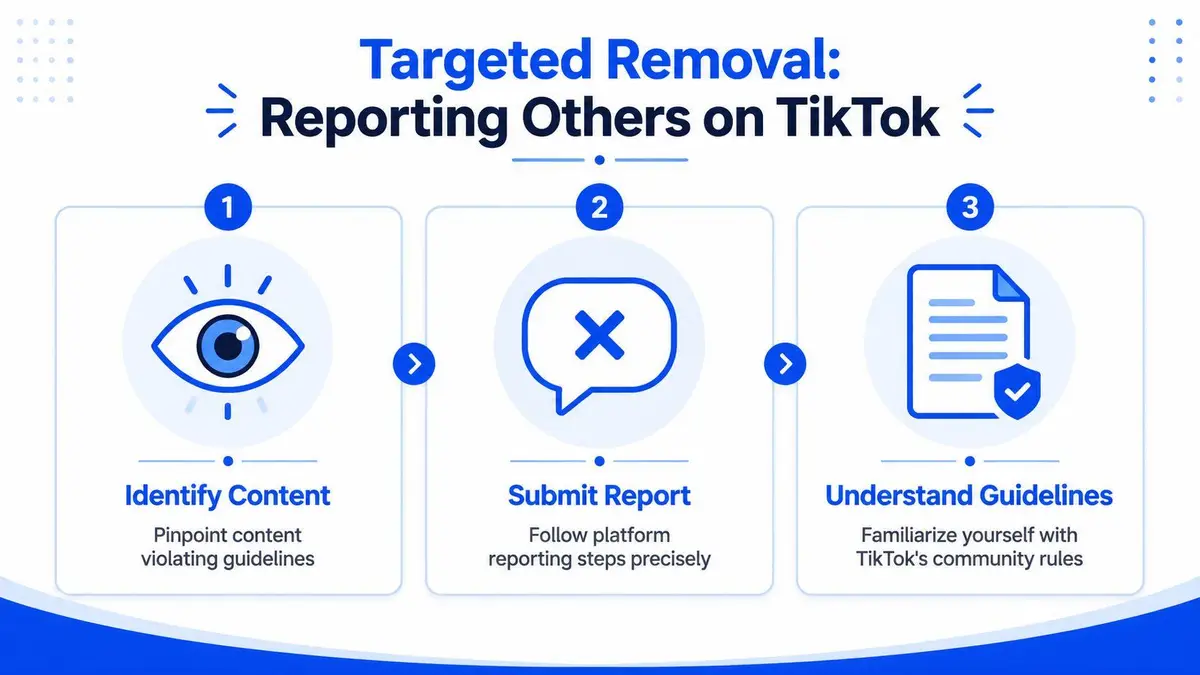
Targeted Removal The Framework for Reporting Others
A harmful post about you is live, comments are building, and the account owner controls the source. Your objective is no longer deletion from your profile. It is targeted enforcement against someone else’s content, using the right policy lane, the right evidence set, and the right escalation timing.
Match the report to the violation
TikTok reviews reports by category. If you file a reputational attack as generic harassment, or a fake account as spam, you reduce the chance of action before review even starts.
TikTok has stated that it automatically removes some content categories, including material involving minor safety, adult nudity, sexual conduct, violent or graphic material, and illegal activities, according to Yahoo Finance’s coverage of TikTok’s automated removals. High-stakes disputes often fall outside those clearer lanes. That is where report quality matters.
Start with a simple rule. Report the platform violation you can prove, not the grievance you feel most strongly.
Impersonation
Impersonation reports succeed when they show likely confusion. Build that case directly.
Include:
- Profile comparison: screenshots of the fake account beside your real account, official website, or verified public profile.
- Identity overlap: username, display name, profile photo, bio language, and branding elements that suggest affiliation.
- Deception evidence: messages, comments, or posts showing the account is misleading viewers, soliciting money, or collecting personal information.
A report that says “this account is fake” is weak. A report that shows a viewer would reasonably believe the account belongs to you is actionable.
Copyright and IP infringement
Copyright complaints require a clean ownership record. Collect the original file, first publication details, source links you control, and any registration or license documents available.
Then document the copied post with precision:
- The account handle
- The post URL
- The upload date, if visible
- Side by side screenshots of your original content and the infringing version
- Comments or captions showing the content is being presented as someone else’s work
Skip broad accusations. Moderators act on proof of ownership and proof of copying.
Here’s a practical demonstration of TikTok’s report flow and account-level controls:
Defamation and harassment
This category breaks down when the report is emotional, vague, or overloaded with background. Keep it narrow. Give the reviewer a short record they can evaluate fast.
Use this structure:
- Quote the exact false statement.
- Attach the document or record showing it is false.
- Show the harm. Use evidence of reputational confusion, client concern, workplace impact, or targeted abuse.
- Show repetition or coordination. Note linked accounts, repeated postings, stitched clips, or comment dogpiles.
Precision wins here. Moderators can act on a documented false allegation tied to a policy violation. They do not act because a report sounds upset.
If the conduct includes threats, doxxing, or repeat targeting across accounts, build a formal evidence file and use a structured cyber abuse content removal process instead of submitting the same in-app complaint over and over.
NCII and intimate privacy violations
Non-consensual intimate imagery requires immediate platform reporting and immediate evidence preservation. Do not contact the uploader. Do not argue in comments. Do not rely on followers to mass-report the post.
Capture the post URL, screenshots, account details, and any proof showing lack of consent. File under the most precise sexual exploitation or intimate privacy category available. If multiple accounts uploaded copies, document each one separately. TikTok often treats each upload as its own enforcement decision.
Use a reporting standard, not a one-off complaint
Single reports fail because they are treated as isolated incidents. High-risk cases rarely are.
Work from a case file. For each violating post, preserve the URL, username, display name, posting date, screenshots, and a brief note explaining the policy category. If the same actor is reposting through backup accounts, record the account links together. That gives you something TikTok moderators can review, and it gives you a record to use if platform reporting stalls.
That distinction matters. The goal is not to press “Report.” The goal is to build a removal record that supports escalation if the platform tools fail.
When Platform Reporting Is Not Enough
TikTok’s reporting tools are useful. They are not sufficient for serious exposure. That distinction matters.
For malicious content, the native Report function has a 40% success rate for manual review, while automated takedowns have a 75% success rate. The same source notes that native deletion doesn’t prevent re-uploads, which occur in 15-20% of cases for high-visibility videos within 48 hours, according to this analysis on TikTok removals and reuploads.
Those figures explain why many people feel trapped in a loop. They remove one instance and another appears. They report clear abuse and receive a rejection. They get one account removed and three more surface with slightly altered usernames.
Why standard reporting breaks down
A platform report is a moderation request. It isn’t a legal determination, and it isn’t a strategic enforcement plan.
Three structural problems show up repeatedly:
- Category mismatch: the report is filed under the wrong policy lane.
- Evidence weakness: the user submits conclusions instead of documents.
- Scale failure: one report targets one post while the abuse exists across multiple accounts, reposts, edits, and stitched clips.
That’s why “I already reported it” doesn’t tell you much. One report may have been the right opening step and still be strategically inadequate.
The reupload problem changes the calculus
The most common bad assumption is that once a video disappears from a profile, the threat is over. It isn’t.
A copied clip can be reposted by the original offender, by supporters, by aggregation accounts, or by opportunists chasing engagement. If the content is high-visibility, reupload risk turns a single takedown into an ongoing enforcement issue.
Deletion is an event. Protection is a system.
At that point, the goal shifts from isolated removal to suppression, tracking, and escalation. You need a record of every appearance, every handle involved, every report result, and every platform response. Without that record, appeals become inconsistent and legal notices become slower to prepare.
If the content targets a public figure, executive, or family office principal, waiting for the app to sort it out is often the wrong move. Standard reporting was built for mass user complaints. It wasn’t built to protect a client whose name, likeness, or private media is already spreading.
For those matters, legal process isn’t overkill. It’s the point where the response becomes proportionate to the risk. A structured legal content removal route exists because moderation tools alone don’t reliably resolve serious attacks.
Escalation Pathways Formal Takedown Notices and Legal Action
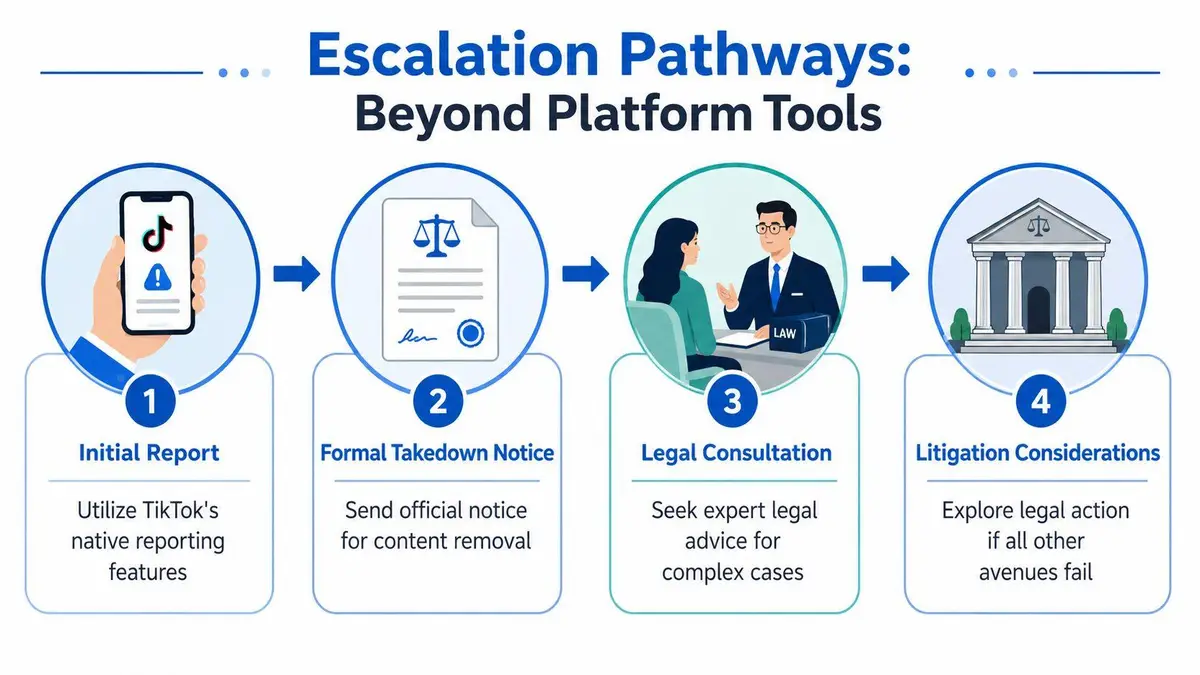
When TikTok’s internal tools fail, stop repeating the same failed action. Escalate. Formal notices change the posture of the case because they move the dispute out of ordinary moderation and into documented legal risk.
Choose the instrument that fits the harm
Not every TikTok dispute should be handled the same way. The right tool depends on the underlying violation.
| Scenario | Best escalation tool | Why it works |
|---|---|---|
| Stolen original video or branded asset | DMCA or copyright takedown notice | It asserts legal ownership and demands removal |
| False factual allegations causing damage | Cease-and-desist letter, platform legal complaint, possible court action | It reframes the dispute as reputational and legal injury |
| Fake account using your identity | Impersonation evidence package and legal demand if needed | It documents deception and confusion |
| Intimate privacy violation or exploitative content | Emergency legal escalation and platform safety reporting | It prioritizes immediate removal and containment |
A DMCA notice is often the cleanest route when the issue is copied content you own. It gives the platform a formal basis to act on copyright infringement. For defamation, harassment, or impersonation, a legal notice has a different job. It forces clarity, preserves the factual record, and creates a paper trail that can support broader enforcement.
Severe violations trigger stronger platform action
TikTok states that it permanently bans accounts for severe violations including CSAM, youth exploitation, violence promotion, non-consensual sex acts, human trafficking, and accounts that reach the strike threshold for multiple violations, according to TikTok’s account and user safety policy on violations and bans.
That matters for escalation strategy. If the content falls near those policy lines, your filing should reflect the exact nature of the threat and the corresponding safety implications. Don’t dilute a severe violation by describing it as “offensive” or “inappropriate.” Use the correct category and document it with precision.
Legal escalation creates leverage that app reports don’t
A formal takedown notice does three things ordinary reporting doesn’t do well.
- It narrows the issue. Instead of asking a moderator to interpret a messy dispute, it identifies a concrete legal basis for action.
- It improves consistency. If multiple uploads exist, a formal notice can address a pattern rather than a single clip.
- It prepares the next step. If the platform delays, the record is already built for counsel, cross-platform complaints, or court-directed relief.
Some clients hesitate here because they think legal action means immediate litigation. Usually, it doesn’t. In practice, the strongest move is often a graduated sequence: preserve evidence, issue a formal notice, pursue platform escalation, and reserve court action for matters that won’t resolve voluntarily.
The best legal notice is concise, documented, and written for action, not theatre.
If you’re dealing with stolen creative work, legal teams and rights holders often benefit from understanding the surrounding copyright process before filing. This overview of managing copyright legal needs is a practical reference point for that side of the decision.
Proactive Defense Monitoring and Reupload Mitigation
A takedown solves the immediate problem. It doesn’t build future resilience. If the content has already attracted attention, you need monitoring in place before the next repost appears.

Build a standing watchlist
Start with a practical monitoring set. Track your full name, common misspellings, brand name, executive title, usernames, campaign tags, and recurring captions tied to the abusive content. Add image and video variants if the material is visual.
Manual searching still has value. It helps you see context, comments, and account clusters. But manual searching alone is too slow for persistent reposting or impersonation campaigns. In higher-risk matters, you need a workflow that records detections, timestamps appearances, and links each copy to the evidence archive.
A useful watchlist usually includes:
- Identity terms: full names, aliases, brand handles, and known impersonation variants.
- Asset markers: unique phrases, visible logos, thumbnail stills, and recurring audio references.
- Threat actors: repeat uploader names, associated accounts, and collaborator profiles.
Focus on friction, not just removal
The best defense reduces the attacker’s ability to keep circulating the same material. That means creating friction at several points.
For owned content, keep original files organized with clear publication history and authorship records. For sensitive media, preserve proofs of origin and date. If reuploads start, those records make reporting and legal escalation faster.
If you operate publicly, tighten account settings and reduce unnecessary exposure surfaces. Limit duets, stitches, or visibility settings where the platform allows it. Restrict contact paths that attackers use to bait engagement and amplify visibility.
Treat evidence like a litigation file
Users often save screenshots randomly. That’s not enough when the dispute escalates.
Use a simple table or folder structure that logs:
| Item | What to capture |
|---|---|
| Account evidence | Handle, display name, profile image, bio, account URL |
| Post evidence | Video URL, caption, thumbnail, upload context, comments |
| Harm evidence | False statements, impersonation cues, outreach attempts, threats |
| Action history | Date reported, category used, platform response, appeal status |
This approach matters because removals often fail from inconsistency, not lack of merit. If every report is built from the same clean record, your submissions become sharper and more defensible.
Preserve first. Report second. Escalate from a complete file, not from memory.
Executing Your Content Removal Strategy
A TikTok removal plan succeeds or fails on control. Determine that first. If the video is on your account, remove it through the native deletion flow and decide before the recovery window closes. If a third party controls the post, build the record before you engage the platform.
Speed matters, but sequence matters more. High-stakes cases go wrong when people report from memory, choose the wrong category, or wait through multiple weak platform responses before escalating.
A workable decision framework
Use TikTok’s built-in tools for contained problems with clear facts. A mistaken upload, an outdated clip, or a single obvious impersonation post can often be resolved through deletion or a tightly framed report.
Escalate early under any of these conditions:
- The content is intimate, exploitative, or tied to personal safety.
- The uploader is anonymous, evasive, or acting with other accounts.
- The post has already been copied, edited, or reposted in variants.
- The claims are false and connected to your business, office, family, or professional standing.
That distinction matters. Some TikTok incidents are routine moderation issues. Others are reputational attacks or legal exposure delivered through a social platform. Treating both the same wastes time and weakens your position.
Optimize for enforceability
The in-app report is only one channel. Better outcomes come from a clean evidence file, accurate classification, and escalation outside the standard queue when platform tools stall.
If you are setting internal policy for social media risk, review how automated moderation systems sort, score, and prioritize reports. This 2026 content moderation guide explains the operational side well, especially for teams that need ongoing monitoring instead of a one-time cleanup.
For executives, creators, and other public-facing principals, use a staged protocol:
- Preserve the full record.
- Remove any content you control directly.
- Submit the strongest platform report available for third-party posts.
- Issue formal takedown notices if the response is slow, inconsistent, or plainly wrong.
- Monitor for reuploads, sockpuppet accounts, and edited copies.
This order protects your options. It also avoids the two mistakes that cause the most damage: destroying evidence by deleting too early, and losing momentum by waiting too long to involve counsel or a specialist firm.
Cases involving NCII, severe harassment, public figure impersonation, or coordinated defamation require immediate professional handling. Delay increases distribution, creates more copies to chase, and raises enforcement costs.
If you need a confidential, high-discretion assessment of a TikTok removal matter, ContentRemoval.com handles source removal, legal escalation, reupload mitigation, and reputation protection for executives, public figures, family offices, and legal teams. Start with a private review of the URLs, account evidence, and platform responses you already have, then move under a clear action plan built for speed and control.
Frequently asked questions
Can I recover a TikTok video after deleting it?
Yes, within 30 days. Deleted posts move to Recently Deleted in Activity Center and can be restored during that window. Once it closes, TikTok offers no official restoration, which is why the article advises saving a local copy before deleting anything you may need for evidence or later use.
How do I get a fake TikTok account using my name removed?
File an impersonation report built to show confusion: screenshots of the fake account beside your real profile or official site, matching username, photo and bio elements, and any messages or posts where the account misleads viewers or solicits money. If the platform does not act, an impersonation evidence package and legal demand is the next step.
What do I do when a removed TikTok video keeps getting reposted?
Shift from one-off deletion to a tracked enforcement process. Log every appearance with handle, URL, date and screenshots, report each upload separately, and issue a DMCA notice for copied content you own or a formal legal notice for defamation or impersonation. Maintain a watchlist of names, captions and recurring audio so new copies are caught early.