
Reputation management on social media for high-profile people and brands is a risk-control function that separates ordinary engagement, containment and formal removal. Crises move through a seed event, amplification, search contamination and institutional impact, so the first hour is for freezing evidence, classifying the claim, choosing one owner and picking a lane, with defamation, impersonation and deepfakes routed to enforcement.
Key facts
- A four-level threat matrix runs from routine criticism up to doxxing, deepfakes and extortion-linked smears.
- Escalate to removal for false accusations, impersonation, manipulated media, doxxing, IP misuse or coordinated harassment.
- A takedown file needs clean evidence, the precise removal basis, platform-specific framing and a map of reposts.
- Every public statement must be factually supportable, legally safe and consistent with later arguments.
Where ContentRemoval.com comes in. ContentRemoval.com takes over when a social media incident becomes an enforcement matter: fake accounts, manipulated clips, defamatory posts and leaked material reported through the correct platform channels, escalated to counsel where needed, de-indexed from search and watched for reuploads across X, Meta, LinkedIn, YouTube and TikTok. Communications directors, general counsel and chiefs of staff usually make the call. A free 15-minute Exposure Scan maps what is removable, and the report is yours to keep. Get a Free, Confidential Exposure Scan or read how our reputation management work is done.
Your social feed rarely announces a crisis with a siren. It usually starts with something small enough to dismiss. A fake account. A clipped video with missing context. A hostile comment thread under an otherwise routine post. Then a journalist’s researcher finds it, a board member forwards it, customers begin asking questions, and someone inside your company decides to “jump in” without a plan.
That is how reputation damage spreads on social platforms. Not as a neat PR event, but as a chain reaction.
If you’re high-profile, reputation management on social media is not a branding exercise. It’s a risk-control function. The correct response is rarely improvisation. You need a disciplined distinction between ordinary engagement, active containment, and formal removal. Most online advice collapses those categories into one. That mistake costs time, evidence, and advantage.
The Anatomy of a Social Media Crisis
An executive wakes up to a message from counsel. There’s a post circulating on X, LinkedIn, and Instagram accusing him of misconduct. The original account has a modest following, but the allegation is framed with confidence and reposted by people who don’t know whether it’s true. A second account appears with his name and photo. By mid-morning, staff members are debating whether to respond publicly. By lunch, clients have seen it.
That sequence is common because social platforms reward velocity, not verification.
The first operational fact to understand is simple. Consumers rely heavily on peer feedback. One source reports that 84% of consumers trust online reviews as much as referrals (Reputation X). If a single review can shape trust, a misleading post, hostile thread, or impersonation campaign can do the same, faster and in public.
How the attack actually unfolds
Most social media crises move through four stages.
- Seed event. A post, review, comment, or fake profile appears.
- Amplification. Other users repeat it, quote it, or attach their own grievances.
- Search contamination. Screenshots move beyond the platform and start appearing in search results, forums, and group chats.
- Institutional impact. Customers, partners, employees, investors, or reporters treat the issue as credible enough to act on.
The mistake is treating stage one as noise. By the time people react, they are already in stage three.
Practical rule: If the content attacks identity, alleges misconduct, or uses your name, image, or trademarks without authorization, preserve evidence before you say a word.
You also need to think beyond social media itself. Reputation incidents often expose broader operational weaknesses, especially around privacy, access control, and internal data handling. For a useful parallel, this piece on managing data privacy for SMBs shows how trust failures become business failures once they’re visible to the public.
Control starts with classification
Not every incident deserves a public reply. Some deserve silence and documentation. Others require immediate escalation to platform enforcement or legal review. If someone is already attacking you with false statements, this guide on what to do if someone is slandering you on social media is the right starting point.
Calm matters. Speed matters more. But speed without structure usually makes the problem harder to remove later.
Building a Proactive Defense Perimeter
A defensible social presence is built before anyone attacks it. Once a false narrative is moving, you’re operating under time pressure. Prevention gives you room to decide instead of react.
Reputation management on social media has already become a formal business function. The market was valued at about $175 million in 2022 and is forecast to reach $585 million by 2030 (Electro IQ). That matters because it confirms what well-informed clients already know. This is no longer an ad hoc task handed to marketing. It is an enterprise risk workflow.
The perimeter you actually need
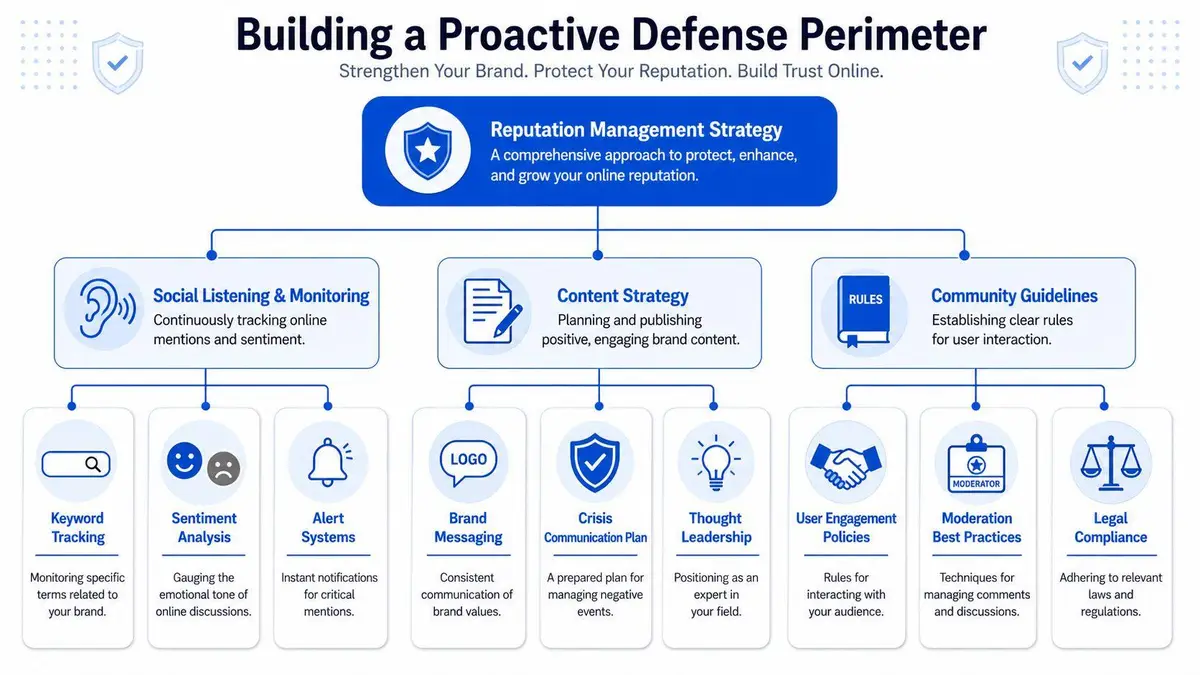
A proper defense perimeter has three layers.
First, account control. Secure your primary usernames, obvious variations, executive names, and common misspellings across major platforms. Do this even if you don’t plan to use every account. An empty but controlled profile is better than a fraudulent one that gains traction before you notice.
Second, monitoring discipline. Basic alerts are not enough. You need tracking for brand names, executive names, product names, key personnel, image reuse, and impersonation indicators. A good monitoring setup watches comments, tags, review sites, public groups, blogs, and news pickup. For a practical baseline, use a dedicated reputation monitoring workflow rather than manual searching alone.
Third, controlled publication. You need a steady stream of accurate, on-brand content tied to the names you need to protect. That content acts as a credibility layer and gives search engines, journalists, and stakeholders verified material to find when controversy appears.
What high-profile clients should standardize
Most clients underinvest in policy because it feels internal and boring. It isn’t. It is where preventable crises are stopped.
- Executive posting rules. Define who can post, who can approve sensitive statements, and which topics require counsel review.
- Escalation lanes. Social staff must know when an issue stays in community management and when it moves to legal, security, or outside specialists.
- Evidence preservation. Screenshots alone aren’t enough if metadata, account handles, timestamps, and URLs are missing.
- Review-ecosystem coverage. Don’t focus only on follower-facing platforms while neglecting Google, Yelp, and TripAdvisor-style environments where public trust is often formed.
A company with weak controls doesn’t have a reputation strategy. It has a response delay.
Monitoring has to extend beyond mentions
Fringe forums, Telegram channels, burner accounts, and stitched video content often surface before the main platforms react. If your profile is visible enough, your team should monitor for impersonation and manipulated media, not just sentiment. That is where many incidents begin.
There’s a useful operational lesson in Email Deliverability Best Practices. The principle transfers directly. Systems fail when teams wait for visible breakdown instead of maintaining the underlying controls that prevent it.
The perimeter isn’t glamorous. It is effective. That is enough.
Incident Triage and Strategic Assessment
The first hour of a social incident decides whether you contain the matter or feed it. Most unforced errors happen here. Someone posts an emotional response. Someone deletes material that should have been preserved. Someone confuses criticism with defamation, or defamation with “just online drama.”
You need triage, not adrenaline.
Separate irritation from actual threat
A useful assessment starts with four questions. Is the content false? Is it spreading? Does it identify a person or business clearly? Does it trigger platform-rule, legal, commercial, or safety concerns?
Those questions matter more than tone. Some of the most damaging material is written calmly and designed to look credible.
Here is a working matrix we use to impose order quickly:
| Threat Level | Description | Example | Initial Action |
|---|---|---|---|
| Level 1 | Low-risk dissatisfaction or criticism | A customer complaint about service quality | Acknowledge, investigate, respond professionally if a response is useful |
| Level 2 | Misinformation or repeated hostile commentary with visible traction | A misleading thread repeating inaccurate claims across platforms | Preserve evidence, assess reach, draft a controlled response, monitor spillover |
| Level 3 | Defamation, impersonation, privacy violations, leaks, coordinated harassment, manipulated media | A fake account posing as an executive, a fabricated clip, or false criminal allegations | Document immediately, stop ad hoc engagement, prepare takedown and legal assessment |
| Level 4 | Severe multi-platform attack with business, legal, or personal safety implications | Doxxing, explicit threats, deepfake abuse, coordinated smears tied to extortion or blackmail | Escalate at once to platform enforcement, counsel, security, and specialist removal support |
What to assess before responding
Organizations often ask, “Should we reply?” too early. Ask these instead:
- Who posted it. A real customer, anonymous account, competitor, activist, impersonator, or coordinated cluster.
- Where it lives. Platform choice matters because each site has different removal channels, evidentiary standards, and repost dynamics.
- How portable it is. Screenshots, clips, and cropped excerpts travel faster than long-form posts.
- What it accuses you of. Allegations of crime, abuse, fraud, or professional misconduct require a much stricter process than ordinary criticism.
- Whether response increases visibility. Some posts die if ignored. Others gain legitimacy if left unanswered.
Silence is not weakness. Unstructured engagement is.
Set response lanes, not just response times
A low-level complaint can often stay with customer care. A false factual claim with growing engagement belongs with communications and legal review. An impersonation account or defamatory post should move quickly into evidence collection and removal analysis, including a close review of how to remove defamatory content from the internet.
The operational principle is straightforward. Match the response to the threat category, not to whoever is shouting loudest internally.
A disciplined first-hour protocol
Use a sequence that reduces risk:
- Freeze the facts. Capture URLs, handles, timestamps, screenshots, and visible engagement.
- Identify the claim type. Complaint, opinion, false statement, impersonation, leak, or manipulated content.
- Assess spread and audience. Core customers, employees, media, investors, personal network, or hostile communities.
- Choose one owner. One decision-maker controls outbound communication.
- Decide the lane. Engage, monitor, ignore, or escalate to removal and counsel.
Triage provides an advantage. Without it, you’ll spend the critical early window generating screenshots, apologies, and contradictions that the other side will reuse against you.
Executing De-escalation and Response Playbooks
Some incidents should be contained through communication. That requires restraint. The purpose of a public response is not to defeat an opponent in open view. It is to lower temperature, correct what can be corrected, and avoid creating a second crisis through careless language.
A standard social media reputation workflow involves classifying feedback by urgency and responding promptly. A major pitfall is inconsistency in tone or over-indexing on growth while ignoring review ecosystems that shape public perception (Sprinklr).
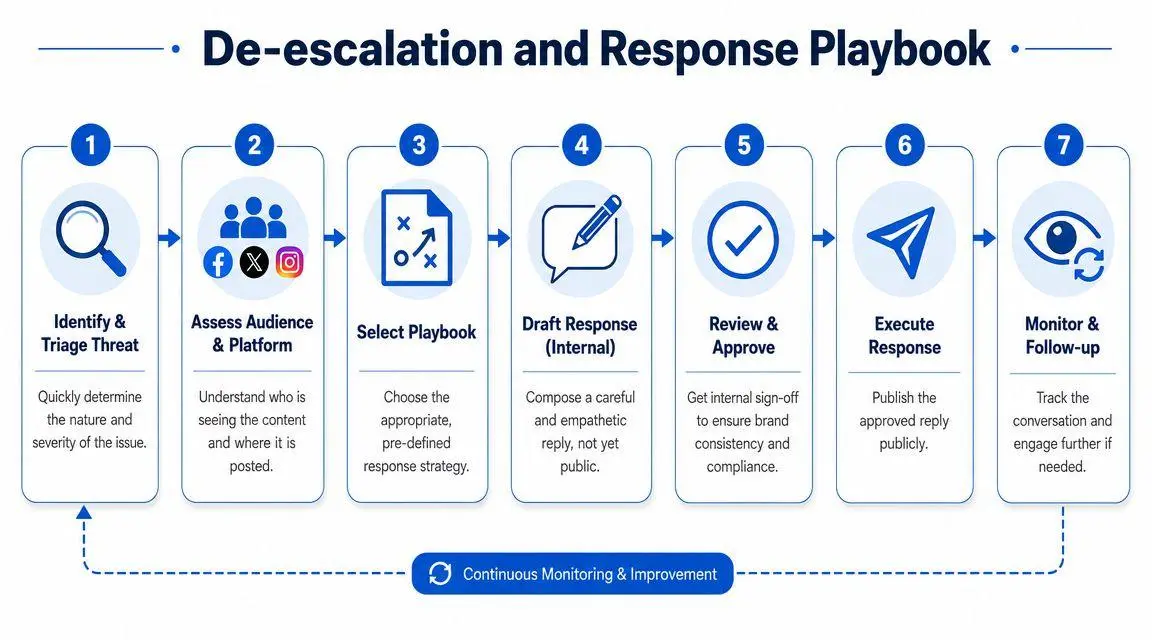
Start with the response map below.
What a controlled response sounds like
A strong statement usually does three things. It acknowledges that the issue has been seen. It avoids validating false premises. It directs the next step into a controlled channel.
That means you should prefer language such as:
- Acknowledge receipt. “We’re reviewing this matter and taking it seriously.”
- Separate empathy from admission. “We understand why people are asking questions” is often safer than “We’re sorry for what happened” if facts are disputed.
- Move specifics offline when appropriate. “Please contact our team directly so we can address the details.”
What you should avoid is just as important:
- Arguing point by point in public
- Speculating about motive
- Threatening legal action impulsively
- Using sarcasm, even if the post is obviously unfair
- Contradicting your own internal stakeholders across platforms
Response discipline: Every public statement should survive three tests. It must be factually supportable, legally safe, and consistent with what you may need to argue later.
For teams drafting sensitive replies, tools that Detect risky wording can help spot language patterns that trigger unnecessary friction or escalation. It won’t replace legal judgment, but it can catch obvious problems before a message goes live.
Here is a concise walkthrough of the process in action:
Documentation is part of the response
If a matter may escalate, preserve every version of every response. Keep approval records. Save deleted comments where possible. Track whether the hostile party edits, reposts, or widens the allegation after your statement.
That documentation serves two functions. It improves operational discipline in the moment, and it creates an evidentiary trail if you later need to prove falsity, harassment, impersonation, or platform abuse.
Pick the right playbook for the right scenario
Different incidents require different posture.
- Legitimate complaint. Respond courteously, solve the issue, and close the loop.
- Misunderstanding. Correct the record once, with precision, then monitor.
- Bad-faith provocation. Minimize oxygen. Don’t reward bait with public theatre.
- Coordinated pile-on. Use a central statement and stop staff from freelancing.
- Identity attack or false allegation. Prepare for enforcement, not debate.
The playbook works only if everyone follows the same script.
Activating Escalation Protocols for Content Removal
At 6:40 a.m., your team finds a fake account using your name, a manipulated clip is spreading across two platforms, and reporters are starting to ask questions. This is the point where public engagement stops being the main task. The priority is containment, evidence preservation, and removal.
Generic reputation advice fails here because it treats every incident as a conversation problem. Severe incidents are enforcement problems. False allegations, impersonation, deepfakes, privacy breaches, leaked intimate material, trademark abuse, and coordinated harassment call for a different operating mode.
A major gap in most reputation advice is the focus on sentiment when fabricated content often poses the primary threat. The growing availability of deepfake and impersonation tools requires a shift from “how do I reply?” to “how do I get this removed and stop reuploads?” (The Square).
The trigger points for escalation
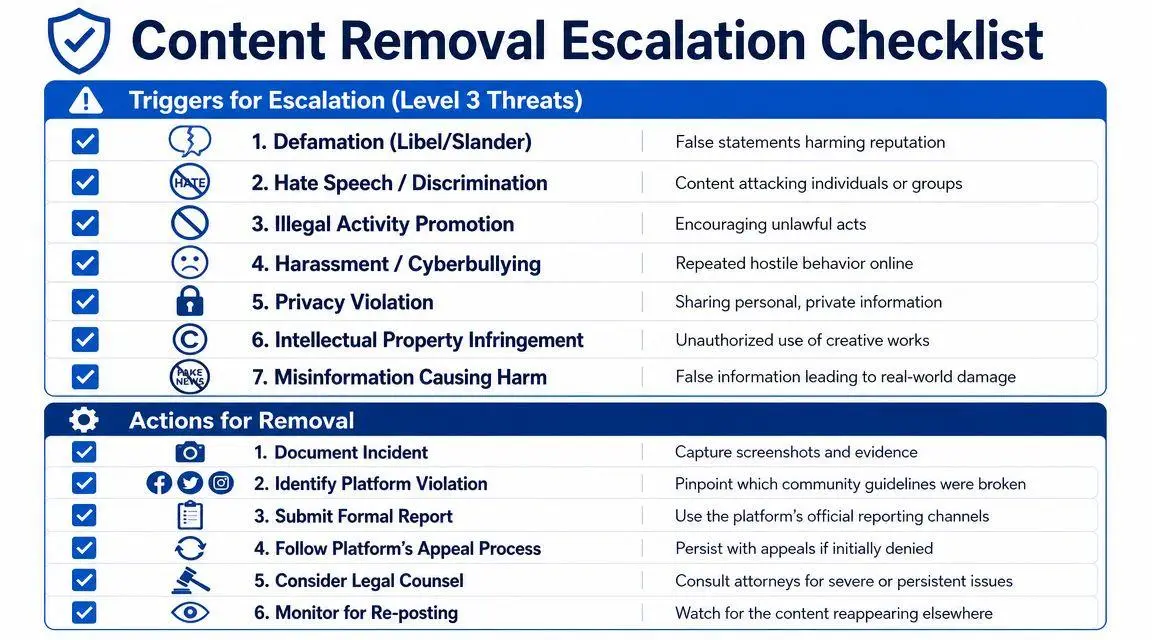
Switch to removal protocol when you see any of the following:
- False factual accusations that threaten your license, role, commercial relationships, or standing with regulators
- Impersonation through fake accounts, cloned profiles, copied branding, or spoofed employee identities
- Synthetic or manipulated media created to manufacture evidence of conduct that never happened
- Doxxing or privacy exposure, including home address, personal contact details, travel plans, or family information
- Intellectual property misuse involving your name, image, logo, or original content
- Harassment patterns that show repetition, coordination, intimidation, or cross-platform spread
These categories require enforcement. They should not be handed to a junior social manager and treated as audience management.
Removal requires a file, not a complaint
A platform report with no structure gets ignored or misrouted. A documented takedown file gives trust and safety teams, counsel, and escalation contacts something they can act on quickly.
Build the file before you file the report:
- Capture the evidence cleanly. Save screenshots, URLs, account handles, timestamps, profile IDs, reposts, comments, and surrounding context.
- State the removal basis precisely. Use the right label. Defamation, impersonation, trademark infringement, privacy violation, non-consensual intimate content, or manipulated media.
- Match the platform’s reporting logic. X, Meta, LinkedIn, YouTube, TikTok, and hosting providers each route complaints differently. A valid claim framed the wrong way can stall for days.
- Track replication risk. Note mirror accounts, stitched clips, duets, repost chains, and search indexing so the response covers reuploads, not just the first URL.
If harmful content disappears once and returns by nightfall, you do not have a resolution. You have a temporary gap in visibility.
Deepfakes raise the stakes
Synthetic media compresses decision time. It gives false claims the appearance of proof, which means the target has to move fast, preserve originals, identify source accounts, and document why the content is fabricated before copies spread further.
This is often the point where professional intervention becomes necessary. The work shifts from posting clarifications to coordinating platform escalations, legal review, impersonation claims, source tracing, and repeat-upload suppression across multiple services.
Legal review should start early
Legal involvement works best before anyone improvises in public. Counsel can classify the threat, preserve privilege where needed, and choose the strongest path for removal. Sometimes platform policy is enough. Sometimes trademark, copyright, privacy law, or defamation law gives you better traction.
The route matters because each claim demands different proof and creates different remedies. Choose the wrong route and you waste time while the content spreads.
Once severe harm is in play, stop treating the incident as a communications exercise. Run it as an enforcement matter.
Post-Incident Recovery and System Fortification
A contained incident still leaves residue. Search results may retain screenshots. Stakeholders may remember the allegation longer than the correction. Staff may keep asking whether the issue is “really over.” Recovery requires a formal closeout, not a sigh of relief.
Measure what changed
Track whether harmful content is still visible, whether impersonation accounts reappear, and whether public conversation has shifted from allegation to clarification. Review sentiment themes, engagement patterns, reach of corrective material, and the effect on business relationships. Don’t obsess over vanity metrics. Focus on whether risk exposure has narrowed.
Conduct a hard post-mortem
Ask uncomfortable questions.
- Where did the incident begin
- How long did detection take
- Who had authority to act
- Which responses helped and which made the matter louder
- Did your monitoring miss impersonation, edited clips, or spillover onto review sites and search
Then update the system. Tighten account controls. Rewrite approval rules. Expand monitoring terms. Create better evidence templates. Train executives who insist on posting spontaneously. Most reputation failures are process failures wearing a communications costume.
Recovery is not reputational if the same attack can land again next month.
Turn one crisis into a stronger operating model
The firms and individuals who handle pressure well do one thing consistently. They treat each incident as intelligence. The event reveals where the perimeter was weak, where the team hesitated, and where enforcement should have started earlier.
That is the long view of reputation management on social media. Defense, triage, response, removal, fortification. Not once. Repeatedly.
If you’re dealing with defamation, impersonation, deepfake abuse, false reviews, or a fast-moving social media attack, ContentRemoval.com can assess the matter confidentially and map the right next step, whether that means platform takedown action, source removal, de-indexing, or coordinated escalation with counsel.
Frequently asked questions
Should I reply to a false accusation about me on social media?
Not until you have preserved evidence and classified the claim. Public argument authenticates the dispute, gives the attacker fresh material and can make platforms see a personal conflict rather than a clean policy violation. False allegations, impersonation and manipulated media belong in an enforcement lane, not a comment thread.
How do I get a fake account impersonating me taken down?
Build a takedown file before you file the report: screenshots, URLs, handles, timestamps, profile IDs and any reposts, with the basis stated as impersonation and framed the way that platform routes complaints. Track mirror accounts and stitched clips so the request covers reuploads, and start legal review early if the account is spreading false claims.
What should a company do in the first hour of a social media crisis?
Freeze the facts by capturing URLs, handles, timestamps and engagement. Identify whether the content is a complaint, opinion, false statement, impersonation, leak or manipulated media, assess who is seeing it, appoint a single owner for outbound communication, and decide whether to engage, monitor, ignore or escalate to removal and counsel.