
Social reputation management in 2026 is a control system for digital threats, not a brand or customer service exercise. It rests on five pillars: strategic listening with threat triage, high-speed response protocols with clear ownership, content neutralization and removal, proactive suppression through assets you control, and crisis simulation so the team does not learn its weaknesses during a live attack.
Key facts
- 68% of executives say current ORM tools fail to eliminate persistent negative content, per Reputation.com.
- Brand reputation is estimated at 30 to 40% of enterprise value by 2026, per Mordor Intelligence.
- Takedown delays under nine hours cut illegal content by roughly 95 to 100%, per an arXiv study.
- Triage every mention as noise, operational issue, narrative threat or high-risk abuse.
Where ContentRemoval.com comes in. ContentRemoval.com is the response unit behind the alarm: verifying whether content is authentic or synthetic, preserving evidence, filing platform and host escalations, coordinating with counsel on defamation and privacy routes, and watching for mirrors afterward. Family offices, executive offices and their lawyers typically call at the containment stage. A free 15-minute Exposure Scan maps what is removable, and the report is theirs to keep. Get a Free, Confidential Exposure Scan or read how our reputation management work is done.
By the time your team notices the issue, the attack has already split into channels. A clipped video is circulating on TikTok. A fake account on X is posting as if it were you. LinkedIn comments are filling with insinuation from people who have never met you. Someone has copied the allegation into a review site, and a journalist’s researcher has started calling.
That is the operating environment for social reputation management in 2026. It isn’t a brand exercise. It isn’t customer service with better software. It is a control system for digital threats that spread faster than internal approvals, legal memos, or press statements.
Most executives still receive the wrong advice first. They’re told to monitor sentiment, draft a holding statement, and engage calmly. Fine, as far as it goes. But that advice fails at the exact point where reputational harm becomes durable: when false, defamatory, manipulated, or privacy-invasive content remains live, gets indexed, gets reposted, and starts feeding search engines and AI-generated summaries.
Introduction The Anatomy of a Modern Reputational Attack
For a high-net-worth client, that shift matters more than the original post. Social platforms reward repetition, not accuracy. Search systems reward persistence, not fairness. Once harmful material acquires enough surface area, every delayed decision multiplies your cleanup burden.
A common mistake is treating this as a communications problem. It’s a threat-management problem. You need to know what is circulating, who is amplifying it, whether the content violates platform rules, whether it creates legal claims, where it is hosted, how fast it is being mirrored, and which removal pathways can be triggered immediately. If your advisers can only “watch,” they are spectators.
A key blind spot has already been identified. A 2024 Reputation.com report on the new rules of reputation management found that 68% of executives believe current ORM tools fail to eliminate persistent negative content, with AI search engines increasingly amplifying unremoved harmful material even when brand sentiment improves. That’s the operational failure most conventional guidance ignores.
Monitoring without neutralization is a weak posture
If your dashboard tells you that sentiment is worsening, but your team cannot remove impersonation, challenge defamation, suppress recycled falsehoods, or force escalation with platforms, then your monitoring stack is just an alarm system with no response unit.
Practical rule: If a post is false, invasive, manipulated, or unlawful, the objective is not better engagement. The objective is containment, removal, and prevention of reupload.
The first hour of a reputational attack is rarely the time for public eloquence. It is the time for evidence capture, threat classification, and platform-specific action. That means preserving URLs, timestamps, account handles, media hashes, and repost pathways before anything disappears or mutates.
If you’re already in that position, a targeted online smear campaign playbook for executives is more useful than another article about “building trust online.” Trust is rebuilt later. Control is established first.
Reputation as a Quantifiable Board-Level Asset
Boards still talk about reputation as if it were atmospheric. It isn’t. It affects enterprise value, deal confidence, recruitment quality, executive credibility, and litigation exposure. Treating it as soft or secondary is a category error.
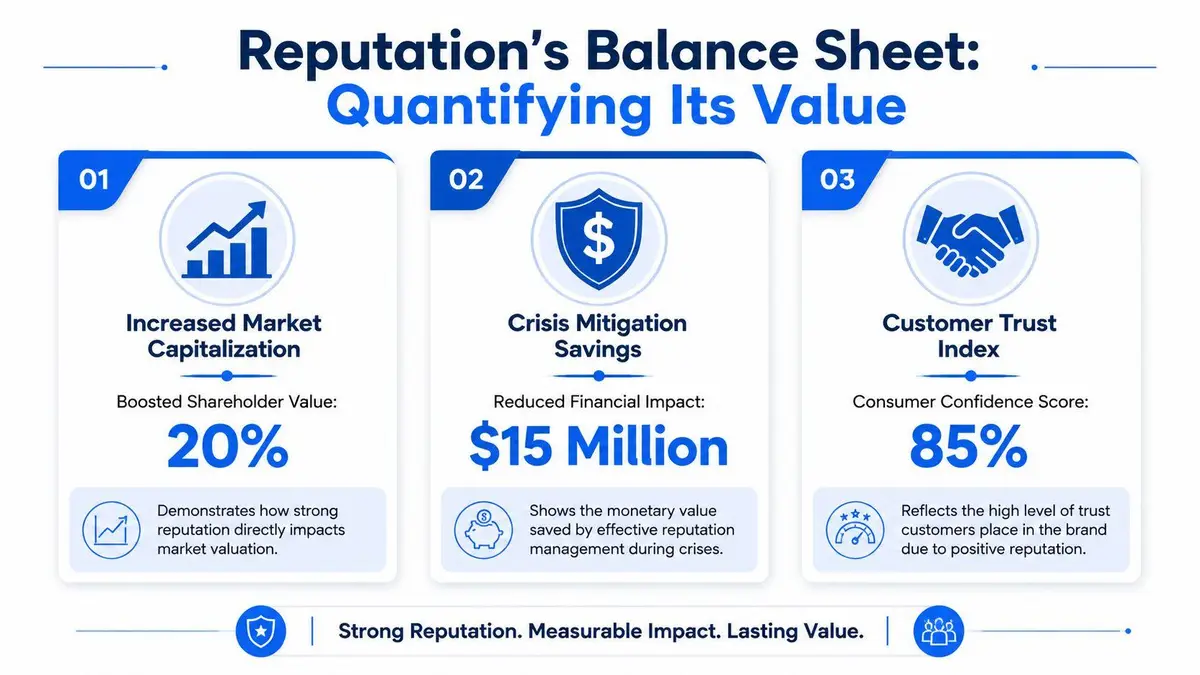
The market data is clear. The global online reputation management market was valued at USD 7.75 billion in 2026 and is projected to reach USD 14.01 billion by 2031, growing at a 12.59% CAGR, according to Mordor Intelligence’s online reputation management market analysis. The same analysis states that by 2026, brand reputation is estimated to represent 30 to 40% of a company’s total enterprise value. That is not a marketing footnote. It is a capital issue.
Why high-value individuals should care even more
For founders, family offices, and public executives, the corporate and personal layers are fused. A hit to the individual often migrates to the company. Counterparties read your search results before meetings. Journalists scan social chatter before calls. Recruiters and candidates do the same. So do activists, litigants, and short sellers.
A review of online reputation management statistics published by WiserReview reports that over 90% of individuals believe social reputation is linked to at least 25% of a company’s market value. The same source notes that 68% of professionals refuse to apply to companies with poor online reviews, and that fake reviews surged 758% between 2020 and 2024. Those are not isolated consumer annoyances. They affect hiring, retention, and confidence in leadership judgment.
The balance sheet isn’t just financial
Reputation sits in three places at once:
| Asset layer | What gets impaired | Typical consequence |
|---|---|---|
| Commercial | Buyer confidence, search credibility, review integrity | Slower sales cycles and harder negotiations |
| Human capital | Employer attractiveness, executive trust | Weaker candidate pipelines and internal uncertainty |
| Strategic | Board confidence, investor comfort, transaction optics | Greater friction in financing, partnerships, and exits |
The firms that handle this well don’t ask whether reputation has value. They ask who owns the risk, what the escalation threshold is, and how quickly harmful material can be neutralized.
Reputation should be managed like a legal exposure with market consequences, not like an image problem with nicer language.
That distinction changes budgets and authority. Once reputation is treated as a board-level asset, response protocols become tighter, evidence handling improves, and approval chains shrink. That is when social reputation management starts to work.
For executives who need to explain this internally, the sharpest framing is valuation, not vanity. A useful reference point is this analysis of how negative search results affect sales and market capitalisation. Search visibility and social reputation don’t live in separate silos. They compound each other.
The Five Pillars of a Defensive Framework
A serious defense system needs structure. Not an ad hoc mix of alerts, PR drafts, and legal panic. The most reliable model I’ve seen uses five pillars that work together under pressure.
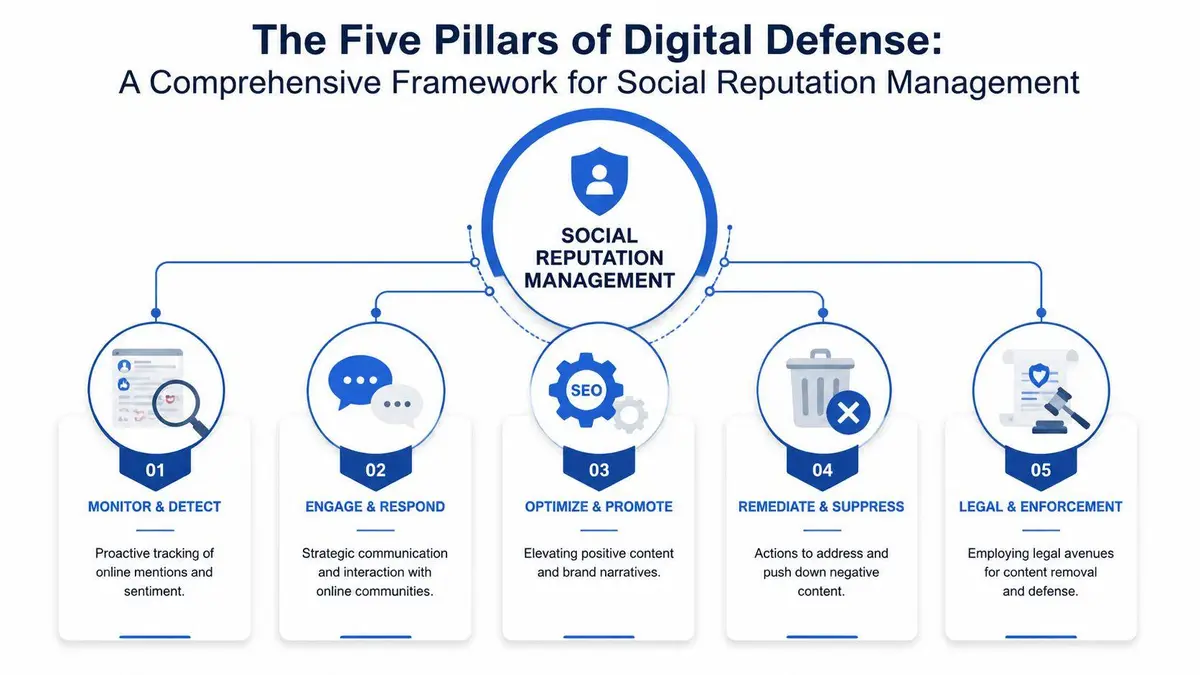
Strategic listening and threat triage
Listening is the front end, not the strategy. Your system should distinguish nuisance chatter from material threats. A critical post from a real customer is one category. A coordinated attack using fresh accounts, mirrored language, and edited media is another.
Real-time monitoring matters because it creates a short intervention window. According to The Square’s guidance on social media reputation management, organizations using real-time social monitoring can detect sentiment shifts within 1 to 2 hours, and 60% of consumers expect a brand to respond within the first hour of a negative post. The same source states that delayed responses correlate with a 35% increase in reputation damage over 30 days.
That doesn’t mean every mention deserves a reply. It means your team needs a triage model that classifies:
- Noise for criticism, sarcasm, and low-reach commentary that doesn’t require escalation.
- Operational issues for legitimate complaints that need customer resolution.
- Narrative threats for false or misleading posts with replication potential.
- High-risk abuse for impersonation, deepfakes, doxxing, leaked intimate material, or defamation.
High-speed response protocols
Speed without authority fails. Someone has to own first response, legal review, platform escalation, and executive notification. If six people need to approve every move, the platform cycle will outrun you.
Your protocol should answer four questions immediately:
- Who decides whether the matter is operational, legal, or security-related.
- Who preserves evidence before edits, deletions, or account changes occur.
- Who communicates externally if a statement becomes necessary.
- Who has standing access to platform reporting, counsel, and specialist escalation.
Different threats require different voices. A service complaint can be handled by customer support. A fabricated sexual misconduct allegation cannot. An executive impersonation account should never sit in a standard social inbox waiting for a polite reply.
Content neutralization and removal
This is where most programs break. They can detect, tag, route, and discuss. They cannot eliminate. That leaves the harmful material live, searchable, and quotable.
Neutralization involves several parallel tracks:
- Platform enforcement for impersonation, harassment, manipulated media, or privacy violations
- Legal intervention for defamation, copyright infringement, confidentiality breaches, or non-consensual intimate content
- Search strategy to reduce discoverability where direct removal is delayed or contested
- Reupload prevention through ongoing monitoring and account mapping
The right question isn’t “Should we respond?” It’s “What can we remove today, what can we suppress this week, and what must be escalated legally now?”
Proactive content suppression
Removal is ideal, but not every harmful item disappears on demand. When that happens, you need suppression. That means strengthening the assets you control and the narratives you can substantiate. Executive bios, verified profiles, authoritative interviews, company statements, legal clarifications, and trusted third-party coverage all matter.
This isn’t cosmetic. It’s defensive architecture. Search and AI systems assemble public narratives from available material. If the only fresh, indexable pages are hostile, that becomes the machine-readable version of you.
Crisis simulation and workflow war-gaming
Teams often discover their weaknesses during a live incident. That is amateur behavior. Run simulations before you need them. Test account access, evidence capture, executive contact trees, outside counsel availability, media holding lines, and escalation routes for each major platform.
A compact internal checklist helps:
- Access discipline Verify who controls brand and executive accounts.
- Evidence discipline Capture URLs, media files, timestamps, and account metadata.
- Decision discipline Define the trigger for legal, technical, and communications escalation.
- Recovery discipline Plan the post-incident review, suppression work, and monitoring reset.
War-gaming does one thing exceptionally well. It removes hesitation. In social reputation management, hesitation is expensive.
Content Takedown and Legal Interventions
The market talks endlessly about listening. The hard work starts when you try to get harmful material offline.

A takedown campaign works best when it separates content into legal and platform categories. Some material should be challenged under platform rules. Some needs formal legal pressure. Some requires both at once. If your team treats every harmful post as a generic “negative mention,” you will lose time and choose the wrong remedy.
What can be removed and how
Here is the practical distinction:
| Content type | Primary pathway | Secondary pathway |
|---|---|---|
| Fake account or impersonation | Platform impersonation report | Counsel letter if linked to fraud or extortion |
| Manipulated or synthetic media | Platform policy escalation | Forensic evidence and legal demand |
| Defamatory accusation | Platform complaint where policies apply | Defamation review and jurisdiction-specific legal action |
| Leaked intimate or private material | Privacy or NCII reporting route | Emergency legal intervention |
| Copied proprietary content | Copyright complaint | Injunction or host-level escalation |
The speed issue isn’t theoretical. A study on takedown delays and illegal content reduction hosted on arXiv found that for expected takedown delays below nine hours, removal results in approximately a 95 to 100% reduction of illegal content. If you wait for internal consensus, you’re choosing a weaker outcome.
Delay is a strategic error
Executives often hesitate because they don’t want to overreact. Fair instinct. Wrong in a live attack. Fast intervention doesn’t require public panic. It requires disciplined private action.
The first task is evidence preservation. The second is route selection. The third is escalation. That sequence should happen in hours, not days.
If the issue touches defamation, false accusations, or platform-hosted abuse, specialist advice matters because the framing of the complaint affects the result. A weak report gets rejected. A properly documented claim with policy mapping, evidentiary support, and legal context has a different trajectory. That’s why high-stakes matters often need counsel and removal specialists working in tandem, especially in cases involving internet defamation counsel and high-stakes content removal strategy.
A brief overview of the mechanics is useful here:
The legal layer most teams underuse
Legal intervention isn’t just about suing someone. Often it’s about changing the platform’s risk calculus, preserving claims, contacting hosts, putting intermediaries on notice, or forcing disclosure where anonymity is being abused.
Early legal positioning often shortens platform disputes because it clarifies that the matter involves rights, evidence, and liability, not mere disagreement.
That is why “engage and move on” is weak advice in serious matters. Engagement has a place. Removal has consequences. Use the right tool.
Escalation Paths for High-Profile Threats
High-profile clients face a category of threat that ordinary brand playbooks barely address. The danger isn’t only negative commentary. It’s synthetic attack infrastructure: voice clones, deepfake clips, cloned profiles, coordinated impersonation, and false narratives spread by accounts that look plausible long enough to do damage.
The exposure is no longer hypothetical. A Frontiers in Communication article discussing AI-driven impersonation risk states that 42% of high-net-worth individuals reported facing AI-driven impersonation campaigns on social media in the last 12 months, while only 12% of major ORM platforms have specialized AI takedown workflows. That gap explains why many discerning clients still feel unprotected despite paying for monitoring.
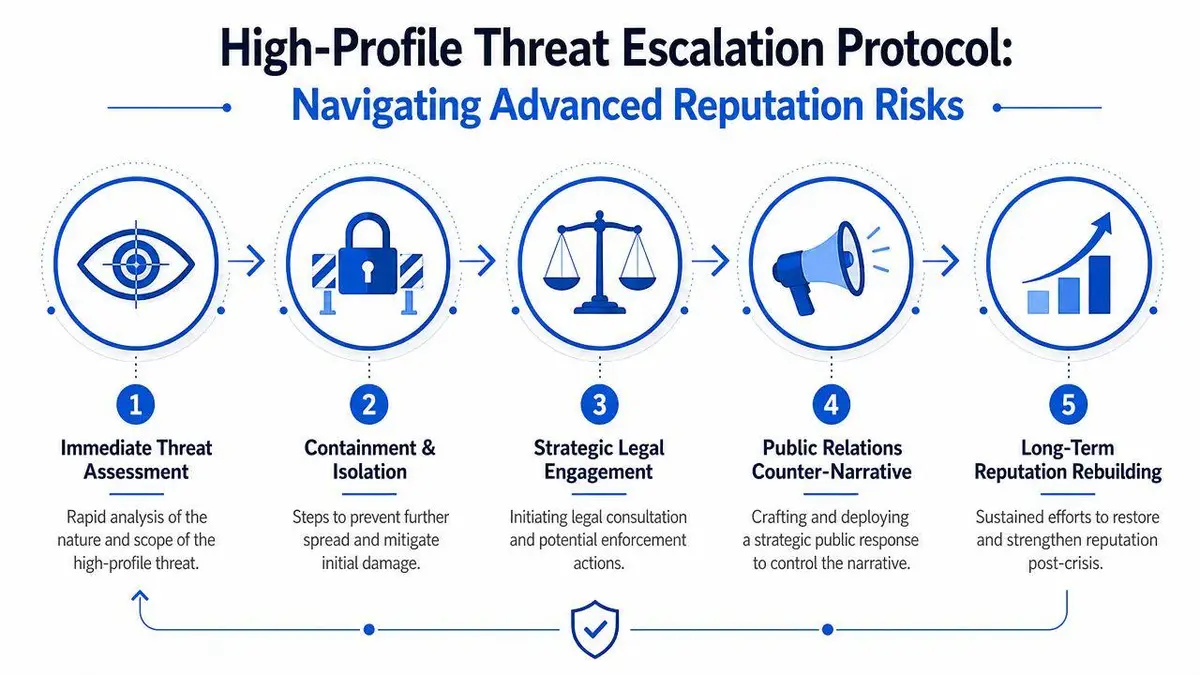
A tiered escalation model that actually works
A family office or executive office needs a visible escalation ladder. Not a vague promise that “the team is on it.”
Tier one is verification. Confirm whether the content is authentic, altered, synthetic, or falsely attributed. Archive everything immediately. If audio or video is involved, preserve the native file where possible and compare it against known authentic material.
Tier two is containment. Lock down compromised or spoof-adjacent accounts, alert key stakeholders privately, pause unnecessary posting, and stop staff from improvising responses. Uncoordinated replies create evidence problems and narrative drift.
Tier three is specialist activation. This is the point for removal operators, counsel, digital forensics, and where necessary crisis communications. Not every problem needs all four. Serious ones usually do.
Tier four is external enforcement. Push platform escalations, host notices, legal demands, and where relevant law enforcement contact. High-risk impersonation campaigns often cross from reputation harm into fraud, extortion, stalking, or market abuse.
Tier five is residual risk control. After the immediate fire is contained, continue monitoring for mirrors, commentary recycling, search persistence, and AI summary contamination.
What the dashboard should show
Most dashboards are vanity boards. They count mentions and color-code sentiment. That is not enough for a principal under attack.
Track indicators that inform action:
- Threat tier classification so everyone knows whether the matter is routine, sensitive, or critical.
- Sentiment shift velocity to identify whether a narrative is accelerating or stabilizing.
- Platform replication pattern to see whether content is isolated or migrating.
- Executive-name mention mapping to catch attacks aimed at the individual rather than the company.
- Removal status by asset so counsel, security, and principals know what remains live.
The protocol must match the threat
Use a simple decision matrix:
| Threat type | First concern | Lead function |
|---|---|---|
| Review fraud | Authenticity and platform integrity | Reputation and legal |
| Executive impersonation | Fraud risk and source removal | Security and platform enforcement |
| Synthetic media | Verification and rapid takedown | Forensics, legal, specialist removal |
| Coordinated smear campaign | Network mapping and defamation analysis | Legal, investigations, suppression team |
The strongest escalation systems do one thing especially well. They remove ambiguity under stress. When your name, family, company, or transaction is under pressure, clarity is worth more than messaging flair.
Conclusion Moving From Reactive Defense to Proactive Control
The phrase social reputation management misleads people because it sounds passive. It suggests observation, moderation, and careful replies. That is only the outer layer. In live conditions, effective reputation work looks much closer to risk control, evidence management, platform enforcement, legal escalation, and narrative containment.
That shift in mindset matters. You do not need a perfect internet. You need a controlled one. You need to know which threats deserve silence, which require rebuttal, which can be suppressed, and which must be removed aggressively before they harden into the public record.
The old model treated reputation damage as something to clean up after the fact. That model is obsolete. Harmful content now travels through social platforms, search results, cloned accounts, recommendation systems, and AI-generated summaries. Once falsehoods cross those layers, they become more expensive to unwind and more difficult to explain away. Waiting for the story to “die down” is not strategy. It is surrender disguised as patience.
The better model is straightforward. Build early detection. Pre-authorize decisions. Preserve evidence fast. Separate routine criticism from hostile manipulation. Use platform procedures properly. Escalate legal issues without delay. Suppress what cannot be removed immediately. Keep monitoring until the reupload cycle ends.
Control comes from systems, not optimism.
For executives, family offices, and public figures, that is the only useful standard. You are not trying to win every argument online. You are protecting asset value, personal safety, commercial advantage, and long-term credibility. Done properly, social reputation management becomes less about defending an image and more about asserting jurisdiction over your digital environment.
If you need discreet help assessing a live threat, ContentRemoval.com handles high-stakes online reputation matters for executives, high-net-worth individuals, family offices, and legal teams. The firm focuses on rapid takedowns, defamation and impersonation removal, privacy protection, and long-term suppression strategy. Start with a confidential assessment and get a clear action plan built for control, speed, and discretion.
Frequently asked questions
What is the first thing to do when a reputational attack starts on social media?
Capture evidence before anything mutates or disappears: URLs, timestamps, account handles, media files and repost pathways. Then classify the threat and select the platform or legal route. Public statements come later, if at all.
How do I decide whether to remove, suppress or ignore a harmful post?
Sort it by category. Impersonation, manipulated media, leaked private material and defamation go to platform enforcement or legal intervention for removal, while content that cannot be removed quickly is suppressed by strengthening verified profiles, bios and authoritative coverage. Low-reach criticism is often left alone.
What should a reputation dashboard show for a high-profile person?
Threat tier classification, sentiment shift velocity, platform replication patterns, mentions aimed at the individual rather than the company, and removal status for each asset. Counting mentions and color-coding sentiment is not enough when a principal is under attack.