
Confidential online reputation removal is the process of eliminating specific harmful digital material, or restricting public access to it, through platform enforcement, legal claims, host intervention and search de-indexing. It differs from PR and SEO suppression because it targets the asset itself, and it is done quietly: evidence preserved first, remedy matched to the platform and jurisdiction, then verified.
Key facts
- De-indexing removes the search pathway; source deletion removes the asset. Both are often used in sequence.
- GDPR-based delisting can remove content from search results in roughly 24 to 72 hours while the source stays live.
- Three questions shape the remedy: where the subject is, where the publisher operates, where the harm is felt.
- One source cited says 30 to 40 percent of removed content resurfaces within 90 days without monitoring.
Where ContentRemoval.com comes in. Quiet removal is the whole practice at ContentRemoval.com: secure intake, evidence preserved before any outreach, the remedy chosen per asset and platform, then verification and monitoring for reposts. Executives, physicians and family office principals usually come through counsel or a chief of staff. A free, confidential 15-minute Exposure Scan maps what can be deleted, delisted or needs watching, and the report is yours to keep. Get a Free, Confidential Exposure Scan or read how our reputation management work is done.
A search result has just become a board-level problem.
It might be a false review campaign against a founder. It might be an old article that no longer reflects the facts. It might be a leaked image, a copied forum post, a people-search listing, or a defamatory accusation published by an anonymous account and then mirrored elsewhere. What matters in the first hour is not outrage. It’s containment, evidence preservation, and choosing the right remedy before the problem spreads.
Individuals often begin in the wrong category. They look for “reputation management,” as if this were primarily a branding issue. In high-stakes matters, it usually isn’t. Public relations can shape narrative. Search suppression can dilute visibility. Neither is the same as confidential online reputation removal. One manages perception. The other targets the offending material itself.
That distinction matters because generic consumer tools routinely underperform when the issue is serious. A 2023 Consumer Reports investigation into personal data removal services found an average success rate of only 35%, with some services removing as little as 4% to 6% of targeted information. The same reporting showed that data often reappeared through broker repopulation. For an executive, investor, physician, family office principal, or public figure, that’s not a workable risk profile.
Confidential removal starts from a different premise. The goal isn’t to look better online over time. The goal is to identify what can be removed, what can be de-indexed, what requires court process, what should never be touched publicly, and how to proceed without turning a contained issue into a larger one.
That requires legal judgment, technical execution, and discretion. It also requires accepting an uncomfortable truth. Some content can be erased. Some can only be made materially harder to find. Some should be challenged immediately. Some should be watched first so the evidence isn’t destroyed before the right notice, platform report, or filing goes out.
Beyond Crisis Management An Introduction
When a damaging result appears, the immediate instinct is often visibility control. Push it down. Publish over it. Call a PR firm. In lower-risk situations, that may buy time. In sensitive matters, it can also leave the underlying asset live, searchable through alternate paths, and available for republication.
That’s why confidential online reputation removal should be treated as a legal and technical discipline, not a marketing campaign. The right question isn’t “How do we make this look better?” It’s “What is this content, where is it hosted, what rules govern the platform, which jurisdiction matters, and what action removes it with the least collateral attention?”
Why generic services fail under pressure
Consumer-grade deletion tools are built for scale, not for adversarial situations. They’re acceptable for routine opt-outs and weak for targeted attacks, defamatory content, coordinated review abuse, copied media, and privacy violations. Once harmful material is mirrored, scraped, or indexed across multiple systems, automation alone rarely solves the problem.
A high-profile matter usually involves at least one of these complications:
- Anonymous publication: the poster hides behind a handle, burner email, or throwaway account.
- Cross-platform spread: a single post is copied to forums, search caches, review sites, and social accounts.
- Mixed legality: some content is false, some is invasive, some may be technically lawful but still removable under platform rules.
- Public-interest tension: publishers and platforms may resist if they believe the content concerns a matter of legitimate public concern.
Practical rule: If the content affects financing, hiring, licensing, litigation exposure, family privacy, or personal safety, treat it as a removal matter first and a branding matter second.
Management versus removal
Suppression has its place. So does strategic communications. But both are downstream tactics. Removal is upstream. It asks whether the harmful asset can be deleted at source, de-listed from search, challenged through platform mechanisms, or forced down through legal process.
That is a narrower, more exact practice. It’s also quieter when done properly.
Defining Confidential Online Reputation Removal
Confidential online reputation removal is the process of eliminating specific harmful digital material, or restricting public access to it, through platform enforcement, legal claims, host intervention, search de-indexing, and related technical measures. It is not synonymous with SEO, public relations, or review response management.

The word confidential does real work here. In a sensitive matter, exposure often increases because someone handles the problem noisily. They send angry emails to the publisher. They post rebuttals on social media. They threaten suit in public. They brief too many vendors. They alert the wrong person at the wrong site and hand them a better story.
A discreet removal strategy avoids that pattern. It limits circulation, preserves evidence, and uses the least inflammatory path that still has legal or technical force.
What it is not
The market blurs several services together. That confusion costs clients time.
| Service | Primary objective | Typical result |
|---|---|---|
| PR and crisis communications | Shape public interpretation | Narrative balancing, not deletion |
| SEO suppression | Push harmful results lower | Visibility reduction, not removal |
| Review response management | Address customer-facing complaints | Public engagement, not source elimination |
| Confidential removal | Delete or delist specific assets | Reduced or zero visibility, depending on method |
A common mistake is hiring a suppression vendor for a removal problem. If the issue is a false accusation, leaked personal data, impersonation profile, or fabricated review cluster, “pushing it down” may leave the core risk untouched.
What confidential work looks like in practice
In practice, the work usually involves a combination of evidence capture, rights analysis, platform mapping, and controlled outreach. The asset is identified precisely. The hosting chain is examined. The applicable policy or legal theory is selected. Then the takedown route is executed without unnecessary publicity.
That may involve any of the following:
- Platform-rule enforcement: using community standards, impersonation rules, privacy policies, or fraud policies.
- IP-based removal: using copyright or related ownership claims where applicable.
- Defamation strategy: where false statements of fact justify legal escalation.
- Search delisting: reducing discoverability when source deletion isn’t immediately available.
Quiet work often succeeds where loud work fails. The objective is to remove the material, not to win an argument with the person who posted it.
The practical difference is simple. PR asks the public to reinterpret the problem. Confidential removal asks whether the problem can be deleted, delisted, or neutralized without creating a second problem.
The Pillars of Removal De-Indexing and Source Deletion
Two methods govern most serious online removals. They sound similar to non-specialists and behave very differently in practice.
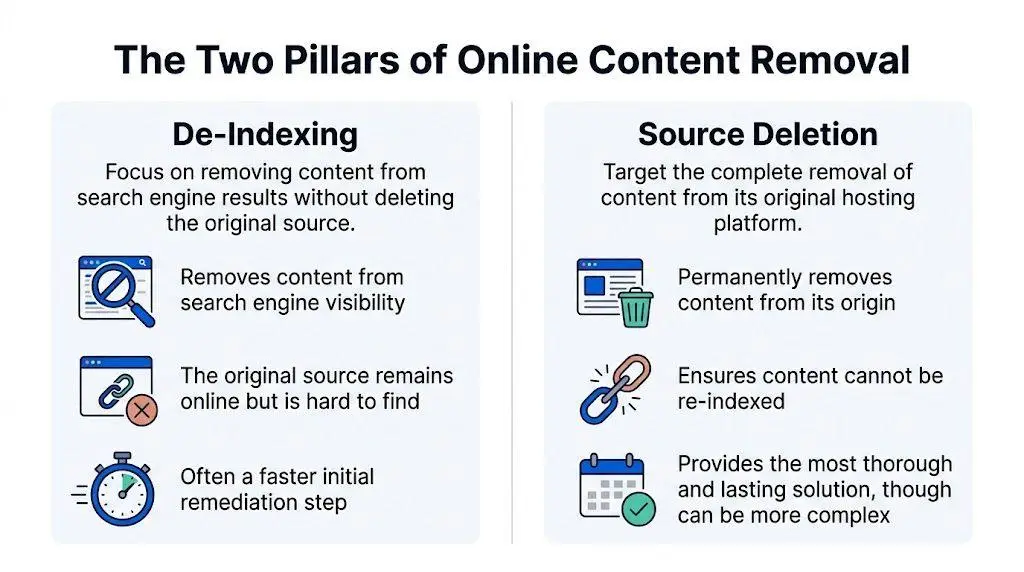
The first is de-indexing. The second is source deletion. A competent strategy often uses both, but never confuses one for the other.
De-indexing removes the pathway
Professional removal operates on a dual-layer model. De-indexing uses mechanisms such as GDPR-based delisting to remove content from search results, often within 24 to 72 hours, while leaving the original source intact, as explained in this analysis of de-indexing and source removal architecture.
Think of de-indexing as removing a book from the library catalog. The book may still exist on a shelf somewhere. It will not be found through ordinary search, but anyone with the direct path can still access it.
That can be an effective remedy when the immediate harm is discoverability. It is especially useful when a search engine will delist under privacy or regional rights frameworks even though the publisher won’t delete the underlying page. For a closer explanation of how that works, see this strategic guide to search result removal.
Source deletion removes the asset itself
Source deletion targets the origin server, platform, or host. It seeks permanent removal from the place where the content lives. That may mean persuading a publisher, invoking a platform violation, working through a host, or obtaining an order that compels compliance.
This is the more definitive remedy. If the page, file, post, or listing is removed at source, search engines have nothing meaningful left to index.
The trade-off is complexity. Source removal usually demands stronger evidence, clearer legal footing, or tighter alignment with platform rules than de-indexing. It also requires understanding who controls what. The site operator may differ from the host. The host may defer to the platform. The platform may route legal requests differently from trust-and-safety reports.
Why both pillars matter
An experienced operator doesn’t ask which method is “better” in the abstract. The question is what sequence best reduces harm.
| Scenario | First move | Likely follow-up |
|---|---|---|
| Search result tied to outdated personal data | De-indexing | Source outreach if listing remains accessible |
| Defamatory post on a social platform | Platform report or legal notice | Search delisting if indexed copies persist |
| False article on an independent site | Publisher or host challenge | De-indexing if source resists |
| Leaked media copied across domains | Source takedowns across hosts | Monitoring for mirrors and re-uploads |
The strategic mistake is treating de-indexing as if it were deletion. It isn’t. It’s access control at the search layer.
This is why removal work sits closer to legal operations and systems administration than to conventional SEO. Each platform has distinct APIs, validation rules, and review pathways. Each jurisdiction changes the options available. A practitioner has to know when to delist, when to force deletion, and when using both at once is the fastest way to shrink exposure.
The Confidential Remediation Process Explained
Clients under pressure usually want two things immediately. They want to know whether the content can come down, and they want to know who will see their matter while that work is underway.
A proper remediation process answers both. It should feel closer to a legal engagement than to a marketing retainer.
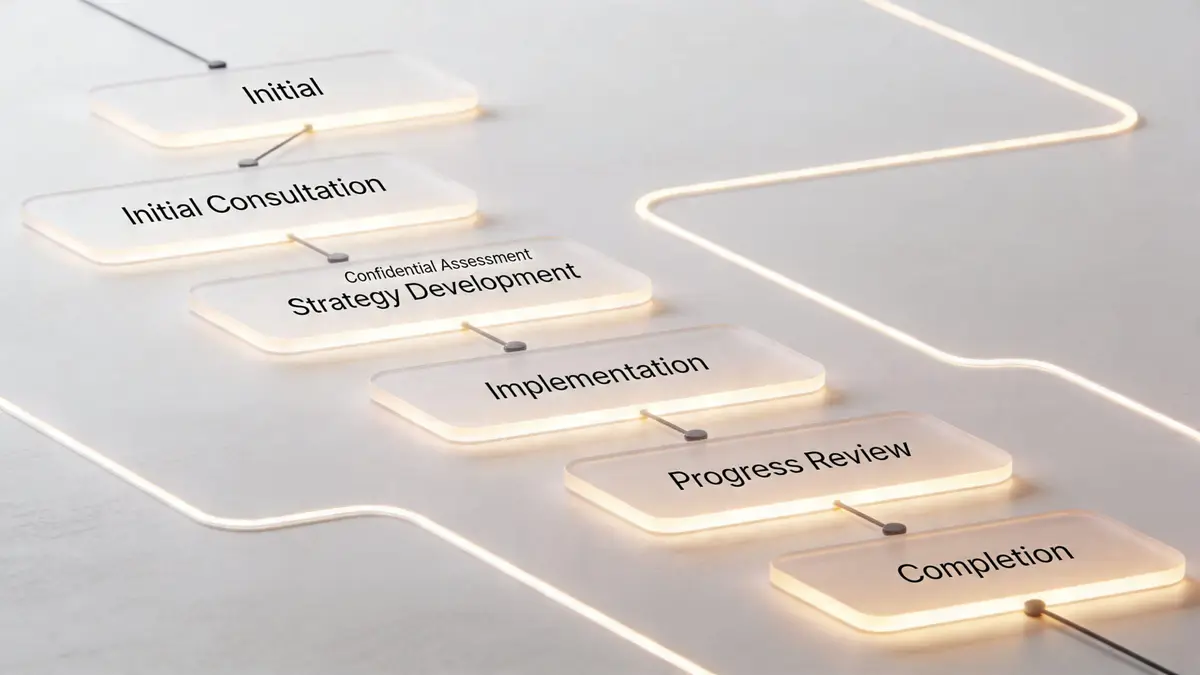
Stage one begins with containment
The first step is intake under controlled conditions. The URLs, screenshots, dates, usernames, cached versions, and any known publication history are gathered before anyone starts contacting platforms or posters. If the matter could lead to litigation, evidence preservation becomes even more important.
This early phase often determines the quality of the outcome. If the client has already engaged publicly, demanded removal in anger, or triggered a hostile response from the publisher, the case becomes harder. Quiet collection first. Action second.
A serious team also separates asset types immediately. A false review campaign is not handled the same way as a leaked image, an impersonation account, a copied article, or a people-search listing.
Stage two is strategy selection
The case transitions from emotional to tactical. The material is classified by legal theory, platform rule set, jurisdiction, and urgency. Some assets justify direct notice. Some call for court-backed process. Some are better approached through host escalation or search delisting while source removal is built.
One category now deserves particular attention. Fake reviews grew 758% between 2020 and 2024, and the FTC banned AI-generated and fraudulent reviews in August 2024, according to this roundup of online reputation management statistics. In the same source, a 1-star rating drop is associated with a potential 5% to 10% revenue loss. That is why false review matters often require decisive source removal rather than public rebuttal alone.
In some cases, practitioners use legal mechanisms such as John Doe lawsuits to obtain orders that support removal when a platform won’t act voluntarily. The point isn’t theatrics. It’s an advantage.
A practical overview of the broader workflow appears in this guide on getting something removed from the internet.
Stage three is execution and verification
Execution is rarely a single letter or one report form. It is a sequence. Notices go out in the right order. Search requests are timed to avoid undermining source negotiations. Platform submissions are adapted to each rule set. Escalations are documented. Mirror sites are identified early.
A short briefing can help clients understand what this looks like in motion:
After action, verification matters as much as initial takedown. The live URL may be gone while snippets remain cached. Search may delist one path while an alternate URL stays indexed. A review platform may remove the visible post but leave account traces that need a second round of reporting.
A professional process ends with proof. Not optimism. Proof means checking source status, index status, mirrors, and any secondary assets that inherited the content.
Clients should expect concise reporting, not vague reassurance. What was removed. What was delisted. What remains. What requires monitoring. What legal options are reserved if the publisher or poster escalates.
Navigating Jurisdictional and Platform Complexities
Removal work breaks down when advisers assume the internet is governed by one set of rules. It isn’t. Rights differ by country. Procedures differ by platform. Even within one matter, the search engine, hosting company, publisher, and social network may all apply different standards to the same content.
Jurisdiction decides leverage
In the European context, GDPR-based rights can support search delisting where personal privacy outweighs public interest. In the United States, privacy and defamation strategies often look different, and IP-based claims may be more effective in certain fact patterns. In other common-law jurisdictions, defamation standards, available relief, and practical enforcement can shift again.
The mistake is assuming a valid complaint in one country produces the same result elsewhere. It often won’t. A takedown request that succeeds against an EU search listing may have no direct effect on the publisher’s server outside that framework. A US-based host may respond more readily to a clear terms violation than to a broad fairness argument. A platform may geo-limit enforcement or require local counsel framing.
That’s why the analysis begins with three linked questions:
- Where is the subject located?
- Where is the publisher or platform operating?
- Where is the harm being experienced?
Those questions shape the remedy more than most clients expect.
Platform rules often matter more than broad principle
Clients often focus on whether content is “wrong.” Platforms focus on whether it violates their written policies and whether the request is properly documented. That distinction is not academic. It determines results.
A defamatory review on a business directory may need one strategy. A cloned Instagram profile needs another. A legacy news article may require editorial outreach, legal argument, and then search-specific relief if the publication won’t amend or remove. A forum thread hosted on an independent domain introduces a different problem because the moderator, owner, host, and registrar may all play separate roles.
| Content type | Primary gatekeeper | Typical pressure point |
|---|---|---|
| Search result | Search engine | Privacy or delisting criteria |
| Social account or post | Platform trust and safety team | Impersonation, harassment, policy breach |
| Review listing | Review platform | Fraud indicators, authenticity, coordinated abuse |
| Independent website article | Publisher or host | Defamation, privacy, IP, policy, local law |
A practitioner needs to know how each system processes requests. Some platforms respond to structured portal submissions. Some require legal notices through dedicated channels. Some ignore general complaints but react quickly to a narrowly framed policy violation supported by the right exhibits.
The same underlying harm can require four different removal arguments across four different platforms.
The operational consequence
For high-profile clients, this complexity affects more than legal theory. It affects timing, staffing, and exposure control. If a case spans multiple jurisdictions or asset types, the work has to be coordinated so one notice doesn’t undermine another. You don’t want a careless outreach to a publisher making a private issue newly newsworthy. You also don’t want a search request filed before preserving the material needed for a court application.
The right strategy is never one-size-fits-all. It is asset-specific, forum-specific, and jurisdiction-specific from the first step.
Ensuring Long-Term Protection and Prevention
Removal is not the end of the matter if the material can be reposted, mirrored, or re-indexed. Many clients learn that only after a successful takedown appears to “fail” weeks later. What failed was the assumption that deletion alone would hold.

Why one-time removal is rarely enough
According to this discussion of monitoring and permanent suppression frameworks, 30% to 40% of removed content resurfaces within 90 days without continuous monitoring. The same source states that clients with 90+ day monitoring cycles achieve 94% success rates in permanent suppression.
Those numbers align with what practitioners see in the field. Harmful material rarely disappears neatly. It is copied to secondary domains, reposted by anonymous users, picked up by archives, or redistributed with slight variations intended to evade basic matching.
What real monitoring does
Professional monitoring is not vanity alerting. It relies on content fingerprinting, crawler-based scanning, and repeat detection across search indices, social platforms, and more obscure repositories. The system watches for the original file, close variants, excerpted text, and newly indexed URLs connected to the same harm.
That matters because early intervention is cheaper and quieter than late cleanup. If a repost is caught before it accumulates links, engagement, or search authority, takedown options are usually cleaner.
A durable prevention framework typically includes:
- Fingerprinting the original asset: creating a reliable signature for text, image, or video variants.
- Scanning for reappearance: checking search engines, platforms, and known mirror patterns.
- Escalation protocols: deciding in advance who approves notices, legal process, or platform reports.
- Verification loops: confirming that removed assets stay removed and that search doesn’t republish snippets.
A better way to think about protection
Clients often ask for “permanent removal” as if permanence were a single event. It isn’t. It’s a managed state.
One useful distinction is this:
| Objective | What it requires |
|---|---|
| Initial takedown | Legal and platform execution |
| Lasting protection | Monitoring, repeat detection, and rapid re-intervention |
The strongest removal file is wasted if nobody watches for resurrection.
Firms differ sharply. Some sell one-off removals and leave the client to discover reposts alone. Others build a post-remediation shield that treats re-upload prevention as part of the original mandate. For executives, founders, families, and public figures, the second model is the only one that matches the actual risk.
Evaluating Professional Services and Pricing Models
The online reputation market attracts competent specialists and opportunists in equal measure. Clients in distress are easy to oversell. They are also easy to scare. That is why vendor selection should be treated with the same skepticism you would apply to litigation counsel in an emergency filing.
Red flags that should end the conversation
The industry includes unethical actors, including mugshot extortionists and firms that collude with site owners. A key warning sign is any guarantee of 100% removal, because outcomes depend on third-party platforms and legal jurisdictions, as noted in this piece on internet reputation company risks and red flags.
If a provider promises certainty before reviewing the content, they are selling reassurance, not judgment.
Other warning signs are less dramatic but just as revealing:
- Unsolicited outreach after an incident: if a firm contacts you immediately after a new negative result appears, ask how they found it and whether they have any relationship to the site involved.
- Vague methodology: “we have proprietary systems” means nothing unless they can explain the actual pathway, at least at a high level.
- No legal literacy: a firm handling defamation, privacy, impersonation, or leaked content without legal fluency is operating half-equipped.
- Pressure to buy suppression before removal analysis: that often signals a standard package, not a customized remedy.
What a serious firm should be able to answer
You don’t need a sales pitch. You need a working theory of the case. Ask direct questions and listen for precise answers.
| Question | What a credible answer sounds like |
|---|---|
| Can this be removed at source, de-indexed, or both? | A conditional answer based on asset type and platform |
| What legal theories may apply? | Specific categories, not generic threats |
| How will you avoid amplifying the issue? | Clear confidentiality and outreach controls |
| What happens if the content reappears? | Monitoring and repeat-enforcement plan |
| How do you report progress? | Verifiable status, not “ongoing efforts” language |
If you’re comparing providers, it also helps to understand the workflow tools serious legal and compliance teams use more broadly. This overview of best legal tech tools is useful because it shows the standard clients should expect around intake, documentation, matter management, and process discipline.
For executives assessing outside help, this guide to evaluating professional content removal services offers a practical checklist.
How pricing usually works
Pricing models vary because the work varies. A single impersonation profile is not the same as a multi-jurisdiction defamation matter with mirrored articles, review abuse, and search indexing across several engines.
Most reputable structures fall into one of these categories:
- Per-asset or per-matter fees: useful when the scope is definable at the outset.
- Retainer plus monitoring: more suitable when reuploads, search persistence, or serial abuse are likely.
- Hybrid structures: often used where immediate removals are paired with ongoing surveillance.
ContentRemoval.com is one example of a firm that combines de-indexing, source removal, and monitoring under confidential assessment-based engagements. The better providers in this category don’t sell certainty. They sell process, judgment, and escalation options grounded in the facts.
If the quote arrives before the analysis, you’re buying a package. Not a strategy.
Initiate Your Confidential Assessment
If the material online is false, invasive, manipulated, stolen, or strategically timed to hurt your business or family, the right response is not public argument. It is controlled assessment, precise execution, and a remedy chosen for the actual asset in front of you.
That is the core divide between ordinary reputation management and confidential online reputation removal. One tries to improve the optics around a problem. The other works to delete, delist, or neutralize the problem itself while minimizing additional exposure.
For high-profile clients, speed matters. So does restraint. A rushed, public, or poorly framed takedown effort can harden a publisher’s position, alert additional readers, or damage future legal options. A disciplined review at the outset avoids that.
The first step should be narrow and discreet. Identify the exact URLs, preserve the evidence, map the platforms, and determine whether the matter calls for de-indexing, source deletion, court-backed process, or monitored containment. Then act in the correct order.
If you need a discreet next step, request a confidential assessment through ContentRemoval.com. The engagement should begin with secure intake, a clear action plan, and a prompt, professional review of what can be removed, what can be delisted, and what requires ongoing protection.
Frequently asked questions
Is reputation removal the same as reputation management?
No. PR shapes public interpretation and SEO suppression pushes results lower, but both leave the harmful asset live. Confidential removal asks whether the material can be deleted at source, delisted from search or challenged through platform mechanisms, and does it without adding publicity.
Why should I avoid contacting the publisher myself?
Angry emails, public rebuttals and premature legal threats often alert the poster, trigger edits or reposts, and hand a hostile publisher a better story. Quiet collection of URLs, screenshots and cached versions comes first; controlled outreach follows.
What are the warning signs of a bad content removal company?
Promises of certain removal before reviewing the content, unsolicited outreach right after a negative result appears, vague proprietary claims, no legal literacy, and pressure to buy suppression before any removal analysis.