
Experts of social media, for an executive or public figure, are not growth operators with strong engagement numbers. They are people who can hold access to your accounts without creating confidentiality, escalation or evidence risk, who understand how algorithms amplify harmful content, and who know when to stay silent, preserve records and escalate to legal and removal specialists.
Key facts
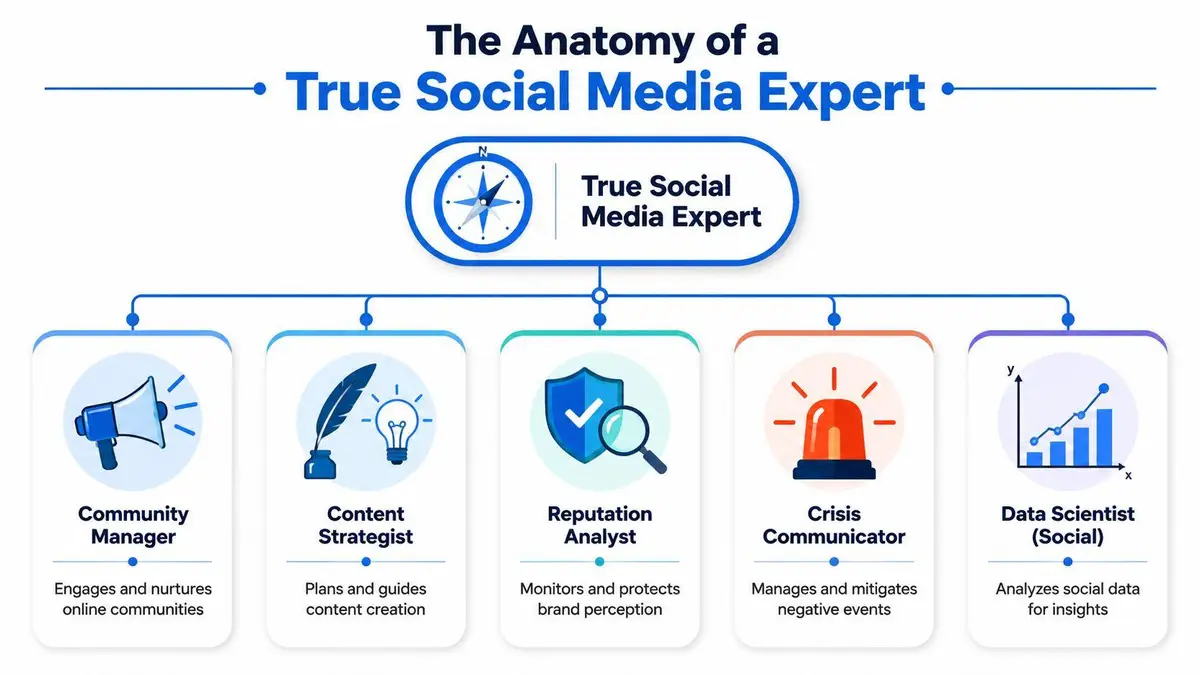
- Five roles are usually collapsed into one title: community manager, content strategist, reputation analyst, crisis communicator and data specialist.
- Harmful posts follow the same algorithmic logic as good ones; early engagement makes them harder to contain.
- Takedowns and de-indexing get harder after the first 24 to 48 hours, and reuploads follow.
- Contracts should cover confidentiality, data ownership, access limits, breach reporting and evidence preservation duties.
Where ContentRemoval.com comes in. ContentRemoval.com is the defensive counterpart to a social media team: when a leak, impersonation account, false allegation or manipulated clip is spreading, we handle source removal, de-indexing, platform escalation and monitoring while the operator preserves evidence and stops feeding the material. A chief of staff, publicist or the principal’s lawyer usually makes contact. A free 15-minute Exposure Scan maps what is removable and the report is yours to keep. Get a Free, Confidential Exposure Scan or read how our content removal work is done.
Most advice about social media expertise is built for growth teams, not for people with real exposure. It treats the hire as a creative operator who posts, replies, and chases reach. That framing is reckless. If you’re an executive, public figure, founder, or family office principal, the person running your accounts can expose confidential information, mishandle a crisis, inflame a legal problem, or make harmful content easier to spread and harder to remove.
That is why I distrust the usual praise for the so-called experts of social media. A polished feed, a decent engagement rate, and a talent for trend-jacking don’t qualify someone to manage a high-stakes reputation asset. You are not hiring for style. You are hiring for judgment, containment, and controlled visibility under pressure.
Beyond Likes The Real Stakes of Social Media Expertise
The standard description of a social media expert is too narrow. It assumes the job is to publish attractive content and keep attention moving upward. For a high-profile client, that is the least important part of the role.
The core issue is scale. In 2026, there are approximately 5.66 billion active social media users worldwide, representing 93.8% of all internet users, and the typical active user engages with an average of 6.75 different social networking platforms per month, spending about 18 hours and 36 minutes weekly across these networks, according to Sprout Social’s social media statistics. Handing an operator access to your accounts means handing them access to a system with global distribution, persistent replication, and audience overlap across multiple platforms.
Access is exposure
A social manager doesn’t just control your captions. They often control inboxes, publishing workflows, ad permissions, community replies, archives, drafts, media libraries, and internal approvals. In practice, they also learn your voice patterns, travel schedule, business relationships, and pressure points.
That creates three categories of risk:
- Confidentiality risk because the operator sees information that was never meant for public circulation.
- Escalation risk because a careless reply, delayed deletion, or poorly timed post can intensify scrutiny.
- Evidence risk because an inexperienced manager may destroy records you later need for legal review, platform reporting, or a takedown request.
Practical rule: If a candidate talks only about reach, content pillars, and audience growth, they are describing a marketing function. Your account requires a risk function first.
The hire must be crisis-capable
Most reputational damage doesn’t begin with a scandal. It starts with one preventable mistake. A rushed post. A tone-deaf comment. A private detail in the background of a photo. A staff member using the wrong account. A fake account left unchallenged long enough to gain credibility.
This is why the best social media operator for a high-profile principal usually feels less like a marketer and more like a security-conscious chief of staff with platform fluency. They need to know when to publish, when to stay silent, when to preserve evidence, and when to escalate immediately.
If they can’t think that way, they are not an asset. They are a point of failure.
The Anatomy of a True Social Media Expert
The phrase “social media expert” is imprecise to the point of being useless. No discerning client would hire a generic “law expert” for litigation, tax exposure, and regulatory review at the same time. Social media should be treated the same way. Different problems require different specialists.
Five roles matter
A serious operation usually combines several functions that clients wrongly collapse into one title.
- Community manager. This person handles audience interaction, comment triage, and direct-message hygiene. Their value isn’t friendliness. It’s restraint. They must know which comments merit engagement, which require silence, and which signal coordinated harassment or a brewing threat.
- Content strategist. This person plans format, cadence, themes, approvals, and distribution. For a visible principal, the strategist should understand not just brand alignment but legal sensitivity, family privacy, and adverse media risk.
- Reputation analyst. This is the most overlooked role. The analyst tracks sentiment shifts, impersonation patterns, hostile narratives, and repeated attack vectors across platforms. They watch for weak signals before they become searchable liabilities.
- Crisis communicator. Many social teams claim they can “handle PR.” Most can’t. A crisis communicator knows how to slow the situation, narrow the message, preserve optionality, and avoid statements that create fresh legal exposure.
- Social data specialist. Someone has to interpret pattern changes in visibility, audience behavior, and content propagation. If your operator doesn’t understand how data informs both reach and risk, they are flying blind.
One person rarely does all of this well
The market is full of generalists who present themselves as complete solutions. That is usually branding, not capability. A person who edits short-form video brilliantly may be poor at moderation under abuse. A brilliant strategist may be careless with platform evidence. A polished agency may outsource inbox handling to junior staff.
The safest hire isn’t the most charismatic one. It’s the one who can define boundaries, escalation triggers, and access controls without being prompted.
If you want a technical view of how agencies are now using automation, monitoring, and workflow systems, Mallary’s developer’s guide to social media AI is a useful reference point. Read it for operational context, then ask your candidate which tasks they automate, which they never automate, and why.
What competence looks like
A true expert doesn’t brag about follower counts first. They talk about approval chains, platform permissions, archive retention, impersonation response, and crisis handoff. They understand that a luxury brand account, a founder account, and a family office principal’s account require different thresholds for visibility and disclosure.
That is the standard. Anything less is a content operator, not an expert.
Evaluating Essential Skills Beyond Follower Counts
Follower count is weak evidence. It can reflect visibility, budget, timing, luck, controversy, or inherited momentum. It tells you almost nothing about whether someone can protect your reputation when visibility turns hostile.

Algorithmic literacy is a protection skill
The first skill I test is whether the candidate understands recommendation systems at a functional level. Social media algorithms operate as AI-powered recommender systems that assign a Relevancy Score to each post, computing a weighted sum of signals such as engagement velocity and predicted user dwell time to determine feed placement. Content with high early engagement is amplified, while low-engagement posts are suppressed, as explained in Brandwatch’s analysis of social media algorithms.
That matters because harmful content follows the same logic. A defaming clip, impersonation account, leaked image, or misleading thread can gain early engagement and become harder to contain once the platform reads it as relevant.
A capable operator should be able to answer these questions clearly:
- Signal recognition. Can they identify when negative engagement is still feeding distribution?
- Containment judgment. Do they know when public replies will worsen reach rather than calm the situation?
- Format awareness. Can they explain which content formats trigger broader discovery and why that changes risk?
- Escalation timing. Do they understand when to stop “community management” and preserve evidence for specialist review?
The real test is control under pressure
Most portfolios show best-case content. You need evidence of worst-case judgment. Ask for examples of moderation decisions, impersonation reporting, false narrative containment, and cross-platform issue tracking. If they have none, they are not ready for a sensitive account.
For ongoing visibility assessment, a disciplined principal should pair operator work with independent reputation monitoring. That separates performance reporting from risk detection, which is exactly what you want when the same team has incentives to defend its own strategy.
If the person managing your visibility is also the only person reporting on your risk, you don’t have oversight. You have dependency.
Metrics that matter more than applause
Vanity metrics flatter teams and mislead principals. I care more about whether the operator can spot narrative drift, reduce exposure to bad-faith engagement, and document threats in a way legal and removal specialists can use.
If LinkedIn is a major channel for your executive profile, benchmarking profile authority can still be useful in a narrow sense. Extrovert’s guide to improve your LinkedIn SSI helps frame how platform-native activity influences visibility. Use that kind of resource carefully. It should inform controlled positioning, not provoke careless overposting.
A useful training clip on strategic measurement and social performance sits below. Watch it with one question in mind: does your operator understand visibility mechanics as a growth game, or as a risk surface?
Questions to Ask Before Granting Access
Do not ask a candidate how they “grow brands.” Ask how they behave when something goes wrong. You need judgment under ambiguity, not a rehearsed content philosophy.
Interview for stress behavior
A credible candidate should handle scenario questions without drifting into clichés. If they answer with “I’d stay authentic” or “I’d focus on transparency,” keep pressing. Those phrases are cover for inexperience unless backed by process.
Here is a practical screening table you can use during interviews.
| Category | Question |
|---|---|
| Access control | What permissions do you need on day one, and which ones should remain restricted to internal leadership? |
| Crisis response | Describe your first-hour actions if a scheduled post goes live during a legal dispute or active controversy. |
| Evidence preservation | If our legal team asks you to preserve all records related to a complaint, what exactly do you retain and how? |
| Impersonation | A fake account starts messaging our partners. What do you do in the first day, and what do you avoid doing? |
| Harassment | How do you document abusive comments, threats, and direct messages without feeding more distribution? |
| Executive privacy | What content approval rules would you set for travel, family references, and real-time location indicators? |
| Platform judgment | When does replying help, and when does replying increase the visibility of the attack? |
| Termination readiness | If your access is revoked immediately, how do you return assets, drafts, archives, and credentials cleanly? |
Listen for what they don’t say
Strong candidates talk about chain of command, screenshots, timestamps, delegated access, legal holds, platform-specific reporting, and message discipline. Weak candidates talk about vibes, storytelling, and “humanizing the brand.”
Use a second layer of questions to test their instincts:
- Backlash discipline. Ask them to describe a time a campaign drew negative reaction and what they did in the first hour.
- Internal coordination. Ask how they handle instructions from legal, PR, and executive staff when those instructions conflict.
- Data restraint. Ask what client information they refuse to store in a third-party tool.
- Off-platform spillover. Ask what they do when social activity begins affecting search results, media inquiries, or employee behavior.
For corporate leadership teams, this issue overlaps with staff conduct and internal policy. A practical companion resource is this guide on protecting company reputation from employee social media. A candidate who cannot discuss that overlap is thinking too narrowly.
The interview should leave you with procedures, not personality impressions.
Red flags that should end the process
Some warning signs don’t deserve a second meeting.
- Metric obsession. If every answer returns to impressions, follower growth, or posting frequency, they will optimize for exposure even when exposure is dangerous.
- Public drama history. If they fight in comments, mock critics, or posture online under their own name, they are telling you how they behave under strain.
- No confidentiality language. If they don’t raise discretion on their own, they don’t understand the assignment.
- Tool dependency without safeguards. If they automate replies, approvals, or inbox actions without discussing review controls, they are introducing risk at scale.
When Expert Strategies Create Reputational Threats
Many accepted social strategies are excellent at producing attention and terrible at protecting a principal. That is the contradiction most clients discover too late.

Perfect imagery often produces ugly consequences
The pressure to appear aspirational, flawless, and constantly desirable has a cost. A study from Goizueta Business School found that when followers consume idealized versions of influencers, a social comparison process occurs that results in negative feelings and a substantial decline in self-esteem, creating reputational risks for the brand or individual promoting the content, according to Goizueta’s research spotlight on idealized influencer imagery.
That matters because backlash isn’t always about factual wrongdoing. It can emerge from accumulated resentment, perceived inauthenticity, or a public appetite to puncture a curated persona. Once that mood shifts, old posts are reinterpreted, screenshots circulate, and critics look for inconsistencies.
Engagement tactics can attract the wrong audience
A manager chasing comments at all costs may use baiting language, divisive framing, or content designed to provoke correction and argument. That can inflate visibility while implicitly training the account to attract hostile attention.
Two problems follow. First, critics become a recurring engagement source, which keeps negative discourse close to your name. Second, your account becomes a richer target for impersonation, clipped misinformation, and defamatory commentary because adversaries know the audience is active and reactive.
If the account is already under attack, use a disciplined response framework rather than improvisation. This checklist for social media defamation and strategic executive response is the kind of operating logic your team should already understand before a problem lands.
Attention isn’t neutral. The wrong kind of attention builds an audience for your next crisis.
Authenticity is not the same as exposure
Many self-styled experts use “be more authentic” as cover for oversharing. That advice is dangerous for high-profile people. Authenticity should mean credible tone and consistent behavior, not uncontrolled access to your family, routines, disputes, or vulnerabilities.
A serious advisor strips away tactics that increase discoverability at the expense of control. If a strategy makes you more legible to stalkers, critics, impersonators, or leak communities, it is not an intelligent strategy. It is a liability with good design.
Coordinating Offense and Defense for Digital Reputation
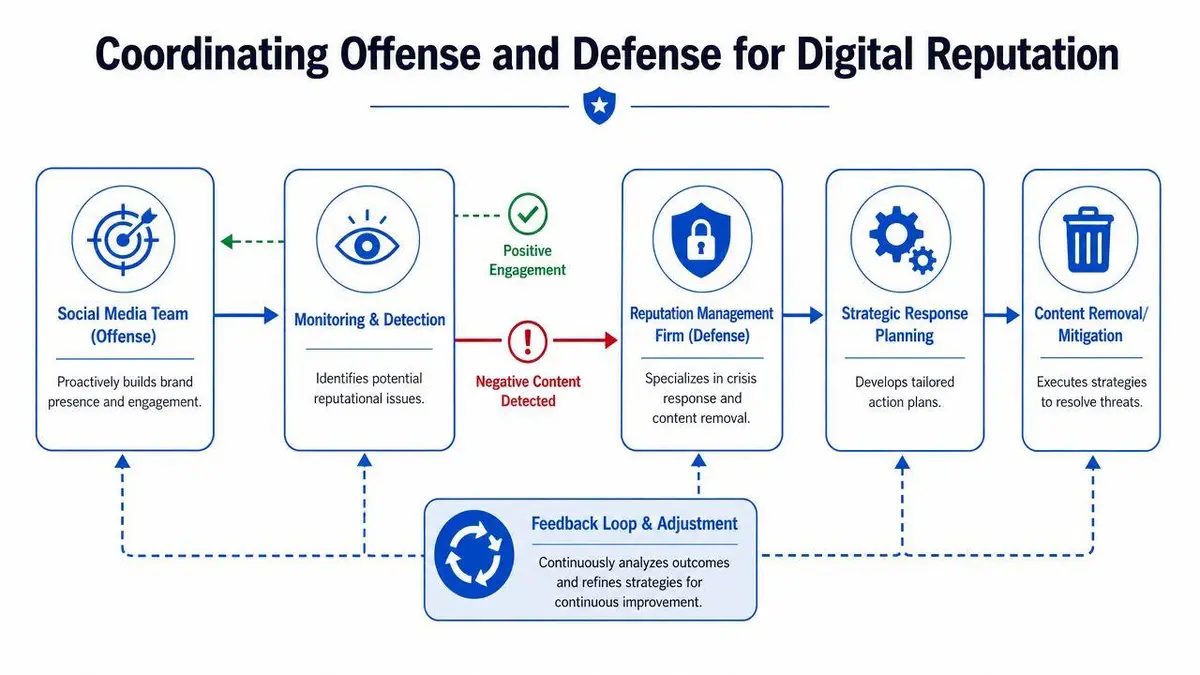
The offensive team builds presence. The defensive team contains harm. If those two functions don’t work from the same playbook, the social team can sabotage removal efforts without realizing it.
The first rule is immediate escalation
At the MIT Social Media Summit, experts identified that algorithms amplify misinformation and harmful content rapidly, making takedowns and de-indexing exponentially more difficult after the initial 24 to 48 hour window and creating a re-upload phenomenon that standard social media strategies fail to address, as covered in MIT Sloan’s summary of the social media trends experts are watching.
That means your social manager cannot treat a leak, impersonation account, false allegation, or manipulated clip as a routine moderation issue. Delay is costly. Public back-and-forth is often worse.
A workable crisis protocol
The cleanest model separates duties sharply.
- Detection
The social team identifies suspicious content, captures evidence, logs timestamps, notes platform URLs, and flags whether the content is spreading through reposts, comments, or direct messages. - Containment
The team pauses non-essential posting, avoids arguing with attackers, and stops any reactive publishing that could drive more engagement into the harmful material. - Escalation
The matter moves to legal and reputation specialists immediately, with preserved records and no editorial interpretation added by junior staff. - Parallel action
While defense professionals assess reporting, de-indexing, and removal options, the social team keeps monitoring for copycats, screenshots, and new account variants.
What the social team must never do
The mistakes are predictable.
- Don’t confront the attacker publicly. That often expands reach and confirms the target value of the material.
- Don’t delete your own records. Screenshots, comment logs, direct messages, and account metadata may be needed.
- Don’t freelance the response. A junior manager improvising language can create admissions, contradictions, or renewed press interest.
- Don’t keep posting as if nothing happened. Normal content can look indifferent, arrogant, or disconnected from the moment.
Silence is not inactivity. In a live threat window, disciplined silence often protects options that a fast public reply destroys.
The best social operators understand that their job in a crisis is not to win the argument. It is to preserve evidence, reduce spread, and support the people handling removal and legal exposure.
Legal and Confidentiality Mandates for Your Social Team
A social media contract for a high-profile client should read more like a risk-management instrument than a creative retainer. If it doesn’t, rewrite it.
The clauses that are not optional
Start with confidentiality. The agreement should cover business information, personal data, unpublished content, travel details, family references, and access credentials. It should survive termination. It should also prohibit portfolio use, informal case discussion, and the retention of screenshots, drafts, or media after the relationship ends.
Data ownership must be explicit. Accounts, creative assets, drafts, audience data, analytics exports, direct-message records, and administrative settings belong to the client, not the freelancer or agency. Return procedures should be immediate and verifiable.
Successful content removal depends on three precise variables: the hosting platform, the specific content classification, and the applicable legal jurisdiction, which determines whether a platform report or a court order is the correct path. Contracts must reflect this precision, as explained in Digital Stakeout’s content takedown guide. If your agreement uses vague language about “online issues” or “platform support,” it is not protective enough.
Add operational terms, not just legal language
Use practical clauses that force good behavior:
- Access limitations that define which tools, devices, and team members may handle the account.
- Breach reporting obligations requiring immediate notice if credentials, drafts, or confidential messages are exposed.
- Evidence preservation duties covering screenshots, logs, and complaint records.
- Termination for cause when there is negligence, unauthorized disclosure, hostile conduct, or security noncompliance.
If you want a plain-language model for how a third party presents its own privacy handling, review our privacy information at WriteStack. Not because it governs your contract, but because it helps illustrate the level of clarity outside vendors should be able to provide when asked how they handle data.
The standard is simple. If someone wants the keys to your public identity, they must accept legal duties equal to the trust you are extending.
If your social presence is already colliding with leaks, impersonation, defamation, or harmful search visibility, ContentRemoval.com provides confidential assessment and rapid action for high-profile clients who need more than generic PR advice. Their team handles source removal, de-indexing, impersonation takedowns, leaked content response, and ongoing monitoring with the discretion these matters require.
Frequently asked questions
What should I ask a social media manager before giving them account access?
Ask which permissions they need on day one and which should stay with leadership, what they do in the first hour if a scheduled post goes live during a controversy, how they preserve records when legal asks, and how they return credentials and archives if access is revoked. Listen for chain of command, screenshots and timestamps rather than talk of storytelling.
Should my social media team reply to a defamatory post or fake account?
Usually not. Public confrontation often expands reach and confirms the material is worth attention. The team should capture evidence, log timestamps and URLs, pause non-essential posting, and escalate to legal and reputation specialists with the records intact and no editorial interpretation added.
Why is follower count a poor way to judge a social media expert?
It can reflect budget, timing, luck or controversy and says nothing about judgment under hostile visibility. Ask instead for examples of moderation decisions, impersonation reporting and false narrative containment. A candidate with none of those is a content operator, not someone ready for a sensitive account.