
Social media and online reputation management for executives means constructing a controlled public narrative while staying ready to dismantle defamation, impersonation, doxxing and fake review campaigns as they appear. Platforms like X, LinkedIn and TikTok now act as the primary trust engine, so the work combines professional monitoring, an Assess, Isolate, Act crisis protocol and specialist content removal.
Key facts
- One in three consumers now skips Google and vets people directly on TikTok or Instagram.
- Common attack vectors: coordinated defamation, impersonation accounts, doxxing and weaponized fake reviews.
- The first 24 to 48 hours of a social media attack decide how far it spreads.
- Document every hostile post with screenshots, URLs and timestamps before responding.
Where ContentRemoval.com comes in. ContentRemoval.com is the removal arm of an executive’s defense: taking down impersonation profiles, defamatory threads, doxxing posts and fabricated reviews at the platform level and keeping them from resurfacing. The executive’s chief of staff, communications lead or general counsel usually makes the first call. A free 15-minute Exposure Scan maps what is removable across every platform, and the report is theirs to keep. Get a Free, Confidential Exposure Scan or read how our reputation management work is done.
Managing an online reputation on social media has evolved beyond public relations into a strategic necessity. It involves the meticulous construction of a public narrative while maintaining a constant state of readiness to dismantle threats such as defamation, impersonation, or damaging leaks. For executives, whose credibility is a primary asset, this function is an essential line of defense.
The New Battlefield for Executive Reputation

Social media is no longer a peripheral concern delegated to a marketing department. It has become the principal arena where executive reputations are forged, tested, and, in some cases, annihilated. For high-net-worth individuals and public figures, platforms like X (formerly Twitter), LinkedIn, and even TikTok function as the new court of public opinion, delivering verdicts with a velocity that traditional media cannot match.
The core anxiety in this environment is the total loss of control. A single video clip taken out of context, a resentful post from a former employee, or a calculated smear campaign can detonate overnight. The resulting damage is swift and severe, impacting everything from brand valuation and investor confidence to personal security.
Search Engines Are No Longer the Initial Point of Inquiry
A significant behavioral shift is underway in how individuals are vetted. Social media has superseded search engines as the primary “trust engine,” with one in three consumers now bypassing Google entirely and proceeding directly to platforms like TikTok and Instagram for due diligence on people and brands.
This trend is more pronounced among younger demographics, where nearly 30-50% of Gen Z users disregard traditional search. The consequences are immediate: a single viral complaint can erode brand favorability by 30% or more within days, transforming a contained issue into a full-scale crisis.
Your digital narrative is now authored by a relentless stream of user-generated content, where perception solidifies into reality instantaneously. Your reputation is no longer what Google indexes; it is what the real-time social media consensus dictates.
The table below delineates common threats high-profile individuals face on social media and the direct harm they inflict.
Common Social Media Threats and Their Business Impact
| Threat Vector | Platform Example | Primary Impact |
|---|---|---|
| Defamation & Slander | A viral X (Twitter) thread with false accusations | Immediate loss of public trust, stock price declines, partnership withdrawals |
| Impersonation Accounts | A fake LinkedIn profile spreading misinformation or soliciting funds | Dilution of personal brand, creation of legal liability, fraudulent solicitation of followers |
| Private Data Leaks | Doxxing on Reddit or Telegram, sharing personal photos/messages | Severe privacy invasion, physical security risks, blackmail attempts |
| Fake Negative Reviews | Coordinated 1-star reviews on a Facebook business page | Customer deterrence, erosion of brand credibility, requires costly response efforts |
These are not hypotheticals; they are daily operational realities that can derail a career or cripple a company if left unaddressed.
Navigating This High-Stakes Environment
This new reality demands a complete strategic pivot from passive monitoring to active defense. The digital footprint you construct, or fail to manage, becomes the definitive record of your character and leadership. On this new battlefield, understanding modern, ethical approaches to personal branding for executives is fundamental to survival.
Without a robust protocol for identifying threats and responding decisively, you cede control of your most valuable asset, your reputation, to anonymous actors and unpredictable algorithms. Effective protection of your online identity requires a strategic framework engineered for this modern threat landscape. Read also: Protecting Your Online Identity A Strategic Framework for Executives. In this volatile environment, professional intervention is not a luxury; it is a necessity.
Understanding the Anatomy of a Digital Attack

Digital attacks are rarely random acts. They are calculated assaults, engineered with precision to exploit specific vulnerabilities and inflict maximum reputational or financial harm. To construct a viable defense, you must move beyond abstract risk assessment and adopt the mindset of a security expert, analyzing the common attack vectors.
These threats are well-orchestrated operations. Attackers may seek to blackmail, extort, sabotage a business transaction, or simply destroy credibility out of malice. Identifying the distinct patterns of each attack is the key to executing a swift and effective response.
Coordinated Defamation Campaigns
This is not a stray negative comment. It is an organized, deliberate effort to flood social media with a false narrative. An adversary, perhaps a disgruntled former employee or a ruthless competitor, utilizes a network of fake or anonymous accounts to amplify disinformation until it dominates the public conversation about you.
Consider a CEO navigating a difficult merger who suddenly becomes a target on X and Reddit. A wave of anonymous accounts, posing as “concerned insiders” or “whistleblowers,” begins disseminating fabricated stories of professional misconduct. These posts are then systematically upvoted and shared, creating a viral storm that legitimate news outlets may amplify, lending the falsehoods a veneer of credibility.
Sophisticated Impersonation Accounts
True impersonation extends far beyond a simple parody account. Attackers construct highly convincing fake profiles on platforms like LinkedIn or Instagram, often leveraging your real photographs and professional history. These fraudulent accounts are then used to interact with clients, colleagues, and associates to spread misinformation or solicit funds, capitalizing on the trust you have spent years building.
Imagine the principal of a family office whose identity is hijacked on a professional networking site. The imposter begins connecting with actual clients and partners, peddling fraudulent investment “opportunities” or posting inflammatory comments. By the time the deception is discovered, your reputation is tied to a scam, and the financial and relational damage is done.
An online reputation attack is an asymmetric threat. A single actor with minimal resources can inflict disproportionate damage on a well-established individual or corporation by weaponizing the very platforms designed for connection and trust.
Frequently, these impersonation schemes are merely the initial step. The attacker leverages the manufactured trust to phish for sensitive information, leading to a more significant security breach.
Strategic Data Leaks and Doxxing
One of the most invasive and alarming attacks is the strategic leak of private information, a practice known as doxxing. This occurs when an adversary maliciously publishes your personal data (home address, phone number, private emails, details about your family) on public forums or dark web channels. The objective is pure intimidation, designed to create real-world security risks for you and your loved ones.
For instance, an executive who takes a public stand on a controversial issue might find their home address and their children’s school information posted in a hostile online forum. This digital attack immediately crosses into a physical threat, demonstrating the close linkage between online reputation and personal security. The entire point is to silence the target through fear.
Weaponized Fake Reviews
For any executive associated with a company, product, or service, reviews are a direct measure of credibility. Attackers can weaponize platforms like Google, Trustpilot, or Facebook by unleashing a coordinated flood of fraudulent one-star reviews. This tactic, often executed by automated botnets or paid click farms, can instantly sabotage a product launch or demolish a company’s hard-earned reputation.
Consider a new venture you have publicly endorsed. Days before its official launch, its online profiles are bombarded with hundreds of detailed, negative reviews making false claims about the product and the company’s ethics. This manufactured outrage completely buries authentic feedback, poisons search engine results, and forces your entire team onto the defensive before operations have even commenced.
Building Your Proactive Digital Defense System
Reacting to a reputation crisis after it has already erupted is a losing strategy. The only viable approach is to build a defense system that anticipates threats and neutralizes them before they gain momentum. A passive stance is not merely outdated; it is a profound liability for any executive or public figure.
Conceive of it as a corporate security system. You would not wait for confirmation that your headquarters was breached. You would install alarms, motion detectors, and live surveillance to intercept an intruder at the perimeter. Professional reputation monitoring operates on the same principle. It is your digital early-warning system.
Beyond Basic Keyword Alerts
Relying on a Google Alert for your name is a dangerous oversimplification. It is akin to placing a single, battery-operated smoke detector in a sprawling corporate campus and hoping for the best.
Standard alerts are slow, superficial, and lack nuance. They only capture content indexed on public websites and cannot distinguish between a glowing news feature and a vicious, defamatory blog post. Crucially, they have no visibility into the private social media groups or anonymous forums where many modern reputation attacks originate.
Professional-grade monitoring is fundamentally different. It employs a combination of advanced technologies to provide a comprehensive, 360-degree view of your digital exposure:
- AI-Driven Sentiment Analysis: This technology does not just find mentions; it interprets them. It scans social media, forums, and news sites to analyze the emotional tone of the conversation, flagging escalating negativity in real-time before it culminates in a crisis.
- Image and Video Recognition: Specialized software actively searches for your face and likeness across the web. This enables the detection of unauthorized uses like doctored images, deepfakes, or leaked personal photos, allowing for immediate action before they go viral.
- Dark Web and Fringe Forum Scanning: Coordinated smear campaigns are often planned in encrypted or anonymous environments inaccessible to standard search engines. Our tools are designed to penetrate these hidden corners of the internet to find emerging threats, such as data leaks or doxxing plans, at their source.
A proactive defense system identifies threats at their point of origin, not their point of impact. The objective is to detect the spark of a reputational fire on a distant forum, not to fight the inferno once it reaches mainstream social media.
This multi-layered approach provides the critical early warning required to mount an effective defense. For our high-profile clients, the value of intercepting a single impersonation account or a leaked document hours before it reaches public consciousness is immeasurable. You can learn more about the specific technologies we deploy in our comprehensive reputation monitoring services.
The Strategic Value of Vigilance
The explosive power of social media is easily underestimated until it is weaponized against you. Over 90% of consumers state that a brand’s online reputation directly influences their purchasing decisions. With 78% admitting that posts from their peers are more influential than official brand content, the narrative is clearly not controlled by the organization. It is shaped by the public.
For an executive, a single negative thread on Reddit or a viral TikTok can completely reshape public perception in hours. This is why proactive defense is not an option; it is a requirement. A full analysis of future trends in online reputation management explores this imperative in greater detail.
Ultimately, a digital defense system is not an expense. It is a core component of asset protection. It provides the intelligence needed to act with precision, shifting your posture from reactive victim to strategic defender. For anyone who cannot afford to be caught off guard, this constant vigilance is the foundation of modern reputation management.
Executing a Crisis Response That Works
When a reputation attack breaches your defenses on social media, the window for effective action is narrow. The first 24-48 hours demand decisive, tactical execution, not debate.
A panicked, disorganized response is precisely what attackers anticipate. It projects weakness and a loss of control, adding fuel to the fire. The only way to command the situation is to follow a proven crisis response framework. This is not a public relations exercise in crafting an apology. It is damage control: stopping the bleed, assessing the wound, and acting with surgical precision.
The Assess, Isolate, Act Protocol
A successful response adheres to a three-step protocol: Assess, Isolate, and Act. This structure enforces deliberate action, preventing the kind of knee-jerk reactions that escalate a minor issue into a catastrophe. Issuing a public denial before understanding the attack’s origin is a classic error. It merely provides more material for the mob to dissect.
Here is the protocol breakdown:
- Assess: First, you must rapidly and dispassionately determine the nature of the threat. Where did the attack originate? How fast is it propagating? Is this a lone actor, a competitor-led smear campaign, or a bot network? A clear assessment dictates the terms of engagement.
- Isolate: The immediate objective is to contain the content and prevent further dissemination. This is where professional intervention is invaluable, as specialists can initiate takedown procedures that bypass standard reporting channels. Isolating the content prevents it from reaching a wider audience and becoming indexed by search engines.
- Act: Finally, you launch a coordinated strategy. This extends beyond simple content removal. It may involve dispatching legal notices, executing de-indexing requests with Google, and preserving evidence for potential litigation. Every move is calculated to dismantle the attack at its foundation.
This professional defense process is built on a foundation of continuous monitoring and rapid detection, which informs the subsequent analysis and response.
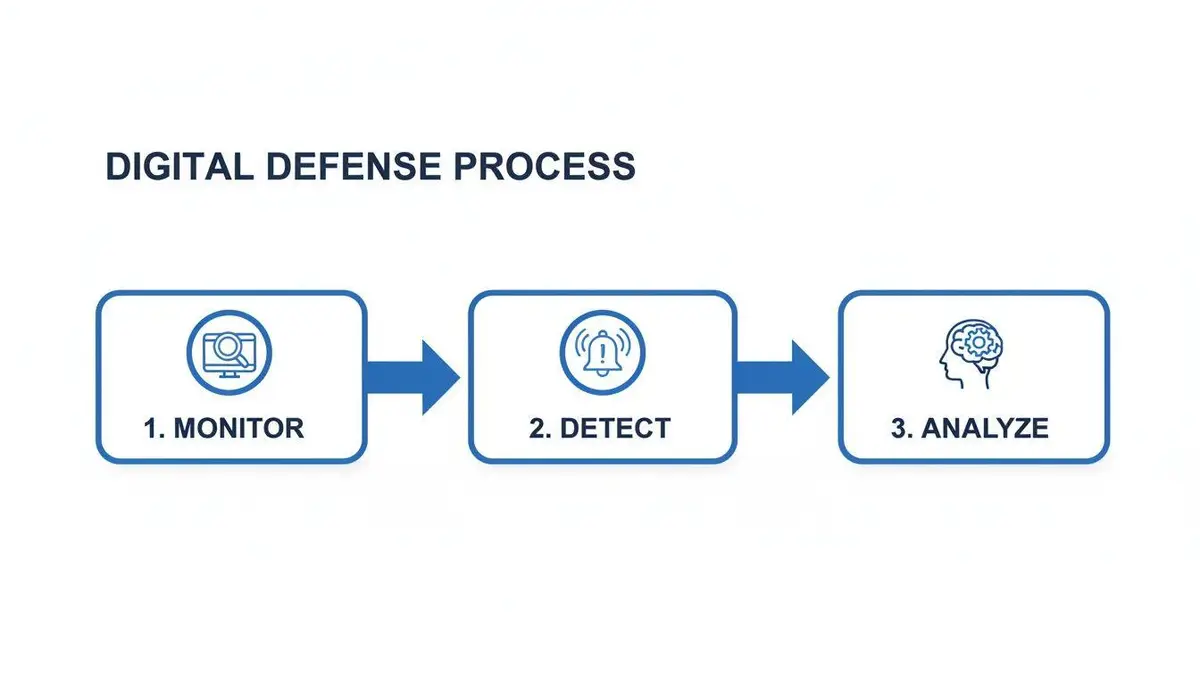
A powerful response is not a reaction. It is the final execution step of a pre-established protocol.
Preserving Evidence and Maintaining Control
During a crisis, evidence preservation is mandatory. Every hostile post, fake account, and defamatory comment must be documented with screenshots, URLs, and timestamps. This creates a chain of custody that is critical for legal action or for engaging cyber-forensics to unmask anonymous attackers.
Simultaneously, you must centralize all communications. Unauthorized comments from employees or conflicting public statements create chaos and provide attackers with more ammunition. A crucial part of a strong defense involves strategic listening. Effective social media community management allows you to gauge public sentiment without inadvertently escalating the situation.
In a social media crisis, silence and precision are your greatest assets. The attacker desires a public, emotional reaction. Denying them that satisfaction buys you the time required to dismantle their attack behind the scenes.
By adhering to the Assess, Isolate, and Act protocol, you reclaim control. You are no longer on the defensive; you are on the offensive, methodically containing the threat and setting the stage for its complete removal. This is the core of professional social media and online reputation management: transforming chaos into a structured, effective counter-operation.
The Strategic Value of Professional Content Removal
Engaging a specialist to remove online content is not a last resort. It is a strategic imperative. When facing a sophisticated digital attack, conventional methods prove inadequate. DIY attempts, traditional public relations, and even standard legal channels were not designed to contend with the speed and complexity of social media threats.
Attempting to navigate a platform’s reporting system independently is like arguing a complex legal case without counsel. You are one voice among millions, submitting a report into a black box governed by algorithms and overburdened moderators. The outcome is uncertain, the process is opaque, and the timeline is almost always too slow to prevent viral dissemination.
The Surgeon vs. The General Practitioner
The distinction is clear: you consult a general practitioner for a common ailment. For a complex cardiac condition requiring immediate surgery, you seek a specialist. A severe online reputation attack (a coordinated smear campaign, a deepfake video, or a persistent impersonator) is the digital equivalent of a cardiac event. It demands a surgeon, not a generalist.
Public relations firms are adept at shaping a narrative, but they cannot remove the content causing the damage. Their function is to manage perception, typically by generating positive press to suppress the negative. This is a valuable tactic, but it amounts to managing symptoms rather than curing the disease.
Likewise, a law firm can draft a powerful cease-and-desist letter or initiate the protracted process of litigation. While legal pressure is a crucial tool, it operates at its own deliberate pace. By the time a lawsuit is filed, a defamatory post may have accumulated millions of views, with the damage already solidified.
Proprietary Processes and Direct Platform Access
This is precisely where a professional content removal firm holds a decisive advantage. These specialists are not merely filling out the same reporting forms available to the public. They are executing a highly technical and quasi-legal playbook refined over years of focused practice.
A specialized firm’s value lies in its ability to bypass standard queues and leverage established, high-level platform relationships. This allows them to escalate cases directly to decision-makers who can act with the urgency the situation demands.
These firms employ proprietary takedown methodologies that have been fine-tuned over thousands of cases. They possess the specific knowledge of evidence and argumentation required to trigger a platform’s most serious policy violations, converting a subjective complaint into an undeniable case for immediate action.
Specialist firms are purpose-built for this work. They use advanced monitoring and rapid-response processes to neutralize harmful viral threads, fraudulent accounts, or leaked data. They often take action within 24-48 hours to halt reputational bleeding and protect revenue, a reality reflected in the latest reputation management statistics.
Beyond Removal: Prevention and Asset Protection
A true professional service does not end with a single takedown. Determined attackers will often attempt to re-upload removed content on different platforms or under new accounts. A key function of a specialist firm is employing technology to monitor for these reappearances, ensuring a threat is not just removed but permanently extinguished. For those facing this challenge, our guide on how to remove online content permanently offers further insight.
For a high-net-worth individual or a C-suite executive, this service is not an expense; it is a critical investment in risk management. Your online reputation is an invaluable asset. Protecting it from targeted attacks requires the same level of specialized expertise you would employ to protect your financial or physical assets. It is a non-negotiable component of modern asset protection.
Frequently Asked Questions About Reputation Crises
During a digital reputation crisis, questions arise with urgency. You require clear, direct answers, not legal jargon or ambiguous assurances. Here is a direct breakdown of the most common concerns we address for clients under duress, clarifying where and why professional intervention is critical.
Can I Legally Force A Platform to Remove Defamatory Content?
A frequent initial question is, “Can’t we just sue them and force a takedown?” While litigation is certainly an option for defamation, the legal system is not structured for the velocity of the internet.
Lawsuits are slow and deliberate, often requiring months or years to resolve. Throughout this period, the damaging content remains online, accumulating views and cementing a negative narrative. It is an inadequate tool for an immediate threat.
A far more effective strategy is to engage a firm with established relationships and direct escalation channels within the platforms. This is about threat neutralization: removing the content swiftly to stop the damage. Legal action should be viewed as a parallel path for seeking financial damages or unmasking an attacker, not as your primary instrument for immediate containment.
In a crisis, the goal isn’t just to be legally right; it’s to be digitally effective. The legal system moves at a walking pace; the internet moves at the speed of light. Your response must match.
How Do You Handle Anonymous Attackers on Social Media?
Anonymous accounts are a preferred tool for online assailants, but anonymity is not an impenetrable shield. Addressing them effectively requires a dual-front approach.
First is the forensic front. Our investigators analyze the digital footprints left behind: examining metadata, tracking IP patterns, and correlating data across platforms. This technical work can often unmask the individual or group orchestrating the attack, creating an avenue for legal recourse.
The second front is more urgent: content-focused containment. Our primary objective is to secure the removal of the harmful material, regardless of its origin. We focus on demonstrating that the content itself violates the platform’s terms of service regarding harassment, hate speech, or defamation. Once the posts are removed, the attack loses its power, even if the attacker’s identity remains concealed.
What Is the Difference Between PR and Content Removal?
This distinction is critical. Public Relations (PR) and content removal are both tools for reputation management, but they solve entirely different problems. Confusing them during a crisis is a costly error.
The difference is analogous to medicine versus surgery.
- Public Relations is the medicine. A PR team works to manage public perception. They draft press releases, secure positive media coverage, and build a counter-narrative to the negative story. They treat the symptoms of the reputation damage by attempting to alter public opinion.
- Content Removal is the surgery. Our function is to go to the source and surgically remove the harmful content itself. We use a combination of technical processes and direct platform relationships to get defamatory posts, fake reviews, or private data permanently deleted. We resolve the cause of the problem.
Attempting to “spin” a negative story with PR while the damaging content is still live and spreading is like redecorating a house that is on fire. The first, non-negotiable step is to extinguish the fire. That means removing the content.
When facing a complex digital attack, a swift and precise response is the only way to protect your assets and regain control. The expert team at ContentRemoval.com specializes in the rapid and permanent removal of harmful online content. If your reputation is under threat, contact us for a confidential assessment.